
free shipping at $99


You've lit a beautifully scented candle, settled in for a quiet evening, and then remembered that a real ring is waiting somewhere inside the wax. The anticipation is part of the appeal, but it also raises practical questions. Is the ring protected from the flame? What happens when the pouch appears? And is the jewelry really worth the price?
Candles with real rings inside combine home fragrance with a delayed surprise. The best products make the candle enjoyable on its own, then add a carefully managed reveal. The difference between a thoughtful premium candle and a cheap novelty usually comes down to construction, burn control, ingredient transparency, and honest value expectations.
A ring candle turns an ordinary evening into a small event. The wick catches, fragrance begins to spread, and the wax slowly changes shape while you wait for the hidden package to appear. You're not watching a candle disappear. You're following a gradual reveal that ends with something you can hold and potentially wear.

A ring-in-candle product is a scented candle containing a sealed piece of jewelry, positioned inside the wax so the package becomes visible as the candle burns down. The jewelry isn't meant to sit openly in the flame or in the liquid wax. Its enjoyment comes from the combination of scent, warmth, suspense, and discovery.
The product offers two distinct rewards:
That format makes sense in the wider history of candles. Candle making dates back more than 5,000 years, with early forms linked to ancient Egyptian rushlights and Roman wick candles around 100 BC, as described in the history of Gurley Novelty and novelty candle manufacturing. Later, paraffin became widely available through the oil industry, and novelty candle makers increasingly focused on decorative, seasonal, and collectible designs.
The modern ring candle isn't an ancient candle category. It's a newer layer added to a long-established product tradition that moved from basic illumination toward decoration, fragrance, gifting, and emotional appeal. The hidden ring makes that evolution interactive. You get a familiar household object, but the product asks you to wait, watch, and participate.
A well-made ring candle isn't created by dropping jewelry into a jar of wax. The manufacturer has to control where the ring sits, how it's sealed, how heat travels through the candle, and how the wick creates its melt pool.
The construction usually works as a set of coordinated layers. A base of wax supports the candle, the jewelry sits inside a protected compartment, surrounding wax provides the fragrance and structure, and the wick is positioned to burn without directing heat toward the hidden item.
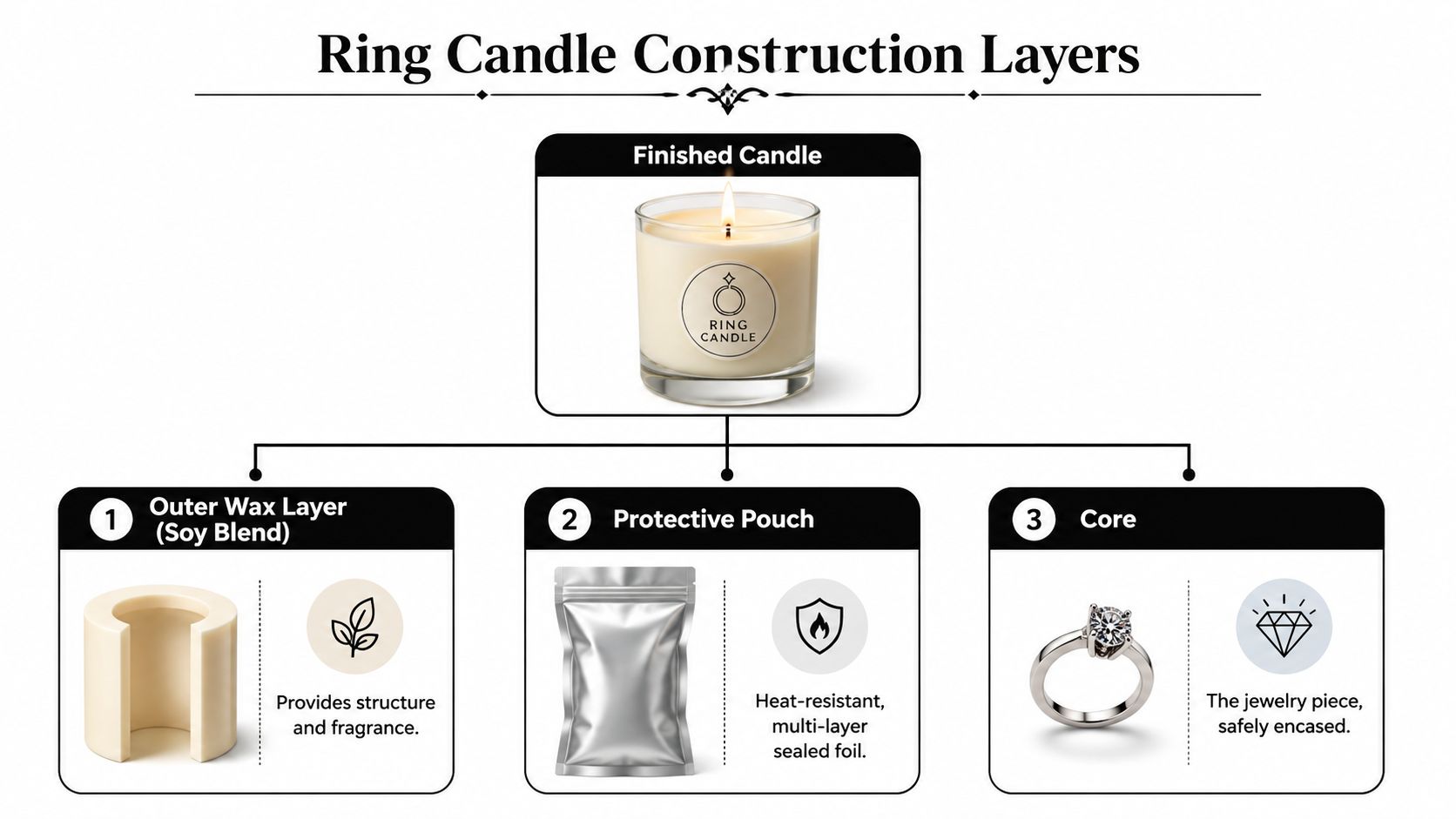
The pouch is the central safety feature. It doesn't make careless burning safe, but it creates physical distance between the ring and the hottest parts of the candle. The ring should remain enclosed until the candle has burned down enough for the pouch to become visible and removable.
A poorly positioned pouch can affect the candle's burn path, while a weak seal can allow wax to reach the jewelry. Premium construction therefore treats the ring as an engineered insert, not an accessory added at the end. Check whether a product description explains the pouch material, placement, and retrieval instructions. Vague language leaves you guessing about the most important part of the design.
The candle should also be tested as a candle. A beautiful ring can't compensate for a wick that mushrooms, a container that overheats, or wax that produces a heavy, unstable melt pool.
A ring candle can be designed with jewelry isolation in mind, but it still contains an open flame. Treat it like any other candle, and follow the product's own instructions closely.
The NYC Fire Department's candle safety guidance advises against candles containing embedded combustible decorative items. That warning is important because combustible inserts can ignite or change flame behavior. A ring candle's jewelry pouch should therefore be heat-resistant and physically separated from the flame, rather than made from a material that can burn.
Before every use, inspect the candle and prepare the area:
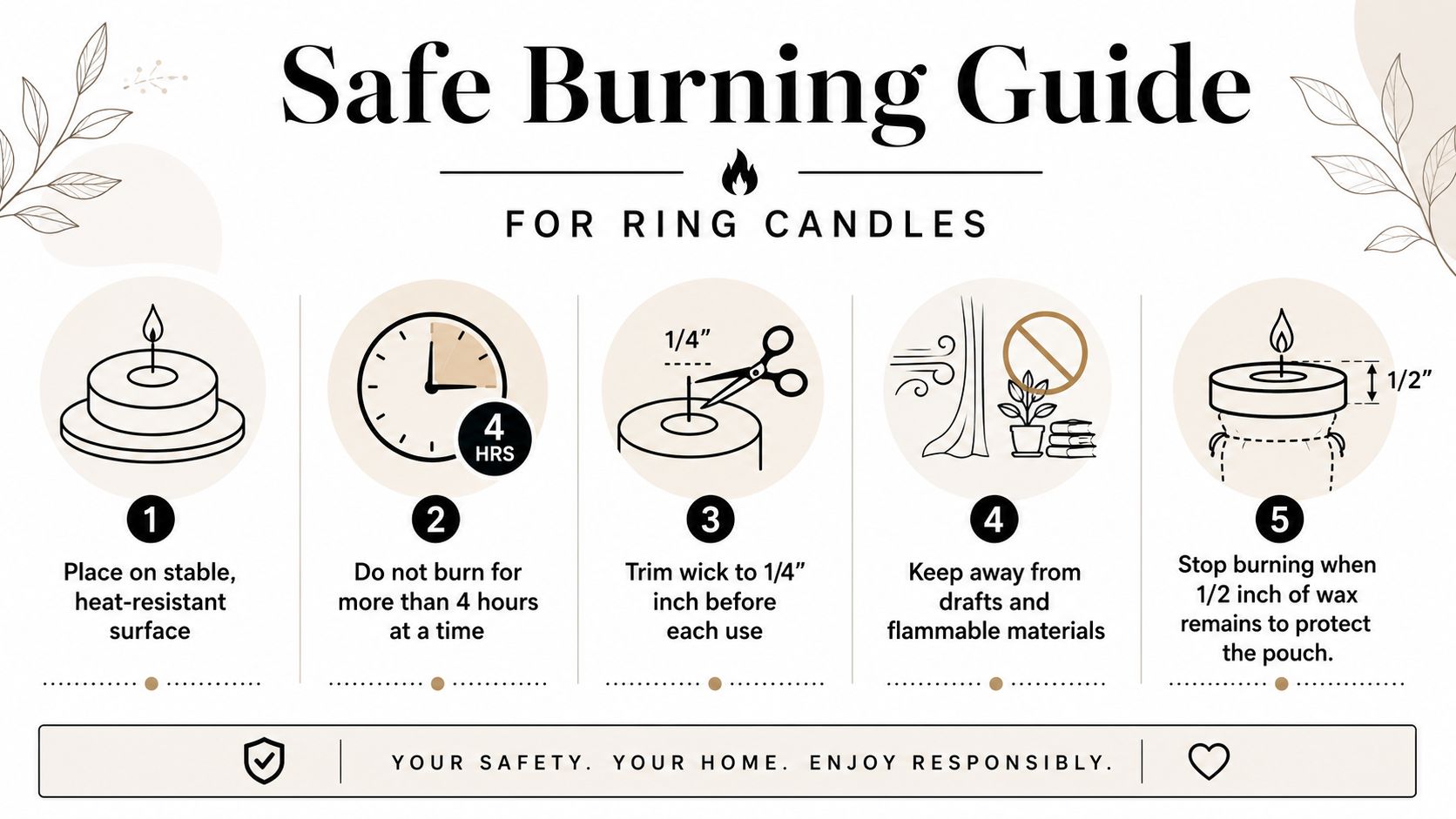
Practical rule: Never reach into a lit candle, even when the pouch is visible. Extinguish the flame first, then use a tool to retrieve the package.
When the pouch starts to emerge, stop treating the moment as part of the entertainment and start treating it as a retrieval step. Extinguish the candle completely. Let the pouch and nearby wax cool enough to handle safely, then remove it with tweezers or tongs. Don't pour molten wax into a sink, and don't try to dig through hot wax with your fingers.
For brand-specific instructions, compare your product's directions with Jackpot Candles' safety and burning tips. The safest ring candle experience depends on both the pouch design and the person managing the burn.
The ring may provide the surprise, but the candle still needs to perform on its own. A reveal can take many hours, so wax texture, scent quality, and burn behavior shape most of the experience.
Soy wax blends are common in premium ring candles because they can support a slower, cleaner burn with little soot while carrying fragrance effectively. Paraffin is also used in candle products. Buyers concerned about renewable ingredients, soot, or labeling should read the exact wax description instead of trusting broad terms such as “natural.” For more context, see this guide to the benefits of soy wax candles.
Quality depends on several connected details:
| Feature | Premium signals | Questions to ask |
|---|---|---|
| Wax | A clearly identified soy blend or other disclosed formulation | Does the brand explain the wax rather than simply calling it “natural”? |
| Fragrance | Exclusive or perfume-grade fragrance oils with a recognizable scent profile | Is the fragrance described clearly, and does the brand disclose relevant ingredient information? |
| Labeling | Transparent ingredient and safety information | Can you find burn instructions before buying? |
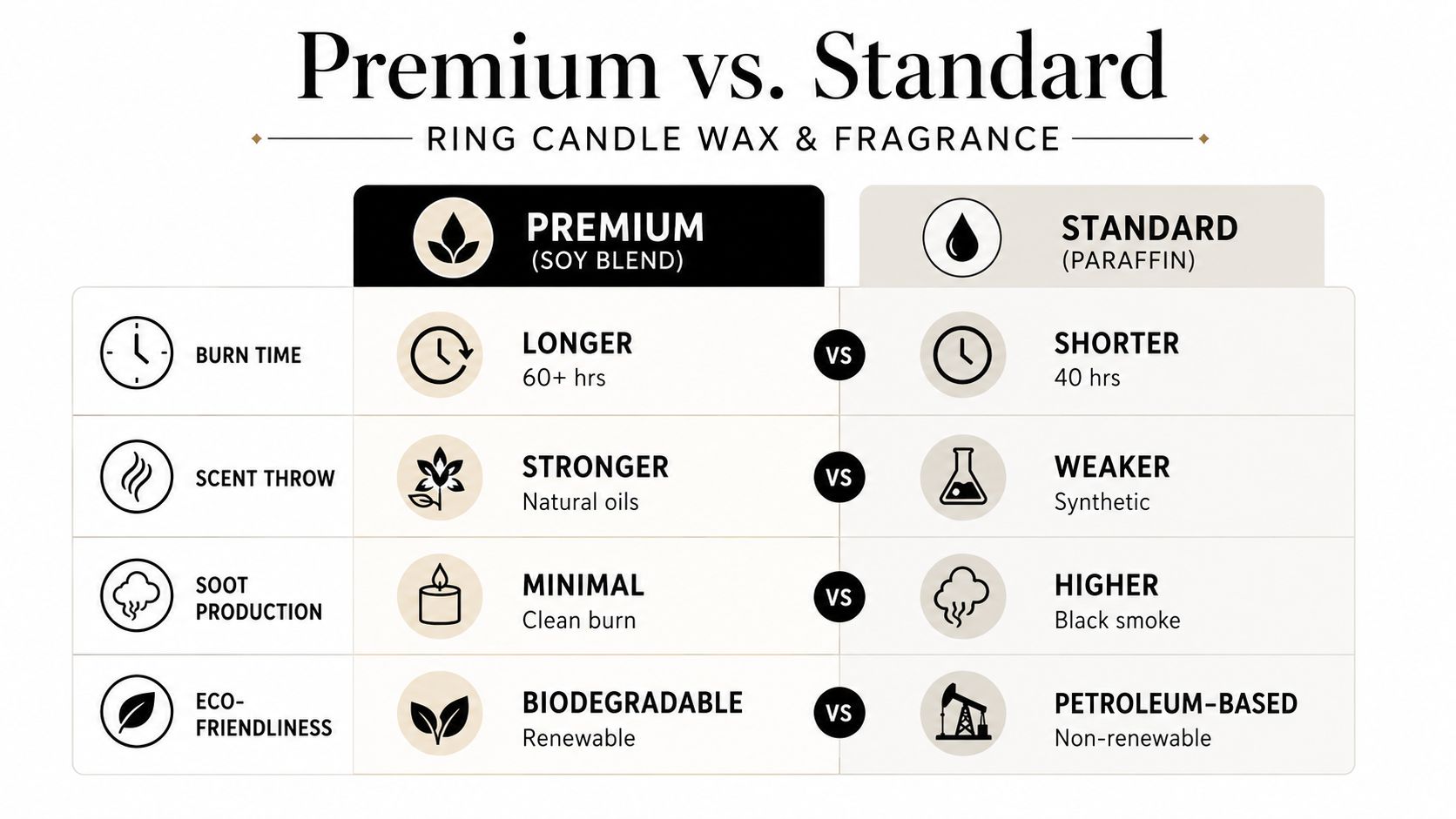
Fragrance should have a clear purpose beyond covering the presence of the hidden pouch. A weak scent makes the candle feel like prize packaging. A well-composed fragrance gives the burn its own appeal, whether the profile is floral, woody, gourmand, or fresh. Gift buyers should match the scent to what the recipient already enjoys rather than choosing solely for the jewelry reveal.
Interest in non-toxic ingredients, phthalate-free formulas, and transparent labeling has grown, according to candles market analysis from Grand View Research. Those labels do not guarantee identical standards across products. Check for a specific wax description, fragrance information, container warnings, and directions for managing the hidden pouch.
The pouch is part of this quality assessment too. Premium construction should keep the jewelry package separated from direct flame and allow it to emerge without turning the reveal into a rushed extraction. That heat-resistant design works together with the wax formula and burn instructions, much like separate parts of one safety system.
Jackpot Candles describes its products as using a proprietary soy wax blend and exclusive, perfume-grade fragrance oils. Treat those details as comparison points, then review each product listing for its actual ingredients and instructions.
The hidden jewelry follows a chance-based value model. Independent retail listings and summaries describe jewelry values ranging from about $15 to $7,500 per candle, while another summary reports typical spending of about $30 to $45 per candle. These figures come from independent coverage of hidden-jewelry candles, not a guarantee that any individual candle contains a high-value ring.
That spread explains why expectations can become difficult. One buyer may uncover a modest fashion piece, while another may receive jewelry positioned at the upper end of the advertised range. The candle combines a scented product with a lottery-like reveal, so the purchase price pays for the full experience rather than functioning as a guaranteed jewelry transaction.
Before buying, separate these ideas:
The independent summary also reports that the category has grown by more than 300% since 2018, suggesting that surprise and giftability have attracted substantial attention. That growth doesn't change the basic rule: don't buy a ring candle expecting a specific financial return.
A trustworthy seller should explain the possible range and avoid implying that every customer receives a jackpot. Lower-value jewelry can still feel worthwhile when it's genuine, attractive, and properly finished. Disappointment often begins when a buyer sees a maximum value without understanding the chance-based structure.
The reveal is safest when you treat it as a short procedure rather than a race to open the package. Wait until the protective pouch is visibly exposed, then extinguish the flame before touching anything.
For a brand-specific walkthrough, use the Jackpot Candles jewelry candle reveal guide. The exact pouch design may differ, so the instructions included with your candle take priority.
Start with a soft, dry cloth to remove loose wax. If residue remains, use a gentle method suitable for the jewelry's material, and avoid aggressive scraping, abrasive cleaners, or sudden temperature changes. When the metal or stone type is unclear, ask the seller before soaking the piece.
Store the ring in a soft-lined jewelry box or pouch, away from moisture and other pieces that could scratch it. If the setting feels loose, the surface looks damaged, or the item may be valuable, pause before wearing it and have a jeweler inspect it. Keep the appraisal or value information supplied with the candle, since it may help with identification and future care.
A trustworthy ring candle seller makes the product understandable before you buy it. You should be able to find the wax type, fragrance description, jewelry category, possible value range, and burn instructions without having to decode vague marketing.
Start with safety. Look for clear instructions covering wick trimming, stable placement, unattended burning, and pouch retrieval. A brand that treats safety as an afterthought hasn't earned confidence.
Then inspect the candle itself. Premium positioning should be supported by a disclosed wax blend and a fragrance description that tells you more than “pleasant scent.” The candle should be worth using even if the ring turns out to be toward the modest end of the stated range.
Examine the jewelry promise. A clear range is more useful than a dramatic maximum with no explanation. Look for information about ring sizing, jewelry types, materials, appraisal handling, and what happens if the item arrives damaged.
Check customer support. A responsive seller should explain how to report a damaged pouch, missing item, or concern about the ring. Reviews can reveal whether the company handles problems clearly, but don't treat every review as proof of a typical outcome.
Red flags include no ingredient disclosure, no retrieval instructions, unclear jewelry descriptions, and prices that seem too low to support both a well-made candle and a meaningful jewelry insert. The Trustpilot review profile for Jewelry Candles illustrates why disappointment management matters in this category. Buyers can react strongly when the revealed item doesn't match their expectations, especially when value language feels unclear.
Jackpot Candles presents a proprietary soy wax blend, exclusive perfume-grade fragrances, genuine jewelry, and stated value ranges as part of its product offering. Those are useful comparison points, but your final decision should still come from the specific listing, safety directions, and customer policies attached to the candle you're considering.
You may be able to remove it once the pouch is visible and reachable, but don't dig through solid wax or reach into a lit candle. Extinguish the flame, allow the package to cool, and use tweezers or tongs. The product's instructions should tell you when retrieval is appropriate.
It can if the pouch is poorly positioned or if loose material enters the wax pool. A properly isolated insert should remain separated from the flame and molten wax until retrieval, but you still need to keep the pool free of debris and monitor the candle while it burns.
Stop wearing it and photograph the ring, pouch, and candle. Contact the seller with your order information and follow its replacement or inspection process. Don't try to polish away a suspected structural defect before documenting it.
No. Wax, wick sizing, fragrance strength, pouch design, jewelry quality, and disclosure practices can vary widely. The hidden ring doesn't tell you whether the candle will burn evenly or whether the final piece will meet your expectations.
Both products use delayed discovery, but the conditions differ. A candle involves an open flame and hot wax, while a bath bomb dissolves in water. Follow the safety instructions for the specific product rather than assuming that a method suitable for one format works for the other.
They work well when the recipient enjoys fragrance and surprise. Choose a scent family that fits the person's preferences, and explain that the jewelry value varies if the product uses a chance-based model. That small explanation helps the recipient enjoy the reveal without expecting a guaranteed high-value ring.
If you want the candle itself to feel as considered as the surprise, explore Jackpot Candles for scented candles and other products with hidden jewelry. Compare the fragrance, wax information, safety guidance, and stated value details before choosing the ring candle that fits your occasion.
Comments will be approved before showing up.