
free shipping at $99


What does “clean burning” mean when the candle label only says “natural” or “soy”? A plant-based wax can be a better starting point than paraffin, but the air in your room also depends on the wick, fragrance, flame, ventilation, and the way you burn the candle.
Think of a candle like a small campfire. A steady flame with the right fuel and airflow burns more cleanly than a flame buffeted by wind. A poorly matched wick, excess fragrance, or a draft can turn even a soy candle into a smoky little engine. This guide will show you how wax chemistry affects emissions, why wick design matters, how fragrance changes the result, which habits reduce indoor pollution, and how to read labels without accepting marketing language at face value. For a broader foundation, candle science and how candles work offers useful background on the fuel, wick, flame, and melt pool.
A clean-burning candle isn't one that produces nothing. Burning wax is combustion, so the flame will release some gases and particles. “Clean” is better understood as a spectrum, from a flame that stays steady with little visible soot to one that flickers, smokes, and leaves residue on nearby surfaces.
Start with what you can observe and what controlled testing can measure:
A candle that performs well on one measure can still perform poorly on another. For example, a strongly scented product may smell impressive but release more fragrance-related compounds than a lightly scented candle. A candle with an attractive wooden wick may still smoke if the wick is too long or the flame sits in a draft.
Soy wax generally gives formulators a useful base, but the final burn comes from the interaction of wax, wick geometry, fragrance load, dye, jar diameter, and room conditions. Two candles made with soy can behave differently if one uses a carefully tested cotton wick and the other uses a wick that's too large.
That's why “clean” shouldn't function as a single checkbox. A well-made soy candle used in a ventilated room, with a trimmed wick and a calm flame, sits toward the cleaner end of the spectrum. A soy candle with an oversized wick, heavy scent, and turbulent airflow may not.
Practical rule: Judge the whole burning system, not the front-label adjective.
The most useful question isn't “Does this candle say clean?” It's “What choices help this candle burn steadily, and does the maker explain them clearly?”
Soy wax and paraffin both provide fuel for a flame, but they come from different material families. Soy wax is made from hydrogenated soybean oil, a plant-derived fat that has been processed into a solid wax. Paraffin is produced from petroleum refining, so its hydrocarbon structure differs from soy's triglyceride-based structure.
That difference affects how the wax melts and travels through the wick. Soy often forms a relatively soft melt pool and feeds the flame at a slower rate. Paraffin can produce a hotter, faster-feeding burn in some formulations. Neither description guarantees a clean result, because wick size and fragrance can change the flame, but the fuel chemistry helps explain why soy is often selected for lower-soot products.
A widely cited comparative combustion study published in the August 2002 issue of the Journal of the American Oil Chemists' Society found that paraffin candles produced substantial visible soot, while soy candles produced little or no soot. The same comparison measured 3.2 mg of formaldehyde per gram of paraffin from paraffin candles, while soy and beeswax candles produced no measurable formaldehyde under the tested conditions. The study summary is important because it compares wax types under controlled conditions rather than relying on a brand claim.
| Property | Soy Wax | Paraffin Wax |
|---|---|---|
| Basic origin | Hydrogenated soybean oil | Petroleum refining |
| Visible soot in the comparative study | Little or no soot | Substantial visible soot |
| Formaldehyde in the comparative study | Not measurable | 3.2 mg per gram of paraffin |
| Burn behavior reported in the study | Slower burn | Faster burn than soy |
| Meaning of “cleaner” | Lower emissions under tested conditions | Higher soot and measured formaldehyde under tested conditions |
The word cleaner is comparative, not absolute. Soy still combusts, and every candle can add particles or VOCs to indoor air. For practical guidance on reducing VOC exposure around the home, these indoor air quality tips from Covenant Aire Solutions provide useful context beyond candle selection. You can also explore why soy wax is often considered better than paraffin for a closer look at the material differences.
The sharpest contrast in the available data concerns fine particles. In a sealed-bedroom comparison, paraffin candles produced 50–60 times higher PM2.5 concentrations than soy candles under the tested setup, according to the study report. PM2.5 refers to very small airborne particles. You can't reliably judge their concentration by sight, and a room can look clear while still containing combustion particles.
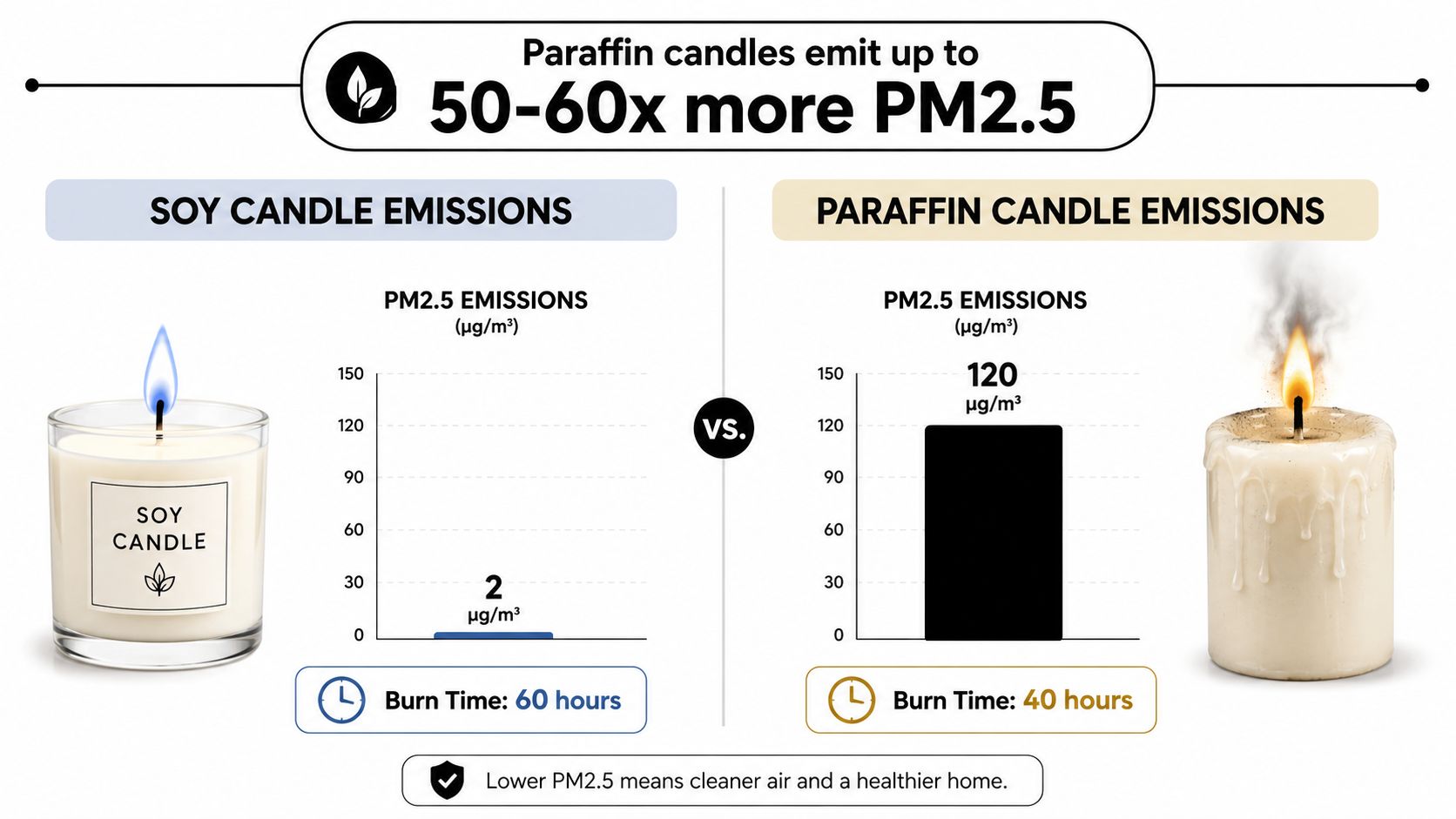
For people with asthma, allergies, or sensitive airways, particulate exposure can be especially unwelcome. Soot can also settle on walls, ceilings, fabrics, and the inside of containers. In a poorly ventilated room, repeated candle use can make the indoor environment feel stale or irritating, even if each individual burn seems brief.
Soy comes from a renewable agricultural source, while paraffin comes from non-renewable petroleum. That distinction matters when you're comparing the raw materials, although it doesn't make every soy candle environmentally ideal. Farming practices, packaging, shipping, additives, and the product's useful life all contribute to the broader footprint.
Burn time is another reason shoppers often prefer soy. The controlled comparison described earlier reported that soy candles burned at a significantly slower rate than paraffin candles, which helps explain why soy products are commonly marketed as longer-lasting. A slower burn can be useful, but it doesn't remove the need for wick care or ventilation.
The sealed-bedroom study also found that soy candles produced only about twice the PM2.5 of the matches used to light them. That finding points to an important practical lesson: the wick and flame can contribute substantially to measured particles. Wax matters, but the way the flame behaves matters too.
No candle should be treated as an air purifier. Soy is often a cleaner option than paraffin, but it still adds something to indoor air. The next question is more useful than “Is soy safe?” It's “What pushes a soy candle toward the cleaner or dirtier end of its performance range?”
A soy label tells you where the wax came from. It doesn't tell you how the finished candle burns. A 2021 chamber study examined an unscented soy candle and measured 204 micrograms of total VOCs per hour and 38 micrograms of PM2.5 per hour under its test conditions, as summarized in coverage of the candle emissions findings. The study also reported that soy, paraffin, palm, and stearin behaved similarly in overall emissions in that comparison.
That doesn't cancel out the earlier paraffin-versus-soy findings. It shows why “clean burning” isn't binary. Different studies use different candles, chambers, burn phases, wick designs, and test conditions. A soy candle can outperform paraffin in one controlled comparison and still release measurable pollutants in another.
Fragrance load is one of the biggest variables. Fragrance oils are designed to evaporate and diffuse, but heat can also change what enters the air. A heavily scented candle may require more fragrance material and a larger or hotter flame to achieve the desired throw.
Wick geometry controls fuel flow. An oversized wick can create a tall, unstable flame and visible soot. A wick that's too short, drowned, or poorly centered can produce an uneven melt pool. Metal-core wicks also deserve caution, especially when the label doesn't disclose the core material.
Additives and dyes can affect the formulation and burn behavior. Some candle makers use materials such as vybar or UV stabilizers to improve appearance or solve surface issues. Their presence doesn't automatically prove a candle is unsafe, but vague ingredient information makes it harder to evaluate the finished product.
| Emission Type | Unscented 100% Soy Candle | Typical Scented Soy Candle |
|---|---|---|
| VOCs | Measurable under chamber conditions | May vary with fragrance formula and load |
| PM2.5 | Measurable under chamber conditions | May vary with wick, flame, scent, and airflow |
| Overall interpretation | Plant-based wax still emits pollutants | “Soy” alone can't predict the complete burn |
Wax origin is one dial, not the entire control panel. Label transparency and burn care help you turn the other dials in a better direction.
Start with the back of the container, not the large claim on the front. Terms such as natural, eco, and clean can sound precise while telling you very little about the wax percentage, wick construction, or fragrance formula. A candle may use those words without clearly stating how much soy it contains.
Look for specific wording such as 100% soy wax, soy wax, or a named blend with the ingredients identified. If the candle uses soy and coconut wax, beeswax, or another material, the maker should say that clearly. A percentage breakdown is more useful than a broad phrase such as “natural wax blend.”
You don't need every label to disclose a complete manufacturing formula, but you should be able to identify the primary wax and distinguish a genuine soy product from a vague blend. If you want a practical place to compare how soy products are presented, browse this farmhouse soy candle collection while checking the descriptions rather than relying only on product photography.
A label that identifies cotton, paper, wood, or zinc-free braided cotton gives you more information than one that says “premium wick.” Be cautious with zinc-core or lead-core wicks, especially if the seller avoids answering direct questions about construction.
Fragrance wording deserves the same attention:
Other warning signs include an unlabeled container, no care instructions, no stated burn information, aggressive dye use, or a bargain price paired with claims of unusually pure ingredients. For a plain-language explanation of what soy wax is and how it becomes a candle, see what soy wax candles are.
A well-formulated candle still needs a controlled flame. The 2021 Indoor Air laboratory comparison found that candle emissions changed by burn phase, with particle number emissions, particle size measures, and mass concentrations generally higher during the initial 0–1 hour phase than during the stable 1–6 hour phase for most candles. Review the Indoor Air study abstract for the controlled testing details.
Begin with the first burn. Allow roughly one hour per inch of container diameter so the melt pool can reach the edges. This helps reduce tunneling, where a narrow well forms around the wick and leaves unused wax along the sides.
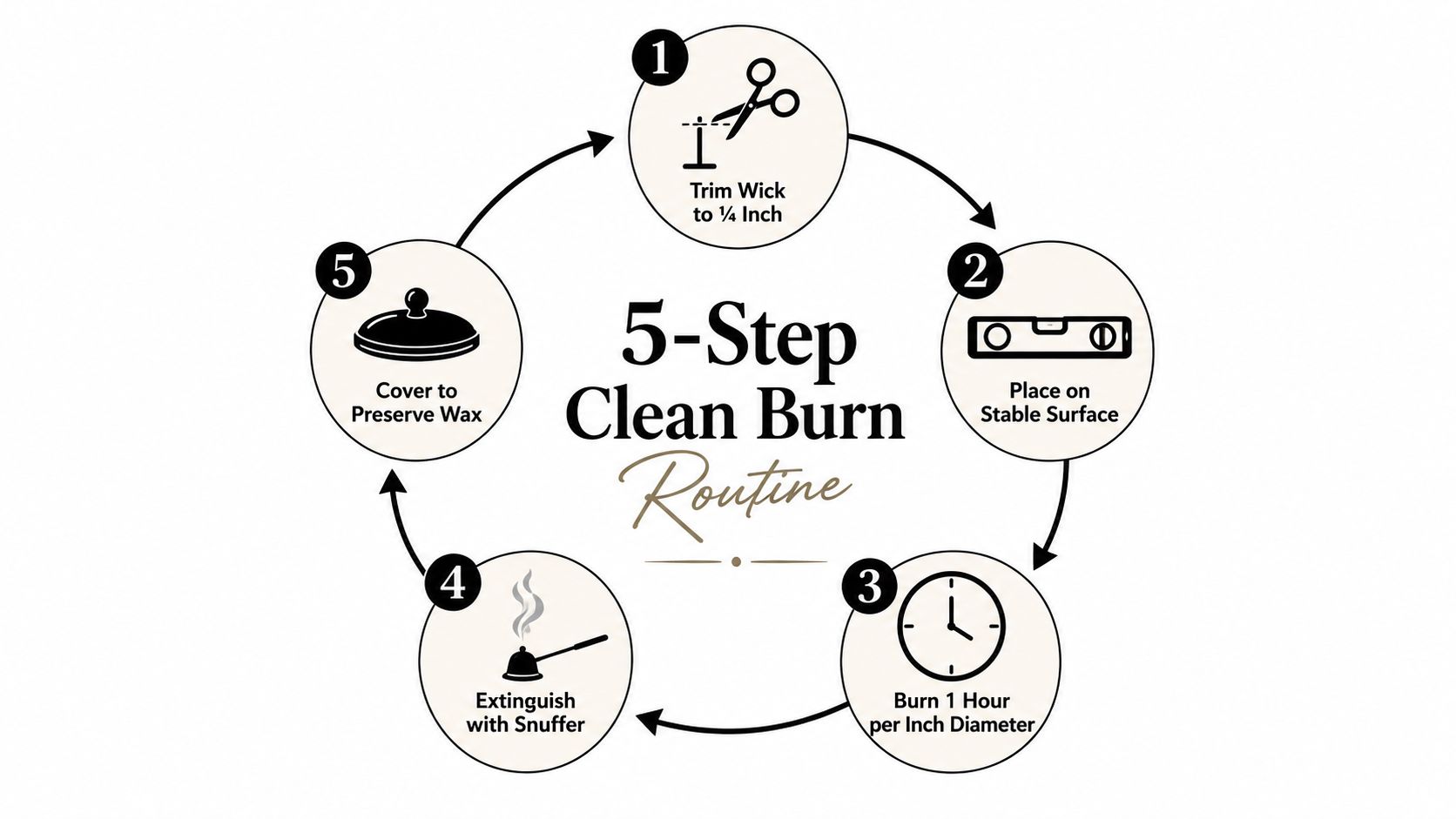
Drafts deserve special attention. Moving air bends the flame, pulls the wick sideways, and can create flicker and smoke even when the wax itself is well chosen. The sealed-bedroom comparison also supports the idea that wick ignition and flame management contribute meaningfully to measured particulate output.
For a visual walkthrough of candle maintenance, use the video below as a practical companion to the written routine.
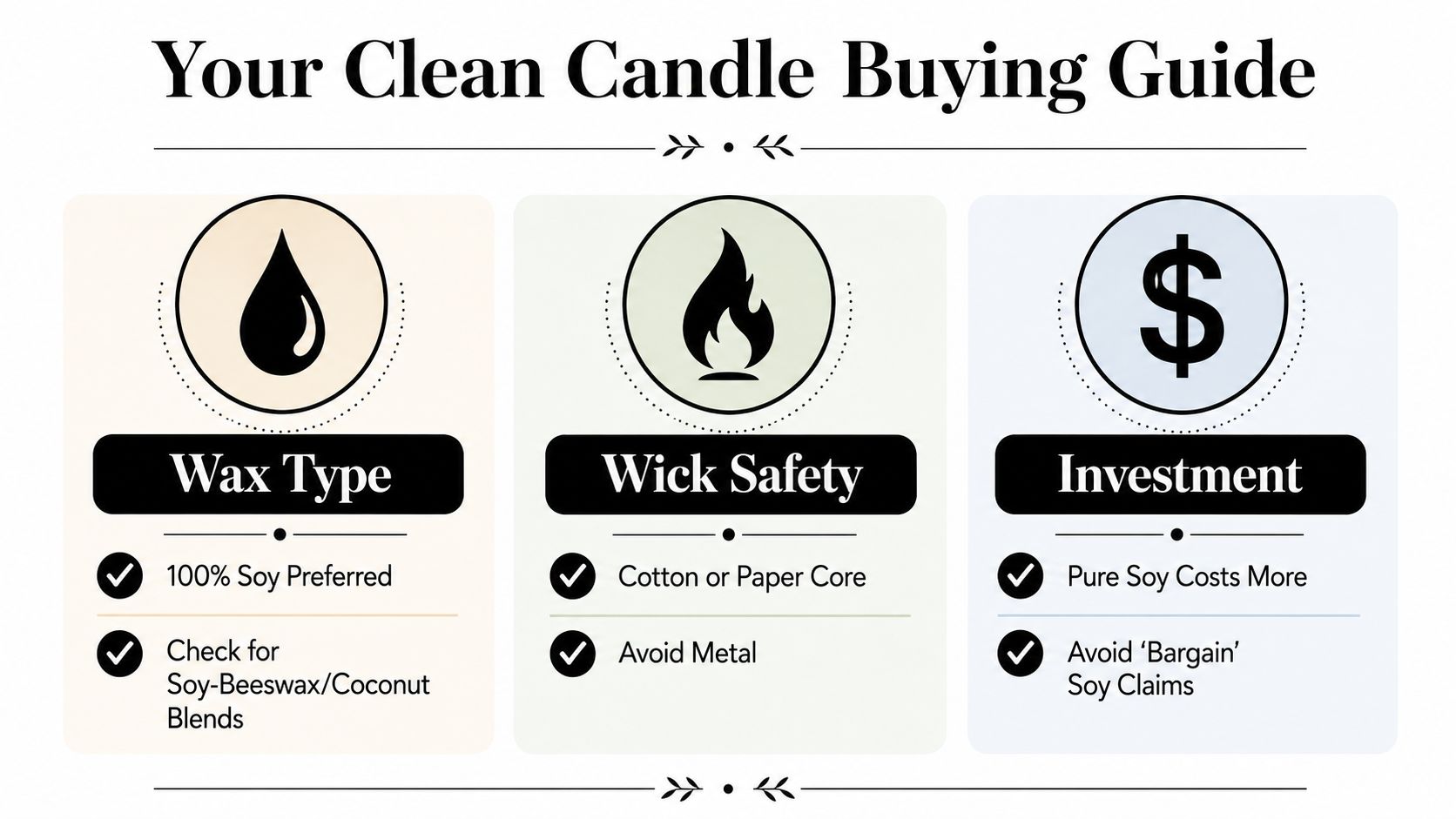
Use three filters before you buy: wax composition, wick construction, and fragrance transparency. These filters work better than judging a candle by its color, scent name, packaging, or the word “clean” printed on the front.
Choose 100% soy when that is what you want, or choose a clearly named soy-coconut or soy-beeswax blend when the maker identifies the blend. Vague wording such as “natural wax” doesn't tell you whether the product contains mostly soy, a small amount of soy, or an undisclosed mixture.
Cotton, paper, and wood wicks are common options for a transparent formulation. Avoid products that don't identify the wick material, and treat any mention of lead or metal cores as a reason to choose another product. Wick material isn't the only factor, but it gives you an early signal about how carefully the product is documented.
Look for a clear statement about fragrance oils, such as phthalate-free, and check whether the maker provides IFRA-related information. Essential oils can sound appealing, but “natural” doesn't mean every person will tolerate the scent when heated. Fragrance strength also depends on the wax, wick, jar, and room, so a powerful throw isn't proof of a cleaner burn.
Price can provide context, but it can't prove quality. A candle using carefully selected wax and fragrance materials may cost more because of its ingredient choices and testing work. Jackpot Candles uses a proprietary soy wax blend with fragrance oils designed to provide strong scent release, making it one example of a product where the wax system and fragrance performance are considered together. For broader product research, this guide to award-winning beauty products for spas can also help you think about ingredient transparency across personal-care categories.
Before checkout, ask whether the seller discloses the wax, wick, fragrance approach, safety instructions, and testing claims. If the answers are easy to find, you're evaluating a product rather than a slogan.
“Clean burning” describes a range of performance, not a permanent quality stamped onto every soy candle. Soy has a strong comparative case against paraffin in controlled testing, including lower visible soot and the reported 50–60 times lower PM2.5 concentration in the sealed-bedroom comparison, but those findings don't mean every soy candle produces negligible emissions.
The biggest practical gains often come from controlling the flame. A well-chosen wax can be undermined by a long wick, a strong draft, excessive fragrance, or a closed room. The 2021 laboratory comparison also showed that emissions vary by candle type and burn phase, so the first ignition period deserves particular care.
Use this checklist when you buy and burn:
Even an unscented soy candle released measurable VOCs and PM2.5 in the 2021 chamber study. That makes moderation and airflow relevant for everyone, and especially for households with asthma, allergies, or limited ventilation. A well-made soy candle, used correctly in a ventilated room, remains a reasonable cleaner-burning home-fragrance option, but the label is only the beginning of the evaluation.
If you're looking for scented candles made with a proprietary soy wax blend and fragrance oils selected for strong room-filling scent, visit Jackpot Candles. Choose a candle with clear burn-care instructions, trim the wick before lighting, and enjoy it with the same attention to indoor air quality described above.
Comments will be approved before showing up.