
free shipping at $99


You've just discovered a hidden ring or necklace inside a scented candle or bath bomb. The reveal is exciting, but the presentation determines what happens next. Does the jewelry become a keepsake on a bedside table, a focal point in a retail display, or the detail that makes an unboxing video memorable?
The best displaying jewelry ideas treat the piece as part of a story, not as an isolated object. This roundup covers eight formats, from compact home and photography setups to retail, digital, and event-ready arrangements. Each one works differently depending on available space, audience, interaction, and maintenance. The right setup should make the jewelry easy to see, preserve the surprise, and help shoppers understand what they're buying.
That principle also applies to visual content, where an AI fashion lookbook can help present jewelry in styled, wearable contexts. For Jackpot Candles, the candle or bath bomb remains the product, while the hidden jewelry creates the discovery moment before becoming part of the customer's personal display.
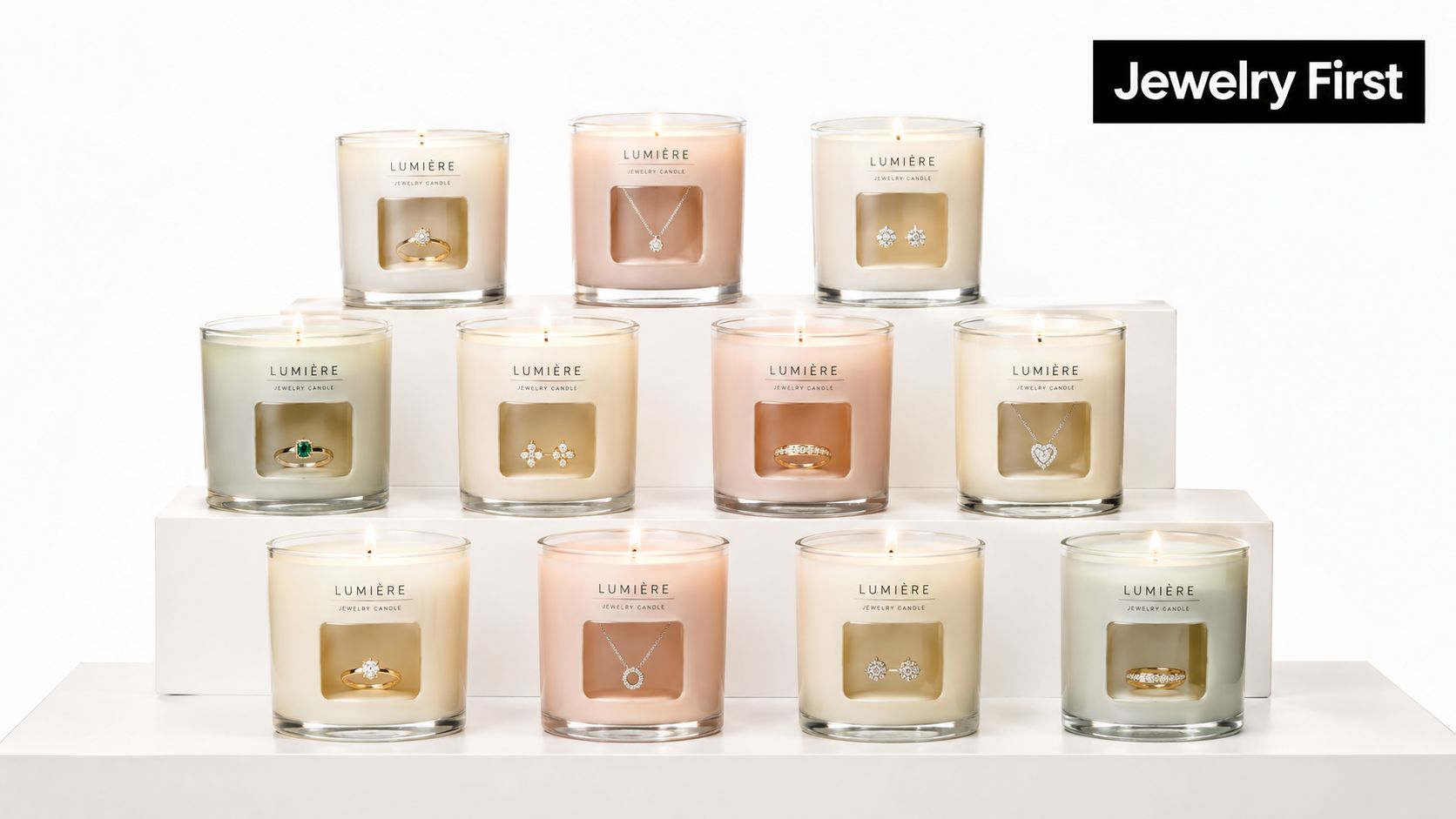
Tiered shelving gives a collection immediate structure. Place Jackpot Candles on ascending levels, then make the jewelry reveal visible through the product's front-facing presentation, supporting imagery, or a separate sample piece. The eye naturally moves across the levels, so the display can introduce the candle first and then direct attention toward the hidden reward.
This arrangement works well in a boutique, gift shop, or showroom where shoppers need to compare several scents and designs without picking up every product. Keep the most visually distinctive pieces around eye level, while placing supporting products on the lower and upper tiers. If a particular jewelry collection is premium, give it more breathing room rather than filling the shelf edge to edge.
Group products by a logic shoppers can understand. You might arrange them by scent family, jewelry style, candle size, or reveal theme. Mixing all of these categories together makes the display look abundant, but it slows comparison and weakens the story.
Use small, readable cards to explain the experience, including the fact that the jewelry is concealed until discovery. Don't imply that every customer will receive the same piece if the contents vary. Clear messaging builds anticipation without creating confusion about the product.
Practical rule: Let the candle lead the sale, but let the jewelry lead the visual intrigue.
Lighting matters here. Jewelry-showroom research links orderly arrangement, sufficient space, and effective lighting with easier navigation and closer inspection, while also showing that display can influence impulsive buying more readily than concerns such as price, quality, or reputation. The visual-merchandising findings support a two-step setup: attract attention with the reveal, then provide substantive product information.
A display station turns browsing into participation. Set up a small counter with an unopened Jackpot Candle, a finished sample showing the reveal stage, and a clean tray containing the recovered jewelry. The customer can understand the journey at a glance, from choosing a scent to finding the concealed piece.
A screen can reinforce the sequence without requiring staff to repeat the explanation. Show short clips of the candle experience, close-ups of the jewelry, and the practical steps involved in retrieving it safely. The footage should feel authentic and well lit, not like a generic product advertisement.
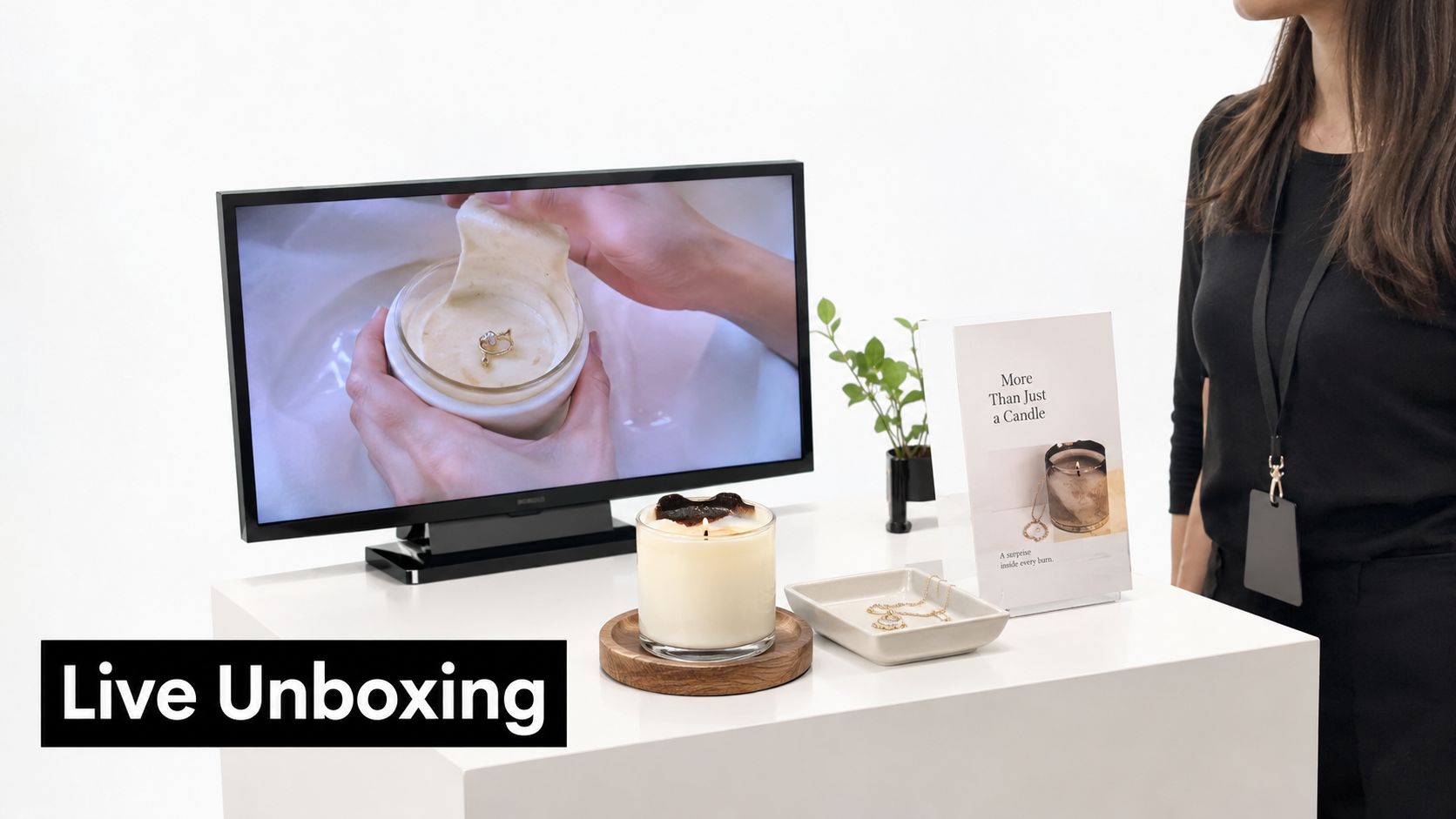
Don't place the finished jewelry directly beside an unopened candle without context. Add a simple sequence, such as choose, burn or use as directed, and discover, so shoppers can connect the objects. If you use a demonstration candle, follow the product's safety instructions and keep heat, wax, ventilation, and customer access under control.
A station also needs maintenance. Replace dusty props, clean the reveal tray, refresh the video, and check that signage hasn't become curled or faded. Rotate sample jewelry so repeat visitors see variety rather than the same reveal every time.
For more practical ideas about turning product interaction into a stronger retail experience, use Jackpot Candles' customer engagement guidance.
The station can also work at an event or pop-up. Keep the counter open on the customer side, place the jewelry close-up where passersby can see it, and give staff a short explanation that focuses on the discovery experience rather than overloading visitors with specifications.
A locked glass cabinet creates a stronger luxury signal than an open table. Combine Jackpot Candles with selected jewelry samples, close-up photography, and concise descriptions that connect the visible pieces to the hidden-jewelry experience. The candle and the jewelry should feel like two parts of one product narrative, not unrelated merchandise sharing a shelf.
Use separate zones inside the cabinet. One section can present the unopened products, another can show jewelry details, and a third can explain the reveal process. This helps shoppers understand that the displayed jewelry is an example of the discovery outcome, not necessarily a guarantee of the exact item inside every product.
High-resolution photography is essential when the jewelry is behind glass. A market summary citing a 2024 U.S. retail digital-experience study reports that 84% of jewelry shoppers used product imagery in purchase decisions, while a separate compiled benchmark reports that 90% of online jewelry shoppers expect 360-degree imagery and zoom. The jewelry imagery summary supports using macro detail, multiple angles, and scale references rather than relying on one hero shot.
For a physical cabinet, use clean, color-accurate LED lighting and keep reflections under control. Technical showcase guidance recommends CRI above 90, narrow beams below 20 degrees for small exhibits, wider beams above 30 degrees for broader illumination, and approximately 4000 K for metallic or shiny jewelry. ERCO's showcase-lighting guidance provides the technical reference.
Keep the jewelry clean before photographing or displaying it. Fingerprints become obvious under directional light, especially on polished metal. In a home setting, the same cabinet can protect a newly discovered piece from dust, children, pets, accidental knocks, and excessive sunlight while keeping it visible.
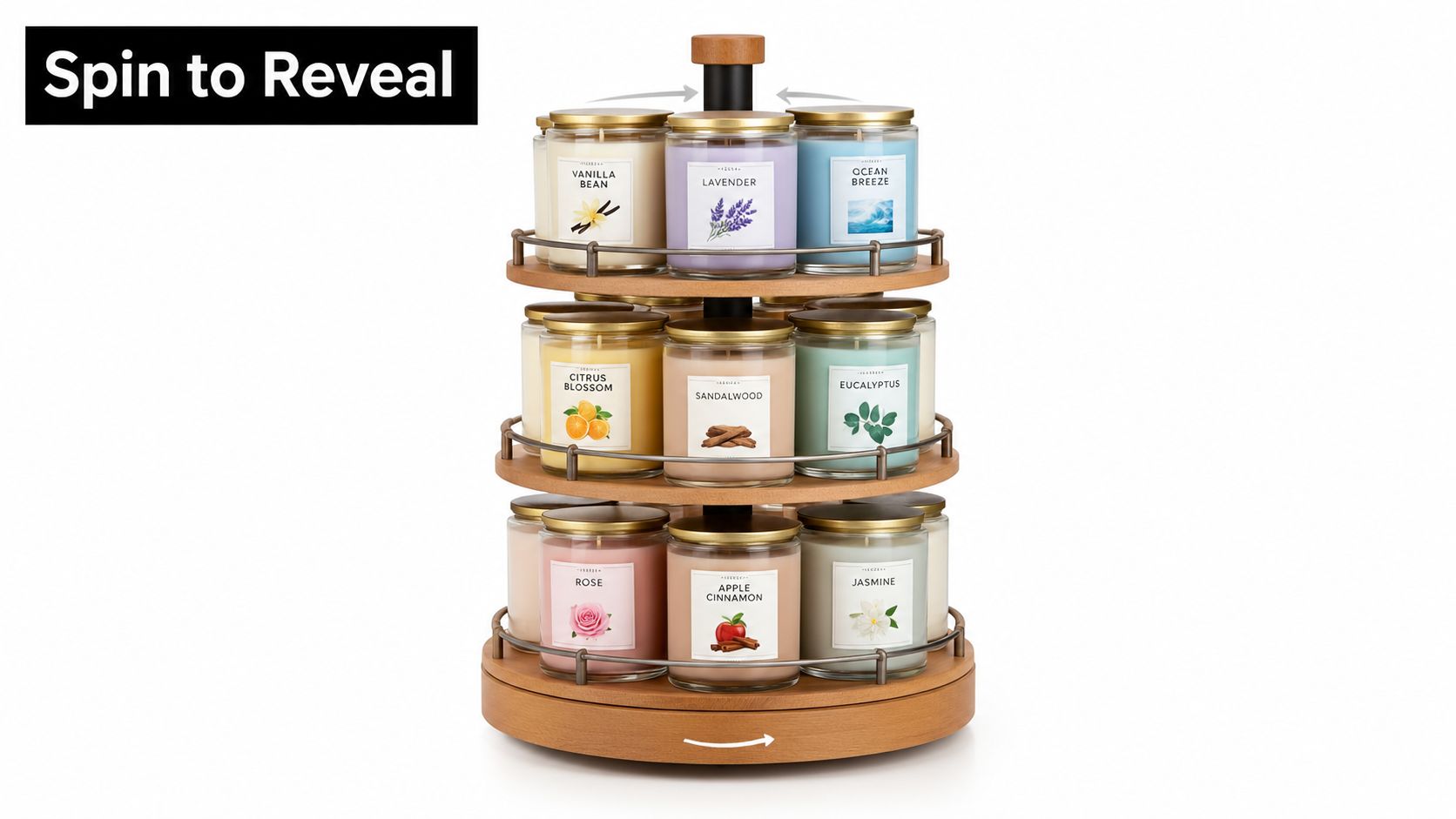
A rotating stand earns its footprint by giving shoppers access to several sides of the collection. Arrange Jackpot Candles in a circular or multi-level format, then label each position with its scent profile and the relevant jewelry information. Customers can turn the stand themselves, which makes comparison more tactile than browsing a fixed shelf.
This format suits a compact retail counter, pop-up table, or event booth. It's especially useful when the front of the store has limited depth but strong foot traffic. Put the display where people can approach it without blocking the entrance, and leave enough room for someone to stop, rotate the stand, and read the labels.
Balance matters more than decoration. Heavy candles placed on one side can make a carousel wobble or tip, while an overloaded stand makes products difficult to remove. Test the mechanism with the actual stock before opening, and check for sticking, scraping, or loose hardware as part of daily maintenance.
Arrange the products in a deliberate sequence rather than scattering them randomly. For example, place lighter scents together, group related jewelry themes, or create a progression from everyday designs to premium-looking presentation. Reorganize the stand when stock changes so empty gaps don't undermine the display.
Motorized rotation can attract attention, but movement isn't automatically better. A motor that turns too quickly prevents inspection, creates noise, or makes labels hard to read. A manual carousel often works better when the purchase requires close comparison.
For photography, stop the rotation and shoot one product at a time. Use a consistent background, a lifestyle frame for scale, and a macro frame for the jewelry. That gives online shoppers the clarity they need without losing the playful character of the physical display.
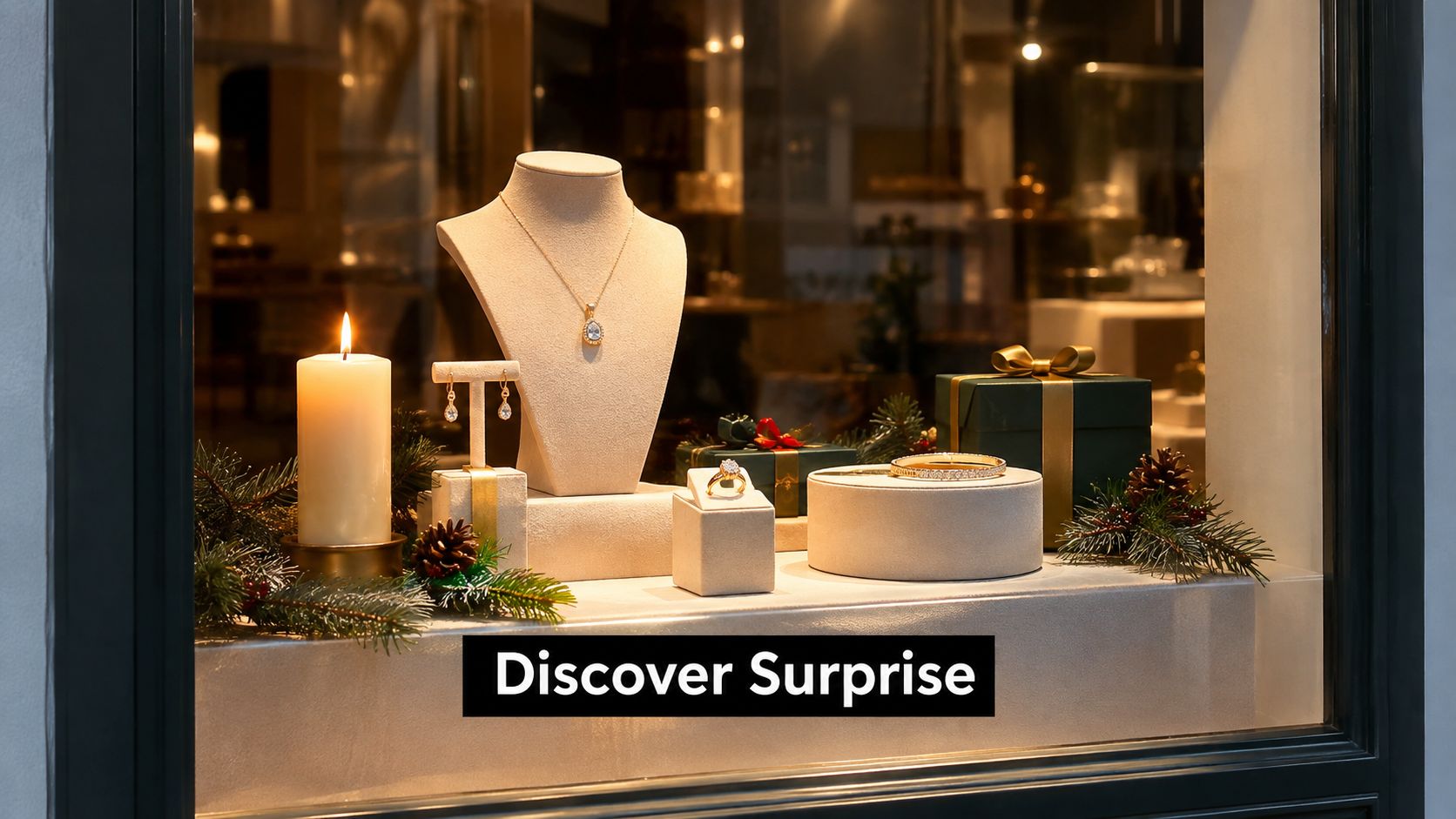
A storefront window has only a short opportunity to explain the product to someone who may never enter. Build the composition around one clear discovery moment: an unopened candle in the foreground, a revealed jewelry piece raised behind it, and a short line of signage explaining that the surprise is concealed inside.
Depth makes the scene readable from the pavement. Use risers, plinths, or stacked platforms to place products at different levels. Keep the jewelry separated from visual clutter so it remains legible through the glass. A necklace can hang vertically, while rings and smaller pieces need a tray or raised platform that catches light without producing glare.
The window should communicate transformation. The candle is not only a scented object, and the jewelry isn't merely an accessory. Together, they tell a simple story about selecting, enjoying, discovering, and keeping.
Seasonal styling can support gifting occasions, but decoration shouldn't bury the product. Use a consistent brand palette, repeat the same core explanation, and change only the supporting elements, such as ribbon, botanical accents, or a winter backdrop.
Photograph the finished window from the viewer's angle before opening. Check whether reflections obscure the jewelry during daylight and whether the lighting still works after dark. A display that looks dramatic from inside the shop may read as a dark silhouette from the street.
For more visual merchandising inspiration, compare the composition with Display Guru's window display concepts. The useful lesson isn't to copy a theatrical installation. It's to give the eye one focal point and let every supporting element reinforce it.
A pegboard or wire grid uses vertical space while keeping the arrangement flexible. Mount it securely, then combine small shelves for Jackpot Candles with hooks, ledges, or mini trays for jewelry samples. The result can work in a boutique, a craft market booth, a home office, or a temporary pop-up where floor space is scarce.
The modular structure is its main advantage. You can move a shelf to make room for taller products, add a ring tray below a jewelry close-up, or reorganize a scent collection without rebuilding the whole fixture. That flexibility also makes it useful for photography, since the grid can create a consistent branded background across product launches.
Don't fill every opening. Research on jewelry-showroom layouts emphasizes orderly arrangement, clear separation, and enough space for movement and inspection. In a home, space-saving demand has also been associated with a reported 33.54% rise in searches for wall-mounted modern fashion jewelry organizers from January to July 2025, according to the cited trend summary. Treat that figure as directional search-interest data, not proof that one organizer will suit every room.
An open pegboard is convenient for pieces worn daily, but it exposes jewelry to dust, sunlight, pets, children, and accidental knocks. Keep sentimental or valuable discoveries in a closed box or cabinet, and use the wall display for a small selection that you can inspect and clean regularly.
Renters can use freestanding grids, removable hooks, or a narrow leaning frame instead of drilling into a wall. Whatever the format, anchor tall structures so they can't topple. For additional ways to separate visible favorites from protected pieces, see Jackpot Candles' jewelry storage solutions.
A gift display should answer two questions quickly: who is this for, and what makes it special? Pair a Jackpot Candle with a bath bomb, a jewelry dish, a card, or complementary packaging, then show the discovery story through a sample jewelry piece or a detailed image. The set becomes easier to understand when the customer can see both the gift moment and the keepsake that may follow it.
Organize sets by occasion or visual theme. A rose-gold palette can use warm packaging and soft neutral props, while a birthday arrangement can use brighter color and a more playful card. Avoid suggesting that a displayed sample is guaranteed to be the exact hidden item unless the product explicitly makes that promise.
Use a small information card that explains the candle or bath bomb, the fragrance direction, the surprise element, and any relevant jewelry details available to the shopper. Keep the card close to the set rather than placing it at checkout, where gift buyers may already have made their decision.
A coordinated package also needs a hierarchy. The candle or bath bomb should remain recognizable, the jewelry story should be obvious, and the supporting products should frame rather than compete. Too many ribbons, boxes, and decorative fillers can make the set look expensive to open and difficult to evaluate.
A gift display works when the recipient can understand the experience before opening the box, while the final jewelry reveal still retains its surprise.
For more ways to organize a discovery-led present, use Jackpot Candles' jewelry gift box ideas. At home, the same format can continue after gifting: place the revealed piece in a small dish or protected case beside the empty packaging, turning the unboxing materials into part of the memory without allowing clutter to take over the room.
A QR code can extend a small physical display into a richer product experience. Place it beside the candle, not underneath a shelf edge or on a busy background. The landing page should show what the product is, explain the surprise element clearly, and offer close-up jewelry imagery, usage guidance, or a short unboxing demonstration.
Digital content is most helpful when it answers a question the physical display can't. A shopper might want to see how a ring looks on a hand, compare pendant scale, understand the reveal process, or view a different scent description. An augmented-reality preview can support that exploration, but it should complement the product rather than imply that the customer can predict the exact hidden jewelry.
Give the QR code a short instruction, such as “Scan to see the reveal experience.” Keep the page fast, readable, and usable on different screen sizes. Test the code under the actual store lighting, including glare from glass and low light in an evening window.
Don't rely on video alone. Add captions, descriptive text, and clear image alt text so the display remains useful when visitors can't play sound or use AR. For inspiration on connecting physical products with digital overlays, explore this augmented reality brand guide.
Content also needs an owner. Assign someone to check links, replace outdated clips, and review the page whenever the product range changes. Track scans and the actions that follow, but interpret the results carefully. A scan shows curiosity, not necessarily purchase intent, so pair engagement data with browsing observations, product questions, and sales behavior.
| Display Type | Implementation Complexity (🔄) | Resource & Cost (⚡) | Expected Outcomes (⭐📊) | Ideal Use Cases (💡) | Key Advantages (⭐) |
|---|---|---|---|---|---|
| Tiered Display Shelving with Jewelry-Forward Positioning | 🔄 Medium, custom shelving & adjustments | ⚡ Moderate–High: shelving, space, lighting | ⭐📊 High jewelry visibility; higher consideration sales | 💡 Flagship stores, boutique counters with space | ⭐ Emphasizes jewelry; professional, browsable presentation |
| Interactive Unboxing Display Stations | 🔄 High, AV setup, live demos, safety controls | ⚡ High: screens, staff, maintenance, safety | ⭐📊 Strong emotional engagement; impulse & social lift | 💡 High-traffic stores, experiential retail, launches | ⭐ Demonstrates authenticity; creates memorable moments |
| Jewelry Showcase Display Cabinet with Candle Integration | 🔄 Medium–High, secure cabinetry & pro lighting | ⚡ High: locked cases, lighting, upkeep | ⭐📊 Elevates perceived value; longer consideration time | 💡 Luxury boutiques, department stores, high-value SKUs | ⭐ Luxury positioning; security; clear value communication |
| Carousel or Rotating Display Stand | 🔄 Low–Medium, install and balancing required | ⚡ Low–Moderate: compact fixture, optional motor | ⭐📊 High engagement; shows many SKUs in small footprint | 💡 Small boutiques, seasonal focal points, store entrances | ⭐ Space-efficient; tactile/interactive; portable |
| Window Display with Jewelry Reveal Focal Point | 🔄 Medium, creative staging & regular refresh | ⚡ Moderate: design labor, lighting, props | ⭐📊 Drives foot traffic; strong first impression & shares | 💡 Storefronts, seasonal campaigns, brand storytelling | ⭐ Eye-catching; immediate value messaging; no extra floor space |
| Wall-Mounted Pegboard or Grid Display | 🔄 Low, simple install, modular reconfiguration | ⚡ Low: inexpensive fixtures, minimal space | ⭐📊 Efficient vertical merchandising; flexible layouts | 💡 Small stores, pop-ups, modern boutiques | ⭐ Cost-effective; highly reconfigurable; contemporary look |
| Gift Set Pairing Display with Jewelry Coordination | 🔄 Medium, bundling, packaging, inventory control | ⚡ Moderate: kit components, packaging, storage | ⭐📊 Increases average order value; simplifies gifting | 💡 Holiday seasons, gift-focused sections, cross-sell displays | ⭐ Boosts AOV; clear gift messaging; themed merchandising |
| Digital-Enhanced Display with QR Codes and Augmented Reality | 🔄 High, AR/QR development, integration, support | ⚡ High: software, content, devices, ongoing updates | ⭐📊 Personalized engagement; measurable digital analytics | 💡 Tech-forward retailers, omnichannel flagships | ⭐ Rich product info without clutter; shareable & trackable |
The best format depends on what visitors need to do. In a retail aisle, tiered shelving makes a broad range easy to scan, while a carousel adds tactile browsing in a compact footprint. A pegboard works when the assortment changes often or the room has more wall than floor space. A locked cabinet suits protected keepsakes, premium presentation, and situations where jewelry shouldn't remain exposed.
Use a window display for people who are passing by. Give it one strong reveal focal point and enough contrast to read through glass. Use an unboxing station for live events, demonstrations, and staffed retail environments where customers can ask questions. The station should show the transition from unopened product to discovered jewelry without creating a safety hazard.
Gift pairing works best when the buyer is shopping by occasion. Group the candle or bath bomb with useful, complementary pieces, then explain the surprise without removing all mystery. Digital enhancements are valuable when shoppers need more detail than the physical display can provide, especially for jewelry scale, close-up inspection, and unboxing guidance.
Before opening the store, publishing the product page, or filming an event, check the setup from the customer's position.
Photography deserves the same discipline as physical merchandising. Show scale with a hand or standardized reference, include multiple angles, and separate the jewelry from the candle in at least one frame. Keep backgrounds and lighting consistent across products so shoppers compare the designs rather than trying to compensate for inconsistent images.
Start with one arrangement, not a full store redesign. Place a Jackpot Candle beside a revealed jewelry piece, observe where viewers look first, and note which questions they ask. Then adjust the height, spacing, lighting, and explanation based on real browsing behavior. A display becomes effective through that cycle of observation and refinement, not through decoration alone.
Jackpot Candles offers scented candles and bath bombs with a surprise piece of jewelry inside, combining fragrance, gifting, and the excitement of discovery. Use that built-in reveal story as the center of a home display, product photograph, retail fixture, or event setup, then visit Jackpot Candles to choose a product and start creating your own presentation.
Comments will be approved before showing up.