
free shipping at $99


The global soy-candle market was valued at $0.72 billion in 2025, according to DataIntelo's soy-candle market report, but popularity doesn't tell you how slowly an individual candle will burn. For that, you need a more practical measure: wax consumed per hour. Long lasting soy candles earn their description when they deliver useful fragrance and light without racing through the wax or leaving much of it stranded around the jar.
Some historical comparisons have described soy candles as burning longer than comparable paraffin candles, but this is not a universal rule. Actual burn time depends on the wax blend, wick, fragrance load, vessel, and burning conditions. A soy label alone cannot tell you how quickly a candle will use its fuel.
A candle's burn time is best understood as wax consumed per hour. A dense hardwood log releases its fuel differently from kindling, even if both provide heat. The comparison helps explain why the way fuel is delivered matters, though candle wax is not wood, and its melting point alone does not establish its burn rate.
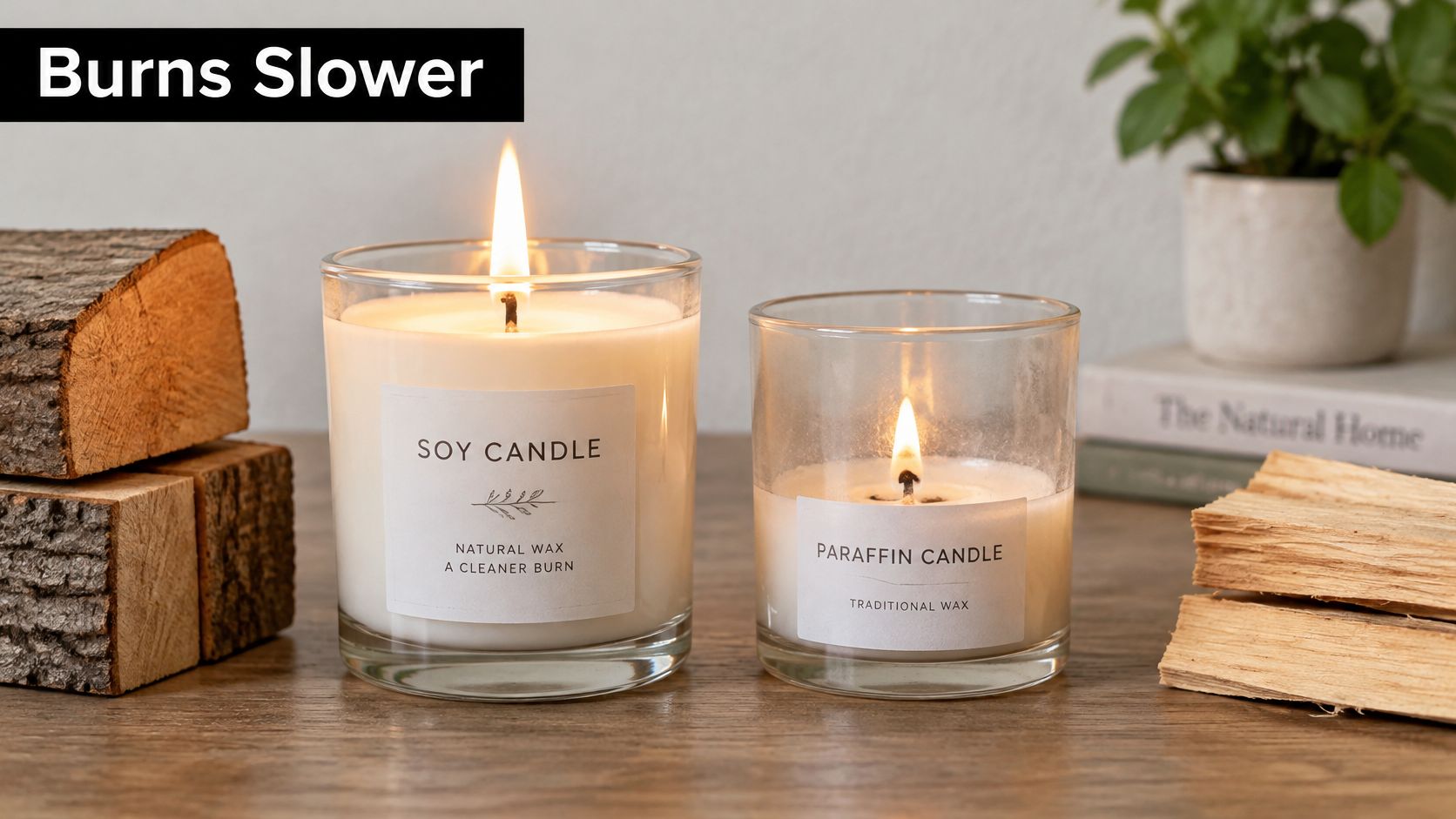
Soy wax starts as soybean oil. Manufacturers hydrogenate the oil, changing its structure so it becomes a harder material suitable for candles instead of remaining liquid. Its plant-based origin distinguishes it from petroleum-derived paraffin, but does not specify how much wax a particular flame will consume each hour.
Practical rule: Soy is a starting material, not a complete burn-performance specification.
The wick draws up liquid wax and supplies fuel to the flame as vapor. Wick size, fragrance concentration, vessel diameter, and the wax blend work together like parts of a small burner. A change in one can alter how steadily wax is consumed, so the soy ingredient alone cannot predict the result.
A well-matched soy candle can burn in a controlled way. If the wick, fragrance load, and vessel do not suit one another, the candle may smoke, tunnel, or use its wax faster than expected. Treat long-burn claims as something to assess against the candle's design and actual use, rather than assuming every soy candle lasts longer than paraffin.
The useful starting formula is burn time = usable wax ÷ average wax consumption per hour. Notice that it says consumption, not melting: liquid wax sitting in the jar hasn't all been used up.
Also notice the word usable. Wax left against the walls or below the manufacturer's safe stopping point doesn't provide additional burning time.
A university candle-emissions experiment reported that paraffin candles produced 50–60 times more PM2.5 than soy candles under its test conditions. That striking result concerns a particular emissions comparison, not a universal burn-time advantage, and it illustrates why test conditions matter more than a broad ingredient claim.
| Factor | What It Changes | Effect on Burn Time | What to Check on the Label |
|---|---|---|---|
| Vessel diameter | Wider jars hold more wax at the same fill height and expose a larger surface | Extra wax can add hours, but the larger flame system may consume it faster | Listed diameter in inches or centimeters |
| Wax weight (fill) | Amount of fuel in the container | More usable wax adds hours at the same consumption rate | Net wax weight in ounces or grams |
| Wick size | Fuel delivery and heat reaching the wax | Oversized wicks can shorten life; undersized wicks can strand wax | Wick specification or maker's testing explanation |
| Fragrance load | Interaction between oil, wax, and wick | An incompatible load can disrupt combustion and reduce useful burn life | Fragrance percentage by wax weight, if disclosed |
| Wax blend | Hardness, melting behavior, and fuel delivery | A tested blend can consume wax faster or slower than another formulation | Ingredient description and soy proportion |
| Wick trimming | Exposed wick and accumulated carbon | Suitable trimming helps maintain controlled combustion | Wick-specific care instructions |
| Room drafts and placement | Direction and stability of the flame | Drafts can cause uneven heating and inconsistent consumption | Placement warnings on the care card |
A wider vessel isn't automatically a longer-lasting candle. It may contain more wax, but it may also need a larger wick or several wicks to heat that wider surface.
Compare it with a larger fuel tank connected to a larger engine. Capacity and consumption must be considered together.
Use a kitchen scale and a simple burn log. Weigh the cool candle before lighting, record the lighting and extinguishing times, then weigh it again after it has cooled completely.
Divide the weight lost by the elapsed burning time to estimate grams consumed per hour. Keep the lid off for both weighings, use the same scale, and record any trimming or unusual flame behavior.
On a product page, look for net wax weight rather than the weight of the filled glass jar. If the maker provides neither a tested consumption rate nor a clear burn-time method, you can compare capacity, but you can't reliably calculate hours before buying.
A candle wick works like the fire at the center of a campsite. Too little heat leaves the surrounding fuel untouched; too much creates an unnecessarily aggressive fire. The right size supplies enough heat for the vessel without turning the candle into a race through its fuel.
The wick is also a fuel-delivery system. It draws liquid wax toward the flame, so changing the wick can change both the melt pool and the rate of consumption.
In Ökometric GmbH's controlled candle-emissions assessment, reference candles across several wax types produced approximately 6–10 micrograms of particulate matter and condensate per gram of wax. Deliberately over-wicked, high-soot samples reached 146 micrograms per gram for soy and 273 micrograms per gram for paraffin.
Those results don't mean a soy candle can't soot. They show why a wax label can't compensate for poor combustion.
Look for a controlled flame and reasonably even heating across the vessel. The melt pool should develop progressively, rather than immediately becoming unusually deep or leaving a persistent narrow shaft down the center.
Don't force the wax to reach every edge by exceeding the maker's maximum session length. Some candles leave a thin rim during early burns that melts later as the flame sits deeper in the vessel.
A full melt pool isn't a reason to keep burning a candle that's smoking, overheating, or behaving erratically.
Wick material also changes the care routine. For a wooden wick, use a wood-wick burning guide rather than assuming the same trimming technique applies to every cotton and wooden design.
| Symptom | Likely Cause | Fix |
|---|---|---|
| Tunneling, with a ring of wax at the edge | Insufficient heat from the wick or repeated short sessions | Allow an adequate session within the maker's limit; ask about a better-tested wick match if it persists |
| Mushrooming, or a black carbon cap | Carbon accumulation, sometimes associated with excessive exposed wick | Extinguish, cool, and remove the carbon cap before relighting |
| Excess soot on the jar or nearby surfaces | Over-wicking, an overlong wick, drafts, or incompatible formulation | Stop burning, correct placement and trimming, and discontinue use if smoking continues |
| Tall, flickering flame | Excess exposed wick, drafts, or an oversized wick | Extinguish and cool; trim as directed and reassess in a sheltered location |
| Uneven melt with pooling on one side | Directional airflow, an off-center wick, or uneven placement | Use a level, draft-free surface; inspect the cooled wick position |
Never try to replace or enlarge the wick in a finished candle while using it. Persistent problems belong with the manufacturer, especially if the vessel becomes unusually hot or the wick shifts toward the glass.
Strong fragrance and long burn duration can be competing design goals. Adding more oil changes the formulation the wick must handle, so a heavily scented candle needs compatibility testing, not just a larger dose of perfume.
The relationship starts with the oil and wax working together.
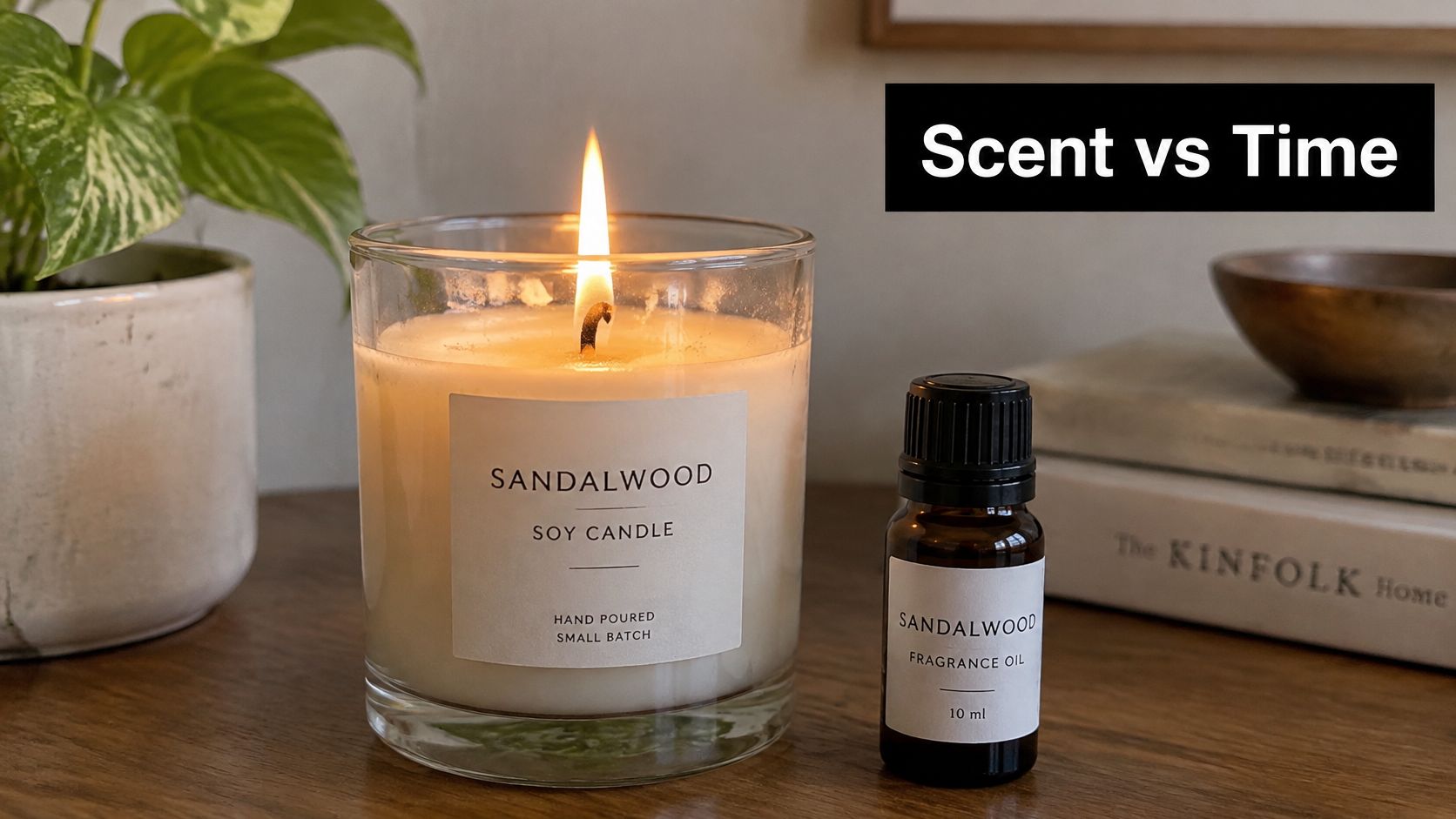
Fragrance load describes the oil added relative to the wax weight. Scent throw describes the fragrance you perceive in the room, and they aren't interchangeable.
A candle can contain plenty of oil yet perform poorly because the formulation or wick isn't suitable. Conversely, a well-matched fragrance can smell satisfying without requiring an aggressive flame.
There isn't a universal fragrance-percentage cutoff that proves a finished candle will burn cleanly or last longer. Ask whether the maker tested that particular fragrance in that wax and vessel, rather than treating a high percentage as a quality badge.
For background on formulation, this guide to soy-wax candle fragrance oils explains the ingredient category behind the scent.
A Portland State University indoor-air investigation found that wax type alone didn't significantly determine the overall emissions profile, while fresh and fruit fragrance categories were associated with higher formaldehyde and acetaldehyde emissions than several other fragrance groups. That finding doesn't establish that every fruit-scented candle is unsafe or that another scent category is emission-free.
Room size, ventilation, formulation, and burning behavior all affect the practical experience. In a small room, start conservatively, provide ventilation without directing a draft across the flame, and stop if the fragrance causes discomfort.
Keep the same observational approach when viewing candle demonstrations.
Visible soot is a reason to stop and troubleshoot, but its absence doesn't prove that a candle produces no emissions. Choose a scent intensity you can enjoy comfortably, then judge whether the flame remains controlled throughout use.
The useful target is balanced scent throw with stable combustion. Wick-fragrance compatibility tells you more about that balance than the word soy alone.
A reliable care routine protects the performance the maker designed into the candle. Keep a wick trimmer or small scissors, a candle snuffer, and the care card together so you're not improvising once the wax is hot.
Use the manufacturer's wick-specific instructions and session limits as your boundaries. A candle that needs unsafe extended burning to behave properly isn't delivering useful longevity.
The illustration is a reminder of the sequence; the product's own directions determine the details.
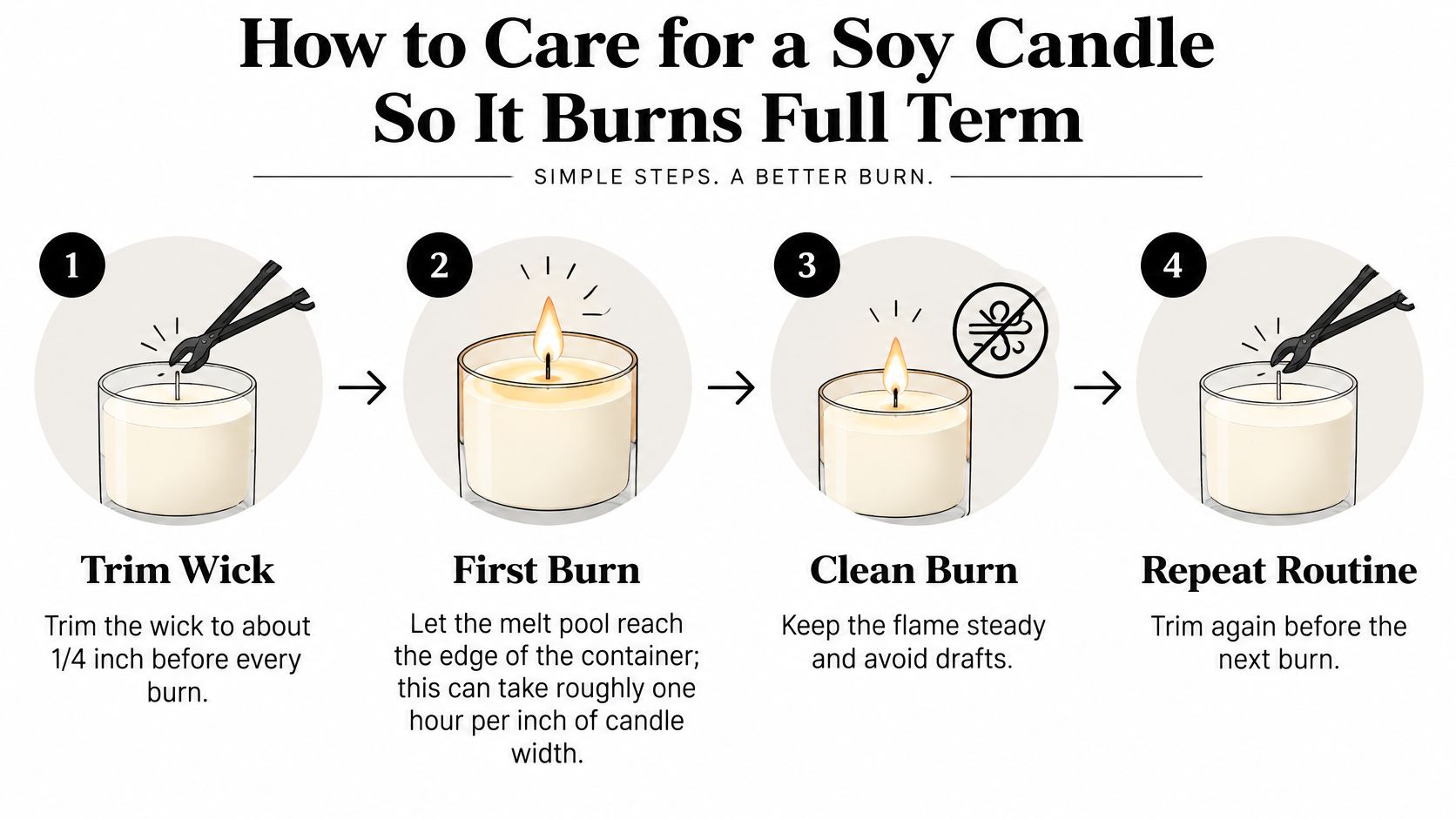
Check the remaining wax before every lighting. Stop at the manufacturer's minimum wax level rather than trying to extract the last possible flame from an almost-empty vessel.
For troubleshooting and handling reminders, keep these practical candle-burning tips alongside your product instructions. Never leave a candle unattended, and extinguish it before sleeping or leaving the room.
Your visual check is straightforward: a controlled flame, progressive melting across the surface, no persistent smoke, and no debris in the pool. If the candle repeatedly fails that check, stop using it and contact the maker.
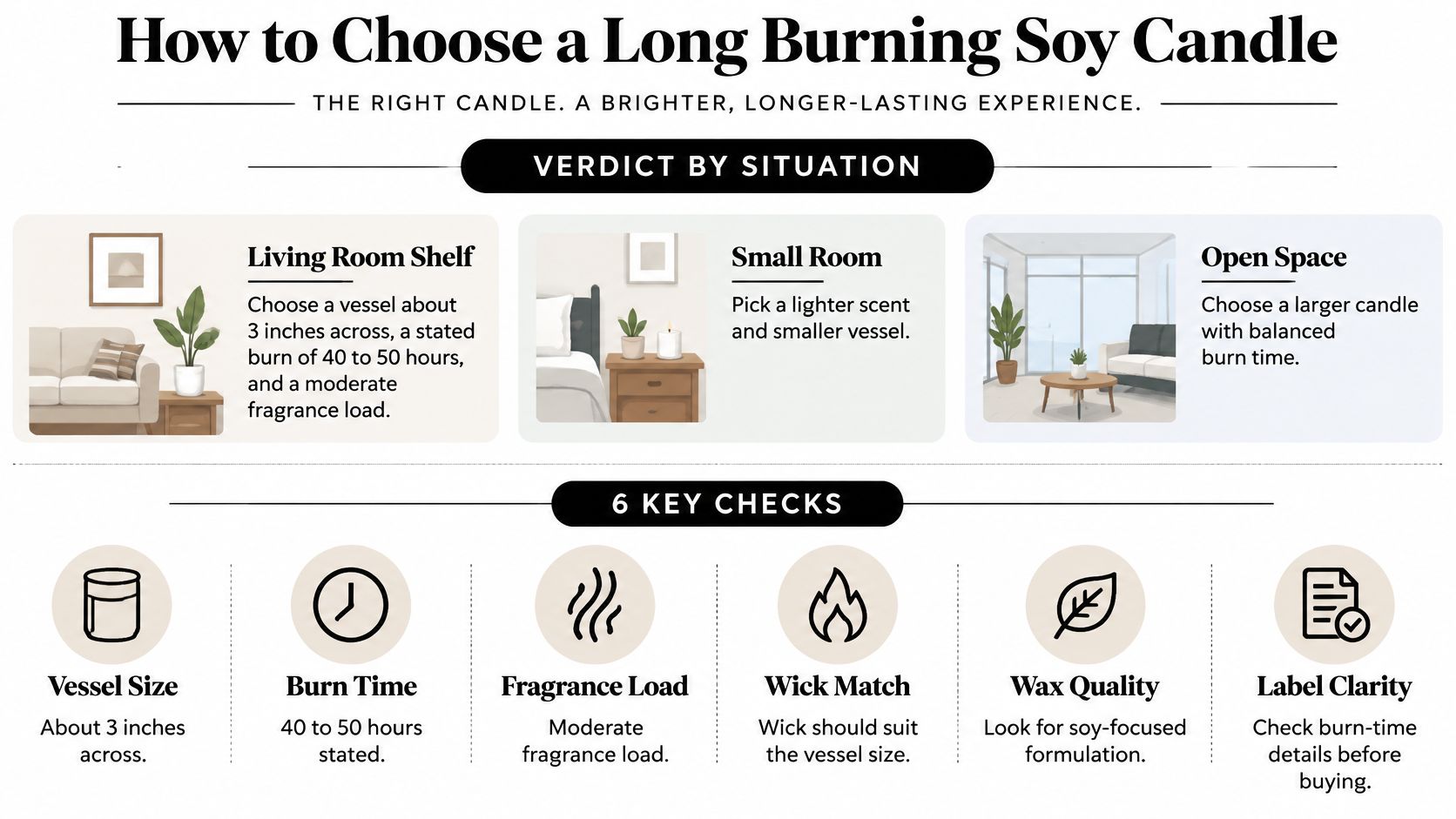
Choose for the place and purpose first, then examine the burn claim. A candle intended for a quiet reading corner doesn't need the same fragrance output as one used in an open living area.
DataIntelo's luxury-wax-candle market report lists a stated burn duration of 40–50 hours for soy candles in that segment. That's a useful example of an advertised duration, not a standard that every jar size or formulation should meet.
For a living-room shelf, prioritize a stable vessel and an open placement with adequate clearance above it. A shelf can look suitable while trapping heat beneath another shelf or putting the flame too close to decorations.
For a small bedroom, choose a scent you find comfortable at close range and plan for ventilation. Extinguish it before you become sleepy, even if you haven't reached the session length you originally planned.
For an open space, ask about the intended room setting rather than automatically choosing the strongest fragrance. A larger candle may provide broader distribution, but its additional wicks can also increase consumption.
For a novelty candle with a hidden item, treat the reveal as a bonus rather than a deadline. Don't extend a session, dig into hot wax, or move the burning vessel to accelerate access to the surprise.
This visual checklist can help organize the shopping comparison, but its example dimensions aren't universal buying requirements.
If you're buying a present, compare the recipient's preferences as carefully as the specifications. A resource such as Bridle Up Hope Shop candle gifts can help you consider gift style, but you should still review care information and burn details independently of the presentation.
Ask whether the wax blend is identified, whether the advertised hours are tied to a clear test method, and whether the wick has been matched to the finished formulation. If a seller can't answer, treat the duration as an estimate rather than a dependable comparison.
Buy useful burning time, not the largest number on the label.
Start with a single candle before committing to a collection. Keep the packaging and care card, record how it behaves in your intended location, and contact the seller if its performance differs substantially from the description.
Soy alone isn't proof of longer life. The more trustworthy choice is a candle with transparent specifications, sensible instructions, and a burn you can observe and repeat safely.
Jackpot Candles offers scented candles made with a proprietary soy-wax blend and a surprise piece of jewelry inside. Visit Jackpot Candles to compare scents and product details, then choose a candle whose stated burn time and care routine suit the way you'll use it.
Comments will be approved before showing up.