
free shipping at $99


Does a high price prove that a candle is premium, or could a well-designed fifteen-dollar candle outperform a ninety-dollar one? Packaging and fragrance names create an immediate impression, but the qualities you can judge are less glamorous and more useful: wax chemistry, fragrance formulation, wick design, and burn behavior.
Premium scented candles are best understood as carefully balanced products. A refined aroma matters, but so does the wax's ability to hold and release that aroma, the wick's ability to create a stable melt pool, and the vessel's ability to handle heat safely. Once you know what to inspect, you won't need to rely on price or branding alone.
“Premium” isn't a regulated technical category. A brand can use the word for a candle with beautiful packaging, expensive ingredients, or a higher retail price. A more useful definition focuses on measurable formulation choices that affect how the candle smells, burns, and ages.
Three pillars provide a practical test:
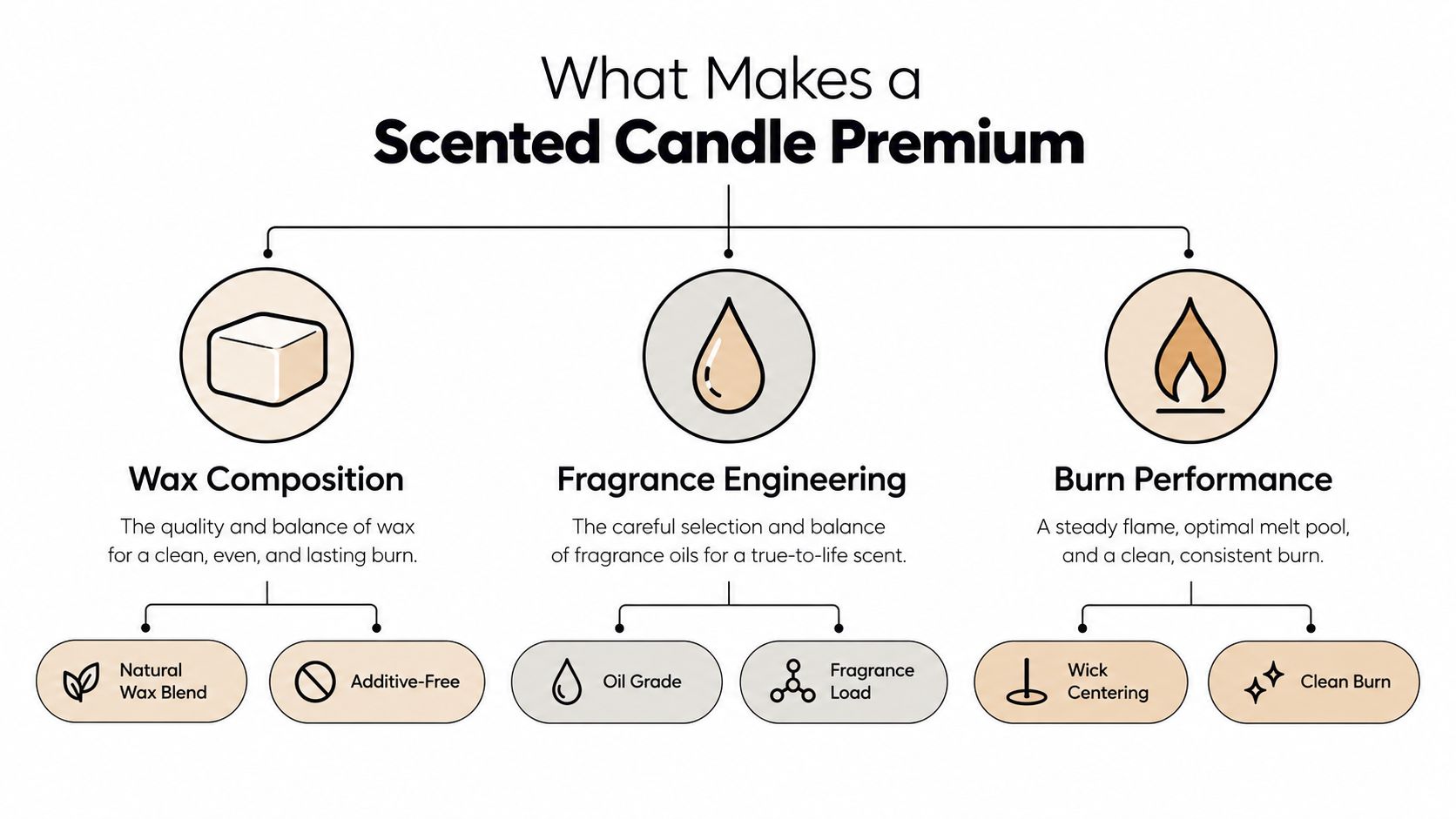
A premium candle doesn't necessarily use one specific wax. Soy, coconut, rapeseed, beeswax, paraffin, and blends can all perform well when the maker matches the formulation to the vessel, wick, and fragrance. The important question is whether the brand explains what it uses and why.
Look for details such as the wax type or blend, the fragrance load, the wick material, and basic care instructions. A label that only says “luxury candle” tells you less than a clear description of the ingredients and expected burn behavior. You can also compare the product's construction with the criteria described in this guide to high-end home fragrance.
A costly vessel may reflect hand-finishing, custom packaging, or a small production run. It doesn't automatically prove that the wax burns evenly or that the fragrance has been blended correctly. Conversely, a modestly priced candle may use a well-tested wax blend and a properly matched wick.
The same evaluation logic applies whether a candle costs fifteen dollars or ninety dollars. Ask whether the construction supports the experience the label promises. If the scent is refined but the candle tunnels, smokes, or leaves oil on the surface, the product isn't fully resolved.
Practical rule: Treat “premium” as a quality hypothesis. Test it through ingredients, construction, and performance rather than accepting it as a fact.
Wax affects more than whether a candle is marketed as natural. It controls the texture of the melt pool, the speed of mass loss, the way fragrance disperses, and how well the wax adheres to the vessel. Many upscale candles use blends because one wax rarely delivers every desired characteristic on its own.
Soy became a common premium choice because it can provide a slower burn and carry fragrance effectively when the wick and container are correctly matched. In controlled combustion testing, soy candles burned at about 3.21 ± 0.37 g/h, compared with 4.26 ± 0.24 g/h for paraffin candles under chamber conditions, and soy produced little to no visible soot while paraffin produced considerable soot (controlled combustion testing of soy and paraffin candles). Those results don't guarantee identical behavior in every home, but they show why wax chemistry matters.
Coconut and rapeseed waxes are often softer and can contribute to a smooth, creamy finish. Makers may blend them with soy to improve texture, jar adhesion, or fragrance release. Beeswax has a naturally warm, honey-like aroma that can influence the final scent, so it works best when that character suits the fragrance. Claims that beeswax automatically purifies indoor air should be treated cautiously, because the overall result still depends on wick, fragrance, ventilation, and combustion.
Paraffin also appears in some premium formulations. A controlled mineral component can help with color, firmness, and scent release, but shoppers should judge the whole formula rather than assuming that a single wax label settles the question.
| Wax Type | Burn Profile | Scent Throw | Sourcing | Typical Premium Use |
|---|---|---|---|---|
| Soy | Often slower and relatively low-soot when correctly wicked | Balanced cold and hot throw | Plant-based feedstock | Main wax or base for blends |
| Coconut | Soft, smooth melt behavior | Often smooth and diffuse | Plant-based feedstock | Blended with soy for texture |
| Rapeseed | Soft to medium firmness | Even release when properly formulated | Plant-based feedstock | European-style natural blends |
| Beeswax | Firm, steady burn with a honey character | Adds its own warm note | Bee-derived wax | Natural formulas and accent blends |
| Mineral blends | Can offer firmness and strong scent release | Often pronounced when well tuned | Mineral or petroleum-derived components | Controlled performance blends |
A wax blend isn't automatically superior. The maker must still test wick size, fragrance compatibility, and vessel geometry. For a more detailed comparison of how those choices affect results, see this guide to the best wax for scented candles.
A candle's fragrance load is the weight of fragrance oil relative to the weight of wax. It isn't measured by filling a container with oil or by judging how strong the cold scent seems. Many candle formulations begin around 1 ounce of fragrance oil per pound of wax, roughly 6% by weight, while tested maximums vary by wax. Container soy waxes may hold about 7% to 11%, enhanced soy blends can reach about 11%, and paraffin container waxes often sit around 8% to 10% (fragrance load guidance and wax compatibility).
Those ranges are ceilings to test, not targets to copy blindly. More oil can increase cold and hot throw, but exceeding a wax's compatibility limit can cause sweating, poor binding, oily surfaces, and an unstable flame. A carefully mixed formulation at a lower load can smell better than an overloaded candle that burns poorly.
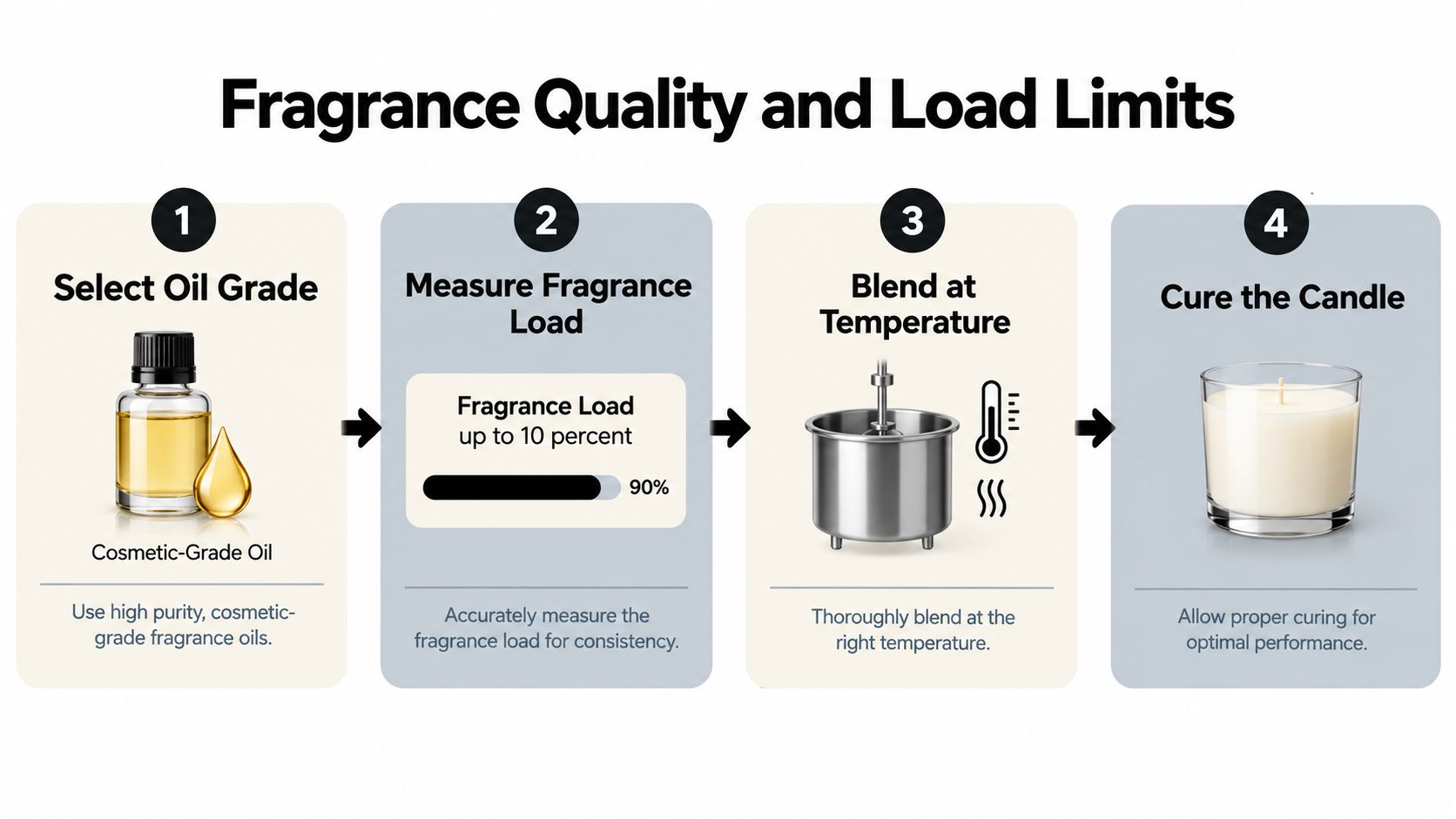
Oil quality affects complexity, balance, and consistency. A premium maker should be able to explain whether the fragrance was selected specifically for candles and whether it has been evaluated for the intended wax and wick system. “Perfume-grade” can describe a richer aromatic profile, but it still doesn't replace burn testing.
Fragrance molecules also behave differently in heat. Some evaporate quickly and create an immediate impression, while others emerge gradually as the melt pool develops. That is why a candle with a powerful cold sniff may feel flat when lit, while a subtler jar can develop more depth in the room.
Wick size controls the heat reaching the wax. Wax temperature affects how fragrance moves through the melt pool. Cure time influences how thoroughly the oil settles into the structure. Vessel diameter and airflow affect how much aroma reaches the surrounding room.
Shoppers don't need to calculate every variable, but they should be skeptical of labels that treat fragrance load as the entire quality story. Load, oil selection, wick, temperature, and cure are one system. A brand that provides clear formulation and care information gives you more useful evidence than a brand that only advertises a high scent percentage.
You can learn a great deal from a candle before lighting it. At a market stall, inspect the surface, wick, vessel, and label. Online, look for the same information in the product description and care instructions.
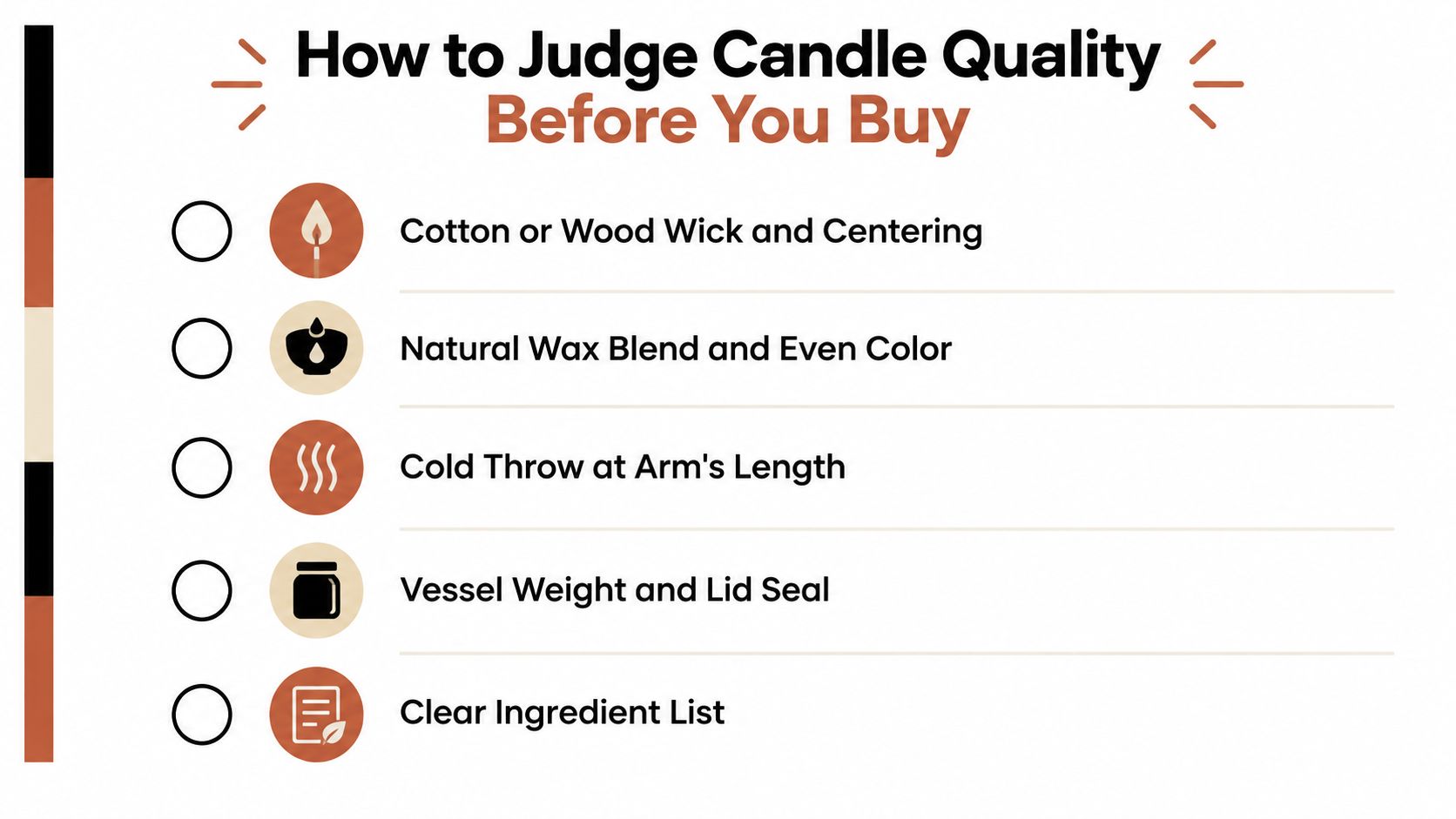
The wick should sit near the center of the vessel and appear clean before use. Cotton and wooden wicks can both work well. A wooden wick may add a soft crackle, while cotton usually offers a familiar flame profile, but neither material guarantees quality without correct sizing.
A black, swollen cap on an unused wick may suggest poor handling, excess residue, or weak finishing control. It isn't conclusive by itself, but it deserves closer inspection. The maker should also explain how to trim the wick before each burn.
The wax should look consistent rather than excessively oily, cracked, or uneven. Minor frosting can occur in some plant-based waxes and doesn't automatically indicate a defect. However, visible sweating or pools of fragrance oil may signal that the wax is holding more oil than it can comfortably bind.
The vessel matters too. Thicker glass or ceramic usually feels more substantial and can offer better resistance to heat stress than a very thin jar. Weight alone doesn't prove safety, but a well-finished vessel, secure lid, centered wick, and clear label show that the maker considered the product as a complete object.
During the first burn, watch how the melt pool develops. The ideal result is an even pool that reaches the vessel's edges without a deep central tunnel. If the flame is unstable, the vessel becomes unusually hot, or soot marks appear quickly, extinguish the candle and contact the maker rather than trying to force a better result.
Cold throw means the scent you notice before lighting. Hot throw means the fragrance released while the candle burns. Cold throw is useful for choosing a fragrance family, but it can't predict the full room experience.
For a visual comparison of construction cues, watch the following product-quality demonstration:
You can also compare these inspection points with this practical guide to candle quality and construction.
Choosing a fragrance becomes easier when you start with the room's role rather than a fashionable note. A kitchen often benefits from brightness and freshness, while a study can support deeper, drier aromas. The goal isn't to follow a rigid rule. It's to select a scent whose emotional weight fits the space.
| Scent Family | Best Rooms | Typical Mood | Best Season |
|---|---|---|---|
| Fresh and citrus | Kitchen, bathroom, entryway | Clean, bright, energetic | Spring and summer |
| Floral and powdery | Bedroom, dressing area, guest room | Soft, calm, welcoming | Spring and early autumn |
| Warm and spicy | Living room, reading corner | Cozy, intimate, enveloping | Autumn and winter |
| Woody and smoky | Study, hallway, living room | Grounded, dry, sophisticated | Year-round, especially cooler months |
| Gourmand and sweet | Dining area, kitchen, entertaining space | Playful, comforting, indulgent | Autumn and winter |
Fresh and citrus scents are practical in spaces where you want a sense of cleanliness. Floral and powdery profiles tend to work well in bedrooms and guest spaces because they can feel gentle without becoming overly formal.
Warm spices create a stronger seasonal signal. Use them in living rooms where people gather, but consider the room's size and ventilation if the fragrance feels dense. Woody and smoky profiles often suit studies because dry woods, suede, smoke, and leather-like notes can create a focused atmosphere without the sweetness of a dessert-style fragrance.
Gourmand scents can make a dining area feel welcoming, but they may compete with food if burned throughout a meal. Use them before guests arrive or after the table is cleared.
In an open-plan home, two complementary families can create continuity. Citrus and wood are a useful pairing because the first adds lift while the second supplies depth. Keep the scents distinct rather than burning several highly similar sweet or floral candles at once.
Seasonal rotation also helps. A room that always carries the same aroma can make your nose less responsive to it. Changing families occasionally gives each fragrance more contrast and makes the choice feel intentional rather than automatic.
A well-formulated candle can still perform badly if you burn it carelessly. Consider a new candle arriving at home. Before lighting it, read the care label, place it on a stable heat-safe surface, and check that the wick is centered and trimmed.
On the first burn, allow the melt pool to develop evenly across the surface. Many makers use a two-hour first-burn guideline as a practical target, but the correct stopping point depends on the vessel, diameter, wax, and maker's instructions. Don't keep burning just to reach a particular time if the container becomes too hot or the flame becomes unstable.
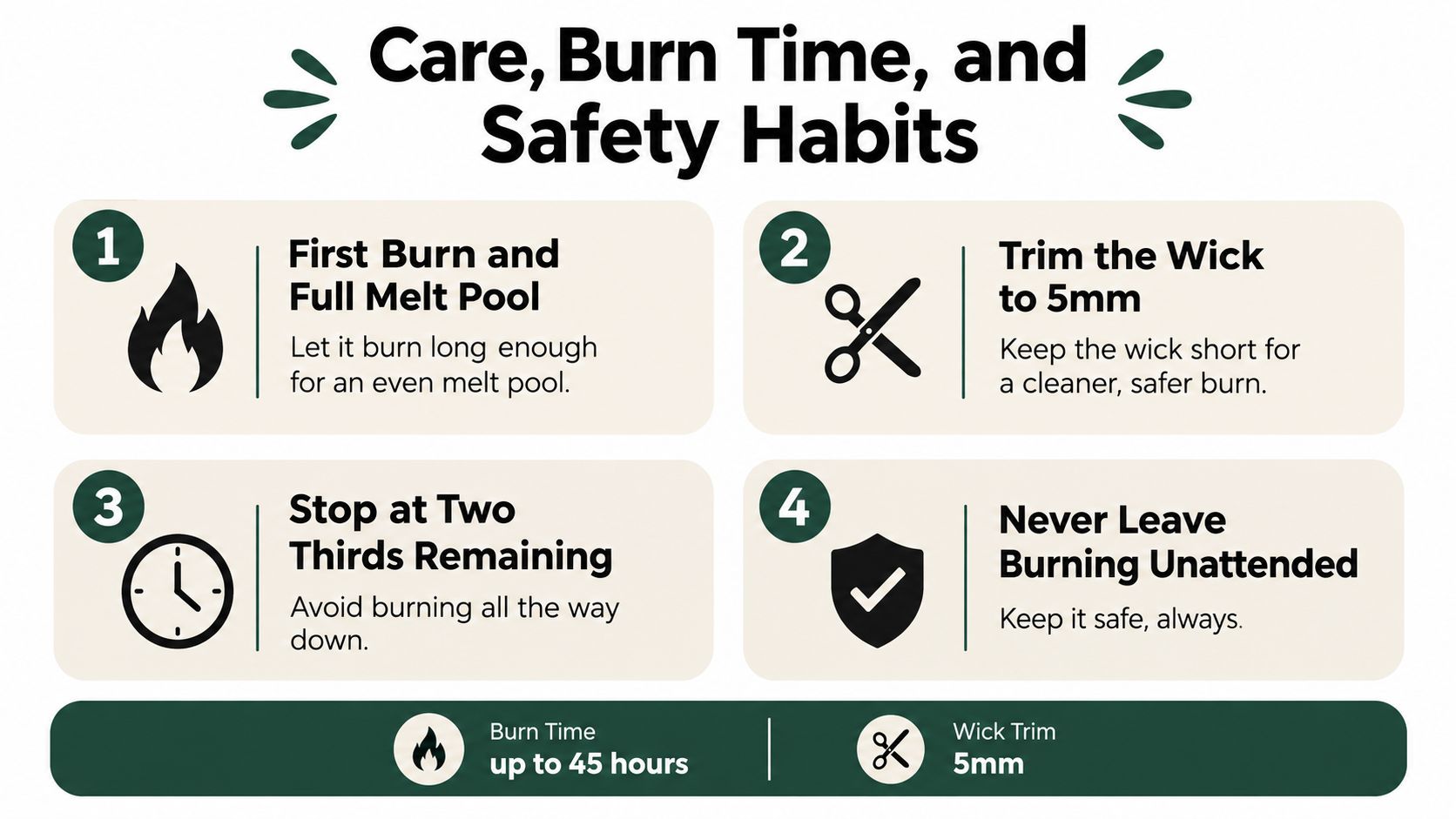
Before every relight, remove carbon from the wick and trim it to the maker's recommended length. A short wick generally helps limit a tall, flickering flame and excess soot. The care graphic uses 5mm as a concise trimming reference, but product instructions should take priority because wick construction varies.
Burn in shorter sessions rather than leaving a candle running through an entire evening. Extinguish it if the flame grows unusually large, the wick develops a heavy mushroom shape, smoke appears, or the vessel becomes excessively hot. Stop using the candle when only a small safety margin of wax remains above the base, following the brand's instructions.
Recent research found that scented candles can raise fine-particle concentrations and alter airborne microbial communities, while another study reported peak fine-particle levels reaching up to 15 times WHO limits in some indoor conditions, particularly where windows were closed or ventilation was blocked (research on candle emissions and indoor air). Premium pricing doesn't automatically mean clean indoor air, so ventilate sensibly and avoid burning candles in small, poorly ventilated rooms for extended periods.
Keep candles away from curtains, paper, dried flowers, drafts, children, pets, and busy walkways. Never leave a burning candle unattended. If a pet has respiratory sensitivity, choose caution over fragrance intensity and discuss household exposure with a qualified veterinarian.
Store unused candles in a cool, dry place away from direct sunlight. Keep the lid on when possible, because dust and heat can weaken the cold scent before the candle is ever lit.
Use these questions before buying online or in person. They turn a vague sense of luxury into evidence you can check.
A gift box can support presentation when it protects the vessel and communicates care instructions. For ideas on how printed gift boxes can support presentation without replacing product quality, consult the Packaging Panda printed packaging guide.
Walk-away rule: If a candle fails two or more checks, its price probably is not justified, whatever the brand name.
If a brand answers two or more questions with marketing language instead of formulation detail, treat the price as unproven and ask the maker directly before buying.
Jackpot Candles offers hand-poured scented candles made with a proprietary soy wax blend and perfume-grade fragrance oils, including Lavender Wooden Wick, Ocean Breeze Wooden Wick, Sweet Pea, and Cinnamon Bun. Visit Jackpot Candles to compare fragrance styles using the formulation and burn-performance criteria in this guide.
Comments will be approved before showing up.