
free shipping at $99


Most advice on soy candles vs wax candles starts with a verdict: soy is clean, paraffin is dirty, and the label settles the matter. That's an easy answer, but it's not a reliable one. After burning hundreds of candles, I've found that a well-made paraffin candle can outperform a poorly wicked soy candle, while a carefully formulated soy blend can make a grocery-store paraffin candle feel unfinished.
The useful question isn't which wax sounds more natural. It's which candle system gives you the burn, scent, soot control, and value you want. Wick size, fragrance concentration, jar diameter, and airflow often matter as much as the wax itself. The wax label is a starting point, not a verdict.
Take three identical candles in identical jars. Give each the same wick, fragrance formula, vessel diameter, and burn conditions, then change only the wax. You might expect one candle to clearly win every category. In practice, the differences in scent strength, flame behavior, and soot can be modest when the rest of the formulation is controlled.
That's because candles don't burn wax in isolation. The wick pulls liquefied wax upward, the flame vaporizes the fuel, fragrance changes the liquid's behavior, and the jar controls how heat moves through the melt pool. A wax with a poor wick match can tunnel, smoke, or produce weak scent even if the wax itself has an excellent reputation.
Wick design comes first. A wick that's too large for a narrow jar can create an oversized flame and excess soot. A wick that's too small for a wide vessel may never melt the wax to the edges, leaving a tunnel and trapping fragrance in unused wax.
Fragrance load changes the experience. More fragrance doesn't automatically mean a better candle. Too much can overwhelm the wick, disrupt combustion, or make the candle smell harsh. Too little can leave even a strong wax feeling flat.
Vessel diameter controls heat. A broad container needs a different wick strategy from a slim tumbler. Two candles made from the same soy wax can behave completely differently because their jars distribute heat differently.
Ventilation affects the flame. A steady room with gentle airflow can support an even burn. A draft from a fan, window, or HVAC vent can make the flame flicker, lean, and produce more visible residue.
Practical rule: Judge the candle as a complete system. “Soy” tells you what the primary wax may be, but it doesn't tell you whether the wick is centered, the fragrance is balanced, or the jar was tested properly.
This is why premium jewelry-in-candle brands focus on the whole formula. A soy or soy-based blend can provide the appearance, handling, and slower burn those products need, but the result still depends on the wick and fragrance engineering. The best brands don't rely on the word “soy” to do all the selling.
Paraffin became the industrial candle workhorse during the 19th century, when petroleum refining made it widely available and inexpensive. Manufacturers could produce it consistently and at a scale beeswax could not match, turning candles from a luxury into a mass-market product. Its predictable texture and compatibility with fragrance made paraffin the default for commercial production. The history of soy wax and paraffin offers useful context for that shift.
Soy wax arrived much later. Michael Richards developed it in 1991 as a less expensive alternative to beeswax. Soy candles reached a wider public in 1995, when The Body Shop became the first chain to offer them broadly. By 1996, manufacturers were using soy wax as a substitute for costly beeswax in commercial candles. Soy's commercial rise belongs to the late 20th century, not to an ancient candle tradition.
Soy wax is made from hydrogenated soybean oil, giving it a renewable, plant-based identity. That identity helps brands position soy as a premium alternative to paraffin, but it does not guarantee better performance.
Pure soy can frost, hold fragrance differently, and create a softer surface than paraffin. Manufacturers often add materials or blend soy with other waxes to improve appearance, scent release, jar adhesion, and consistency. That is ordinary formulation work, not a defect.
Paraffin remains the benchmark for scale and cost because manufacturers have had much longer to refine its production. Soy is a newer major wax category, with roughly three decades of commercial history, while paraffin has spent far longer as the industry standard.
The practical lesson is straightforward: wax history explains the material's behavior, not the quality of the finished candle. A jewelry-in-candle brand may favor a premium soy blend for its appearance, handling, or slower burn, but those advantages still depend on the complete formula and testing. Paraffin is the legacy workhorse. Soy is a comparatively recent plant-based formulation that performs well only when designed carefully.
Soy and paraffin can both produce excellent candles. The wax label predicts less than many comparison articles suggest. Wick design, fragrance load, vessel size, and burn conditions usually decide whether a candle burns evenly, fills a room, or leaves soot behind.
| Attribute | Soy Candles | Paraffin Candles |
|---|---|---|
| Burn time | Often slower, with strong results when properly wicked | Often faster, with performance heavily affected by wick and vessel |
| Scent throw | Usually softer and more restrained | Typically stronger and more immediate |
| Visible soot | Can be low under suitable conditions, but isn't soot-free | Can produce visible soot, especially with poor wick or burn control |
| Emissions | Not emission-free, and formulation matters | Not uniformly worse, though some tests show higher levels for specific samples |
| Cost position | Premium soy blends can cost more | Usually the lower-cost industrial option |
| Best fit | Smaller rooms, gifting, slower ambience, and buyers seeking a plant-based wax | Large rooms, bold fragrance, short events, and tighter budgets |
Soy often burns more slowly because its larger molecular structure can move through the wick at a slower rate. An independent school science project using equal-sized votive candles reported average burn times of 25:21:56 for soy and 16:04:13 for paraffin. After outliers were removed, soy still measured 25:21:56 versus 19:38:26, with the reported advantage varying from roughly 29% to 58%, depending on how the results were treated. The independent burn-duration test offers useful evidence, but it does not predict every finished candle.
Wick choice, jar shape, fragrance load, wax blend, and airflow can all change the outcome. Treat soy's slower-burn reputation as a tendency, not a guaranteed calculation. A poorly wicked soy candle can tunnel and waste wax, while a well-tested paraffin candle may burn evenly enough to deliver better value.
Paraffin usually carries fragrance aggressively. Choose it when you want a candle to announce itself across a large living room or deliver a strong scent during a short event. Soy generally gives a softer cold throw and a more measured hot throw, although a premium soy blend with a compatible fragrance can perform impressively.
For a closer examination of how wax choice and formulation affect scent performance, use this guide to the best candle wax for scent throw. Immediate intensity is not the same as quality. A candle that fills a room quickly can also become tiring or overwhelming, particularly for people who react to fragranced products.
Buyers who experience headaches, congestion, coughing, or other symptoms should review understanding fragrance sensitivity symptoms and triggers and choose a lighter fragrance profile with good ventilation. That recommendation applies to both wax types.
A controlled combustion study on hydrogenated soybean oil candles found substantial visible soot from paraffin and little or no visible soot from soy under the tested conditions. The average soot-filter darkness measured about 32 for paraffin and about 95 for soy, where the higher L-value indicated much lower particulate loading for soy. The same study reported no measurable formaldehyde from soy combustion, compared with 3.2 mg of formaldehyde per gram of wax from paraffin under comparable testing. The controlled soy and paraffin soot comparison supports soy's advantage in that specific setup.
The wider evidence does not justify calling soy emission-free. A 2021 candle-emissions study found that wax and wick composition strongly influenced black carbon, PM2.5, and particle-phase PAHs, while having less effect on nitrogen oxides, formaldehyde, and gas-phase PAHs. Another test summary reported TVOC results for comparable paraffin, soy, stearin, and beeswax candles ranging from 3.07 to 5.09 µg per gram of wax consumed. High-soot soy and paraffin samples emitted 1.79 and 2.84 µg/g, compared with 3.07 and 4.08 µg/g for their reference candles. The emissions research indexed by PubMed shows why “soy is emission-free” is an overstatement.
My recommendation is simple. Choose soy when lower visible soot matters, but judge the entire candle system rather than the front-label wax claim. Soy can burn cleaner in controlled comparisons, yet an untrimmed wick, a draft, or a closed room can undermine that advantage. Paraffin remains a sound choice when strong scent and lower cost matter more.
A clean burn comes from three interacting systems: the wick, the fragrance load, and the room environment. Wax matters, but these variables decide whether the flame gets the right amount of fuel and oxygen.
A cotton wick sized for the vessel should create a stable flame and a melt pool that expands evenly without racing up the jar. Oversizing a wick in a small container can produce a tall flame, excessive heat, and black residue. Undersizing a wick in a wide vessel can leave a deep tunnel, weak scent, and a thick rim of unmelted wax.
Wick trimming matters just as much. A long, mushroomed wick can flicker and smoke. A wick trimmed too aggressively can struggle to sustain a stable melt pool. Keep the wick centered, and follow the maker's burn instructions instead of assuming every candle should be treated identically.
Soy candles commonly use fragrance loads in the 6% to 10% range, but that range is not a universal guarantee of performance. Candle science and combustion basics help explain why fragrance concentration must work with the wax and wick rather than operate as a standalone selling point.
Too much fragrance can interfere with fuel delivery and create a heavy, oily, or acrid burn. Too little may produce a pleasant cold scent but almost no aroma once the candle is lit. A good candle maker tests the complete formula, not just the wax in a mixing pot.
A candle needs a steady environment. Place it away from fans, open windows, doorways, and strong HVAC currents. Ventilation still matters because a room should not become heavily saturated with fragrance, but direct airflow across the flame is the problem to avoid.
| Variable | Optimal Range | Problem If Off |
|---|---|---|
| Wick size | Matched to jar diameter and wax formula | Oversized wicks soot and overheat, undersized wicks tunnel |
| Wick position | Centered and upright | Uneven melt pool and contact with the vessel |
| Fragrance load | A tested level suited to the wax | Weak throw, unstable flame, or harsh aroma |
| Airflow | Steady, gentle room circulation | Flicker, smoke, uneven melting, and faster fuel use |
| Burn setup | Clear space around the vessel | Heat damage, drafts, and inconsistent performance |
Two soy candles can therefore perform more differently from each other than a soy and paraffin candle with matched wicks and similar testing. That's the part most “natural versus petroleum” comparisons leave out.
A soy candle makes sense for a bedroom, bathroom, office, or smaller sitting area where you want controlled ambience rather than an aggressive fragrance blast. Soy's softer, slower character also works well for gift candles, especially when the product includes a surprise ring or necklace inside the jar.
Jewelry-in-candle brands favor premium soy blends for practical reasons. The wax can provide a smooth decorative surface, a slower reveal, and a presentation that supports an embedded package without making the candle look industrial. The formula still needs testing, but the blend gives the maker more control over appearance and fragrance than an inexpensive commodity candle.
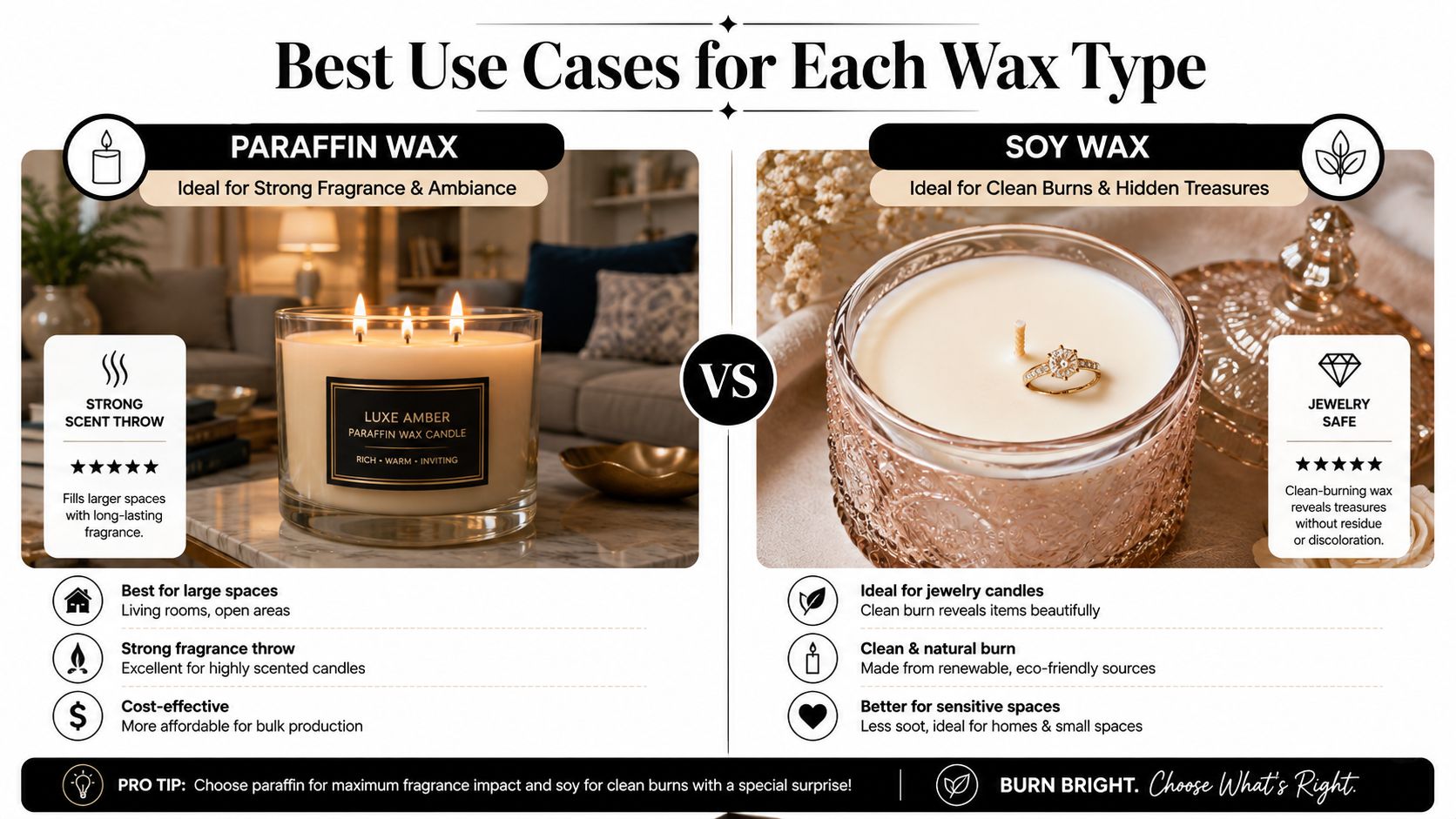
Paraffin remains the practical choice for a large open room when you want strong hot throw quickly. It also makes sense for dinner parties, receptions, and other short-use occasions where inexpensive votives need to create an immediate visual and aromatic effect.
Crafters may prefer soy when they remelt containers, because its lower melt point can make cleanup and handling easier. That convenience doesn't make every soy candle better, but it can matter to hobbyists who work with wax frequently.
Pure soy isn't the only serious option. Soy-coconut blends can improve the feel and appearance of the finished candle, while soy-paraffin blends can add fragrance strength and visual consistency. A gifting brand that needs a decorative surface, reliable scent, and manageable production process may choose a blend because it solves more problems than purity alone.
The label “soy blend” deserves scrutiny, but it shouldn't be dismissed automatically. A transparent blend with a tested wick can outperform a candle marketed as 100% soy but sold with poor instructions and an unsuitable wick.
Buy soy if your priority is lower visible soot, a slower ambience, and a plant-based wax identity. It's also the sensible first choice for people who burn candles in small rooms, dislike overpowering fragrance, or want a jewelry candle that feels like a considered gift rather than a disposable novelty.
If you have asthma, respiratory concerns, or a known sensitivity to fragrance, don't treat soy as medical protection. Wax type alone can't guarantee comfort, and fragrance oils may be the more relevant trigger. Choose lightly scented products, ventilate the room, burn for shorter sessions, and stop using any candle that causes symptoms.
A soy label is not a health certificate. It's one clue about the formulation, not proof that the candle is harmless for every household.
Paraffin is the better fit when you want maximum scent throw on a budget. Large living spaces can benefit from its strong fragrance delivery, and short events often don't justify paying for a premium wax blend. Paraffin also gives makers strong color payoff and predictable production behavior, which explains its continued presence in mass-market candles.
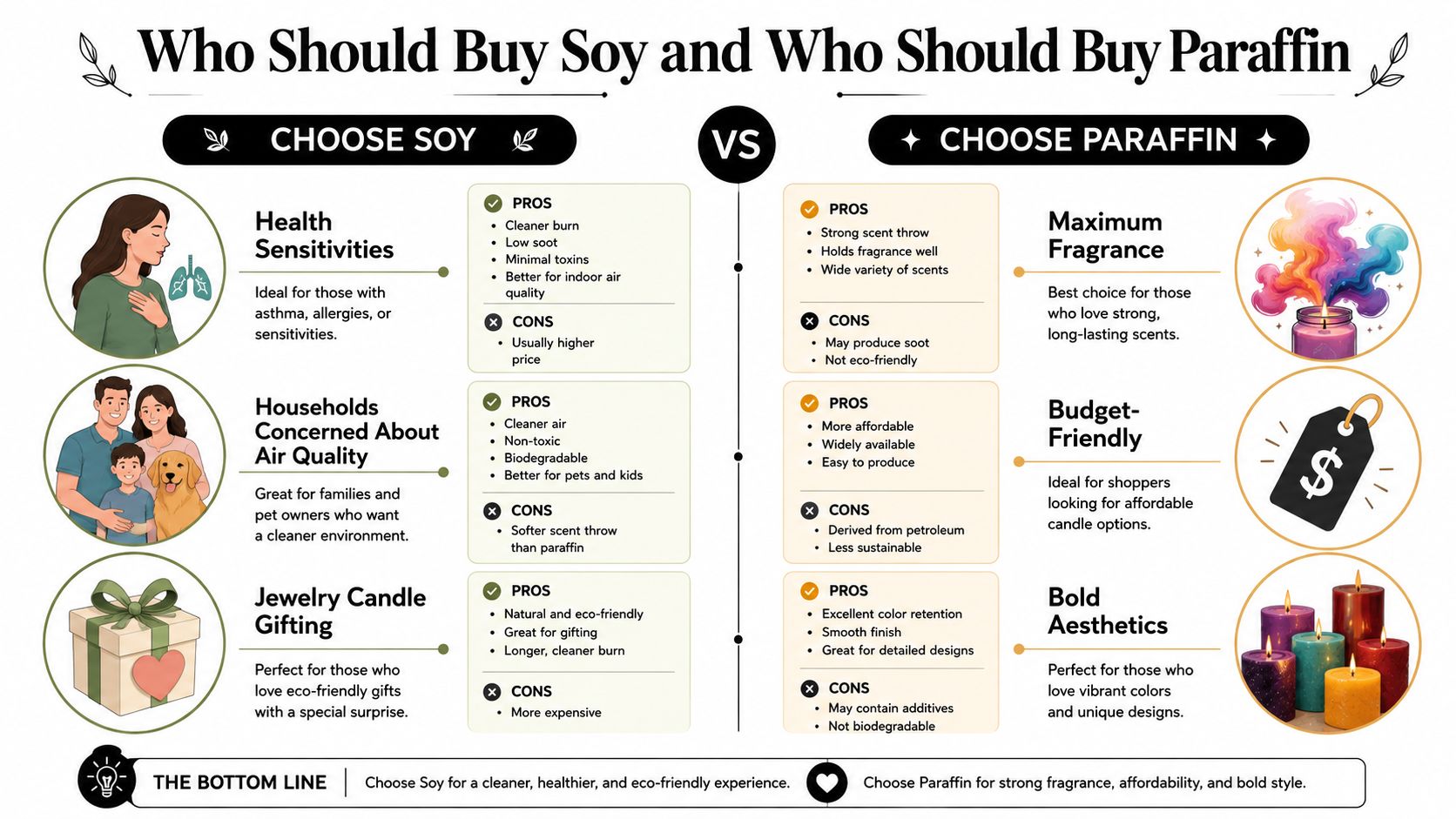
Choose a soy blend if you want a smoother compromise. A soy-coconut formulation can suit shoppers who care about presentation and a softer burn. A soy-paraffin blend can suit buyers who want some of soy's positioning without giving up the room-filling throw associated with paraffin.
For households with children or pets, the recommendation is not “buy soy and forget the rest.” Put the candle on a stable, unreachable surface, keep it away from bedding and curtains, trim the wick, and never leave it unattended. A well-made candle still produces a flame, and safe placement matters more than the front-label promise.
You can assess most candles in a shop or online listing before buying. Look past the wax headline and inspect the evidence of actual formulation quality.
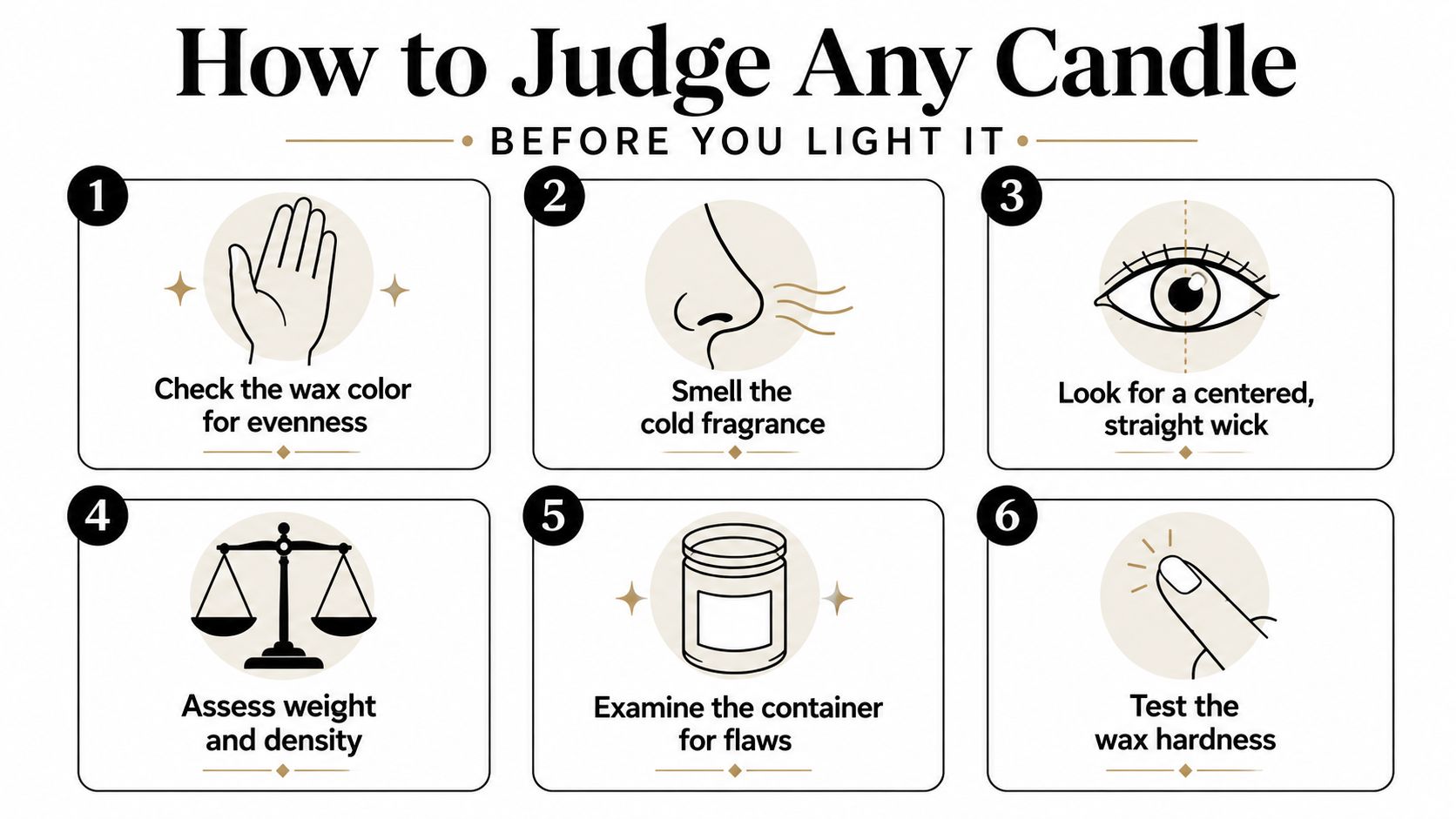
Once you buy, follow a tested burning routine. The guide to burning a candle properly covers the practical habits that protect the vessel and improve consistency, including wick care and placement.
The best soy candles are not good because the word “soy” settles every question. They're good because the maker has balanced the wax, wick, fragrance, jar, and instructions. The same standard applies to paraffin.
Jackpot Candles offers scented candles and bath bombs with a surprise piece of jewelry inside, using a proprietary soy wax blend and fragrance oils designed for a rich room aroma. Visit Jackpot Candles to compare jewelry candles with the full candle system in mind, not just the wax label.
Comments will be approved before showing up.