
free shipping at $99


The most popular advice for buying affordable clean burning candles is also the least useful. You're told to buy soy, avoid paraffin, and assume a higher price means cleaner air. That shortcut sounds sensible, but it doesn't tell you how the candle in front of you will actually burn. A soy label alone proves little, and an expensive jar can still soot, flicker, or release a heavy fragrance load into a small room. You'll choose better when you judge two things together, evidence of a stable, low-soot burn and cost per burn hour.
A clean-burning candle leaves little soot, keeps a steady flame, and doesn't blacken its jar or nearby walls. That plain definition is more useful than a wax name because you can see it during a burn. The wax melts evenly, the flame holds its shape, and the fragrance smells like the scent you chose instead of smoke.
The comparison below shows the features to look for before you connect them to wax, wick, and room conditions.
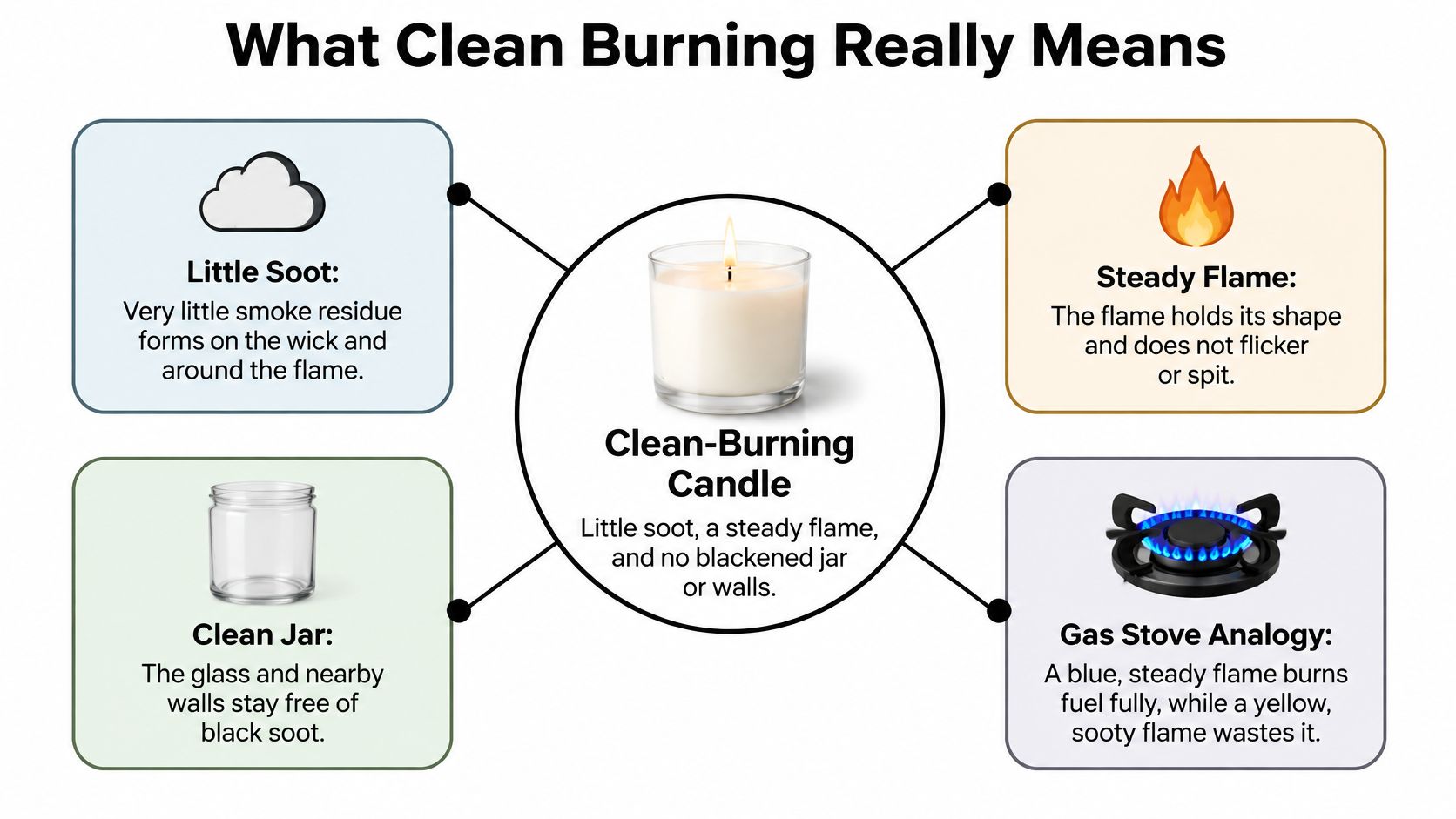
Think about a gas stove burner. A steady flame uses its fuel in a controlled way, while a yellow, smoky flame wastes fuel and leaves residue on a pan. A candle works on the same basic principle, even though its flame looks different. When the wick feeds melted wax at a rate the flame can handle, combustion stays steadier. When too much fuel reaches the flame, or a draft keeps disturbing it, combustion becomes less complete and soot, the black residue you can see, becomes more likely.
Readers often mix up three different meanings of clean. The first is less visible particulate soot on the jar and in the air. The second is fewer airborne chemicals, such as formaldehyde and other volatile organic compounds connected with combustion or fragrance. The third is a steady, even burn that uses the wax across the surface instead of tunneling down the center. Those three qualities often support each other, but they're not interchangeable.
Controlled testing shows why you shouldn't stop at the wax category. In an emissions study comparing normally burning paraffin, soy, palm, and stearin reference candles, particulate and condensate output was approximately 6 to 10 micrograms per gram of wax. Deliberately over-wicked versions produced far more, about 146 micrograms per gram for soy and 273 micrograms per gram for paraffin.
Those numbers don't mean every candle in your home will match a laboratory reference candle. They show something more practical. Wick sizing, flame stability, and fragrance loading can overwhelm the wax label. A well-matched paraffin candle can burn neatly under stable conditions, while a poorly wicked soy candle can smoke and coat the jar.
Clean burning is a performance result, not a wax ingredient. Look for evidence that the whole candle system was designed and tested to burn steadily.
Use three tests as you shop. First, check for information about soot and wick matching. Second, consider fragrance dose, not just fragrance strength. Third, look for signs of burn stability, including sensible instructions and a stated burn time, so cleanliness and value can be judged together.
| Criterion | What good looks like | Red flag | Budget impact |
|---|---|---|---|
| Wax blend named | Specific blend stated, such as soy or soy-coconut, with percentages | Clean claim with no wax named | No extra cost to print |
| Wick matched to jar | Wick size listed for the jar diameter, or sized by test | One wick listed for every size | Low, prevents soot without a price rise |
| Fragrance load | Load percentage and fragrance category stated | Only strength words such as powerful | Lower load often costs less to make |
| Burn testing | Burn or emissions testing described under standard conditions | No testing mentioned | Testing adds maker effort, but disclosure itself is low cost |
| Room size guidance | Recommended room size stated for scent throw | No size guidance given | Low |
| Burn time | Approximate hours of burn stated for the jar | Only weight listed | Lets you calculate cost per burn hour |
You can work through those six rows on a product page or label in a few minutes. Don't score a candle by how attractive its claims sound. Score it by how many questions the seller answers clearly enough for you to check.
Start with the wax blend. A seller doesn't need to publish a secret recipe, but naming the main waxes and, when possible, their proportions is more informative than calling a product natural or clean. Next, check whether the wick suits the jar diameter. A narrow jar and a wide jar don't need the same fuel feed, so a maker selling several sizes should be able to explain how each wick was chosen. Then look for the fragrance load and category. Words such as powerful, rich, or room-filling describe an intended impression, but they don't tell you how much fragrance is in the wax or whether the scent suits a bedroom, bathroom, or open living area.
Count the clear answers. A candle that answers at least five of the six criteria is a strong candidate at most price points because the seller is giving you enough detail to compare both performance and value. A candle that answers only the scent question is asking you to trust its marketing.
That doesn't make the scorecard a laboratory test. It can't measure particles in your room, and it can't verify a seller's claims. Its job is to create a sensible shortlist, which is why the testing row matters. You want to know whether the maker describes burn testing under repeatable conditions and checks for problems such as flicker, mushrooming wicks, soot on the container, or an excessively hot melt pool.
Most of those gaps don't require expensive ingredients to fix. Printing a burn time, wick size, fragrance category, or room recommendation adds little or no material cost. That's important for budget shoppers because clear information is not a luxury feature. Affordable clean burning candles can be transparent without becoming premium priced, and that transparency lets you separate thoughtful design from a vague clean-burning promise.
A soy label alone does not prove a candle will burn cleanly, just as a higher price does not guarantee lower emissions. Soy blends are often affordable and widely available, so they can be a practical starting point. The wax is only one part of the candle: its wick, fragrance, and vessel also affect how it burns.
| Wax | Typical price tier, general market observation | Soot in normal burns | Soot when over-wicked | Scent, general observation |
|---|---|---|---|---|
| Paraffin | Often lower priced | 6 to 10 micrograms per gram, reference group | 273 micrograms per gram | Scent performance varies by formulation |
| Soy blend | Often lower to mid-priced | 6 to 10 micrograms per gram, reference group | 146 micrograms per gram | Scent performance varies by formulation |
| Palm or stearin blend | Varies by product | 6 to 10 micrograms per gram, reference group | No reliable value stated | Scent performance varies by formulation |
| Beeswax | Often positioned at a premium | No reliable value stated | No reliable value stated | Natural scent varies by product |
| Coconut-soy blend | Varies by product | No reliable value stated | No reliable value stated | Scent performance varies by formulation |
The price and scent descriptions are general observations, not measured results or guarantees for individual candles. The soot figures come from controlled reference burns, which help compare combustion under those conditions. They do not rank every retail candle: a product's wick, fragrance, vessel, and use can change its performance. Where emissions evidence is missing, no reliable value stated is more useful than a guess.
Paraffin remains widely used partly because it is inexpensive, readily available, and can hold fragrance well. Grand View Research reports that paraffin candles accounted for 30.4% of the global candle market in 2025. Those qualities help explain its presence across budget ranges, but popularity and price do not establish how cleanly a particular candle burns.
The controlled comparison offers a more specific picture. During normal burns, paraffin and soy candles fell within the same 6 to 10 micrograms per gram reference range. When deliberately over-wicked, emissions rose to 273 micrograms per gram for paraffin and 146 for soy. In everyday terms, an over-sized wick is like a stove turned too high: it can make combustion less steady. In that stressed comparison, paraffin produced more particulate output, while the normal-burn values were similar. A comparison of soy and paraffin candles can help clarify differences between the waxes, but it cannot replace product-specific burn information.
Beeswax is often sold at a premium, but its price and natural origin do not establish its soot performance. The cited controlled comparison does not provide a reliable beeswax value, so it cannot support a numerical ranking against paraffin or soy. Treat that missing evidence as uncertainty, not as proof that beeswax is either cleaner or less clean.
Coconut-soy and palm or stearin blends also have limited emissions information in this comparison. For these options, check that the maker identifies the blend and provides product-specific burn details. For shoppers weighing price against clean-burn evidence, a named soy or soy blend may be a reasonable starting point, not a guarantee. Compare the available evidence with the product's cost per burn hour, rather than assuming a fashionable wax name or a higher sticker price means lower emissions.
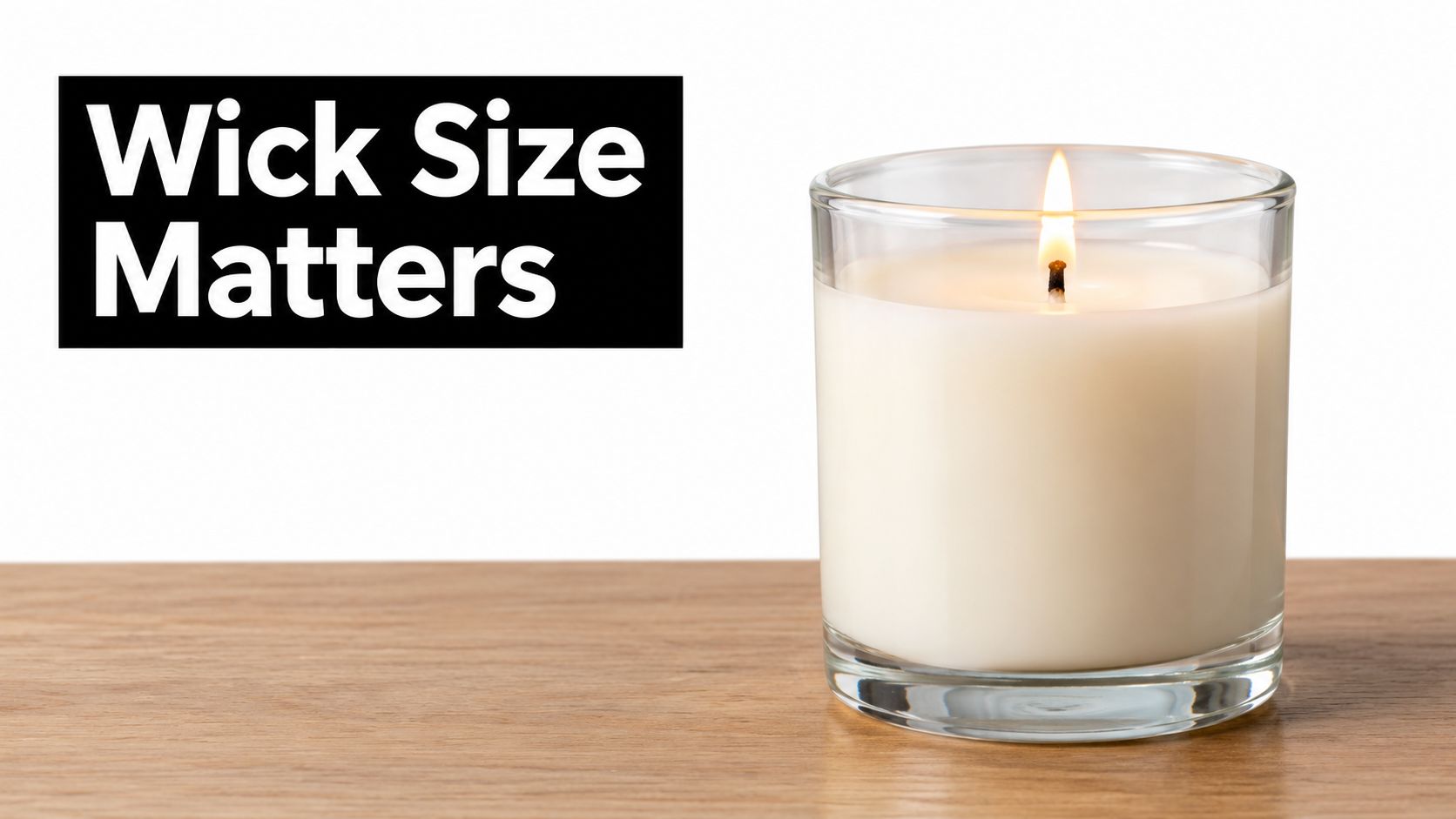
Think of the wick as the candle's throttle. It draws melted wax upward and controls how much fuel reaches the flame. Set that throttle too high and the flame grows tall, unstable, and smoky. Set it too low and the flame can't melt wax to the edge, leaving a tunnel and wasting fragrance trapped in the unmelted sides.
This image gives you the simple visual to remember before you look at construction details.
Cotton braid wicks are common because their behavior is familiar and predictable when they're sized correctly. Wood wicks create a wider flame and a crackling sound, but that wider fuel path makes careful sizing especially important. Zinc-core wicks use a core to help the wick stay upright, which can support a more consistent flame position. None of those constructions is automatically clean. A cotton wick that is too large can soot, and a wood wick that is carefully matched can burn steadily.
Jar diameter is the buyer's easiest clue. A wider surface needs enough heat to form an even melt pool, so it may need a larger wick or more than one wick. A small jar fitted with an oversized wick can consume wax quickly and smoke. If the same candle is sold in several sizes, the product information should make sense for each size rather than suggesting one wick solves every geometry.
Scent load means the amount of fragrance carried by the wax. More fragrance can create a stronger throw, but it also gives the flame and heated wax more fragrance material to release into the room. If the wick cannot maintain stable combustion with that formulation, soot risk rises and the scent can take on a smoky edge.
The room matters just as much as the jar. Research summarized by the American Chemical Society found that fragrance compounds from scented wax melts reacted with indoor ozone to form nanoscale airborne particles, at levels comparable to previously reported levels from combustion-based candles. That finding involved wax melts, so don't treat it as a direct measurement of every candle. It still illustrates an important principle: fragrance is part of indoor air exposure, not just a pleasant extra. Learning how makers balance fragrance oils in soy wax candles can help you read scent descriptions with that dose in mind.
Room rule: A powerful scent designed for a large, open room isn't automatically the right choice for a small bedroom. Match the fragrance dose to the space, and choose a lighter load for small rooms or scent-sensitive people.
You don't need to abandon scented candles to make a cleaner choice. Buy the strength that fits the room, burn the candle where air can circulate, and favor sellers that describe fragrance category and room guidance. A moderate scent you can enjoy comfortably is better value than a powerful scent you have to extinguish early.
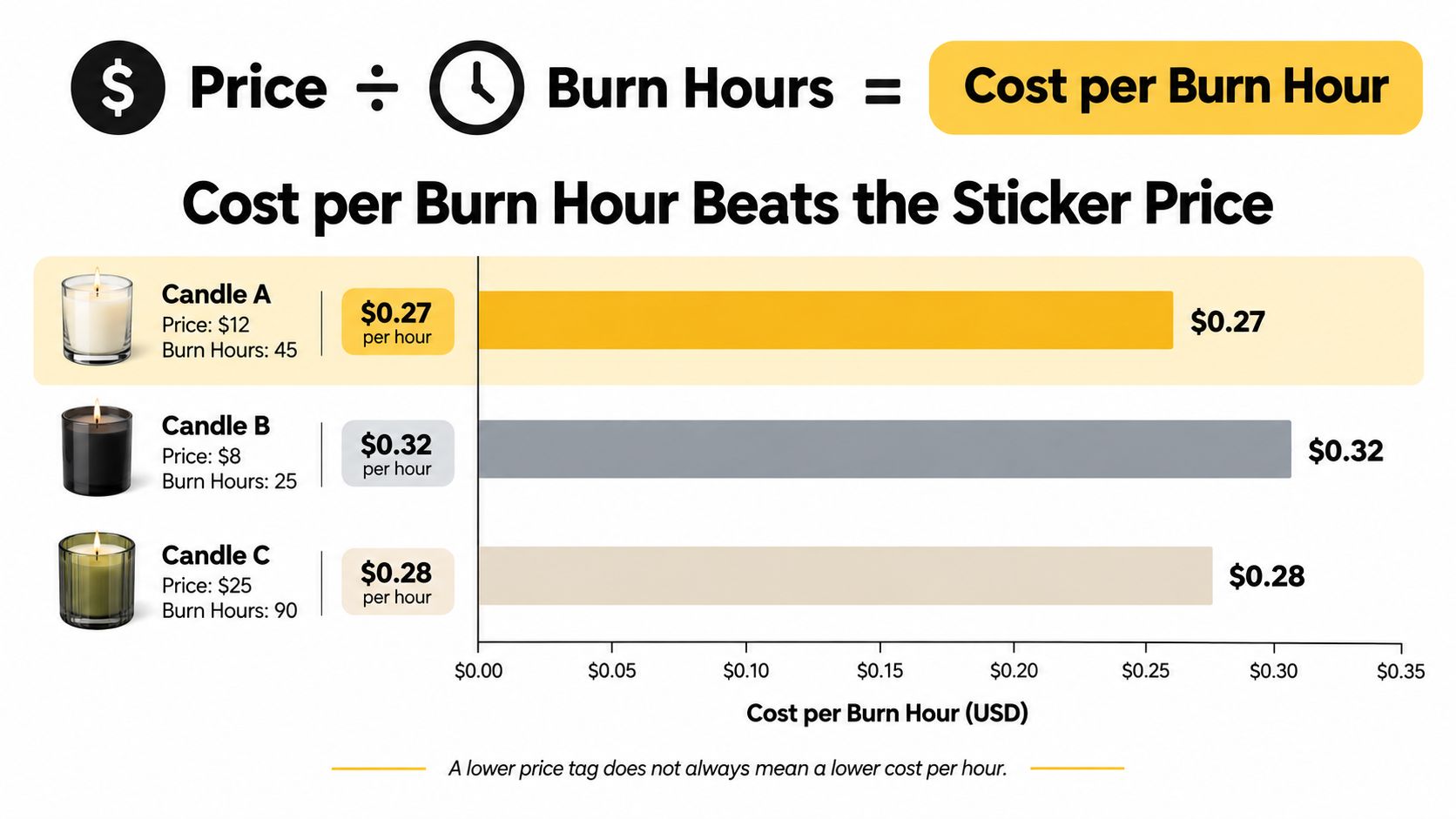
A higher price does not automatically buy more burn time or a cleaner burn. Compare candles using two separate checks: price divided by burn hours equals cost per burn hour, while clean-burn evidence needs to be assessed on its own. The arithmetic is simple. For example, a candle costing $12 with 45 hours of burn time works out to about $0.27 per hour. One costing $22 with 60 hours comes to about $0.37 per hour. In this example, the less expensive candle also costs less per hour.
The chart comparing cost per burn hour across three candles illustrates why the sticker price alone can mislead: a low-priced candle may run out quickly, while a larger jar may provide more usable hours.
Use the following as a blank worksheet, not as market data. Fill in each candle's current price and the burn time stated by its seller, then divide price by hours.
| Candle type and size | Price (USD) | Burn time (hours) | Cost per burn hour (USD) |
|---|---|---|---|
| Budget soy, 8 oz | Enter product price | Enter stated hours | Price ÷ hours |
| Mid-range soy blend, 8 oz | Enter product price | Enter stated hours | Price ÷ hours |
| Premium scented, 8 oz | Enter product price | Enter stated hours | Price ÷ hours |
| Large jar with published burn time, 14 oz | Enter product price | Enter stated hours | Price ÷ hours |
The calculation needs both numbers. Weight alone isn't burn time: wax density, wick consumption, fragrance, and burning habits all affect how long a candle lasts. If a seller does not give an approximate burn time, you cannot compare its cost per hour reliably. Treat the missing information as a drawback when scoring the candle, rather than guessing from the jar's size.
The video below shows a candle burning, making visible how the flame and wax change during use. It does not provide the price or burn-hour figures needed for the calculation.
Price and clean-burn evidence answer different questions. A 2025 independent thesis comparing commercially available candles found that unscented candles generally produced the lowest VOC accumulation in its comparison. It also found differences among scented candles, but the results do not establish a rule for every product.
The thesis is one comparison, not a universal ranking of candles. Formulas and testing conditions vary, so its findings cannot show how every candle will perform in every room. The practical conclusion is narrower: a higher price did not reliably predict lower emissions in that comparison. Likewise, a soy label alone does not establish how cleanly a candle burns. Use price and published burn time to assess value, and look for relevant burn evidence separately.
For a practical purchase, compare the cost per hour using the seller's stated burn time, then weigh any available clean-burn information. Avoid paying extra for packaging unless it brings a benefit you value. If reducing fragrance-related VOC exposure is a priority, consider unscented or lightly scented options. If fragrance matters to you, choose a candle whose scent you can comfortably enjoy throughout a burn session.
Good burning habits cost very little, yet they can decide whether a well-designed candle performs as intended. They also protect the hours you paid for. A candle that tunnels or burns too hot wastes wax, while a controlled flame stretches fragrance across more sessions.
These four habits capture the routine before the detailed steps explain why each one matters.
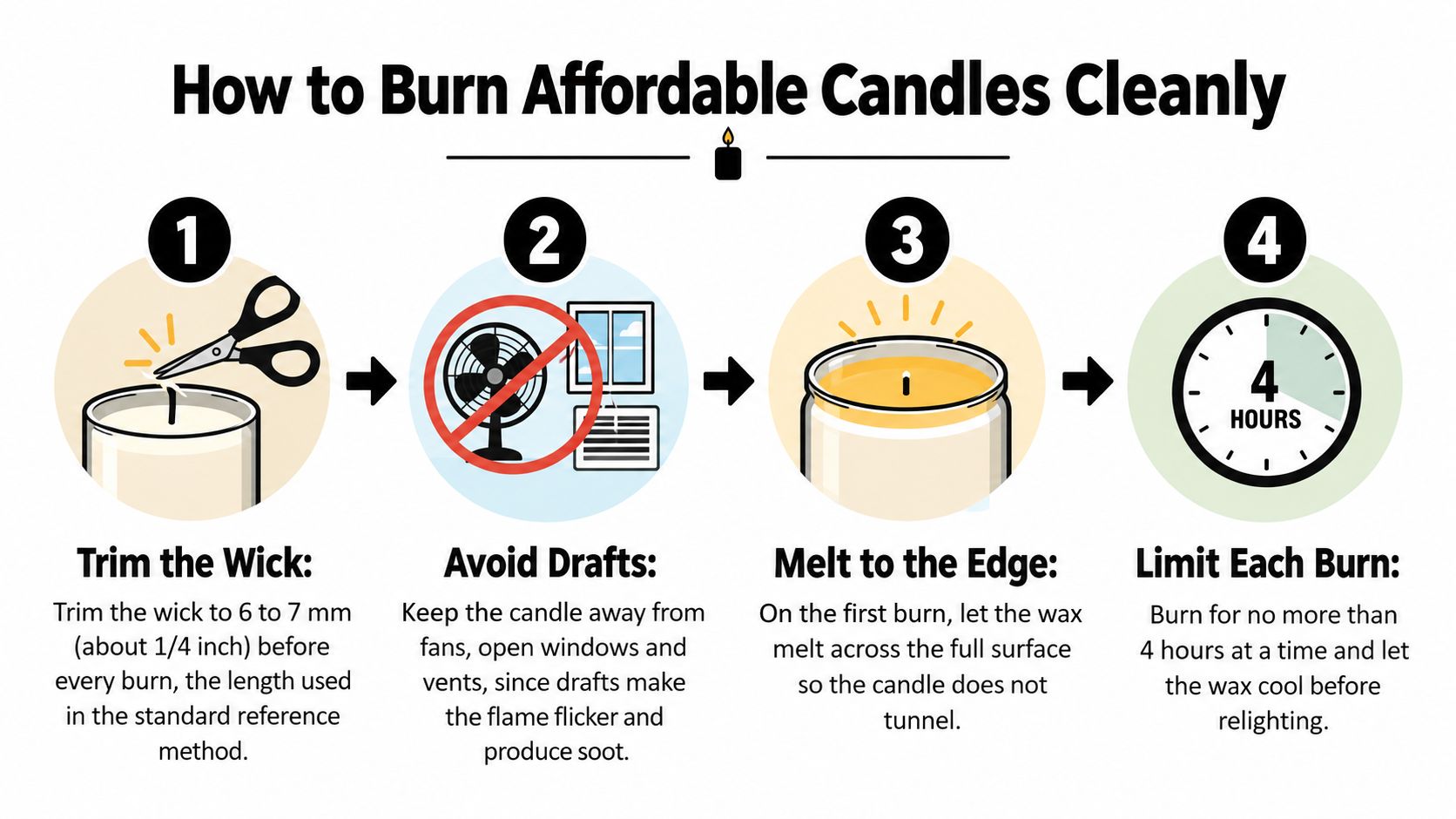
Don't trim as short as possible. A wick cut too aggressively can produce a weak flame, poor fragrance release, and tunneling because the melt pool never gets enough heat. Your target is a repeatable length, not the shortest nub you can create. The step-by-step guidance on how to burn a candle properly is worth checking if your candles repeatedly tunnel or smoke.
A wick trimmer or a pair of scissors is a small purchase. A steadier flame, less soot on the jar, and more usable hours from wax you already bought make it the cheapest burn-quality upgrade available.
These habits cannot rescue every badly designed candle. If the flame still smokes after you've trimmed the wick and removed drafts, the wick may be wrong for the jar or the fragrance formulation may be difficult to burn stably. Record that result, apply it to the scorecard, and don't assume the failure is yours. Affordable clean burning candles should make good performance achievable under ordinary, careful use.
Choose the candle that combines credible clean-burn evidence with the lowest cost per burn hour for the room where it will actually burn. Wax type is one clue, not a verdict. A sticker price shows the upfront cost, while scent strength matters only if it suits the space. Paying more did not reliably mean lower emissions, and a soy label by itself proves little.
For a small bedroom and a $15 budget, compare three options. A soy blend identifies its wax, explains its wick choice, describes its fragrance strength, and publishes burn time. A cheaper paraffin candle promises a strong scent but offers no room guidance or burn hours. A third smells appealing in the store but says little about its wax or testing. The soy blend earns a higher score because it provides more useful details and lets you estimate hourly cost, not just because it is soy.
Use the same questions for Jackpot Candles or any other scented candle: What wick size does it use? What room size is recommended? What is the approximate burn time? Is there evidence behind a minimal-soot claim? A candle's added feature may catch your eye, but its burn performance and usable hours determine whether the price makes sense.
Then follow three steps. List three candidates within your budget. Score each one against the six criteria and calculate cost per burn hour. Choose the highest scorer that fits the room, then use careful burning habits to give its design a fair test.
To compare Jackpot Candles options, check burn time, room fit, and product details before choosing a fragrance. Browse the Jackpot Candles collection and select a candle with clear value for each burn hour.
Comments will be approved before showing up.