
free shipping at $99


Jackpot Candles is a real, operating U.S. company that sells candles and bath bombs with sealed jewelry inserts, but “legit” in the safety and prize-value sense depends on independent evidence rather than brand claims alone. The safest answer is qualified: the business appears genuine, while the quality of the candle, reliability of support, and worth of the jewelry require separate checks.
That distinction matters because a dramatic ring reveal can make three different questions feel like one. Is the product safe to burn or use? Is the seller trustworthy when something goes wrong? Is the hidden jewelry worth what the buyer paid? A positive unboxing video may answer the entertainment question, but it can't settle all three.
The evidence is also uneven. Candle safety has an established research and incident record, while public coverage of Jackpot Candles leaves less clarity around expected jewelry value, prize distribution, and the practical outcome of customer complaints. The most useful approach is to judge the company through three lenses, product safety, brand trustworthiness, and prize value, then verify the details on the current product and policy pages before ordering.
Are Jackpot Candles legit in every sense that matters to a buyer? The available evidence supports a narrower answer. It appears to be a legitimate specialty retailer, rather than an untraceable storefront, selling scented candles and bath bombs with sealed jewelry inserts. Its company information page offers a starting point for checking the business identity and presence.
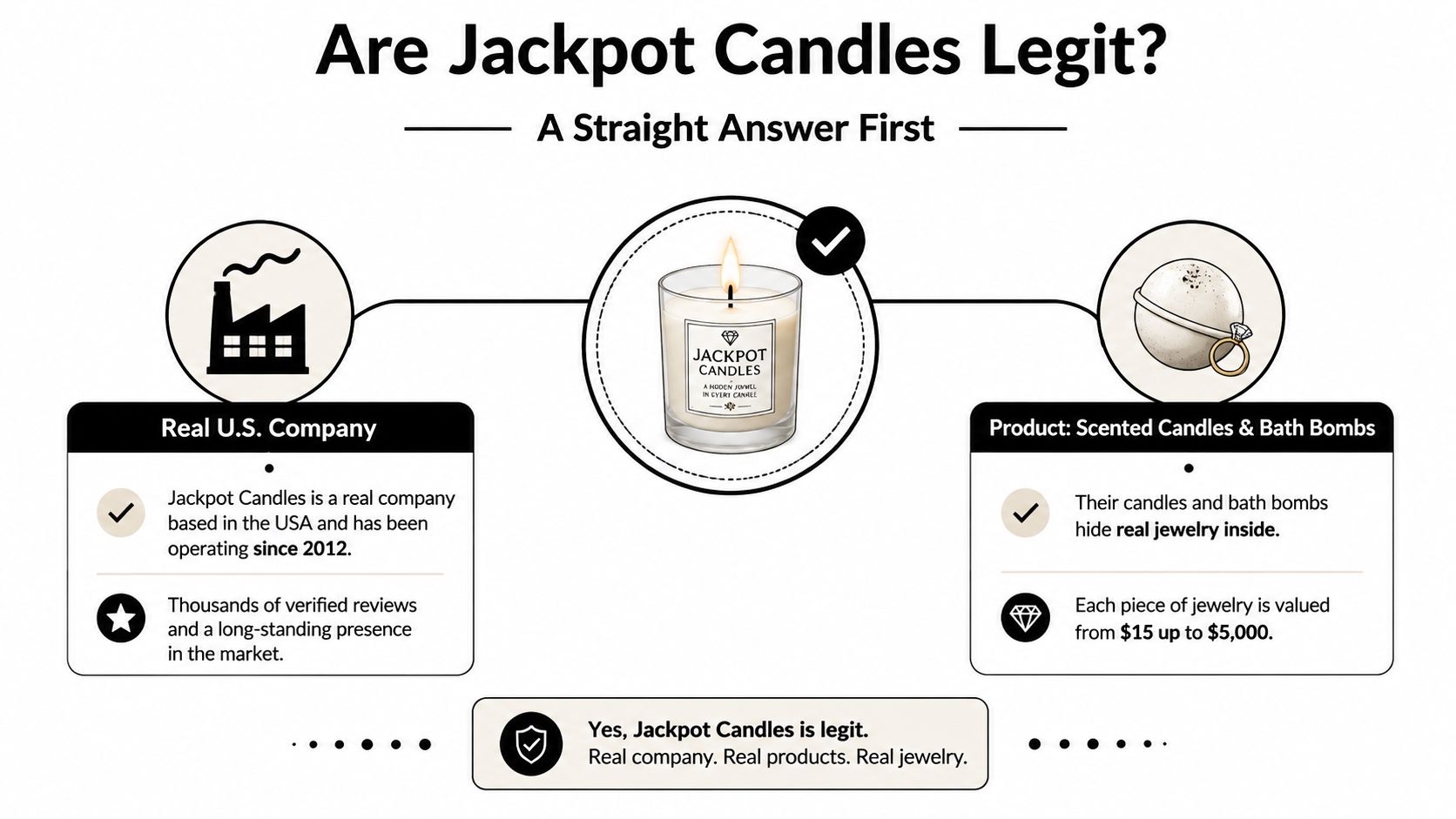
A visible business is not proof of universal satisfaction. A candle may burn poorly, product descriptions may leave jewelry details unclear, and a customer may face delays or limits when seeking help. “Legit” should therefore be tested across three separate questions: Is the product safe to use? Is the brand trustworthy when problems arise? Is the hidden jewelry worth the purchase price?
Product safety comes first. The National Fire Protection Association reports that candles were the heat source for 2% of reported home fires, 2% of home fire deaths, 5% of home fire injuries, and 3% of direct property damage in home fires during 2020-2024. Fire departments responded to an annual average of 5,894 home structure fires involving candles, causing 63 civilian deaths, 532 civilian injuries, and $286 million in property damage each year during that period. Its candle safety guidance points to nearby flammable décor and unattended or misused candles as major contributors. Follow the label, keep the flame attended, and treat the jewelry reveal as a safety step rather than a race.
Brand trust requires records. Check the seller's name, contact methods, return information, replacement terms, and product descriptions. Reviews become more useful when they show repeated patterns about shipping, defects, or support instead of isolated praise or anger.
Prize value needs its own check. A concealed ring can provide novelty without being fine jewelry. Review the material description, any verification option, and exactly what the stated value represents.
The fairest conclusion is qualified. Jackpot Candles appears to be a real seller, while safety, service, and jewelry value still require separate verification before purchase.
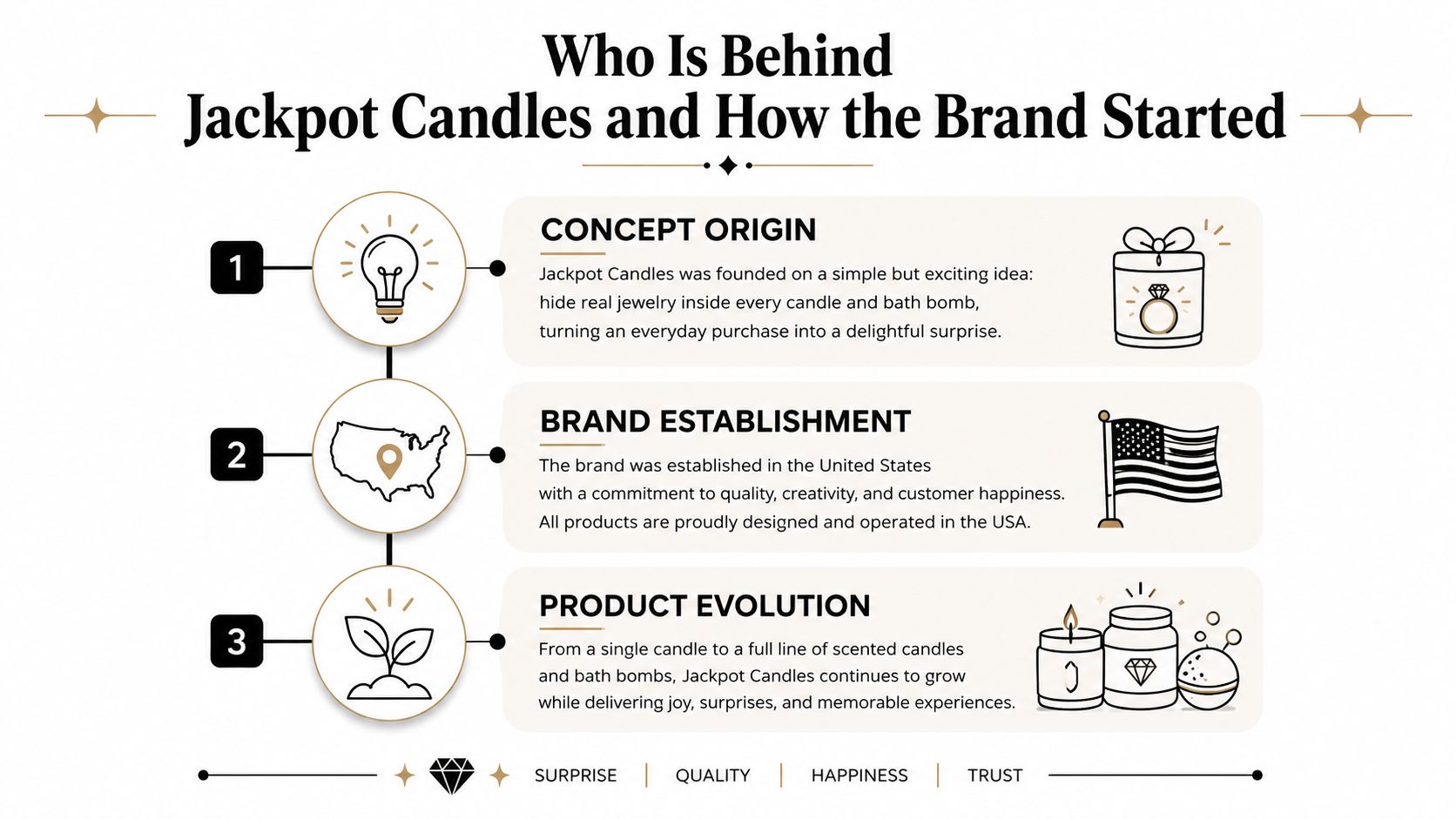
The brand grew around a simple retail idea: make the product's final moment part of the purchase. Instead of selling only fragrance and ambiance, Jackpot Candles places a sealed jewelry item inside a candle or bath bomb. The buyer receives a scent experience, waits for the reveal, and ends with an object that may be worn, inspected, gifted, or questioned.
That model fits the wider shift toward experience-driven e-commerce. Packaging, suspense, social videos, and the reveal itself become part of the product. A customer may remember the moment a pouch surfaced from wax more vividly than the scent description on the label. That emotional component helps explain the brand's appeal, but it shouldn't substitute for ordinary retail checks.
The company presents itself as a U.S.-based online business with products sold through its own website and promoted through digital marketing channels. Its commercial footprint supports the conclusion that shoppers are dealing with an established seller rather than an anonymous payment page. Still, a polished website, affiliate content, or a large social audience doesn't prove that every item matches its description.
The more revealing evidence appears after checkout. Customers need to know who ships the order, where returns go, how missing jewelry is handled, and whether customer service can resolve defects. Review histories should be read as a timeline. A complaint about delivery, a policy revision, or a recurring issue with communication carries more weight when similar reports appear across different periods and platforms.
Verification point: Match the ordering domain, company name, contact details, return address, and policy language before paying.
The brand's origin explains why the product exists. Its present-day reliability depends on whether the company keeps information current and responds consistently when the surprise is damaged, missing, or materially different from the listing. Readers should also distinguish reviews of the candle itself from reviews of the jewelry. A pleasant scent doesn't prove the ring is valuable, and a disappointing ring doesn't automatically prove the wax is unsafe.
That separation protects buyers from two common errors. Enthusiastic creators may focus on the reveal and omit after-sales problems. Angry reviewers may describe a poor outcome without showing whether they followed burn instructions or contacted support. Neither side alone provides a complete audit of the business.
The jewelry shouldn't be loose in molten wax. Jackpot Candles says the item is enclosed in a heat-resistant pouch, then positioned inside the candle during manufacturing. As the wax burns down, the package becomes visible and can be removed after the candle has been extinguished and the exposed area has cooled enough to handle safely.
The exact position can vary by product. A pouch may sit toward the center, closer to the base, or in another designated area. That placement creates an engineering problem: the insert must remain protected without disrupting the wick, vessel, flame, or melting pattern.
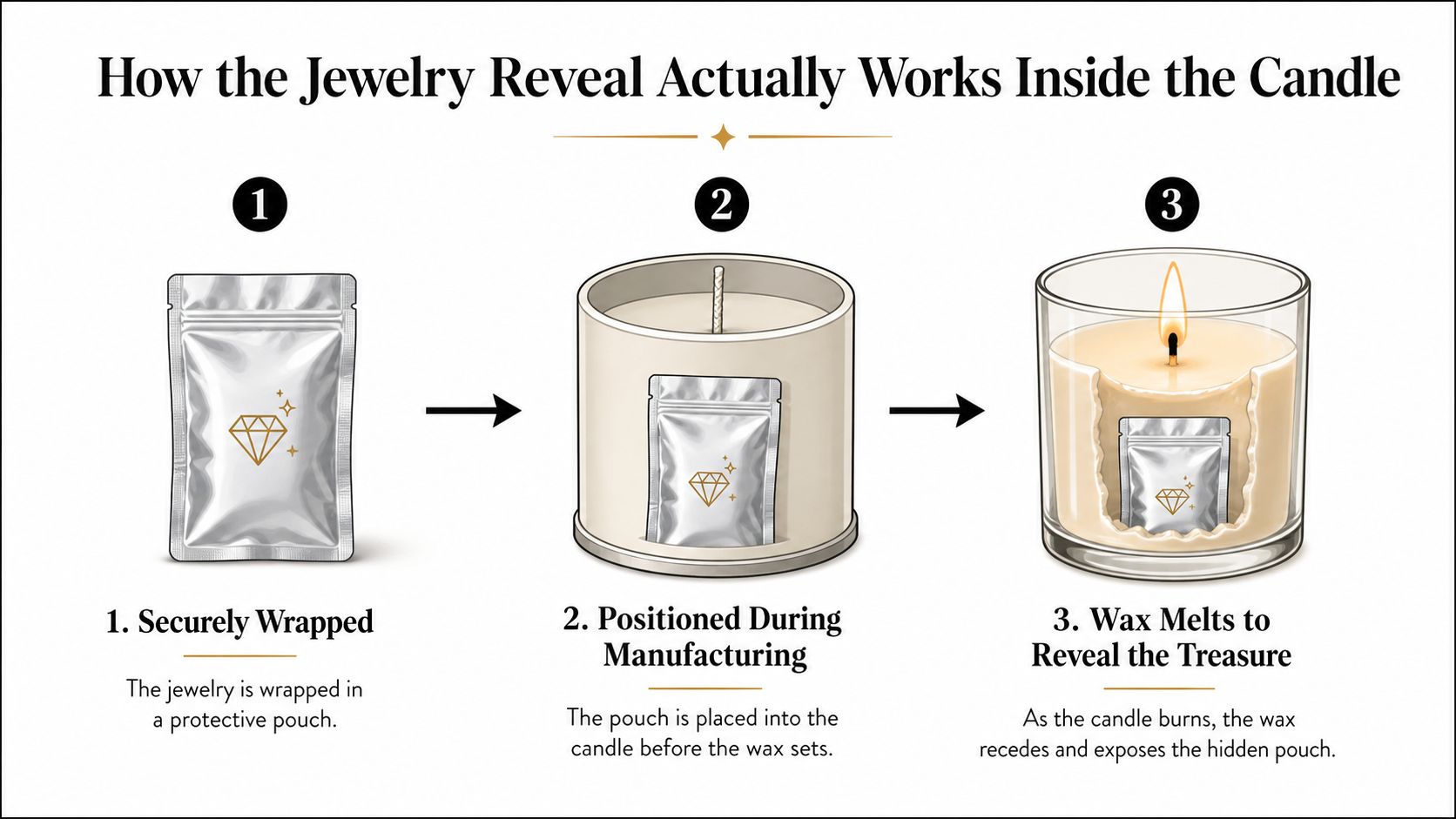
Safety rule: The reveal is part of the manufacturing design, but retrieval still involves hot wax and an open flame. Treat it as a normal container candle until the candle is fully extinguished.
Bath bombs use a different mechanism. The product dissolves in water, revealing a packaged item without the open-flame risk, although users still need to manage moisture, residue, and cleanup. The company's own explanation of the concept is available in its guide to how Jackpot Candles work.
Understanding the assembly process also clarifies what legitimacy means. The jewelry isn't a reward discovered in untouched wax. It's an insert integrated into a manufactured consumer product, so the relevant questions concern sealing, placement, heat behavior, labeling, and retrieval instructions.
Jackpot Candles markets a proprietary soy wax blend and describes its candles as cleaner and longer-lasting than traditional paraffin products. The broad technical premise is plausible, but the claim shouldn't be treated as a guarantee for every candle. Wax formulation, wick size, fragrance concentration, vessel dimensions, and user behavior all affect combustion.
A study of candles made from hydrogenated soybean oil found that paraffin candles produced significant soot, while soy candles produced little or no visible soot under the test conditions. The same research measured 3.2 milligrams of formaldehyde per gram of paraffin from paraffin candles, while soy and beeswax candles did not produce measurable formaldehyde under those conditions. It also found that soy candles burned more slowly when the wick was trimmed. Those findings support meaningful differences between waxes, but they don't eliminate the need for testing a particular blend. The company's explanation of its formulation appears in its guide to soy wax candle safety.
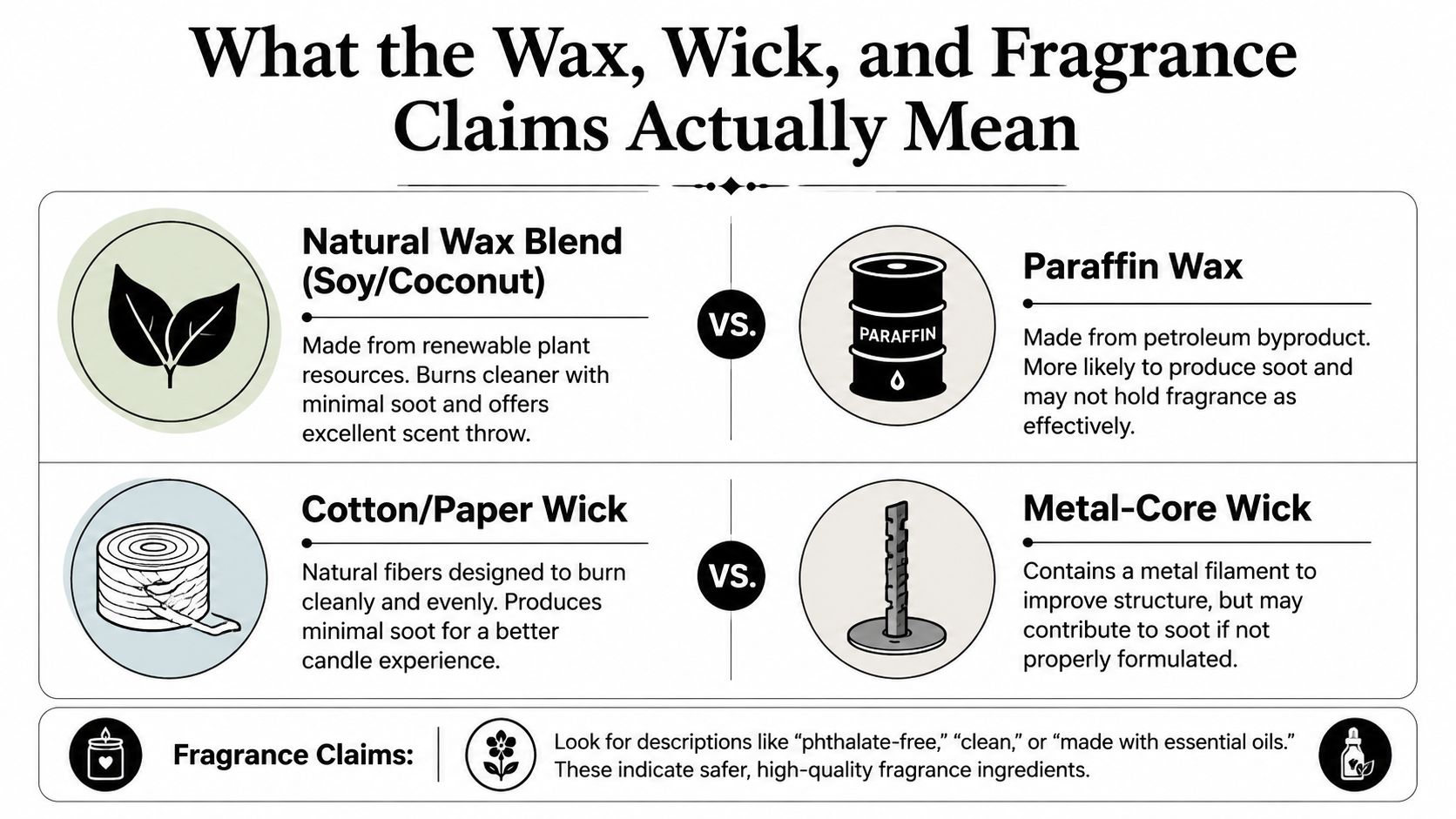
A cotton or cotton-paper wick draws melted wax into the flame. If the wick is too small, the candle may tunnel and leave wax along the sides. If it's too large, the flame may burn aggressively and create excess smoke or heat. Trimming helps maintain steadier combustion, but it can't correct a poor wax-wick match.
Fragrance load matters too. Independent candle-making guidance generally places soy wax around 6% to 10% fragrance by weight, with 6% to 8% often presented as a practical balance between scent throw and burn stability. Exceeding a wax's tested capacity can cause sweating, wick clogging, black smoke, or poor burning rather than producing a stronger aroma. The technical discussion is outlined in this soy wax fragrance-load guide.
Look for a named wax type, wick description, fragrance information, burn instructions, and warnings about the insert. The hidden jewelry should remain sealed and shouldn't interfere with the flame or vessel. ASTM F2601 formalizes safety requirements for candle accessories, and a revised version was published in 2025. The ASTM-related candle accessory guidance provides useful context for judging whether an embedded object has been considered as part of the product design.
A soy blend can be technically credible. That doesn't mean a buyer should accept vague labeling or ignore abnormal smoking, overheating, cracking, or uneven burning.
Customer feedback presents a divided picture, and the division often follows the part of the transaction each reviewer values most. Positive comments tend to focus on the experience: an appealing scent, a satisfying reveal, attractive presentation, or a gift recipient's reaction. Negative comments more often focus on the transaction: delayed communication, shipping problems, weak scent throw, or disappointment with the jewelry.
The available review coverage doesn't provide a dependable, independently verified picture of jewelry economics. The Trustpilot review page for Jackpot Candles shows mixed public sentiment and complaints, while other review aggregators present more favorable feedback but still identify delivery and communication as concerns. That inconsistency doesn't prove either side is right. It means buyers should examine recent, detailed reviews and distinguish product criticism from service criticism.
| Review Theme | Positive Mentions | Negative Mentions |
|---|---|---|
| Fragrance | Pleasant scents and enjoyable home ambiance | Scent can feel weaker than expected |
| Reveal | Fun suspense and satisfying unboxing | Jewelry may feel ordinary or disappointing |
| Shipping | Some buyers report smooth delivery | Others describe delays or communication gaps |
| Customer support | Resolved issues for some customers | Slow responses appear in complaints |
| Jewelry | Surprise value can exceed expectations | Missing, low-value, or poorly described items drive dissatisfaction |
A short video showing a ring emerging from wax demonstrates that the reveal can happen. It doesn't establish the ring's material, retail value, or the likelihood of receiving a similar item. Conversely, one complaint about a disappointing ring doesn't establish that every product contains a problem.
Pay attention to evidence attached to the review. Photos of the pouch, product label, order record, damaged vessel, or jewelry stamp are more useful than a one-line rating. Also check whether the reviewer explains how the candle was burned. A safety complaint carries different implications if the buyer followed the instructions than if the candle was left unattended or burned to its base.
The balanced reading is that the concept produces genuine enjoyment for some buyers, while service and value expectations create friction for others. Reviews support caution, not a categorical finding that the company is fake.
A seller's policies often reveal more about practical legitimacy than its advertising. Jackpot Candles' public materials describe returns and customer-service contact options, but buyers should read the current wording before ordering because eligibility, remedies, and documentation requirements can change.
The central questions are simple. Can you return an unwanted candle, or is the remedy limited to store credit? What happens if the vessel arrives broken? How does the company handle missing jewelry, a damaged pouch, or a product that doesn't match the listing? A “satisfaction guaranteed” message sounds broad, but the operative policy controls what the customer can request.
Keep the order confirmation, packaging, product page, and photographs. Photograph the shipping box before discarding it, then capture the candle, label, pouch, and jewelry from several angles. Don't alter or repair the product before the company has reviewed the claim.
A clear support request should identify the order, describe the problem precisely, and state the remedy sought. “The item was bad” gives a service agent little to investigate. “The package arrived damaged, and the insert was missing from the sealed product” creates a documented sequence.
For general background on how businesses structure return terms, RecurX provides an overview of about refund policy, though customers should rely on Jackpot Candles' current policy for their actual purchase.
A restrictive return process doesn't automatically make a retailer illegitimate. Specialty goods may have hygiene, opened-product, or verification considerations. But buyers should recognize the risk before treating the jewelry as an investment. If a return results in store credit rather than cash, the customer remains tied to the seller. If support requires photographs or verification, preserving the item and packaging becomes important.
The practical standard is transparency. A trustworthy retailer should make the policy easy to locate, explain what happens in common failure scenarios, and provide a usable contact route. Shoppers should save a copy of the terms that applied at checkout, especially when buying a gift or a product with a concealed insert.
This is the least settled part of the legitimacy question. Public reviews often discuss scent, delivery, and the excitement of the reveal, but they rarely establish the expected jewelry value compared with the purchase price. Without clear distribution data, independent appraisals, or a dependable verification process, the buyer can't treat a maximum advertised value as a typical outcome.
“Retail value” also needs careful interpretation. A retail label may describe a suggested selling price rather than what a buyer could receive from a jeweler, pawn shop, resale marketplace, or insurance appraiser. Replacement cost, resale value, precious-metal content, gemstone quality, and brand recognition can all differ.
Check the product listing for the stated materials. A ring described as sterling silver should be evaluated differently from one described as gold, gold-plated, cubic zirconia, or a lab-created stone. Look for hallmarks where appropriate, but remember that a stamp alone isn't conclusive proof. A professional jeweler can test metal composition and assess stones more reliably than a casual visual inspection.
The research supplied for this article doesn't provide verified prize odds, a verified distribution table, or a reliable set of wholesale cost ranges for Jackpot Candles' jewelry. Those missing facts are important. They prevent a responsible calculation of the average prize value.
| Prize Tier | Advertised Retail Value | Typical Materials | Estimated Replacement Cost | Common Findings |
|---|---|---|---|---|
| Entry tier | Confirm on the current product page | Confirm from the listing and item markings | Requires material and professional assessment | Costume or plated jewelry may be possible |
| Mid tier | Confirm on the current product page | Check for sterling silver, plated metal, or stone details | Depends on metal weight and stone identity | A visually attractive item may have modest intrinsic value |
| Higher tier | Confirm on the current product page | Seek documentation for precious metals or gemstones | Requires independent verification | A claim should be supported by appraisal or testing |
| Maximum tier | Treat as a ceiling unless distribution data is disclosed | Confirm with a qualified jeweler | Don't assume stated retail equals resale | Rare outcomes shouldn't define the ordinary purchase |
The novelty can still have legitimate value. A customer buying a gift may be paying for fragrance, packaging, suspense, and a keepsake rather than purchasing jewelry at wholesale cost. That can be a reasonable choice, but it should be described as an experience purchase with uncertain prize value, not as a guaranteed route to fine jewelry.
Before ordering, run the product through a short evidence check. The purpose isn't to eliminate all uncertainty. It's to identify the uncertainty you're accepting.
Product safety: The category is plausible, but the insert and candle must be handled carefully. Candle safety risks are well documented, and a sealed pouch doesn't remove the need for supervision.
Brand legitimacy: Jackpot Candles appears to be a real specialty retailer with an identifiable product concept and online operation. Mixed review signals mean buyers should read current policies and preserve purchase evidence.
Prize value: This remains the weakest documented area. Without transparent prize distribution and independent verification, customers shouldn't assume the jewelry's advertised retail value reflects typical resale or replacement value.
So, are Jackpot Candles legit? Yes as an operating specialty seller, with important qualifications around product handling, service expectations, and jewelry economics. Visit the listing with a clear purpose: buy for the candle-and-reveal experience if that appeals to you, and treat the jewelry's financial value as uncertain unless the product documentation and independent verification support it.
Jackpot Candles offers scented candles and bath bombs with sealed jewelry inserts, combining a standard home-fragrance product with a reveal experience. If you understand the safety, policy, and value trade-offs, visit Jackpot Candles and review the current product details before deciding.
Comments will be approved before showing up.