
free shipping at $99


You've picked a bath bomb that smells lovely, watched the water turn a beautiful color, and settled in for a relaxing soak. Then you climb out with tight, itchy, or blotchy skin. Before you blame every unfamiliar ingredient on the wrapper, turn the package over: the most useful clues are usually in what the label reveals, what it leaves vague, and how the complete formula suits your skin.
After a relaxing soak, tightness, itching, or redness can leave you wondering whether the bath bomb was “toxic.” Those reactions point to different possibilities: irritation, allergy, and poor product suitability are not the same problem. A formula can work well for someone else and still be a poor match for your skin.
A bath works as one complete recipe. Fragrance, cleansing ingredients, water temperature, and soaking time all shape the experience together. Attractive packaging can't tell you how those factors will suit you.
If discomfort follows a bath, keep the wrapper and note what you used before replacing the product. Record whether you'd recently shaved and describe what you felt or saw, such as stinging, tightness, itching, or redness. If reactions recur, these details can help you explain the pattern to a clinician.
Water is another factor to consider separately. For product research, Water Filter Advisor's guide to the best shower filters for hard water offers a starting point. A filter change may not resolve a reaction to a bath bomb, and filtration and water softening are not interchangeable.
Practical rule: Change your shopping criteria before changing your entire bathroom. Begin with a readable ingredient list and look for answers to your specific concerns.
For bath bomb ingredients to avoid, label literacy is more useful than a frightening list. Start by separating a known personal trigger from a name that just sounds unfamiliar. Then consider the finished product and your own experience, rather than judging a single ingredient in isolation. That approach helps you make a more informed choice without treating all chemistry as a warning sign.
Read a bath bomb label like a recipe card. First identify the base, then the additions that provide scent, color, texture, or bubbles. That makes a long ingredient list easier to understand without pretending that every ingredient performs the same job.
The familiar fizzing base combines baking soda, commonly listed as sodium bicarbonate, with citric acid. For a closer explanation of that interaction, the guide to how bath bombs work provides useful background. Other parts of the recipe may include an oil or butter, coloring materials, fragrance, and ingredients intended to create foam.
Use this visual as a category map, not as a required recipe for every product.
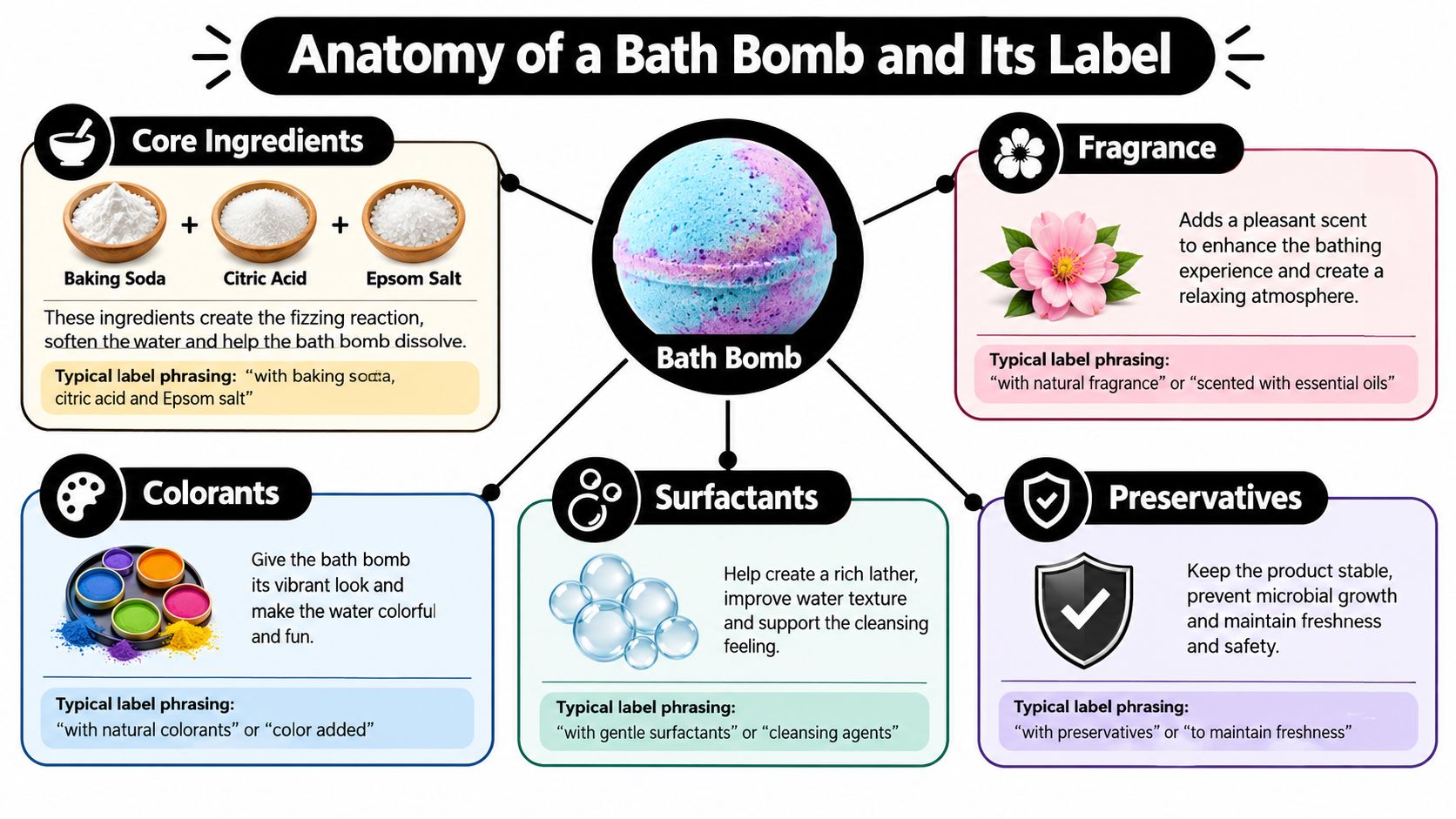
INCI, short for International Nomenclature of Cosmetic Ingredients, is the naming system you'll encounter on cosmetic ingredient declarations. Treat those names as identifiers rather than warnings. A technical-looking name can help you compare products more precisely than a front-label description such as “luxurious botanical blend.”
Build your reading habits around these distinctions:
Ingredient order can help orient your reading, but don't turn position into a safety ranking. You can't calculate your exposure from the list alone, and an allergen doesn't become irrelevant because it appears near the end.
A label is a map, not a safety certificate. Your task is to locate the information that matters to your skin and recognize when you need more detail.
Fragrance deserves close scrutiny, particularly if you've reacted to scented cosmetics before. Allergic contact dermatitis is a delayed immune reaction that can produce itching, redness, swelling, or eczema after exposure. That delay can make it difficult to connect a reaction with an otherwise pleasant bath.
The American Contact Dermatitis Society estimates that approximately 3.5% to 4.5% of adults are allergic to one or more fragrance ingredients, rising to about 20% among people referred for patch testing, as described in its core allergen reference. Those populations aren't interchangeable: people referred for testing already have reasons to suspect a skin allergy.
Replacing perfume with an essential oil doesn't automatically remove the concern. Naturally occurring fragrance compounds can also act as sensitizers. The FDA's guidance on cosmetic allergens supports identifying and avoiding personal triggers rather than relying on “natural” or “botanical” wording.
A useful analogy is a recipe containing an ingredient you're allergic to. Whether that ingredient came from a garden or a factory doesn't answer the question that matters: is your trigger present?
If you're exploring scent options, SEYANTE's introduction to aromatherapy oils can provide context for the terminology. Treat it as scent education, not evidence that an essential oil will suit allergy-prone skin. Likewise, browsing scents for bath bombs is a separate task from establishing ingredient compatibility.
A fragrance description tells you what a product is meant to smell like. An allergen disclosure helps you decide whether it belongs in your bath.
For someone with a known fragrance allergy, vague “parfum” wording leaves an important question unanswered. Ask the manufacturer for the full fragrance-allergen breakdown and compare it with your clinician's avoidance guidance. Strong scent isn't a reliable concentration measurement, but a heavily perfumed product is a sensible place to exercise extra caution.
Don't use earlier symptom-free baths as proof that you'll never react. Instead, use your current allergy history and the current product information to guide the decision.
A bath bomb can color the water and create foam, but those effects come from ingredients with different jobs. Surfactants, color additives, and preservatives deserve separate consideration. Calling them all “bad chemicals” is like judging every tool in a kitchen by the same standard: what matters is what each one does and how the finished formula suits your skin.
Surfactants help lift oils and soil from a surface. Washing an oily dish shows the trade-off: stronger cleansing can remove more than you intended, and skin is not a dish. More bubbles don't automatically mean a better bath.
Sodium lauryl sulfate, or SLS, can be a concern in formulas for sensitive skin. DermNet's explanation of soaps and cleansers describes SLS as more irritating than sodium laureth sulfate, or SLES, and explains that surfactants can cause irritant dermatitis, with redness, dryness, and chafing. SLS and SLES are different ingredients, but seeing SLES on a label alone does not tell you whether the full formula will feel gentle.
If you bathe often, ask whether extra foam adds anything you want. The overall cleansing effect matters alongside warm water, soaking time, and your skin's condition.
Dyes and preservatives can be relevant for people with specific sensitivities. Their presence alone does not make every colored or preserved product unsuitable. Read the declared ingredients against your own known triggers.
ALODERMA's overview of harmful additives in skincare can offer more context, but use it to support your own label reading, not as a universal list of ingredients to avoid. The video below shows these ingredient categories on a product label.
A wrapper covered in flowers can feel reassuring. But “natural” describes an origin story, not your skin's response, and “chemical-free” isn't a useful way to evaluate a formulation. The more practical question is whether the maker identifies what's present.
Consider two hypothetical labels. One says “natural fragrance” without further detail; another provides information you can compare with your diagnosed allergens. The second gives you a better basis for a decision, regardless of which package looks more botanical.
In the United States, “hypoallergenic,” “fragrance-free,” and “for sensitive skin” have no federally governed definitions, according to the FDA's explanation of fragrances in cosmetics. Fragrance ingredients may also appear collectively as “fragrance” rather than as a complete individual breakdown.
Fragrance-free is a more useful target than unscented, provided the maker can explain the formula. Unscented products may use masking fragrance materials to reduce the smell of other ingredients. Ask whether the product contains perfume, essential oils used for scent, or masking fragrance, not whether it smells strong.
European rules offer more specific disclosure requirements. Designated allergens must be listed above 0.001% in leave-on products and 0.01% in rinse-off products; the framework expanded under Regulation (EU) 2023/1545 from the commonly referenced 26 substances to more than 80 allergens or groups, as detailed in the European Commission's fragrance-allergen labeling guidance. The same regulatory history includes the EU bans on Lyral since August 2019 and Lilial since March 2022.
Label-reading reminder: A disclosure threshold tells you when labeling is required. It doesn't promise that a lower concentration will suit someone already sensitized.
Bath bombs generally involve rinse-off exposure, but that classification doesn't make personal allergy information unnecessary. Prefer current, specific ingredient details over sweeping reassurance, and don't treat the absence of a named allergen as proof of absence.
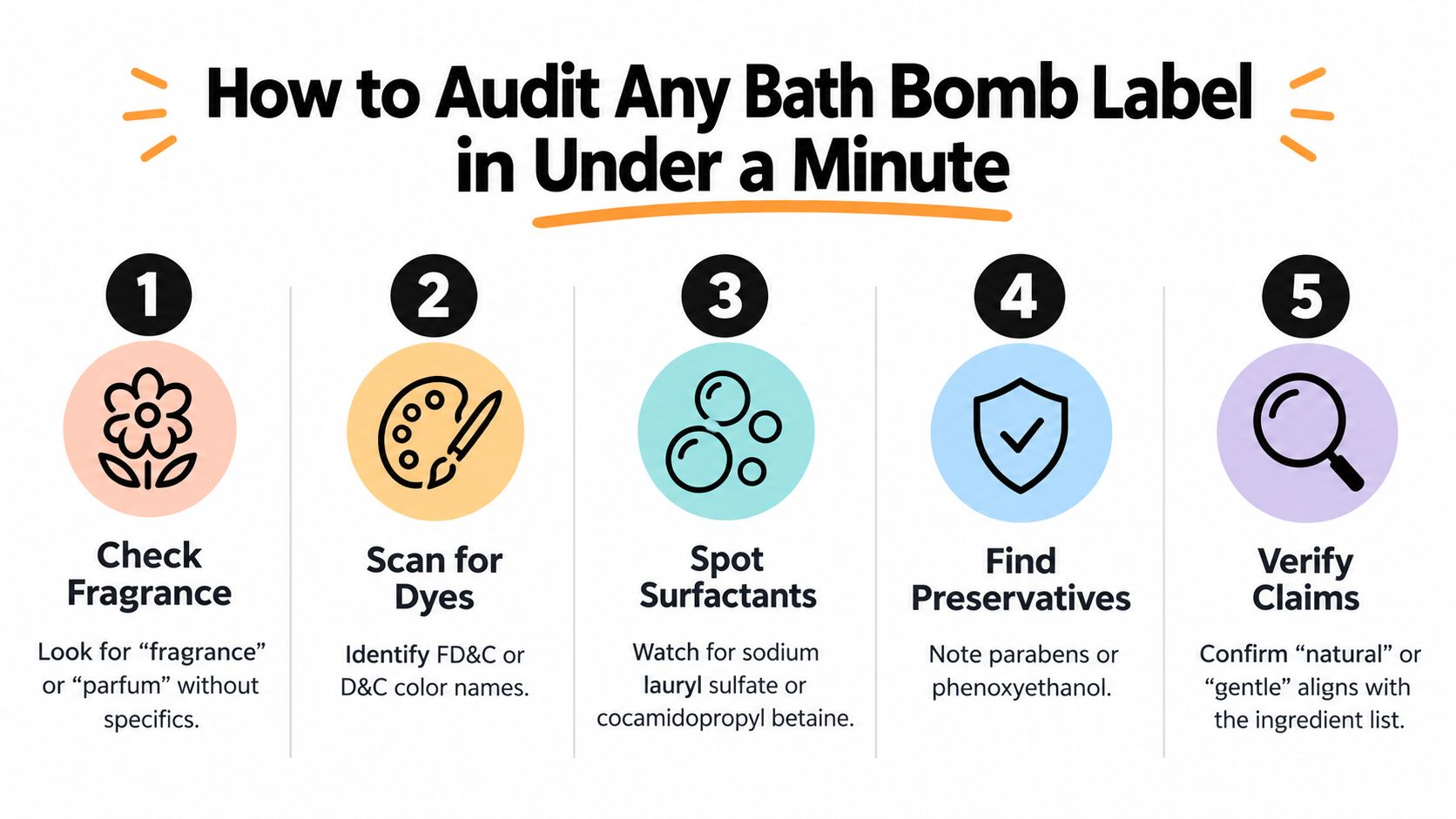
Make your first pass a screening exercise, not a research project. You're deciding whether the label gives you enough information to continue considering the product. An unresolved personal allergy may require more time than the initial scan.
This checklist helps you organize that first look.
U.S. cosmetics generally don't require premarket approval, except for color additives, although companies remain legally responsible for safety, as the FDA explains in its cosmetic-ingredient guidance. Don't interpret availability for sale as individualized reassurance.
Send a focused request: “Please provide the fragrance-allergen information for this product and confirm whether it contains perfume, essential oils used for scent, or masking fragrance.” Add your diagnosed allergen names if you have them. If the response doesn't resolve your concern, choose another product rather than filling the gap with assumptions.
For jewelry-surprise bath products, also ask whether the jewelry, coating, or packaging can contact skin or remain in the water. Check how the item is separated, recovered, and handled according to the product instructions.
Clinician-led patch testing is the appropriate route for investigating suspected allergic contact dermatitis. It isn't equivalent to casually trying a product on a small patch of skin, and a symptom-free home trial can't certify that a full soak will be suitable.
The most useful substitute sometimes isn't another ingredient. It's removing an optional function: fragrance you don't need, color you don't value, or foam that leaves you uncomfortable. That approach avoids replacing one poorly understood formula with another.
A swap table should therefore be a decision aid, not a set of guaranteed-safe substitutions. The following options reduce uncertainty or remove a flagged feature; their suitability still depends on the finished product and your sensitivities.
| Flagged Ingredient | What It Does | Common Concern | Gentler Alternative |
|---|---|---|---|
| Undisclosed fragrance or parfum | Provides scent | You can't reliably compare the mixture with personal allergens | A verified fragrance-free formula, or fuller disclosure that resolves your concern |
| SLS | Provides cleansing and foam | Irritation and excessive oil removal | A non-foaming formula, or a lower-irritancy surfactant system evaluated in the finished product |
| A colorant you're allergic to | Colors the bath | Exposure to a recognized trigger | A formula without that colorant, ideally without optional coloring |
| A preservative you're allergic to | Serves the product's preservation needs | Exposure to your diagnosed allergen | A properly formulated product using a different system compatible with your avoidance list |
A coconut-derived surfactant isn't automatically suitable because its origin sounds familiar. Mineral coloring isn't a universal allergy solution, and changing a preservative to phenoxyethanol or another system doesn't establish superiority by name alone. Ask what evidence supports the complete formula, rather than accepting an ingredient swap as proof.
For formulators, useful questions include whether the finished product has undergone appropriate compatibility assessment and human repeat-insult patch testing. For shoppers, the practical version is simpler: ask whether the maker has evaluated the product for its intended use and can explain any sensitive-skin claim.
The base deserves the same measured thinking. Don't condemn citric acid because its name includes “acid,” or assume baking soda guarantees gentleness because it's familiar. A fizzing reaction doesn't establish how the final bathwater will suit your skin.
If you're interested in choosing your own recipe, review this guide to making bath bombs. Keep optional additions purposeful, and don't confuse a short homemade ingredient list with a tested finished product.
A confident routine begins before you turn on the tap. Choose products using the same priorities each time: relevant ingredient information, compatibility with known sensitivities, and clear instructions. You don't need to investigate every cosmetic ingredient equally.
Give your current skin condition priority over your planned bath. Damaged, eczematous, or recently shaved skin calls for particular caution with fragrance and cleansing ingredients. If your skin is already uncomfortable, postponing a new bath product is a reasonable choice.
When you introduce a product, avoid adding several other unfamiliar bath products at the same time. Keep the packaging and notice how your skin feels afterward. If discomfort develops, stop using the product rather than repeatedly testing your tolerance.
Remember the distinction between observation and medical testing. A small home trial may help you notice immediate discomfort, but it doesn't establish that you're free of fragrance allergy or that prolonged exposure will be comfortable.
Ingredient rules and formulations can change, so check the package you're buying rather than relying indefinitely on an old favorite's reputation. Your most reliable habit is calm skepticism: neither fear every technical name nor trust every botanical claim.
Judge the finished product, not an isolated ingredient. For your next soak, choose the bath bomb whose label answers your questions, not the one whose scent catches your attention.
Jackpot Candles offers scented candles and bath bombs with a surprise piece of jewelry inside. Visit Jackpot Candles to explore the options, and review the bath bomb's ingredient information and jewelry-recovery instructions before choosing one for your routine.
Comments will be approved before showing up.