
free shipping at $99


The very best long lasting scented candles almost always have a few things in common: natural waxes like soy or coconut, high-quality fragrance oils, and a little bit of proper care. It’s this combination of elements that creates that rich, room-filling aroma that sticks around instead of fading away after an hour.

Have you ever brought home a beautiful new candle, lit it, and felt that wave of disappointment as its amazing scent just... vanishes? It’s a super common problem that can make you wonder if a truly persistent fragrance is just a myth.
This guide is here to help you look past the pretty packaging and big brand names to see what really gives a candle its staying power. My goal is to give you the insider knowledge to turn every candle you buy into a great investment for your home's atmosphere.
We’re going to get into all the key pieces that create an amazing sensory experience, from the science behind how a scent fills a room to the simple care tricks that can practically double your candle's life. Think of this as your roadmap to picking candles that deliver both stunning aromas and incredible longevity.
The search for a scent that lasts is more than just a personal preference—it's driving a huge industry. The global scented candle market is expected to hit around $4.36 billion by 2025, mostly because we're all looking for ways to boost wellness and create a cozy vibe at home.
This has pushed candle makers to really focus on quality, sparking a big shift toward eco-friendly waxes like soy and coconut that are known for burning longer and cleaner.
Choosing a long-lasting candle is about understanding its anatomy. It’s not just wax and a wick; it's a carefully balanced system where the wax type, fragrance oil concentration, and wick size work together to create a slow, steady, and fragrant burn.
This guide breaks down everything you need to know to find the best long lasting scented candles. We’ll walk through a few key areas to build up your candle smarts:
Beyond just candles, getting a feel for different home fragrance options can give you a bigger picture of how to create an inviting atmosphere. By the time you finish this guide, you’ll be able to spot a high-quality, long-lasting candle before you even light it.
Have you ever lit a new candle, excited for a wave of beautiful fragrance, only for the scent to disappear in a flash? It’s a common frustration. But why does one candle fill your home with a rich aroma for hours, while another barely makes an impression? The secret isn’t magic—it’s a fascinating bit of science called scent throw.
Think of your candle as a tiny, heat-powered diffuser. When you light the wick, the flame melts the surrounding wax, creating a liquid pool. This melt pool is the engine that drives the scent, releasing fragrance molecules into the air as it heats up. The size and temperature of this pool are everything when it comes to how much aroma you actually get.
A good candle is designed to create a stable, even melt pool that reaches the edges of the container. This prevents a nasty problem called tunneling, where the wick burns straight down the middle, leaving a thick wall of unmelted wax behind. When a candle tunnels, all that precious scented wax along the sides goes to waste, and the candle's aromatic life gets cut dramatically short.
Scent throw actually comes in two different forms, and understanding both will make you a much smarter candle shopper. It’s all about how a candle smells before you light it versus after.
A candle can smell amazing unlit but have a disappointing hot throw. This is the difference between a candle that just looks pretty and one that truly creates an atmosphere. The right balance of wax, fragrance oil, and wick size is what creates that powerful, room-filling hot throw we all want.
Just like your favorite perfume, a candle’s scent is built in layers, or "notes." These different scent components evaporate at different speeds, creating a fragrance that evolves over time and has real staying power.
A candle's scent profile is a symphony of top, middle, and base notes. The longevity of the fragrance you perceive is often determined by the strength and quality of its base notes, which are the last to evaporate and linger the longest.
Here’s a simple way to think about it:
Many of the same principles for maximizing fragrance longevity in perfumery apply to candles, too. A candle loaded with deep base notes is built to last, ensuring its beautiful aroma sticks around.
The single most important ingredient in any candle isn’t the fragrance—it’s the wax. Think of the wax as the engine that powers your entire scent experience. Just like the engine in a car determines how far and how fast it can go, the type of wax in your candle dictates how long it will burn and how well it throws its beautiful aroma into your room.
Different waxes have completely different personalities. Some burn hot and fast, releasing a powerful but short-lived burst of fragrance. Others are slow-burners, offering a more mellow and consistent scent that lasts for hours and hours. Knowing the difference is what separates a candle connoisseur from a casual buyer.
Once you understand what you're looking for, you can read a candle label like a pro. That "soy wax blend" on the sticker will mean something more—it'll tell you about the candle's potential burn time, scent strength, and even its environmental footprint.
For the longest time, paraffin wax was the king of the candle world. It's a byproduct of petroleum, it's cheap, and it holds fragrance pretty well. The downside? Paraffin tends to have a higher melting point, which means it burns hotter and, consequently, much faster.
This is where natural waxes have completely changed the game. Waxes made from soy, coconut, and beeswax have become incredibly popular, and for good reason. They generally have a lower melting point, which means the wax melts at a cooler temperature. The result is a much slower, more even burn. Slower burn equals a longer-lasting candle, simple as that. You get way more bang for your buck.
A candle's burn time is directly tied to its wax's melting point. Natural waxes like soy melt at lower temperatures, slowing down how quickly the wick uses up the fuel. This not only extends the candle's life but also ensures a steadier, more consistent release of fragrance.
To see what this really looks like in practice, take a look at the average burn times for some of the most common waxes out there.
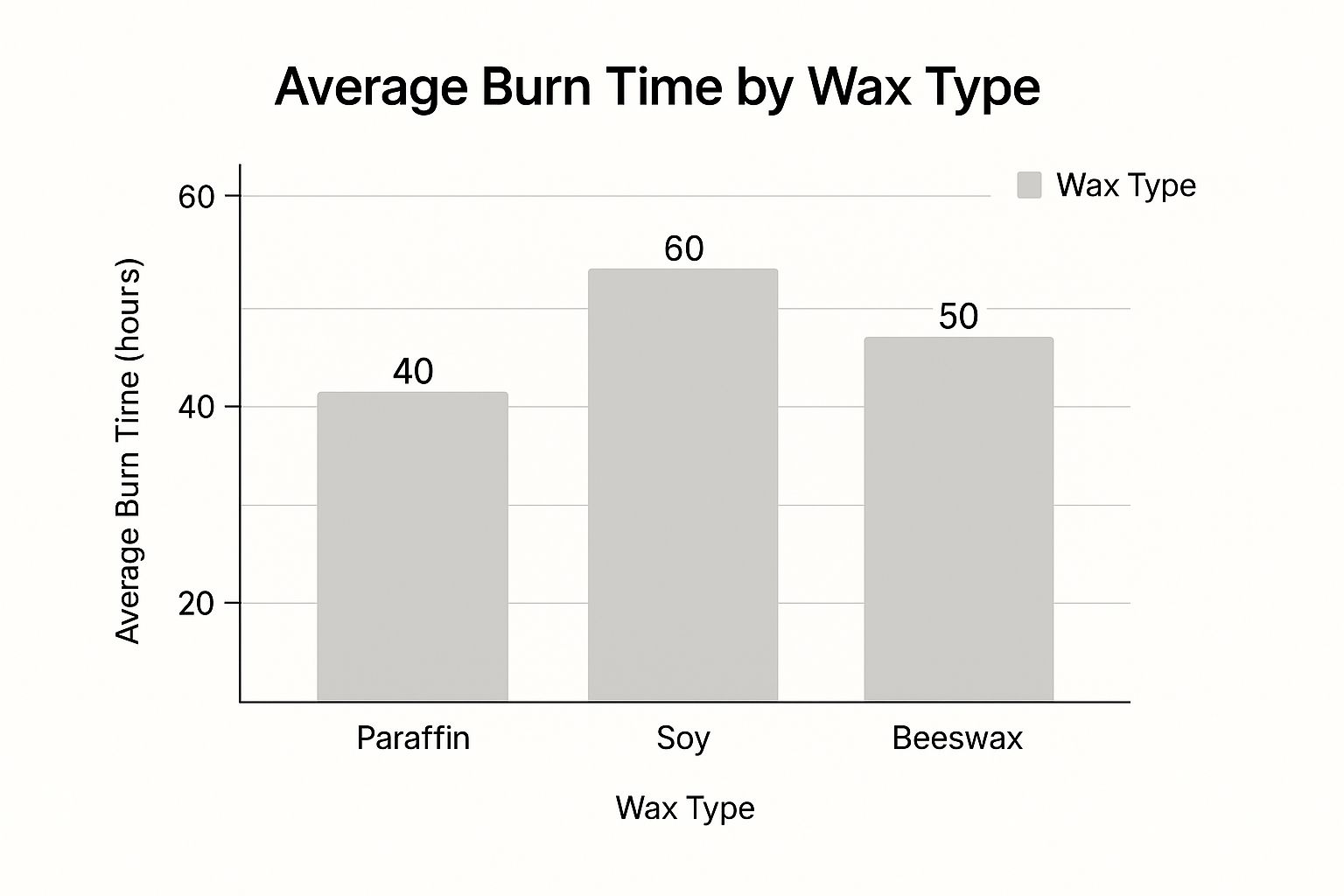
As you can see, a natural wax like soy can give you up to 50% more burn time than a paraffin candle of the exact same size. That’s a huge difference and a major reason why natural waxes are a smarter choice for longevity.
To really zero in on your perfect candle, it helps to get to know the key players. Let's break down the most popular options you'll find on the market. If you want to go even deeper, our guide on the best wax for scented candles has tons more detail.
Below is a quick comparison to help you understand the unique perks of each wax type.
| Wax Type | Average Burn Time | Scent Throw Strength | Environmental Impact | Best For |
|---|---|---|---|---|
| Soy Wax | High | Excellent | Renewable, Biodegradable | Long-lasting, clean-burning candles with strong scents. |
| Coconut Wax | Very High | Superior | Sustainable | Luxurious, slow-burning candles with a powerful fragrance. |
| Beeswax | Highest | Moderate | Natural, Air-Purifying | Extremely long burn times and a naturally sweet aroma. |
| Paraffin Wax | Low | Strong | Petroleum Byproduct | Budget candles where burn time is less of a priority. |
Each wax has its own unique charm and purpose, making the choice a matter of personal preference and priority.
If you think of wax as the foundation of a long-lasting candle, then the wick and fragrance oils are the dynamic duo that really brings the magic. The wick is like the engine, controlling how fast the wax is used, while the fragrance oils are the high-octane fuel powering that amazing scent experience.
Getting this combination just right is a delicate art. A wick that’s too big for its jar will create a huge flame, burning through your beautiful candle way too fast. But if the wick is too small, it won't be strong enough to melt the wax all the way across, leading to that frustrating "tunneling" effect where good scented wax gets stuck to the sides.
Let’s stick with that car analogy for a second. A candle’s wick is the engine, and its job is to pull melted wax (the fuel) up to the flame at a steady, controlled pace. A good engine gives you a smooth ride and great gas mileage; a good wick gives you a beautiful, even flame and the longest possible burn time.
This is why the wick material and size have to be perfectly matched to the wax and the container. It's this level of detail that makes the best long lasting scented candles perform so well.
When a wick is sized correctly, the melt pool will reach the edges of the jar within the first couple of hours. This is key because it sets up an even surface for every burn that follows, making sure you get to enjoy every last drop of scented wax.
So the wick sets the pace, but the fragrance oils? They determine the power and personality of the scent. The quality and concentration of these oils are what separates a weak, barely-there smell from a rich fragrance that fills the room and lasts.
High-quality candles use complex, perfume-grade oils designed to mix perfectly with the wax and release their aroma slowly and steadily as the candle burns. A higher "fragrance load"—the percentage of oil in the wax—means a stronger scent throw. Most premium candles have a fragrance load somewhere between 6% and 12%.
The real test of a candle's scent isn't just how strong it is when you first light it. It's about the quality of the fragrance and its ability to linger in a room long after you've blown out the flame.
It's a competitive world out there for candle makers, and the top brands know that amazing ingredients are what keep customers happy. Big names like Yankee Candle, Bath & Body Works, and Diptyque make up about 55% of the global market by investing in premium fragrance oils and smart designs, like multi-wick candles that burn more evenly and smell even stronger.
Just like in your favorite perfume, the structure of a candle's fragrance is a huge deal. Scents built on heavy base notes are chemically designed to stick around longer because their larger molecules evaporate much more slowly than light, airy top notes.
For a scent that truly has staying power, look for candles with these kinds of robust base notes:
When you light a candle rich in these notes, you're not just getting an immediate burst of aroma. You're building a foundation of scent that will gently perfume your space for hours, creating that lasting, cozy ambiance that is the signature of a truly exceptional candle.
Getting your hands on one of the best long-lasting scented candles is a great start, but how you treat it at home makes all the difference. Proper care is the secret that determines whether you get 30 hours of beautiful fragrance or 60. It’s not complicated, but a few simple habits will protect your investment and unlock the full potential of your candle's scent and lifespan.
Think of a quality candle as a finely tuned instrument. Without a little care, it just can't perform at its peak. Nailing down a few key habits ensures every single burn is as clean, fragrant, and long-lasting as the very first one.
That very first time you light up a new candle? It's the most critical moment in its entire life. This initial burn sets the "memory" for the wax, creating a blueprint for how it will melt every time after. Mess this up, and you'll end up with tunneling—that frustrating issue where the wick burns straight down the middle, leaving a thick wall of unused wax clinging to the sides.
To get it right, you have to let the candle burn long enough for the melted wax to reach the entire edge of the jar. This takes a bit of patience, usually about one hour for every inch of the candle’s diameter. For a standard 3-inch candle, you'll want to set aside a solid 3-hour burn time.
The first burn is your one chance to establish a full, even melt pool. This 'wax memory' prevents tunneling and ensures that all the scented wax is consumed over the candle's life, rather than being left behind on the walls of the jar.
Once that memory is set, the candle will follow the same pattern, melting evenly and efficiently every time. This single step can dramatically boost your candle's total burn time.
If the first burn is the foundation, then trimming the wick is the most important piece of ongoing maintenance. Before every single burn, you should trim the wick down to about 1/4 of an inch. When a wick is too long, it creates a large, flickering flame that spits out soot and burns through your precious wax way too quickly.
A trimmed wick gives you a smaller, calmer, more controlled flame. This steady flame consumes the wax much more slowly and cleanly, giving you a better burn and a significantly longer life for your candle. You don't need fancy tools—a dedicated wick trimmer, nail clippers, or even a sharp pair of scissors will do the trick.
This small step makes a huge difference:
Even after that crucial first burn, you need to keep an eye on how long you let your candle burn each time. As a general rule, never let a candle burn for more than four hours at a time. Any longer, and the wick can become unstable, creating a large, potentially dangerous flame.
Plus, an overheated jar can become a safety hazard. All that extra heat can also cause the fragrance oils to burn off too quickly, which dulls the scent you love so much. For more pro advice, check out our complete guide to candle burning tips that covers this in more detail. Sticking to a 2-4 hour window keeps everything balanced, safe, and smelling fantastic.
Believe it or not, how you put out your candle actually matters. Just blowing it out can splash hot wax everywhere and fill the room with a plume of smoke, instantly ruining the beautiful fragrance you were just enjoying.
To keep the scent pure and your wax clean, reach for a wick dipper or a candle snuffer. A wick dipper is a neat little tool you use to gently push the lit wick into the melted wax, which extinguishes it without any smoke. A snuffer is that classic bell-shaped tool that you place over the flame to cut off its oxygen. Both methods get the job done without the smoke and soot, leaving your candle ready for its next clean burn.
Even after you get the basics down, you might still have a few questions about getting the most out of your scented candles. That's totally normal! This section tackles some of the most common things people wonder about when they're trying to perfect their fragrance experience. Think of it as your go-to guide for any little issues that pop up.
We’ll walk through some practical problems and clear up the finer points of what makes a great candle. The goal here is to help you feel confident enough to pick out and care for your candles like a total pro, making sure every single burn is as amazing as the first.
It's one of the most frustrating things: you've had a candle going for an hour, but that beautiful scent seems to have just... disappeared. Before you get mad at the candle, the most likely reason is something called olfactory fatigue, or "nose blindness." Basically, your scent receptors just got used to the aroma and decided to tune it out for a bit.
Luckily, there's an easy fix. All you need to do is step out of the room for about 15-20 minutes. When you come back, your senses will have hit the reset button, and you should be able to smell that lovely fragrance all over again.
If that little trick doesn't work, here are a couple of other things that might be going on:
While a high price tag isn't always a perfect guarantee, it often points to higher-quality ingredients that create a better, longer-lasting experience. Pricier candles are usually an investment in craftsmanship, using premium stuff that cheaper candles tend to skip.
A more expensive candle often means the maker has used better natural waxes like soy or coconut blends that burn slower and cleaner. It also usually means they've put in a higher percentage of complex, perfume-quality fragrance oils and spent a lot of time testing to get the wick and wax ratio just right. This all adds up to a clean, even burn that lets you enjoy every last drop of scented wax.
You can definitely find some great affordable candles out there, but a premium price usually means the candle was made with top-notch materials designed for a stronger, longer-lasting scent. It’s an investment in a better fragrance experience from start to finish.
It seems simple, right? The more wax, the longer the burn. A 12 oz candle will naturally last longer than a 6 oz one. But the candle's shape and design actually play a huge part in its performance and lifespan, too.
The width of the candle is a big deal. A wider jar often needs more than one wick to make sure the wax melts evenly across the whole surface and doesn't "tunnel" down the middle. Multi-wick candles are amazing for filling a big room with scent, but they also burn through wax much faster than a single-wick candle of the same size.
On the flip side, a tall, skinny pillar-style candle can burn for a very long time, but you have to watch it more carefully. You need to make sure it gets an even melt pool every time you light it to avoid wasting all that wax along the sides.
Curing is a super important step that happens behind the scenes in candle making, and it makes a huge difference in how your candle smells. It's the time after the hot wax and fragrance oil have been poured when the candle is left to sit and cool. This lets the fragrance molecules mix and bind with the wax perfectly.
This is especially crucial for natural waxes. A soy wax candle, for instance, can take up to two weeks to cure the right way. A candle that has been cured properly will give you a much stronger, more consistent scent from the very first time you light it until the very end.
When you buy a high-quality candle, it comes to you fully cured and ready to light. This invisible step is a major reason why some candles smell rich and amazing their whole life, while others fizzle out fast. It’s a sign that the maker really cares about creating a top-tier product.
Ready to experience the difference that quality craftsmanship makes? Discover your next favorite scent with Jackpot Candles, where every premium soy wax candle not only offers a long-lasting, beautiful fragrance but also holds a surprise piece of jewelry inside. Explore our collection and find your hidden gem today.
Comments will be approved before showing up.