
free shipping at $99


You've lit a scented candle, settled into a quiet evening, and noticed a small foil packet appearing through the melting wax. The fragrance is filling the room, but your attention has shifted to the hidden surprise. Inside may be a ring, yet the quality of the experience depends on more than the reveal. The wax, wick, fragrance, container, capsule, and jewelry all need to work together.
A candle with surprise ring inside combines an established home-fragrance product with a gift experience built around anticipation. Candles have a documented history of more than 5,000 years, while rings and other jewelry have been found in ancient Egyptian tombs and in the Indus Valley civilization, where jewelry objects date to the 3rd millennium BCE. The history of candles and the history of rings) help explain why this pairing feels familiar and meaningful even though the hidden-jewelry format is modern.
The enjoyable version of this product gives you a candle worth burning and a ring worth examining afterward. The disappointing version treats the candle as little more than packaging for an unclear novelty item. The difference comes down to reveal mechanics, burn performance, safety information, and honest expectations about jewelry value.
The appeal starts before the wick is lit. A well-presented candle invites you to inspect the jar, read the scent description, and wonder what might be sealed inside. You may buy one as a birthday gift, place it in a care package, or keep it for an evening when you want a small ritual with an uncertain outcome.

The usual format is straightforward. A scented candle contains a ring or another jewelry piece inside a protective, heat-resistant foil capsule. As the wax melts, the capsule becomes visible, and you retrieve it before opening the wrapping to discover the jewelry. The experience combines a familiar sensory product, fragrance, warm light, and a reveal that feels closer to opening a gift than finishing a candle.
That emotional combination makes the format suitable for several occasions:
The useful expectation: The surprise should add to the candle, not excuse poor candle quality.
That principle matters because the jewelry is unknown at the point of purchase. You can control whether the scent suits the recipient, whether the container looks giftable, and whether the manufacturer explains the wax and safety practices. You can't fully control personal taste in the ring, but transparent product information can reduce the risk of an unpleasant surprise.
A thoughtful buyer should therefore judge two products at once. First, ask whether you'd enjoy the candle if the ring were modest fashion jewelry. Then check how clearly the company explains the ring range, the protective capsule, and safe retrieval. The following details will help you understand what happens after lighting and how to assess the result.
Most surprise ring candles follow a simple sequence, but the timing and placement of the capsule can vary by product. The jewelry is generally placed inside a sealed foil pouch or capsule designed to protect it from direct contact with melted wax and flame. It sits below the surface, so the candle can look and burn like an ordinary scented candle until the wax pool reaches it.
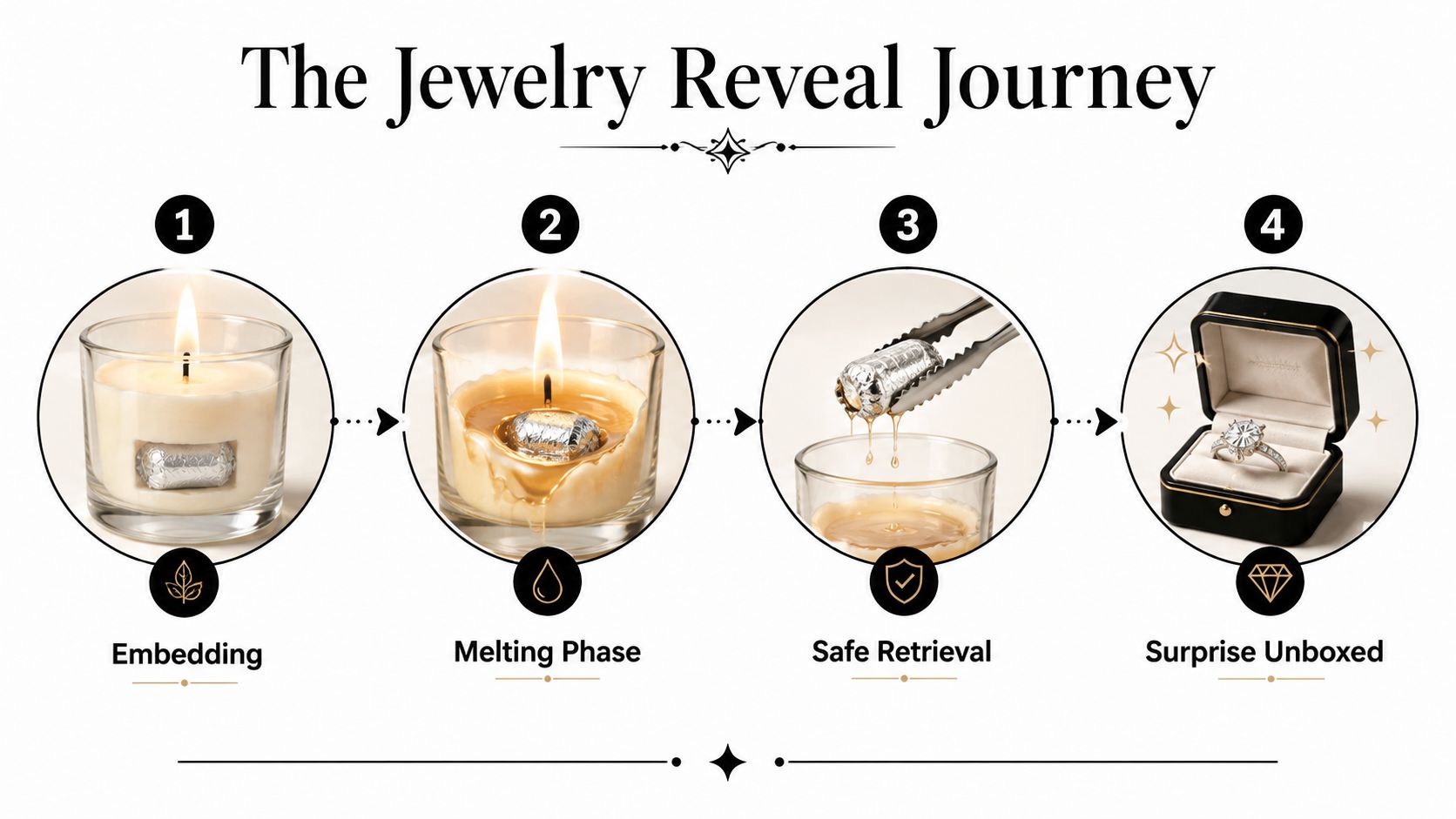
Patience protects both the candle and the user. Burning for the manufacturer's recommended period allows the wax to melt around the capsule instead of forcing an irregular channel through the surface. If the packet shifts, it may still be recoverable, but its movement can change the local wax flow or bring the capsule closer to the wick. Stop the burn and follow the product instructions if the packet touches the flame, becomes damaged, or appears likely to interfere with the wick.
A packet that falls to the bottom isn't automatically proof that the candle is unusable, but it does require caution. Don't continue burning just to chase the jewelry. A seller that provides clear instructions for a shifted capsule is showing better practical awareness than one that discusses only the excitement of the reveal.
The candle should remain worthwhile even if the ring doesn't match your style. Start with the wax because it influences the way the candle melts, carries fragrance, and leaves residue on the jar and capsule.
Soy wax and soy blends are common choices for products positioned as premium candles. In controlled independent combustion testing, soy candles produced peak PM2.5 levels at or below 88 µg/m³, compared with 3361 µg/m³ for paraffin candles, alongside lower measured TVOCs and NOx. The study comparing soy and paraffin candle emissions provides the relevant testing context.
Those results don't mean every soy candle burns perfectly or that every paraffin candle performs poorly. They do show why wax selection deserves attention in an enclosed jar containing a foil capsule. A cleaner-burning wax can reduce visible soot accumulation and help the fragrance remain part of the experience rather than being overwhelmed by smoke or residue.
Wax disclosure should be specific. Look for “soy wax” or “soy blend” with enough detail to understand what you're purchasing. Treat an undisclosed wax type as a quality-information gap rather than assuming the candle uses a cleaner formula.
Fragrance descriptions should feel concrete. Notes such as cedar, oud, vanilla, citrus, or amber tell you more than “luxury scent.” Perfume-grade fragrance oils can provide a richer, more room-filling aroma than a weak fragrance that disappears soon after lighting, but scent strength also depends on the wax, wick, jar size, and room conditions.
The wick needs to match the vessel. Cotton and wood wicks are both used in scented candles. What matters most is a stable flame and an even melt pattern. A candle that repeatedly leaves a thick wall of unmelted wax around the sides may be tunneling, which wastes wax and can make the capsule harder to reach safely.
Burn guidance should be clear. A quality listing should explain how to trim the wick, where to place the jar, when to stop burning, and how to retrieve the packet. The instructions in this candle-burning guide are useful for understanding good general practice.
The candle's label may advertise a long burn, but don't accept an unsupported figure as proof of quality. Evaluate the container, scent clarity, wick behavior, and instructions together. If the candle smells pleasant cold but produces a harsh odor when lit, the ring won't repair that weakness.
A hidden object changes the candle's interior, so you shouldn't assume that ordinary candle advice covers every situation. The capsule can influence wax movement, create an obstruction near the wick, or shift during burning. Independent user discussion has raised concerns about how hidden items may affect tunneling, jar heat, and the risk of a packet moving or falling during the burn, as reflected in this conversation about candles with surprises inside.
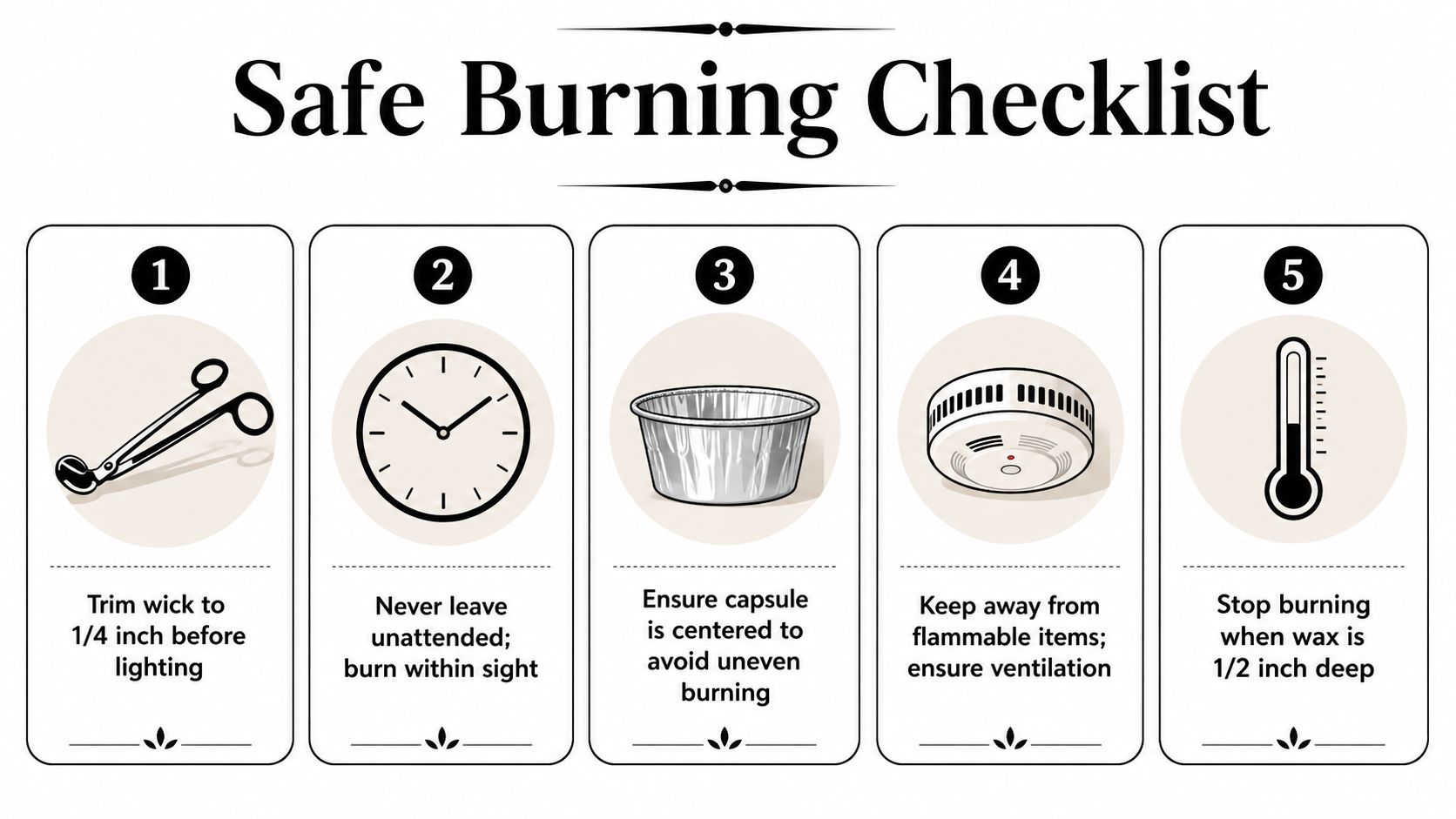
Keep the candle within sight while it's burning. Use a sturdy, heat-safe holder or surface, and don't place the jar directly on delicate furniture. A warning label can help communicate handling risks when a candle is being stored or given as a gift, particularly if several household members may use it. Resources covering self-adhesive warning labels may be useful for organizing that information clearly.
Never dig for the packet while the flame is lit. Don't push the capsule toward the wick, pour melted wax into another container, or continue burning if foil begins to scorch. If the item shifts toward the flame or rests directly against the glass, extinguish the candle and contact the seller for instructions rather than improvising.
Stop using the candle if the jar cracks, becomes excessively hot, smokes heavily, or develops an unstable flame. The capsule's presence doesn't guarantee danger, but it does mean you need to observe the burn instead of treating the candle as a standard decorative add-in.
The ring also needs its own safety check. Jewelry regulations in some major markets restrict lead in jewelry to 0.05% by weight and cadmium to 0.01% by weight, as outlined in jewelry safety guidance on restricted metal content. Ask whether the seller sources and tests the ring like wearable jewelry, especially if the piece will sit against skin for extended periods.
After opening the packet, inspect the band, setting, edges, and finish. Don't wear a ring with a sharp point, loose stone, flaking surface, or unknown metal warning. A reputable seller should make it easy to ask about materials and compliance.
Most buyers want to know whether the hidden ring will be a genuine fine-jewelry piece, a wearable fashion accessory, or a novelty item. The honest answer depends on the seller's product range. Some companies provide appraisals or explain possible value tiers, while others describe the ring only as a surprise.
A ring can be enjoyable without being expensive. Costume or fashion jewelry may offer attractive color, shape, and styling flexibility, even when it doesn't contain precious materials. The problem isn't receiving a modest ring. The problem is paying for an unclear promise and discovering that the seller never explained what “value” meant.
Look for:
Current jewelry coverage has highlighted sculptural shapes, colored gemstones, bold beads, baroque pearls, charms, and other statement styles for 2025, rather than only generic small accessories. Cosmopolitan's jewelry trend coverage is useful for comparing a seller's ring examples with broader style direction.
That doesn't mean every hidden ring needs to follow a trend. Personal style matters more than a seasonal list. A minimalist recipient may prefer a plain band, while someone who enjoys expressive accessories may welcome a colored stone or sculptural silhouette.
The guide to ring value in jewelry candles can help frame the purchase as a combination of candle enjoyment and jewelry discovery. Before buying, decide which part matters most. If you need a specific stone, metal, size, or monetary value, a mystery product may not be the right category. If you value the reveal and want a potentially wearable accessory, reasonable uncertainty can be part of the fun.
A first purchase becomes easier when you separate confirmed product information from marketing language. Read the candle listing as if you were buying a normal scented candle, then read the jewelry details as if you were buying a ring.
Use this checklist while comparing products:
| Quality Indicator | What to Look For | Red Flags |
|---|---|---|
| Wax formula | Clear disclosure of soy wax or a soy blend | Wax type isn't stated |
| Fragrance | Specific scent notes and clear fragrance information | Vague “luxury” wording with no notes |
| Burn guidance | Instructions for wick care, placement, and retrieval | No directions for the hidden capsule |
| Candle performance | A stated burn estimate, with enough detail to assess the vessel and wick | Unsupported claims or no burn information |
| Jewelry safety | Material details and evidence of compliance | No information about metals or skin contact |
| Ring value | A transparent range, examples, or appraisal explanation | Unrealistic promises with no conditions |
| Customer evidence | Reviews and photos showing actual reveals | Only polished promotional images |
| After-sales support | Clear return, exchange, and damaged-item policies | Difficult-to-find contact information |
Don't treat a high claimed value as a substitute for documentation. Ask what you would receive if the ring were not your preferred style, whether the product can be returned, and whether the candle itself can be replaced if the capsule damages the burn.
For a gift, scent selection and presentation may matter more than ring specifications, but the recipient still needs safe-use instructions. For personal use, focus on your own fragrance preferences and whether you would enjoy the candle without a spectacular reveal. A company such as Jackpot Candles offers scented candles and bath bombs with hidden jewelry, including ring-focused products, so shoppers can compare its product details with other sellers rather than relying on the surprise alone.
Customer reviews can reveal practical issues that product pages omit. Look for comments about soot, tunneling, fragrance strength, capsule retrieval, ring finish, sizing, and customer service. One attractive review doesn't establish a pattern, but repeated details can help you identify whether the seller's description matches the buyer experience.
Choose a surprise ring candle by scoring the candle and the jewelry separately. On the candle side, prioritize a disclosed soy formula or soy blend, a clear fragrance description, a suitable wick, practical burn instructions, and evidence of even performance. On the jewelry side, look for material information, safety compliance, honest value language, style examples, and a workable solution if the ring arrives damaged or doesn't fit.
Different buyers should weigh the features differently:
The safest choice is a product from a company that treats the capsule and ring as engineered parts of the experience, not as an afterthought. You may not receive the exact style you imagined, but careful buying can make the candle enjoyable before, during, and after the reveal.
If you want to explore a scented candle designed around a hidden jewelry reveal, visit Jackpot Candles to compare candle and bath bomb options, scent descriptions, and the surprise experience. Choose a product whose candle quality, safety information, and jewelry expectations fit the person who'll receive it.
Comments will be approved before showing up.