
free shipping at $99


So, you’re trying to decide between fragrance oils vs essential oils for your next project. It's a classic crafter's dilemma, and honestly, the "right" answer really just boils down to what you're trying to create.
Are you aiming for the pure, straight-from-the-earth essence of a plant with all its therapeutic vibes? You're in essential oil territory. Or are you looking for a scent that's consistent, incredibly diverse, and can stand up to the heat of candle making? That’s where fragrance oils shine.
Getting to know the real differences between these two is your first step toward making amazing handmade goodies. One is literally born from nature, capturing the soul of a plant, while the other is a product of scientific artistry, opening up a world of endless aromatic possibilities.
This choice is a big deal. It will shape everything from how strong your scent is and how well it behaves in your recipe to your final costs and whether you can claim any therapeutic benefits.
It all comes down to a simple trade-off: Do you want the authentic, wellness-focused potential of a natural essential oil, or do you need the reliable performance, wild scent variety, and heat stability that only a fragrance oil can offer?
Whether you're pouring candles, pressing bath bombs, or mixing up soaps, this is the fundamental question that will guide your entire process. Let's lay out the key distinctions so you can see them side-by-side.
To make things super simple, here's a quick rundown of what sets these two apart. Think of it as your cheat sheet for choosing the perfect scent source.
| Attribute | Fragrance Oils (FO) | Essential Oils (EO) |
|---|---|---|
| Source | Synthetic compounds, lab-created | Pure plant extracts, steam distilled or cold-pressed |
| Scent Variety | Virtually limitless, including abstract concepts like "Ocean Breeze" | Limited to scents found in nature (e.g., lavender, lemon) |
| Heat Stability | High; engineered to perform well in hot wax | Varies greatly; many degrade or evaporate at high temperatures |
| Ideal Use Cases | Candles, wax melts, room sprays for strong, consistent scent | Aromatherapy, diffusers, therapeutic bath and body products |
| Consistency | Highly consistent from batch to batch | Can vary based on harvest, season, and origin |
After a quick look, you can see how each one has its own clear strengths. Neither is "better"—they're just different tools for different jobs.
You can really see the difference in how these are used by looking at the money behind them. The fragrance oil market was a huge USD 41.12 billion in 2023, which tells you just how much they're used in all sorts of consumer products.
On the other hand, the essential oil market came in around USD 8.8 billion in 2022. It's smaller, but it's growing like crazy as more people jump on the natural wellness train. This really shows how fragrance oils own the commercial scenting world, while essential oils are the champions of natural and therapeutic goodies. If you're curious, you can learn more about the fragrance oil market growth on introspectivemarketresearch.com.
Before you can really get into the fragrance oils vs. essential oils debate, you have to pop the cap and understand what’s actually inside. Their origins are completely different, and that's what shapes how they perform, what they smell like, and where they shine in your crafting projects, whether it's candles or bath bombs.
Essential oils are literally nature’s perfume. They are pure, potent compounds pulled directly from plants—think flowers, leaves, bark, and even citrus peels. The whole point of the extraction process is to capture the plant's true scent and its therapeutic qualities.
Getting an essential oil is an all-natural process. It’s all about bottling the plant's unique chemical signature without adding anything synthetic. There are two main ways it's done:
These careful methods give you a highly concentrated oil from a single plant. This purity is exactly why essential oils are the backbone of aromatherapy. To learn more, you can check out some of the most popular essential oils and their benefits in our handy guide.
Fragrance oils, on the other hand, are born in a lab. They are synthetic scents, carefully designed by experts and often blended with natural extracts to hit a very specific fragrance target. This scientific approach opens up a whole world of creative possibilities.
These oils are made from aroma chemicals, which can be created from scratch or derived from natural sources. This gives perfumers the power to invent scents you’d never find in nature, like "Fresh Linen," "Ocean Breeze," or even yummy aromas like "Birthday Cake." Because they’re engineered, they’re incredibly consistent and stable, which is a huge plus when they’re hit with the high heat from melted candle wax.
A big misconception is that "natural" is always "safer." While essential oils come from plants, they are powerful chemical compounds that can easily irritate skin if not diluted properly. On the flip side, high-quality fragrance oils are specifically formulated and tested to be skin-safe for things like lotions and bath bombs, giving you a reliable and often allergen-friendly option.
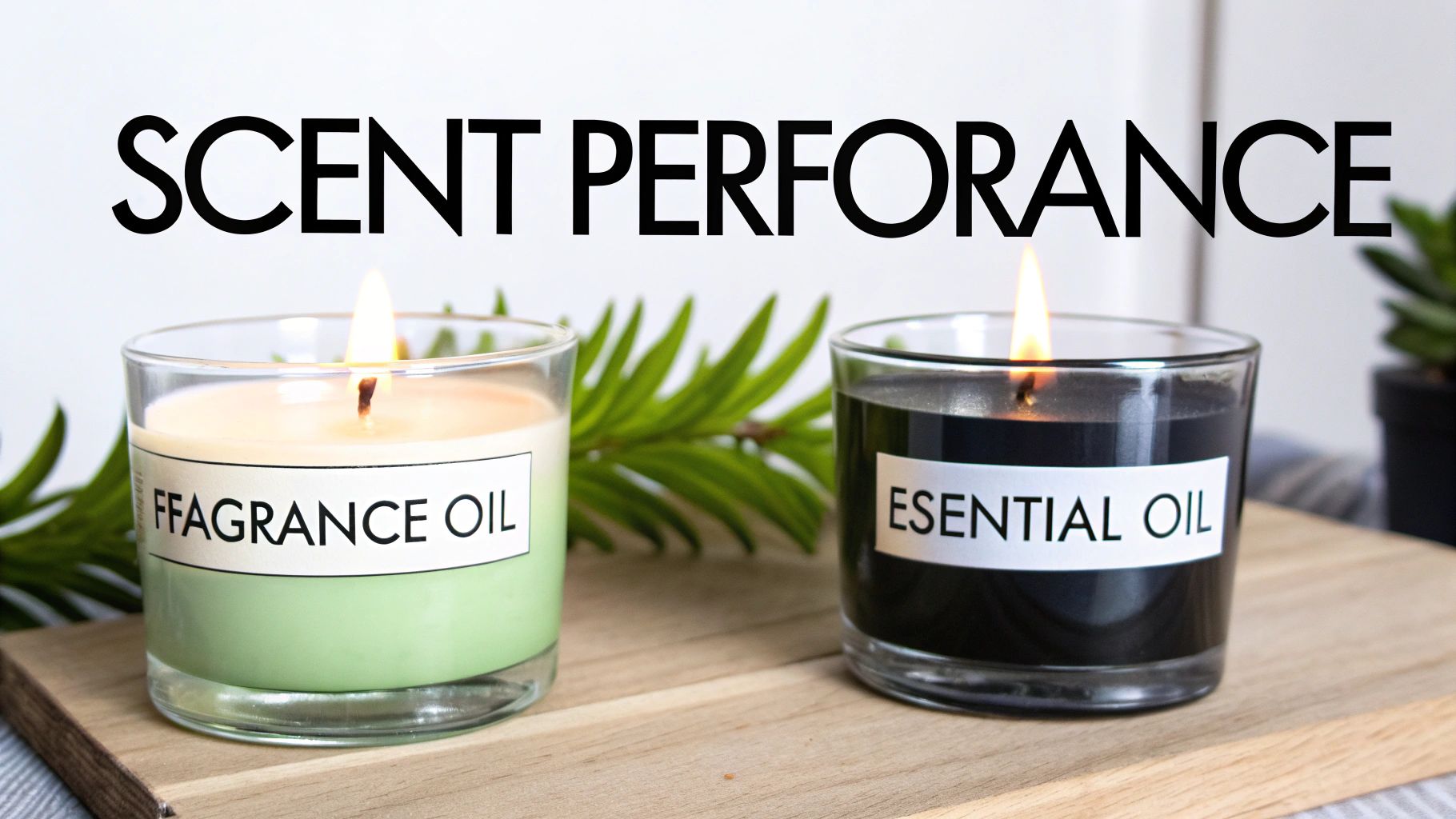
When you're making something scented, the final aroma is everything. It's your signature! This is where the real-world differences between fragrance oils and essential oils pop, especially when you turn up the heat in projects like candle making.
In the candle world, we talk a lot about two things: cold throw and hot throw. The cold throw is how the candle smells just sitting there, unlit. The hot throw is the magic that happens when you light the wick—it’s the scent that fills the room. Getting a great scent in both states is the ultimate goal, and that’s why your choice of oil matters so much.
Let's get straight to it: fragrance oils are built for this. They are scientifically formulated to be stable, bind perfectly with wax, and handle high temperatures like a champ. This means you get a reliable, powerful hot throw that actually fills up a room.
Essential oils, on the other hand, are much more delicate because they're completely natural and volatile. When you pour them into hot wax, many of them just can't take the heat. They start to break down or evaporate, which makers call "burning off." The result? You might have a candle that smells amazing before you light it, but once the flame is going, the scent is weak, different, or gone altogether.
Key Insight: A fragrance oil is specifically designed to survive and thrive in a candle's hot melt pool. An essential oil’s job is aromatherapy, not high-heat performance, which is why the hot throw can be so disappointing.
For a consistent, room-filling aroma in your candles, fragrance oils are almost always the way to go. It's the reason professional candle makers depend on them. If you’re ready to dive in, our guide on the best fragrance oils for candle making is a great place to start your search.
When you're making bath bombs, soaps, or lotions, high heat isn't the main issue. Instead, you have to think about scent stability and longevity. The complex mix of ingredients in these products can totally change how an oil behaves over time.
Fragrance oils are developed to stay true when mixed with all sorts of cosmetic ingredients. They are far less likely to morph or fade away, ensuring your "Cucumber Melon" soap smells just as fresh on day 30 as it did on day one.
Essential oils can be a bit of a gamble here. Some, like earthy patchouli or sandalwood, are fantastic and have amazing staying power, acting like natural anchors for the scent. But others, especially those bright, zesty citrus oils like lemon or bergamot, are notorious for fading fast in soap, sometimes leaving you with a product that barely has a scent at all.
Here’s a quick table to show you how fragrance oils and essential oils really perform when you put them to work in candles and bath bombs.
| Performance Metric | Fragrance Oils | Essential Oils |
|---|---|---|
| Candle Hot Throw | Excellent: Engineered for a strong, consistent scent release in hot wax. | Poor to Fair: Often degrades or evaporates, leading to a weak scent. |
| Scent Consistency | High: Every batch smells exactly the same, which means reliable products. | Variable: The aroma can change based on the plant's harvest, season, and where it was grown. |
| Longevity in Soap | Good: Formulated to stay stable and true to the original scent over time. | Varies: Some last a long time (base notes), while others fade quickly (top notes). |
At the end of the day, picking the right oil is about matching its natural strengths to what your project needs. If you're looking for powerful, predictable scents that can handle the heat and stick around, fragrance oils are your most reliable partner in crafting.
When you're whipping up products that go directly on the skin, like bath bombs or lotions, safety is everything. This is where the fragrance oils vs essential oils debate gets really serious. It's so easy to think "natural" automatically means "safe," but that's a common misconception that can lead to some pretty unhappy skin.
The real scoop is that both types of oils demand respect and a solid understanding of how they work.
Essential oils are powerful, concentrated plant magic. While they smell incredible, some of them can be real bullies to your skin if you don't handle them correctly. For instance, certain citrus oils like bergamot are phototoxic. That's a fancy word meaning they can cause nasty reactions, even burns or dark spots, if you put them on your skin and then go out in the sun. Others can build up an allergic response over time.
This is why proper dilution is non-negotiable with essential oils. You should always, always mix them into a carrier oil—think jojoba or sweet almond oil—before they even think about touching the skin or going into a bath.
Now, let's talk about high-quality, cosmetic-grade fragrance oils. These aren't just random scents; they are specifically engineered and put through the wringer with rigorous testing to ensure they're safe for your skin.
Good suppliers will make sure their fragrance oils follow strict rules from organizations like the International Fragrance Association (IFRA). The IFRA sets clear, maximum safe usage levels for every kind of product you can imagine, from leave-on lotions to rinse-off soaps.
This gives you, the creator, a clear and reliable safety map. You can use a specific fragrance oil in your bath bombs with complete confidence, knowing it was formulated to be stable and non-irritating for that exact purpose. To dive deeper into what makes for a skin-loving creation, check out our guide on whether bath bombs are good for your skin.
Here's the bottom line: Safety isn't about natural vs. synthetic. It's about knowing the chemistry, understanding the risks, and sticking to the rules. A well-regulated, skin-safe fragrance oil is often a much safer bet for your body products than an essential oil that's been used improperly.
So how do you make the smart choice? Always check the paperwork from your supplier. Any seller worth their salt will provide a Safety Data Sheet (SDS) and an IFRA certificate for every single fragrance oil they sell.
Learning to read these two documents is a game-changer. It empowers you to create things that are not only beautiful and smell amazing but are also safe and up to standard. It's the kind of diligence that protects both you and everyone who gets to enjoy your handmade goodies.
When you're trying to decide between fragrance oils and essential oils, let's be real—your budget is a huge factor. The price difference isn't random; it all comes down to how they're made and where they come from. Figuring this out will help you make a smart choice for your candle-making business or even just your weekend hobby.
Essential oils almost always have a higher price tag, and there’s a really good reason for it. Their cost is tied directly to farming. It takes an absolutely massive amount of plant material to get just a tiny bit of pure oil.
Think about it like this: it can take over 200 pounds of lavender flowers just to produce one single pound of lavender essential oil. And for the really special stuff like rose or sandalwood? The amount you get is even smaller, which sends the prices sky-high.
This super intensive extraction process means the price of essential oils can swing wildly depending on what’s happening in the agricultural world. A few things can really impact the cost:
Fragrance oils, on the other hand, are much more stable and affordable. Since they're created in a lab, their production isn't at the mercy of Mother Nature. This efficiency in manufacturing means lower, more predictable costs for you.
The biggest difference in cost really boils down to one thing: scalability. Fragrance oils can be made consistently in huge batches whenever they're needed. Essential oils are limited by how much plant material is available, and that can change from one season to the next.
Availability is another big piece of the puzzle. Everyone's loving natural products right now, which has caused a huge spike in demand for essential oils. The global essential oils market was estimated at a whopping USD 25.86 billion in 2024 and is expected to hit USD 56.25 billion by 2033. This boom can sometimes put a strain on the supply of popular or rare oils, which, you guessed it, affects the price. You can dive deeper into these market trends with this report on natural ingredients from Grand View Research.
Fragrance oils are a different story. They're widely available from tons of suppliers. Their synthetic nature means that your favorite "Vanilla Bean" or "Ocean Breeze" scent can be made over and over again perfectly. For a small business that needs to count on having inventory in stock at a price that won't change, fragrance oils offer some serious stability.
So, you're standing at a crossroads: fragrance oil vs. essential oil. Which one is right for what you’re making? Instead of getting tangled up in endless pros and cons, let's cut to the chase and look at real-world scenarios.
The best way to decide is to ask yourself one simple question: What’s the single most important thing I want this product to do? Am I aiming for a powerhouse scent that fills a room? Or am I creating something more natural, meant for a therapeutic experience? Your answer is your compass.
When you’re making candles, the holy grail is usually a strong, consistent scent that people can actually smell. If a powerful, room-filling “hot throw” is your goal, then fragrance oils are hands-down your best bet. They’re specifically engineered to bond with wax and handle the heat, so your candle smells amazing both cold and when it's burning.
Essential oils, on the other hand, often don't play well with hot wax. Their delicate compounds can break down or evaporate too quickly, leaving you with a candle that barely whispers its scent.
Now, let's talk bath and body. If you're creating bath soaks, lotions, or soaps where aromatherapy is the star of the show, a high-quality essential oil is the way to go. For a calming bath bomb, real lavender essential oil delivers those genuine therapeutic benefits that a synthetic fragrance just can't match.
But what if you want a fun, whimsical scent like "birthday cake" or "ocean breeze"? Or what if you need a scent that won't mess with your soap-making process? In that case, a skin-safe fragrance oil is the more reliable and creative choice.
The big takeaway here is that one isn't "better" than the other. It's about picking the right tool for the job. Match the oil's strengths to your project's goals, and you'll get results you can count on every time.
This decision tree gives you a quick visual to help you pick based on your main focus.
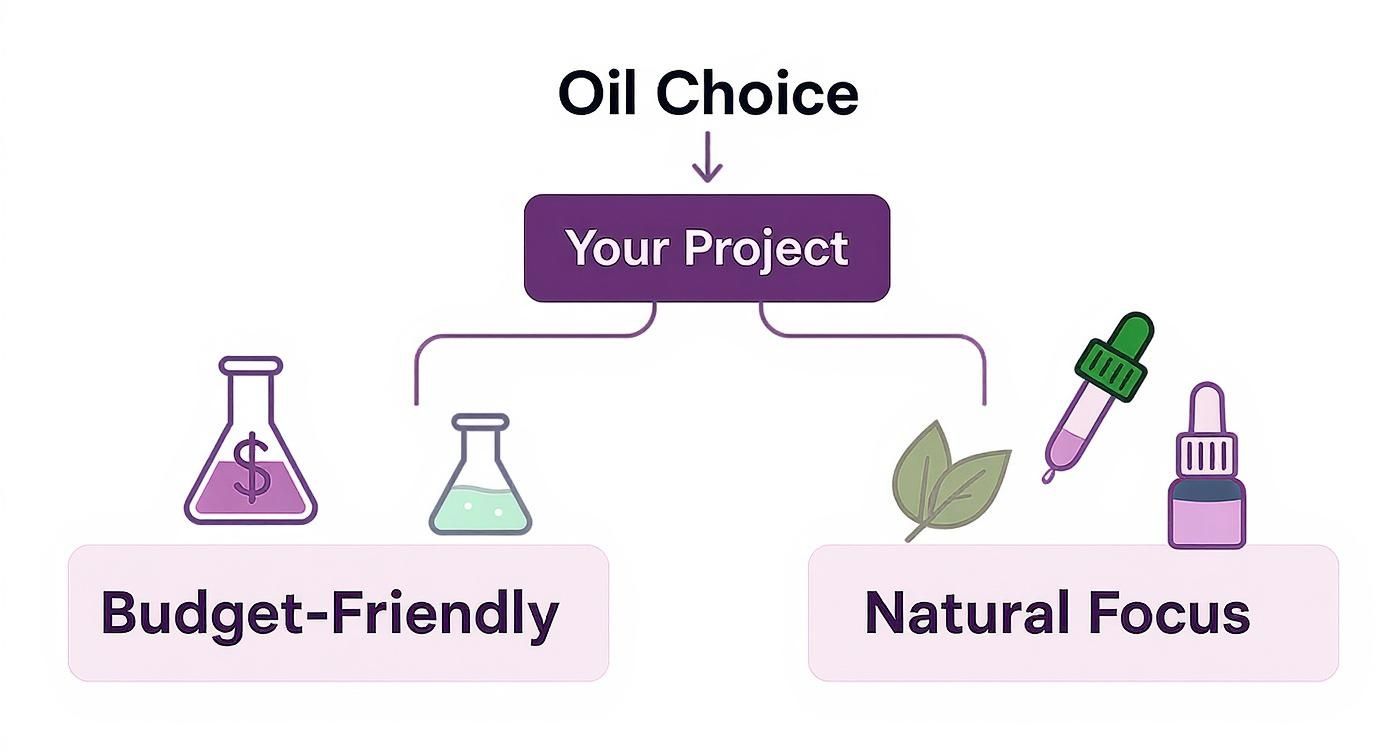
It really boils down to this: if you’re all about natural, therapeutic benefits, lean into essential oils. If you need bold performance, endless variety, and a budget-friendly option, fragrance oils are your go-to.
When you're first exploring the world of candle making, a few questions always seem to pop up about fragrance oils and essential oils. Let's tackle some of the most common ones crafters run into.
You absolutely can, and lots of makers do! It's a fantastic way to create a scent that's totally unique to you. For instance, you could take a rich, buttery vanilla fragrance oil and blend it with pure lavender essential oil. This gives you a stable, long-lasting base with a genuinely natural, calming top note.
Playing with these kinds of hybrids lets you have the best of both worlds. You get all the creative possibilities and staying power of fragrance oils, plus the authentic aromatherapy vibes from essential oils.
Most of the time, yes! High-quality fragrance oils today are typically both vegan and cruelty-free, but it's always smart to double-check with your supplier. Back in the day, some scents (like musk) came from animal sources, but now, those are almost always created synthetically.
Reputable suppliers will be upfront about their standards and will clearly state if their products are vegan and haven't been tested on animals. If you don't see it on the product page, just ask! It’s the best way to make sure their sourcing matches your own ethical standards.
This is a classic headache for anyone who's tried making candles with only essential oils. The simple answer is that essential oils are volatile. That's a fancy way of saying they evaporate very easily, especially when you add heat to the mix. Many have a low flash point, which is the temperature where they turn to vapor.
When you pour delicate oils like lemon or eucalyptus into hot wax, they can basically "burn off" before the candle even sets. This can leave you with a super weak scent or one that smells completely different than you intended. Fragrance oils, on the other hand, are designed specifically for high-heat applications. They have higher flash points, so they stay strong and true in hot wax, giving you that powerful, consistent scent you're looking for.
At Jackpot Candles, we stick with premium, perfume-grade fragrance oils. It’s our way of guaranteeing that every candle delivers a rich, room-filling aroma from the first light to the last. Ready to find your new favorite scent (and the surprise jewelry inside)? Head over to https://www.jackpotcandles.com.
Comments will be approved before showing up.