
free shipping at $99


U.S. household holiday spending fell by roughly one-third after 2000, according to a summary discussed in Joel Waldfogel's historical analysis of holiday gift giving. That reframes budget gifting: spending less doesn't mean abandoning the occasion. It means choosing something useful and counting the costs that don't appear on the gift's price tag.
When you search for gift sets under 10, the useful question isn't just what fits in a basket. It's what you can buy, package and deliver within your limit, and whether the recipient will enjoy what's inside.
A small gift set works like a tasting flight. A few coordinated samples tell a story that an unrelated assortment can't. Tea, honey and a handwritten card suggest a quiet break, while a handful of miscellaneous clearance finds leaves the recipient guessing.
Say you're thanking coworkers at the end of a busy season. You could choose a different novelty for everyone, or assemble matching desk-break kits with a personal note. The second approach gives you a repeatable shopping list without making each gift feel anonymous.
The same logic suits teacher thank-yous, host gifts, stocking fillers and neighborhood exchanges. You're recognizing a relationship, not trying to furnish someone's home.
A thoughtful set follows these rules:
For this guide, under $10 means the total you pay, including tax, shipping and presentation. Pick the theme before the products, and you'll have fewer tempting extras to remove later.
A set can look inexpensive on the shelf and still exceed a $10 budget once tax, shipping, and presentation are added. Use the table to compare each idea's main cost driver, then check the full price before buying. The item prices vary by seller, so these guides describe where the cost tends to sit rather than promise a specific total.
| Set idea | Typical contents | Typical cost | Best for |
|---|---|---|---|
| Hot cocoa and marshmallow kit | Cocoa sachets, marshmallows, small card | Sachets are usually the smallest line item; the marshmallow topping is the main cost. | Coworkers, neighbors |
| Tea sampler | Individually wrapped tea bags, honey stick, small spoon | Tea portions set the base cost; adding a spoon increases it. | Teachers, hosts |
| Hand-care trio | Travel hand cream, lip balm, emery board | Travel-size products bought individually can cost more per item than multipack portions. | Friends, colleagues |
| Stationery pack | Notebook, pens, sticky notes | The notebook is usually the largest purchase; pens and sticky notes add to the total. | Students, teens |
| Snack tin | Popcorn, nuts or candy in a reusable tin | The tin adds a separate cost unless you already have one; snacks make up the contents cost. | Stocking fillers, age-appropriate gifts |
| Coffee sampler | Single-serve coffee packs, stir stick | Coffee packs drive the cost; check that the portions suit the recipient's brewing equipment. | Office gifts, host gifts |
| Bath salt sachets | Sealed sachets, small muslin bag | Sachets make up the product cost, and a new muslin bag adds to the total. | Recipients who enjoy baths |
| Seed packet set | Seed packets, plant tag, paper card | Seed packets are the main purchase; tags and cards add smaller costs. | Gardeners, supervised family activities |
These are assembly ideas, not fixed retail quotations. Package sizes, seller prices, tax, and delivery charges can change the landed cost. A reused container can keep the total lower than buying a new tin, while gift wrap or a bag adds another expense.
For context, a 2026 analysis by Thousand Gift Ideas covering 4,653 gift products found an average listed price of $58.48 and a median of $25.99. The average is higher because expensive products pull it upward. Neither figure sets a spending target for a small gift.
Those figures don't show how many products fit under $10 or what shoppers buy. Judge a set by what the recipient can use, how often they may use it, and what each use costs after the full price is counted. A tea sampler suits someone who drinks tea; stationery makes more sense for someone who writes by hand. A coffee sampler also needs to match the recipient's brewing equipment.
Buying rule: Remove an item that doesn't support the theme before reducing the quality of the item that does.
For someone who enjoys fragrance, you can shop crystal aromatherapy sets on Loyaltie. Compare the current landed cost with your limit, including any delivery or presentation costs.
Begin with what the person does during an ordinary day. Their routine gives you a better selection rule than their age, job title or the seasonal display.
Bath products need more knowledge of the recipient than paper goods. Confirm that the person uses a bathtub, enjoys the format and welcomes the fragrance before browsing bath and body gift set ideas.
Write the recipient's routine in a sentence before shopping: they draw during their commute, make tea after work or solve crosswords at breakfast. That sentence is your filter for every item you consider.
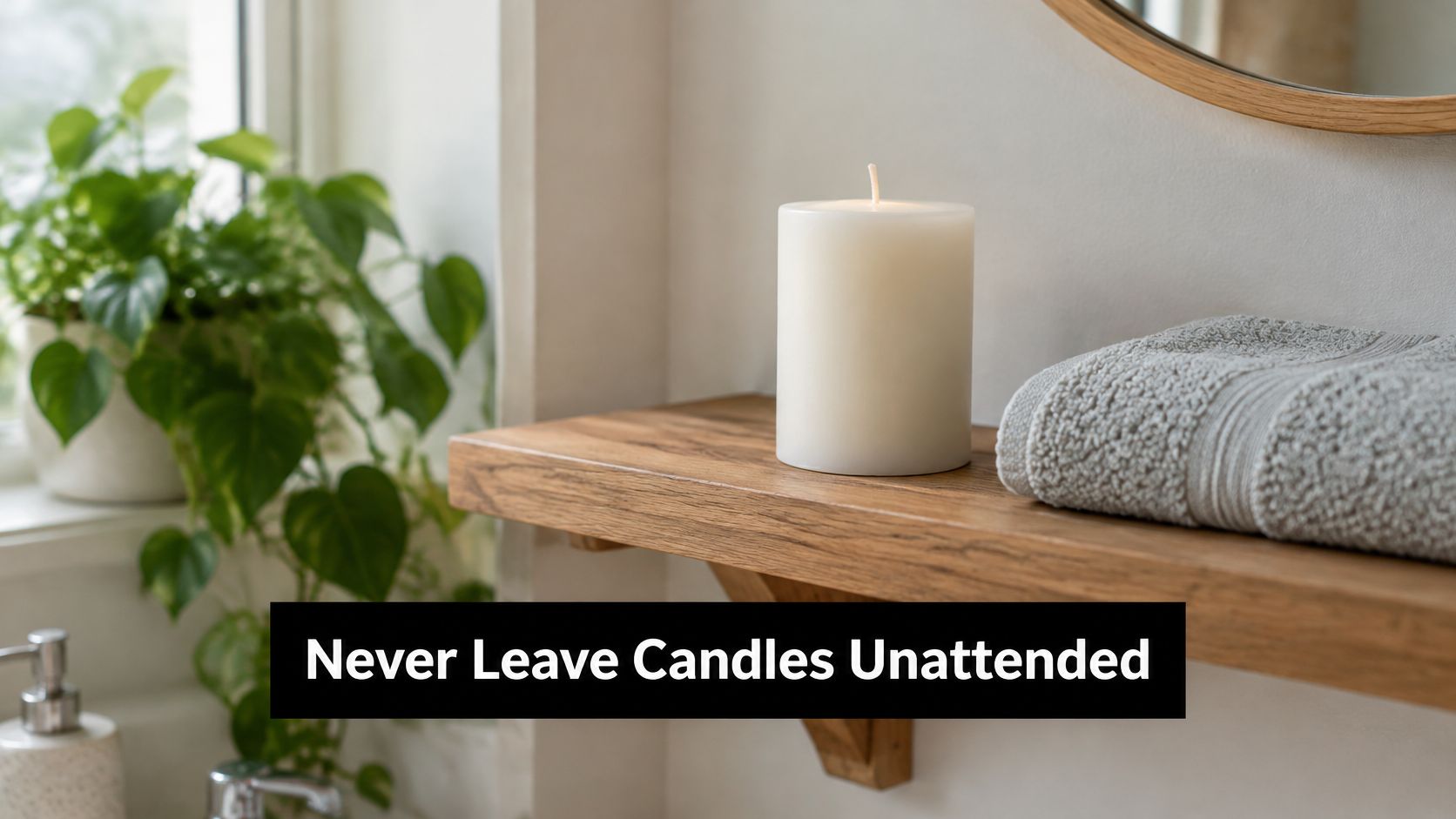
A cheap candle still has an open flame, and an inexpensive bath product still touches someone's skin. Low price isn't evidence of low risk. The National Candle Association's candle-safety guidance says candles should never burn unattended and should stay away from children and pets.
Even a simple candle-and-towel arrangement needs a suitable place for use.
Before choosing a bath bomb, review its ingredient list alongside this guide to bath bomb ingredients to avoid. Use the information to ask better questions, not to diagnose someone's skin needs.
A well-chosen small gift includes enough information for the recipient to decide how to use it. If a suitability check fails, swap the item rather than trying to solve the mismatch with a warning card.
Build the set on a clear table before buying decorative supplies. Gather scissors, a pen, scrap paper for your shopping tally and any containers you already own.
Use this visual sequence to keep the assembly focused.
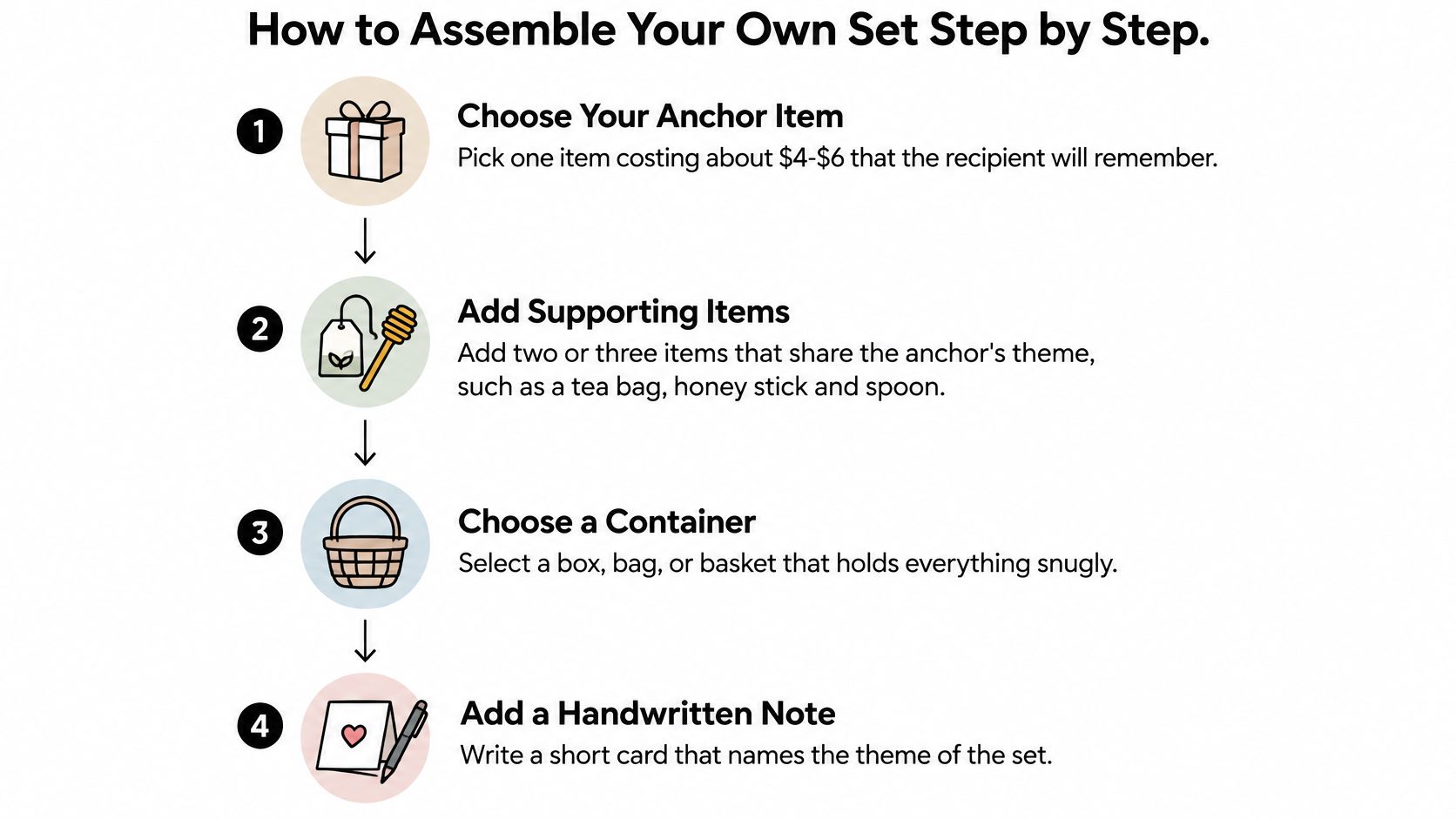
For container inspiration, browse these gift basket ideas, then scale the format to your actual contents. A compact box can look more considered than a basket padded mostly with filler.
This video offers another visual reference while you plan the presentation.
A container should hold the gift securely, not require you to buy more products to fill it.
Before sealing, check that food labels remain attached, lids are secure and the recipient can identify every product. Save unused ribbon and tissue for another occasion instead of adding them just because they're available.
The shelf price is only the starting point. Landed cost = items + sales tax + shipping + wrap and card. Add each expense before deciding whether the set fits the limit. To compare value, divide that total by the realistic number of occasions the recipient will enjoy the gift.
| Cost line | Hypothetical example | Where it moves the total |
|---|---|---|
| Main item | $6 | Protect spending on the item the recipient wants |
| Supporting items | $1 total | Remove unrelated extras first |
| Wrap, box or tin | $1 | Reuse a clean, suitable container |
| Card or label | $0 if using paper already owned | Write on cardstock you already own |
| Shipping | $2 share | Compare pickup or in-store purchase |
| Sales tax | About $0.50 | Include it before approving the purchase |
These figures illustrate how to fill in a budget worksheet, not fixed retail prices. Replace each example with the amount for your purchase. If you buy a multipack solely for this gift, count the full amount paid, even if some contents remain. Keep that cash outlay separate from the portion assigned to each recipient.
For example, a $6 set, $1 wrap and $2 shipping share total $9 before tax. Add sales tax to the checkout total before calling the gift under $10. The same shelf price can fit one budget and exceed another once delivery and tax are included.
Then consider value per use. A gift with a $9 landed cost enjoyed on three separate occasions costs $3 per use. Count plausible occasions, not every sip, pencil stroke or moment spent looking at the packaging. Frequent use can make a modest set feel like better value than a cheaper item used only once.
In Pro Carton's 2025 European consumer packaging survey, 64% of consumers sought sustainable options only when they cost the same as less sustainable alternatives. For your budget, that is a reminder to count the actual payment first, rather than letting an environmental label justify an overrun.
Reusable means the recipient has a practical next use for the container. Recyclable means it can enter an appropriate local collection system. Decorative packaging is not automatically either. A tin that will genuinely hold snacks may add value after opening, while an elaborate box destined for disposal can take money away from the gift. Judge the set by its full cost and what the recipient is likely to use.
A set's shelf price is only the starting point. Compare what each source offers with the amount you'll pay after tax, shipping and gift wrap. The table gives typical price expectations for small items or sets, not a guarantee that a complete gift will stay under $10.
| Source | Typical price range | Selection | Best for | Watch for |
|---|---|---|---|---|
| Dollar and discount stores | Small items often cost a few dollars each | Changing mix of small goods | Stocking fillers and supporting items | Flimsy construction or damaged packaging |
| Grocery and drugstore seasonal aisles | Small food or personal-care items often cost a few dollars; sets vary | Food and personal care | Hosts and coworkers | Seasonal availability and expiry dates |
| Big-box seasonal sets | Small ready-made sets may be priced in the single digits | Ready-made assortments | Gifts needing little assembly | Attractive boxes with less useful contents |
| Post-holiday clearance racks | Marked-down items can cost a few dollars, depending on the original price | Remaining seasonal stock | Durable supplies for future gifts | Dated packaging and limited choice |
| Online marketplaces and small sellers | Prices vary; delivery may add to the item price | Themed and customizable sets | Specific interests | Delivery charges and unclear dimensions |
| Specialist candle and bath retailers | Smaller items or discovery formats may be priced in the single digits | Fragrance-led gifts and discovery formats | A separate special-occasion option | Assuming every format fits the same budget |
Treat these ranges as a starting point, then check the actual price and checkout total. A low price for one component does not mean the finished set will fit your limit.
Discount stores make it easy to compare small items side by side. Check notebook bindings, pen packaging, container lids and seals before buying multiples. A low-priced item still needs to do its basic job.
Grocery and drugstore aisles let you compare seasonal food gifts with everyday versions nearby. Read the contents list rather than judging by the illustration, and check expiry dates so the recipient has time to use perishables. For a ready-made set, inspect how many useful contents are inside; small travel sizes can look more substantial in a large box.
After a holiday, plain tins, paper bags, ribbon and durable stationery may suit future gifts better than dated seasonal packaging. Check food and personal-care products for condition, storage instructions and expiry information before setting them aside.
Keep a note of what you bought and whom it might suit. Without that reminder, an early purchase can disappear into a cupboard and lead to buying a replacement.
Online, check dimensions, net contents, seller information and delivery timing before judging a set from its photograph. Compare the delivered total with an equivalent local purchase, including any wrap or packaging needed to give it.
Skip products you don't need just to reach a free-shipping threshold. The extra cost only makes sense if those items were already on your list.
For a candle or bath gift, compare the specific item and its delivered cost with your budget set. A different format is not automatically a like-for-like substitute, so judge it by its useful contents and total cost.
Make the final decision with your recipient's routine beside your shopping list. Choose the set that fits that routine, not the one with the most pieces or largest box.
If a price drops after you buy, check the retailer's own adjustment terms before placing another order. Compass+ explains how shoppers may recover savings after a purchase, but eligibility needs checking with the seller rather than assuming a refund is available.
Final check: Would this person use the contents if they arrived without the decorative packaging?
Buy once the answer is yes and the complete payment fits your limit. Save the worksheet for your next gift list, noting which contents were easy to source and which packaging you can reuse.
Jackpot Candles offers scented candles and bath bombs with a surprise piece of jewelry inside, adding a discovery element to a personal-care gift. If you're considering that format for a separate special occasion, visit Jackpot Candles and compare current prices with your complete under-$10 option before choosing.
Comments will be approved before showing up.