
free shipping at $99


You've got the wax melted, the vessels lined up, and a bottle of gingerbread fragrance oil on the bench, but the batch still isn't a sure thing. The question isn't whether the scent smells good out of the bottle, it's whether it behaves in wax, survives cure time, and throws in the room without sweating, scorching, or fading flat.
The first gingerbread batch of the season usually happens in a rush. A maker wants something that feels warm, familiar, and unmistakably holiday, then the test burn exposes every weak decision in the formula, from the wax choice to the fragrance load. Gingerbread works because shoppers already understand the mood it creates, and a good candle version can deliver that bakery comfort without needing a complicated blend of notes.
A gingerbread candle has to read like spice, bakery, and warmth at once. If it leans too hard into cinnamon, it starts to feel generic. If it drifts too sweet, it can smell like frosting instead of baked dough.
That's why this fragrance is a useful seasonal anchor for a holiday line. It gives you a scent profile that can sit beside vanilla, pine, orange, or chai without disappearing, and it gives the maker enough room to tune throw, sweetness, and dryness in the wax. The practical decisions end up being the ones that matter most, wax choice, fragrance load, pour temperature, cure window, and whether the formula needs a companion note to keep it from feeling one-dimensional.
Practical rule: treat gingerbread as a performance fragrance, not a novelty. If the first burn doesn't carry across the room after cure, the issue is usually formulation, not the scent idea itself.
A lot of guides stop at “holiday favorite,” but that misses the core purpose. The purpose is to make a candle that still smells like gingerbread after it's been heated, cured, and burned in a typical room. That's where the rest of the formula decides whether the candle feels polished or just seasonal.
Gingerbread fragrance oil isn't a literal cookie extract. It's a constructed fragrance accord, which means the scent is built from aroma chemicals and supporting materials that mimic the baked-spice profile people expect from gingerbread. In one published allergen declaration for a gingerbread fragrance oil, benzyl benzoate made up 69.95% of the listed composition and eugenol made up 6%, with trace benzyl alcohol at 0.002% (allergen declaration PDF).
The scent usually lands in layers. The opening tends to feel like warm spice, often read as cinnamon, clove, or ginger. The middle is where the bakery character shows up, often as molasses or brown-sugar warmth, and the base is what keeps the candle from smelling sharp or thin once it's in wax.
That base is where two bottles labeled “gingerbread” can smell completely different. One formula may feel drier and spicier, while another comes across sweeter, rounder, or more vanilla-heavy. If a supplier adds vanillin or other sweeteners, the candle may smell richer, but it can also discolor wax, especially in pale soy pours. If the formula is stabilized for a cleaner finish, the scent can feel less plush but easier to work with.
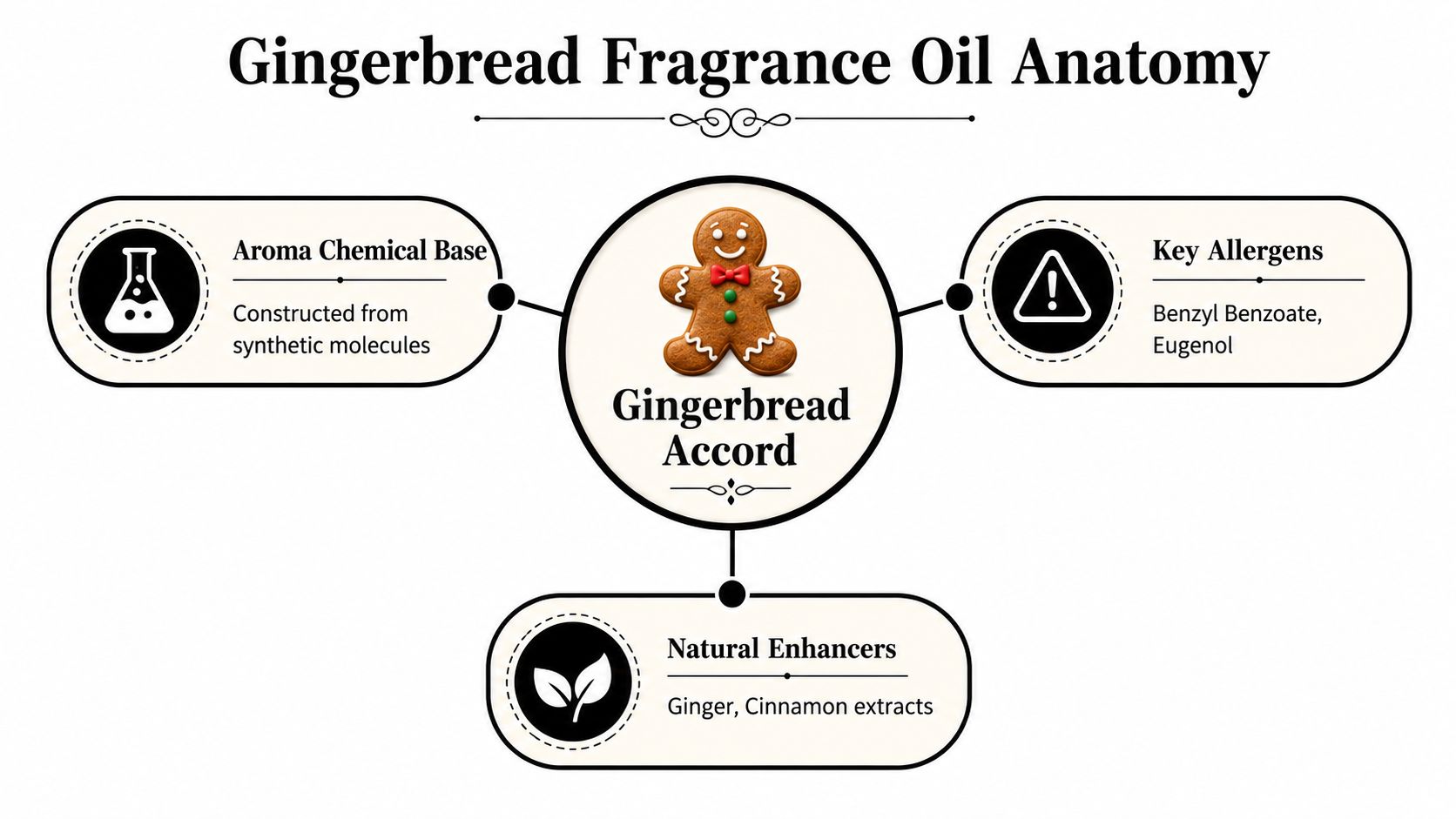
The compliance side matters just as much as the smell. A supplier's allergen declaration tells you what's doing the work in the formula, and that gives you a better clue about performance than the name on the label does. If you're comparing bulk options, read that document before you buy. A candle-safe gingerbread oil can still be a very different animal from a bath or body formula, and those differences show up in both behavior and labeling.
For a wider look at what fragrance oils are made of, this explainer on what fragrance oils are made of is a useful companion read.
If the data sheet is thin, assume the candle maker will have to do more testing, not less.
Gingerbread behaves differently depending on the wax under it. Paraffin usually gives the easiest throw with bakery notes because it carries spice well and tends to tolerate stronger loads. Soy can smell beautifully rich once cured, but it usually rewards tighter control and more patience. Coconut or apricot blends often burn cleanly, yet heavy bakery accords can feel softer or less stable in them.
If you're a soy-first maker, the decision usually comes down to balance. You want a wax that can hold gingerbread without muting it, but you also don't want a formula that starts sweating or getting fussy in warm storage. That's why many makers settle on soy blends for holiday lines, especially when the goal is a cleaner burn and a candle that still feels substantial.
Jackpot Candles uses a proprietary soy wax blend, which fits that soy-first mindset, but the important part is the behavior you're aiming for, not the brand name. Soy generally needs a more careful load test than paraffin, while waxes with more softness can need a gentler fragrance approach if the bakery accord is heavy.
| Wax Type | Typical Load Range | Throw Strength | Best Use |
|---|---|---|---|
| Paraffin | Can handle stronger testing windows | Often very strong for spice and bakery | Fast-turn holiday candles and room-filling scents |
| Soy | Needs a tighter, measured test range | Strong when cured properly | Clean-burning seasonal candles |
| Coconut or apricot blends | Often prefers a more restrained load | Can be smooth, but bakery notes may soften | Premium pours where a softer profile is fine |
Wick choice matters here too. A heavier gingerbread pour needs enough heat to mobilize the wax, but not so much that it overheats the jar and scorches the fragrance. If the wick is undersized, the candle tunnels or throws weakly. If it's oversized, the top can get too hot and make the scent read harsh or unstable.
For a more wax-specific comparison, the best wax for scented candles discussion is useful when you're deciding what kind of holiday line you want to build.
A gingerbread candle can look fine in the jar and still fail on the burn table if the fragrance load is too high, too low, or added at the wrong stage. The job is balancing scent strength with wax behavior, because the candle-safe label on a bottle does not tell you where soy starts to sweat, where vanillin starts to stain, or where a wick begins to pull the blend too hard.
A practical starting range for gingerbread fragrance oil in candles is 3-10%, and one supplier lists 8-10% for candles, or 1-1.5 oz/lb wax (The Flaming Candle gingerbread fragrance oil). Another gingerbread listing gives 3% to 10% or 6% to 12% depending on the blend, which is a useful reminder that the ceiling comes from the oil, the wax, and the finished candle you want, not from a single universal rule. For a broader look at how makers compare fragrance strength in soy, the soy wax candle fragrance oils guide is a useful reference point.
Soft wax systems give less room for error, so start low and work up. In soy, I usually begin testing around 6-8%, then move higher only if the hot throw and cold throw both stay weak after cure. That approach keeps you from chasing scent strength with a load that later causes wet spots, seepage, or a flame that has to work too hard.
Pour temperature is part of that same decision. Gingerbread fragrance oils commonly show high flash points, including >200°F (>93°C), 198°F (92°C), and >212°F (>100°C) in supplier SDS documents (Praan Naturals SDS). A sensible working rule is to add fragrance well below the flash point and keep a 5-10°C safety margin so you reduce volatilization losses and keep handling safer. In soy blends, a test window around 170-180°F is a practical place to start, then adjust based on how the wax takes the oil and how the finished candle burns.
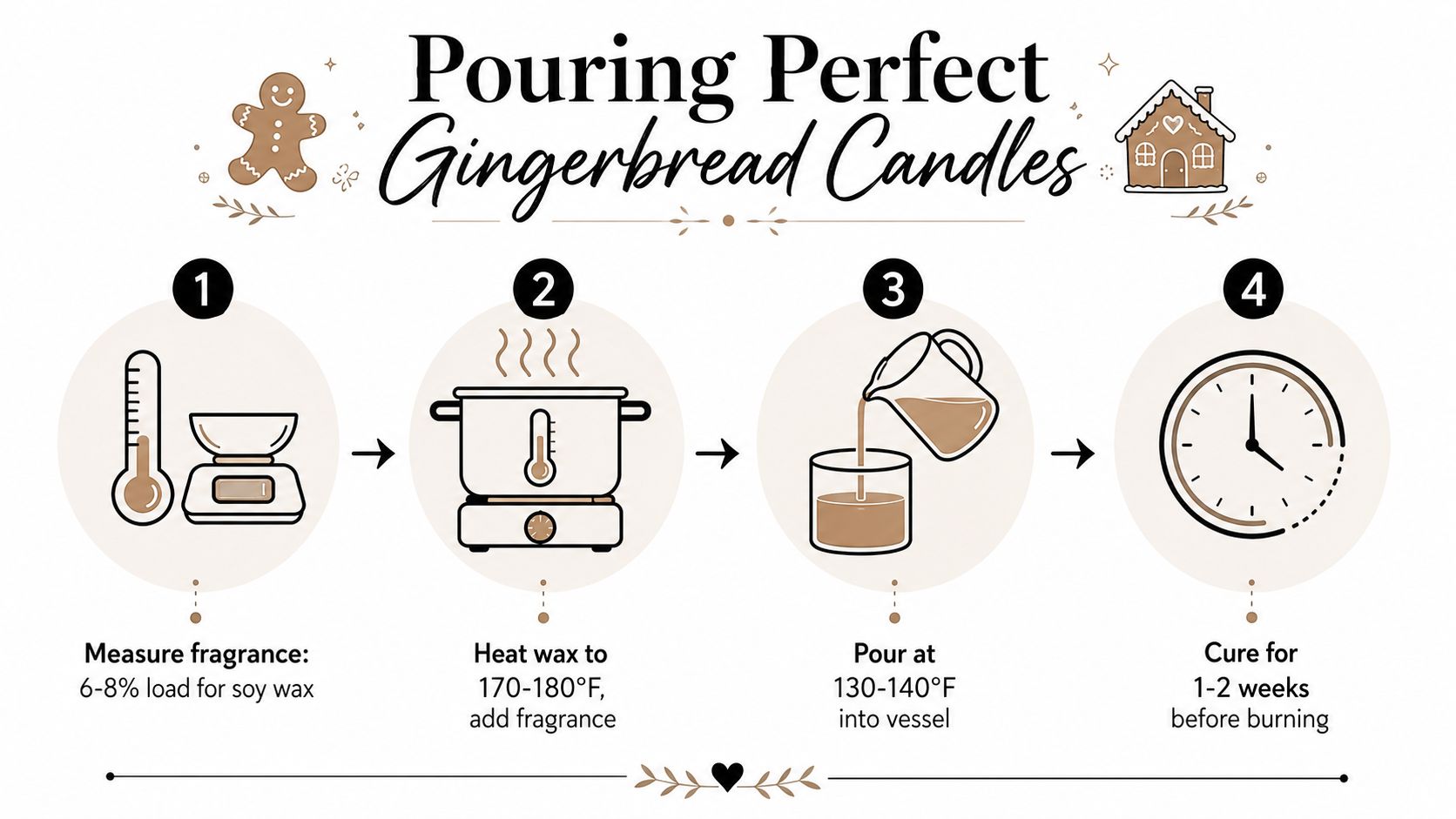
Soy candles with gingerbread usually need 7-14 days to cure before you trust the first burn test. That curing time lets the fragrance settle into the wax and gives the scent profile time to round out. Burn too early and the candle often reads thin, even when the final version will perform better.
I weigh fragrance to within 0.1 oz, record the batch number, and test the same candle at 24 hours, 7 days, and 14 days. I also keep notes on wick size, melt pool depth, and whether the top throws spice before bakery. That kind of record matters more than guessing, especially if you are trying to compare blends with different vanillin levels or different flash point margins.
One variable at a time keeps the results usable. If you change the load, the wick, and the pour temp together, you do not know which decision fixed the candle or which one caused the problem. That is where candle fragrance oil ratio tips help, because the ratio work only means something when the rest of the test log stays steady.
Seasonal makers who stay consistent usually make the process repetitive on purpose. The candle tells you more when the notebook is simple and the variables stay controlled.
Gingerbread works well as a lead note, not always as a solo act. A strong blend can make the candle smell more finished, especially if the gingerbread oil leans dry or sharp. The trick is to give it support without burying the bakery character that made you choose it in the first place.
A bakery-cozy blend usually pairs gingerbread with vanilla and butter rum. That route pushes the candle toward dessert warmth and softens the spice edge. It's the version most likely to feel familiar in a family room or kitchen.
A spiced-warm blend can use cardamom and cedarwood alongside gingerbread. That combination keeps the candle from feeling sugary and gives it a more grounded, grown-up profile. It's useful if you want holiday mood without turning the candle into a pastry replica.
A citrus-bright blend with sweet orange and a touch of clove gives gingerbread more lift. That can be helpful if the oil feels dense in soy or if you want a holiday candle that doesn't sit heavy in smaller rooms.
Useful ratio: keep gingerbread at the center of the formula, then use supporting notes to shift the mood, not replace it.
A practical starting point is to keep gingerbread at 60-80% of the total fragrance load, complementary spice notes at 10-25%, and fixatives at 5-15%, then adjust after burn tests and customer feedback. If you want more ideas on how makers think about ratios and balance, candle fragrance oil ratio tips is a helpful outside reference.
Vanilla, tonka, benzoin, and a small touch of patchouli can help anchor spice-heavy formulas in soy. They don't need to dominate. Their job is to keep the top notes from burning off too fast and to round out the dry-down so the candle still smells intentional on a second or third burn.
A small set of blend directions can carry a whole holiday line. Two or three tested combinations are usually more valuable than a shelf full of half-used oils, especially when the goal is to repeat the same scent successfully across multiple pours.
Most gingerbread candle failures come from the same few mistakes. The scent is strong in the bottle, but the finished candle doesn't behave the same way. That mismatch usually comes from temperature, load, or cure time, not from the scent profile itself.
Weak throw usually points to one of three causes. The fragrance may have been added too hot, which lets some of it flash off before it can bind. The load may be too low for the wax, especially in a heavier soy system. Or the candle may just be under-cured, which makes the first burn unfairly weak.
Sweating shows up when oil beads on the surface. That often means the load is too high for the wax, or the candle sat in a warm room or warm shipping environment. The fix is usually a slightly lower load and better storage conditions, not more fragrance.
Mottling is a soy crystallization issue, not a fragrance defect. A heavy gingerbread load can make it more visible, but the pattern itself comes from the wax structure. Keep the room temperature steady during the first 24 hours after pouring, then decide whether the mottling is part of the look you can live with.
Diagnostic shortcut: if the candle smells weak at 24 hours but improves by day 7 or 14, the formula may be fine and the candle just needed more cure time.
The practical habit that saves the most batches is simple. Write down pour temp, fragrance load, wick size, and storage conditions for every test candle. That record turns guesswork into repeatable adjustments, which matters more with bakery scents because they expose small mistakes quickly.
Working with high-load bakery accords also means staying alert to flash point and ventilation. The bottle doesn't need to be handled carelessly just because it smells like cookies. Keep your workspace controlled, and don't assume every gingerbread oil behaves the same way.
A gingerbread fragrance oil can be fine for candles and still be a poor fit for lotion, soap, or bath products. Supplier guidance often gives one limit for Candles, Room Fragrance Products and much lower limits for body-contact formulas such as creams, lotions, and soap. That gap is the part makers miss when they copy a candle note into a bath batch without checking the separate product category first.
I keep the paperwork beside the recipe. A register like the Safety Space WHS register helps track fragrance, storage, and handling notes in the same place as your candle tests, which matters once you are comparing several seasonal oils at once. For labels, stay inside what your supplier documents support. That means being careful with allergen disclosure, only using phthalate-free if the claim is backed up, and treating natural as a claim that needs support, not a decorative word.
I also look at the formulation details before the next pour. Flash point is one check, wax compatibility is another, and fragrance load still has to fit the wax without pushing the system into sweating or poor burn behavior. Weigh the oil accurately, pre-warm the bottle if your process calls for it, and mark each test candle with the batch and date so you can compare it to the last pour instead of guessing.
A gingerbread formula can look candle-safe on paper and still need careful handling in practice. The practical job is to confirm what the oil is approved for, keep the formula within your wax's limits, and document each batch well enough to repeat it or fix it on the next run.
Comments will be approved before showing up.