
free shipping at $99


Ever wondered what's really inside that little bottle of "Vanilla Bean" or "Ocean Breeze" fragrance oil? It’s not magic, but it’s a fascinating mix of art and science. Unlike an essential oil, which is a straight shot from a single plant, a fragrance oil is a carefully composed recipe.
Think of it like a master perfumer creating a signature scent. Every single ingredient is hand-picked for a specific reason, all working together to create a consistent, beautiful, and long-lasting aroma.
Creating a fragrance oil is a lot like a chef following a detailed recipe. Each component plays a vital part, from the main aromatic notes that you smell right away to the background ingredients that make the scent last in products like our candles.
The goal is to design a scent profile that’s often more complex and stable than what nature can provide on its own.
At its heart, every high-quality fragrance oil is built from four main types of ingredients. Perfumers combine these elements in super-precise ratios to create the incredible library of scents we all know and love. It’s all about producing a balanced, safe, and reliable fragrance experience, every single time.
This image breaks down the essential components that make up a typical fragrance oil recipe.
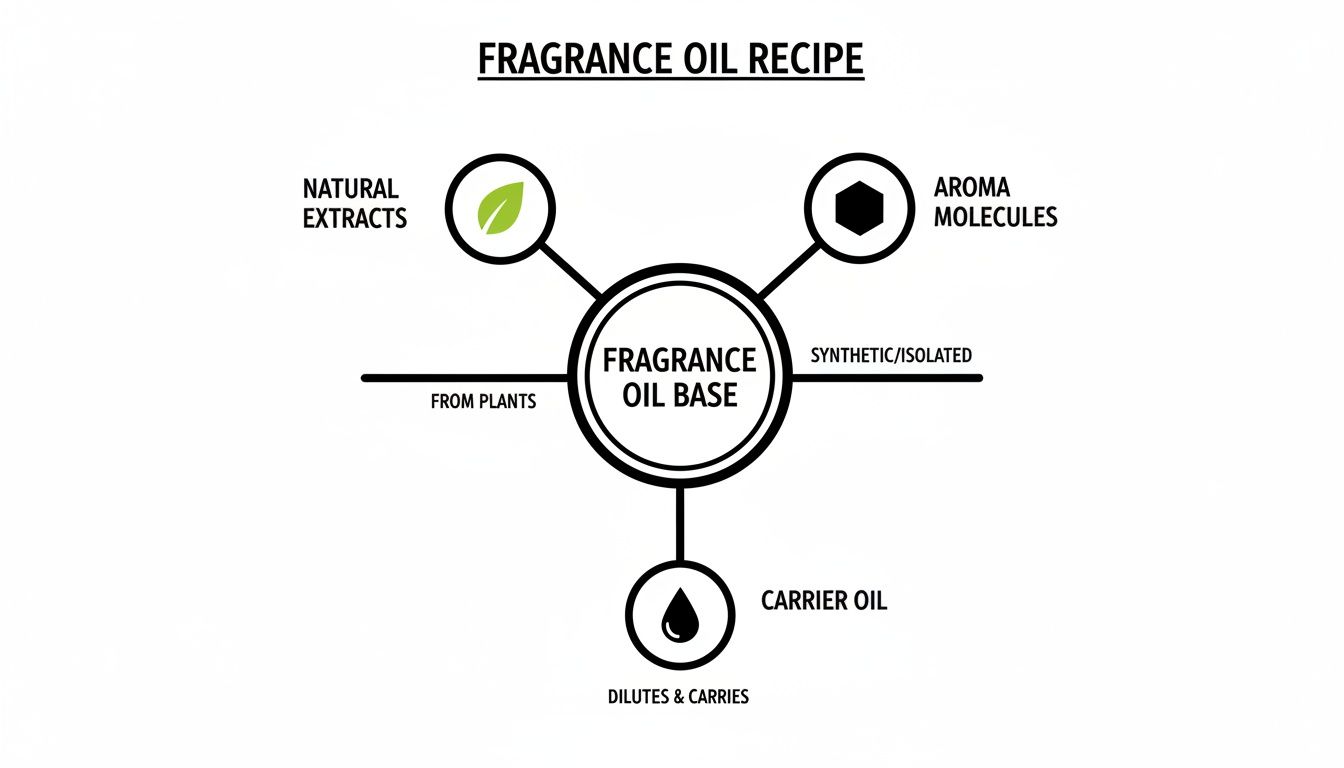
As you can see, the final scent is a symphony created from natural extracts, specially made aroma molecules, and a carrier oil base that holds it all together.
To give you a clearer picture, here's a quick rundown of those core components.
| Component Type | What It Is | Common Example |
|---|---|---|
| Natural Extracts | Aromatic compounds taken directly from plants, like flowers, fruits, or resins. | Rose absolute, lemon oil, vanilla extract |
| Aroma Molecules | Synthetic compounds, often identical to natural ones, made in a lab for consistency. | Vanillin (from vanilla), Linalool (from lavender) |
| Carrier/Solvent | A neutral, unscented oil that dilutes the potent aromatics and helps them mix. | Dipropylene glycol (DPG), isopropyl myristate |
| Fixatives | Ingredients that slow down evaporation, making the scent last much longer. | Benzoin, synthetic musks, sandalwood notes |
These building blocks are the foundation of modern perfumery and are key to creating the dependable, high-quality scents we use at Jackpot Candles.
Modern fragrance oils are incredibly sophisticated. These blends often contain dozens, and sometimes over 100 individual aromatic chemicals! Many of these were first found in essential oils and then recreated in a lab to improve stability and consistency.
These aromatic compounds are dissolved in a liquid carrier—typically solvent-grade oils—to ensure they mix seamlessly into candle wax or other products. This is where the science gets really interesting.
The true artistry of a fragrance oil is in the balance. It’s not just about what scents are in the mix, but how they’re stabilized and delivered to make sure the first whiff is just as captivating as the last lingering note.
Understanding the formulation also means being aware of how components are classified, such as perfumery products with flammable solvents, which form the base for many fragrance oils. This is crucial for handling and using them safely, whether it's in a home diffuser or a professionally made candle. Every single part of the formula is chosen not just for its scent, but for its physical properties and safety profile, too.
To really get what fragrance oils are made of, we have to ditch the simple idea that "natural is always good" and "synthetic is always bad." The truth is way more interesting. The world's best perfumers use a mix of both, treating them like different colors on a painter's palette. This lets them create scents that are consistent, safe, and often impossible to get from nature alone.
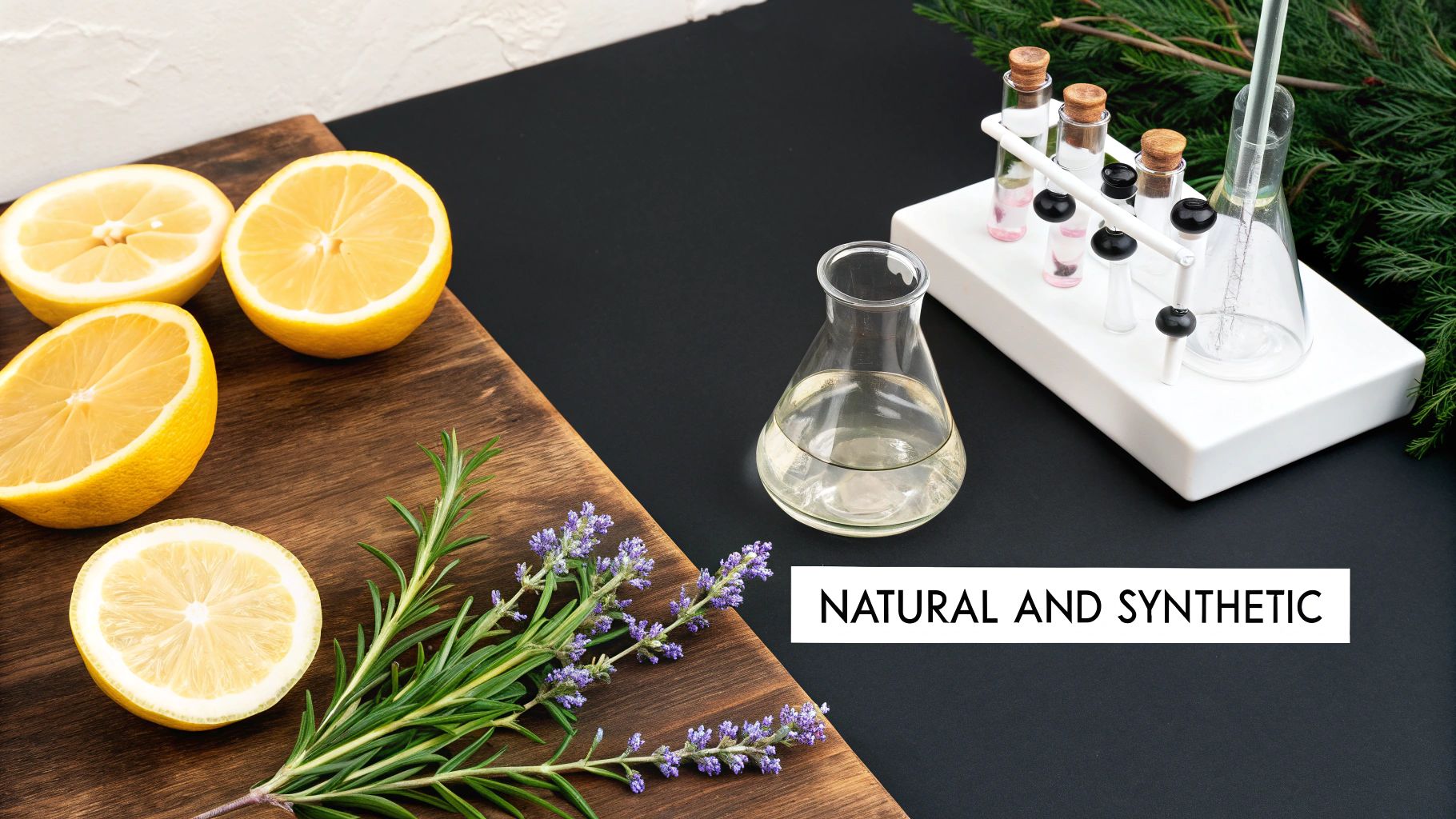
This powerful combination unlocks incredible creativity and reliability in perfumery. It's how we make sure your favorite candle smells just as amazing from the first burn right down to the very last.
When we hear "natural," most of us immediately think of pure essential oils. While those are definitely part of the picture, the term also covers something called natural isolates. Think of these as single scent molecules that have been "isolated" or pulled out from a natural source.
For instance, a lemon peel is packed with hundreds of different aromatic compounds. A perfumer might only want that one bright, zesty note, so they'll extract just the limonene molecule. This gives them a pure, consistent building block without all the other background scents you'd find in the whole essential oil.
This process gives perfumers a level of precision that’s absolutely crucial for creating balanced and predictable fragrances. You can dive deeper into the key differences in our guide comparing fragrance oils vs. essential oils.
Synthetic aroma molecules are the real backbone of modern perfumery, opening up a huge world of creative possibilities. These are generally created by chemists in a controlled lab environment and can be broken down into two main types.
Key Takeaway: Using synthetics isn't about cutting corners; it's about expanding the artistic and technical possibilities of fragrance creation. It allows for sustainability, safety, and scent profiles that nature alone simply can't provide.
This control ensures purity and removes the natural allergens that can sometimes pop up in raw botanical extracts, making synthetics a safe and reliable choice for the products you use in your home.
These are molecules made in a lab that have the exact same chemical structure as their twins found in nature. A perfect example is vanillin, the main compound that gives vanilla its classic smell and taste.
This "nature-identical" approach gives perfumers a dependable and ethical source for popular notes, ensuring your vanilla-scented candle always has that perfect, creamy aroma you love.
This is where fragrance creation gets truly artistic. Fantasy molecules are compounds that don't exist anywhere in nature—they've been invented entirely by scientists. These brand-new scents are what allow for abstract and imaginative fragrance concepts.
Ever wonder how a candle can smell like "Fresh Rain," "Ocean Mist," or "Clean Cotton"? You can't exactly bottle those scents directly from the source. They're built using unique synthetic molecules designed to trigger a feeling, a memory, or a specific vibe. Exploring how perfumers use raw materials, like in a guide to patchouli oil perfume, shows how they build upon both natural and novel notes to create a complete sensory experience.
This ability to invent new smells is what allows brands like Jackpot Candles to offer such a diverse and captivating range of exclusive fragrances. It’s the artful blend of natural isolates, nature-identical synthetics, and unique fantasy notes that defines the sophisticated, perfume-grade quality you experience in every product.
A spectacular fragrance is so much more than just the scents you smell right away. Behind the scenes, two crucial but often-overlooked components are working hard to deliver that perfect, long-lasting aroma. These are the hidden heroes of the fragrance world: carriers and fixatives.
Without them, the powerful scent compounds would be unruly, unstable, and gone in a flash.

These ingredients are the foundation of a high-performing fragrance oil, ensuring the scent is safe, consistent, and has the staying power to beautifully fragrance your space from the first burn to the last.
Imagine trying to drink super-concentrated fruit juice straight from the container—it would be way too strong! Carrier oils act like the water you’d add to that concentrate. They are neutral, unscented solvents that dilute the potent aromatic chemicals to the perfect strength.
This step is absolutely critical for a few reasons:
Common workhorses in the fragrance industry include dipropylene glycol (DPG) and isopropyl myristate (IPM). Perfumers love them because they’re great at dissolving scents, don’t have a smell of their own, and have proven safety records in home fragrance.
Now, let's talk about staying power. Ever notice how some scents seem to vanish almost as soon as you smell them? That’s because some scent molecules, especially light and airy top notes like citrus or mint, are highly volatile—meaning they evaporate very, very quickly.
This is where fixatives come in. Think of a fixative as the bassline in a song. You might not always notice it on its own, but it anchors the entire melody and gives the music structure and depth.
Fixatives are heavier, less volatile molecules that essentially hold down the lighter top and middle notes, dramatically slowing down how fast they evaporate. This simple but brilliant trick is what makes a fragrance last for hours instead of minutes.
By extending the life of those more fleeting aromas, fixatives create a richer, more complex, and longer-lasting scent experience. They make sure the fragrance unfolds gracefully over time, revealing its different layers without the top notes disappearing instantly.
Perfumers pull fixatives from both natural and synthetic sources, and each one brings something unique to the final blend.
Here at Jackpot Candles, we know that a luxurious scent experience depends on more than just the notes you smell upfront. Our perfume-grade fragrance oils are crafted with high-quality carriers and effective fixatives to ensure a consistent, safe, and beautifully enduring aroma that truly fills your room and lasts.
Understanding what goes into a fragrance oil—the delicate balance of natural extracts, specific aroma molecules, carriers, and fixatives—is one thing. But appreciating the artistry that goes into choosing a truly incredible blend? That's a whole different story. At Jackpot Candles, we don’t just pick scents; we curate experiences. And that whole process starts with an absolute commitment to perfume-grade quality.
That’s not just some buzzword we throw around. For us, "perfume-grade" is a promise. It means we hold our candle fragrances to the same high standards of complexity, sophistication, and safety as fine personal perfumes. We partner with world-class perfumers who work with premium raw materials and follow the strictest global safety guidelines. We're incredibly picky because we know the scent is the heart and soul of your candle.
Our scent selection process goes way beyond simple, one-note fragrances like "vanilla" or "lavender." We look for complex, layered blends that tell a story as they burn. Think of it as the difference between a single piano key and a full symphony. A fantastic perfume-grade fragrance unfolds over time, revealing distinct top, middle, and base notes.
A truly luxurious scent experience is dynamic. It should captivate you from the moment you light the wick, evolve as the wax melts, and leave a beautiful, lingering aroma long after the flame is extinguished. This is the standard we set for every Jackpot Candle.
This commitment means we sift through hundreds of potential fragrances. We’re searching for unique character, a scent that sparks an emotion, and a clean profile that performs perfectly in our proprietary wax. The goal is to discover those special blends that can completely change the vibe of a room and create a memory. If you want to learn more about how different oils perform, our guide on the best fragrance oils for candle making offers some great insights.
A world-class fragrance oil is only as good as the wax carrying it. That’s why we spent so much time developing our own proprietary soy wax blend, specifically engineered to be the perfect partner for these premium oils. Compared to old-school paraffin, our soy blend has some major advantages for delivering a top-tier scent experience.
This teamwork between our wax and oil is no accident. We run every single new fragrance through a tough round of testing to make sure it not only smells amazing in the bottle but performs like a dream when you light it. We check how the scent travels in different-sized rooms (that's the hot throw) and how it smells before you even light it (the cold throw). This ensures that the fragrance you fall in love with is the one you get to enjoy, rich and true, from the first light to the very end.
Knowing what goes into a fragrance oil is only half the story. The other, arguably more important half, is making sure those ingredients are safe for you and your home. Your peace of mind is everything, which is why the fragrance industry doesn't just wing it—it's guided by strict, global safety standards. This isn't a free-for-all; it's a precise science dedicated to creating beautiful aromas you can enjoy with total confidence.
At the heart of this worldwide safety effort is the International Fragrance Association (IFRA). Think of IFRA as the world's top authority on fragrance safety. This independent group of scientific experts spends its time rigorously analyzing thousands of different ingredients, both natural and synthetic, that go into fragrance oils. Their main mission? To set the rules for making and using scents safely.
IFRA's guidelines aren't just gentle suggestions—they're the gold standard that every reputable fragrance maker and brand follows. These standards are incredibly specific, laying out exactly which ingredients can be used and, just as importantly, at what maximum levels for different products.
For example, a fragrance oil that's perfectly safe for a candle has a completely different safety threshold than one used in a body lotion that you rub directly onto your skin. This detailed framework is all about protecting you, the consumer.
The work at IFRA never stops. Their standards are constantly updated based on new scientific research. This forward-thinking approach means that as we learn more about ingredients, the safety rules protecting you also evolve. Here’s what that looks like in the products you use:
This careful system of checks and balances ensures that the fragrance oils in your favorite products have been thoroughly tested and approved for their specific purpose.
At Jackpot Candles, our commitment to your safety is unwavering. We exclusively partner with perfumers and fragrance houses that strictly adhere to all IFRA standards. This is a non-negotiable part of our selection process.
This dedication means you can kick back, relax, and enjoy the beautiful, complex aromas filling your home, knowing they are built on a solid foundation of science and safety. We believe true luxury isn't just about a gorgeous scent; it's about the confidence that comes from using products crafted with the utmost care and integrity.
To learn more, check out our guide on selecting high-quality candle fragrance oils and what really sets them apart.
Ever lit a candle and felt underwhelmed by a barely-there scent? Or maybe you’ve seen a candle where the wax looks oily and strange? The secret behind a perfectly scented candle often comes down to a crucial measurement known as fragrance load.
Think of it like sweetening a glass of iced tea. A tiny bit of sugar won’t make much difference, but dumping in half the sugar bowl will create a sludgy, undrinkable mess. Fragrance load is the exact percentage of fragrance oil mixed into the candle wax by weight, and getting it right is a precise balancing act.
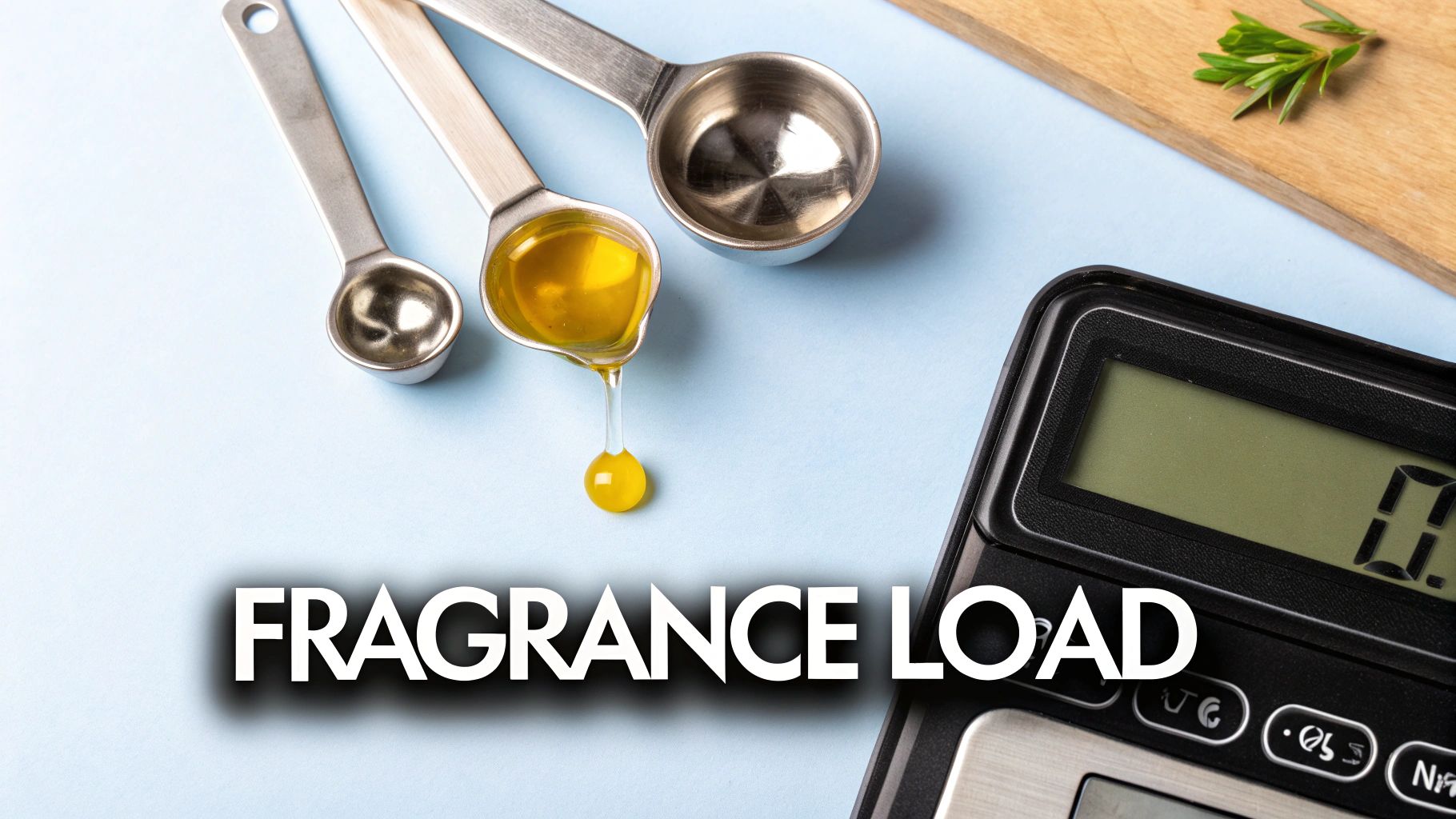
This calculation is fundamental to candle making, determining not just the scent’s intensity but the candle's overall performance and safety. It’s a key piece of the puzzle in understanding what fragrance oils are made of and how they’re designed to work.
It seems logical that adding more fragrance oil would create a stronger-smelling candle, but that’s only true up to a certain point. Every type of wax has a maximum capacity for how much oil it can molecularly bind with. Exceeding this limit leads to a host of problems.
A candle with too much fragrance load can’t properly hold onto the oil. This can cause the oil to seep out, creating oily pools on the surface or even clogging the wick, which prevents it from burning correctly. This is why a perfectly crafted candle is about balance, not just sheer power.
When the wick becomes oversaturated, or "drowns," it struggles to draw fuel (melted wax) and can produce a weak, sputtering flame or extinguish itself entirely. This is a common issue you'll see in poorly formulated candles.
So, what is the ideal range? While it varies slightly based on the specific wax and oil, the industry has established a well-tested sweet spot. In major markets, professional candle makers typically work within a range of 5–12% fragrance oil by weight.
For a strong yet stable scent throw, the most common and effective band is 6–10%. Many popular waxes, including high-quality soy blends, can safely hold up to 10% without compromising burn quality. You can dive deeper into how these percentages impact candle performance on Nikura.com.
This carefully determined range ensures the candle has a powerful scent throw—both when cold (cold throw) and when lit (hot throw)—without any structural issues.
To help visualize this, here’s what happens at different levels:
| Fragrance Load | Potential Outcome | Analogy |
|---|---|---|
| Below 5% | Very weak scent, likely unnoticeable when lit. You'll probably feel disappointed. | Making a pitcher of lemonade with just one lemon slice. It’s technically there, but you can’t taste it. |
| 6-10% | The "Sweet Spot." Strong, balanced scent throw that fills a room. The wax and wick perform as intended. | The perfect cup of coffee—strong enough to be flavorful but not so strong that it's bitter or overpowering. |
| Above 12% | The wax "sweats" oil, the wick clogs and won't stay lit, and the flame can become dangerously large or sputter. | Adding way too much flour to a cake recipe. The whole thing falls apart and becomes an inedible mess. |
As you can see, that 6-10% range is where the magic happens.
Achieving a luxurious, room-filling aroma is a testament to the expertise behind the candle's creation. It’s a careful calibration between three key elements:
At Jackpot Candles, we meticulously test every fragrance to find its perfect load within our proprietary soy wax blend. This guarantees a safe, beautiful, and powerfully aromatic experience every time you light the wick.
Of course! Here is the rewritten section, crafted to sound like an experienced human expert and match the provided examples.
As you dive into the beautiful world of home fragrance, it’s totally normal for questions to pop up. Getting to know what’s really inside a fragrance oil helps you pick scents for your home with confidence. We get a lot of the same great questions, so we’ve put together some clear, straightforward answers for you.
Nope, they're actually quite different, though they can sometimes be partners in creating a scent.
Think of essential oils as nature in a bottle. They’re extracted directly from a single plant—like lavender from the lavender plant or lemon oil from a lemon peel. They capture the pure, raw scent of that one specific thing.
Fragrance oils, on the other hand, are like a perfumer's recipe. They are carefully crafted blends that can include natural components, specially designed aroma molecules, or a mix of both. This expert blending opens up a whole universe of scent possibilities that are often more stable and consistent in products like candles than essential oils can be on their own.
This is a really common concern, and a few things could be at play. While some people are just sensitive to a particular scent note, the problem often comes down to the quality of the candle itself. Low-grade paraffin wax, for instance, can release impurities when it burns. A poorly made wick can create soot. Both can be irritating.
That’s why high-quality candles are so different. We use a clean-burning, proprietary soy wax blend and only IFRA-compliant fragrance oils. Everything is designed to minimize those potential issues, leaving you with a comfortable and purely pleasant experience.
Absolutely, as long as they are created by experts and stick to strict global safety rules. Every reputable brand, including ours here at Jackpot Candles, only uses fragrance oils where every single ingredient has been rigorously tested and approved for home use by groups like the International Fragrance Association (IFRA).
It's also interesting to know that in many cases, lab-created molecules are actually purer and more predictable than their natural counterparts, which can sometimes have surprise allergens. This scientific precision is a huge part of modern fragrance safety.
The takeaway? Don't let the word "synthetic" scare you. In the world of fragrance, it means consistency, sustainability, and a commitment to science-backed safety standards that keep you and your family safe.
This one is a hard no. You should never apply fragrance oil made for candles directly to your skin. It’s a huge safety rule. These oils are super concentrated and formulated specifically to be diffused safely through the heat of a candle.
Products designed for skin—like lotions, perfumes, or soaps—use completely different grades of fragrance at much lower, carefully regulated levels. To stay safe and have the best experience, always use fragrance products exactly as they’re intended.
At Jackpot Candles, we believe a luxurious home fragrance experience starts with transparency and trust. We hand-select only the finest, perfume-grade oils and hold ourselves to the highest safety standards. That way, we know every candle that leaves our hands will fill your space with beautiful, complex aromas you can enjoy with complete peace of mind.
Ready to experience the difference for yourself? Discover your new favorite scent in our collection of premium soy candles, each with a surprise piece of jewelry waiting inside. Find your perfect fragrance at Jackpot Candles today!
Comments will be approved before showing up.