
free shipping at $99


Boosting your customer lifetime value isn't about one-off sales.It's a complete mindset shift focused on building genuine, long-term relationships that keep people coming back for more. Think of it as moving beyond a single transaction to creating a loyal fan who loves what you do. This means elevating the entire customer experience, from that first click to their tenth order, and personalizing how you talk to them.

So many e-commerce brands get stuck on a hamster wheel, constantly chasing new customers. This sprint for fresh leads is not only exhausting but incredibly expensive. It's what's often called the "leaky bucket" problem, and it's a tough cycle to break.
This is where Customer Lifetime Value (CLV) completely changes the game.
CLV isn't just another number to pop into a spreadsheet. It’s a way of looking at your business that puts relationships first. It calculates the total amount of money you can expect from a single customer over their entire time with you. When you start focusing on CLV, you stop thinking about transactions and start thinking about connections.
Let's be real: finding a new customer can cost five times more than keeping an existing one happy. That's a huge difference. When you make CLV a priority, your focus naturally moves toward nurturing the amazing customers you already have.
This is the real secret to sustainable growth. Here’s why:
Take a brand like Jackpot Candles. Someone might buy their first candle for the fun of finding jewelry inside. But it’s the amazing scents, great experience, and feeling of getting something special that turns them into a repeat customer. A loyal fan who buys candles for every birthday and holiday is worth far more than ten people who buy once and disappear.
Here's where it gets really powerful. Studies have shown that increasing customer retention by just 5% can skyrocket profits by anywhere from 25% to 95%. That’s not a typo. Even small efforts to keep your customers happy can have a massive impact on your bottom line.
At the end of the day, a high CLV is a sign of a healthy, thriving brand. It tells you that you're delivering real value and building relationships that last. This single metric should be the compass that guides your decisions, from where you spend your marketing dollars to how you train your customer service team.
For a great overview of what makes customers stick around, it's worth exploring the principles of understanding customer loyalty. By focusing on this one metric, you're not just chasing sales—you're building a brand that can weather any storm. For more on this, check out our guide on improving e-commerce conversion rates.
You can't improve what you don't measure. Before you can dream up brilliant ways to increase customer lifetime value, you need a solid way to track it. Without a clear baseline, you're just guessing whether your retention strategies are actually moving the needle.
The good news? You don't need a Ph.D. in data science to get started. You can begin with a simple, straightforward calculation and get more sophisticated as your business scales.
The most basic way to get a snapshot of CLV is by multiplying three core metrics:
Let's run a quick example for a brand like Jackpot Candles. Say a typical customer spends $50 on average per order (AOV), comes back to buy a new candle four times a year (Purchase Frequency), and stays loyal for about two years (Customer Lifespan).
The back-of-the-napkin math looks like this: $50 x 4 x 2 = $400.
Just like that, we have a simple CLV of $400. It's a great starting point.
That $400 figure is useful, but it's a revenue number, not a profit number. It overlooks a huge piece of the puzzle: the cost of your products. A customer who spends $400 isn't putting $400 straight into your pocket.
This is where we bring in gross margin. To get a much more accurate picture of a customer's real worth, you need to factor in how much profit you make on each sale after accounting for the cost of goods sold.
The formula gets a small but powerful tweak:
(AOV x Purchase Frequency x Customer Lifespan) x Gross Margin %
Let's revisit our Jackpot Candles example. If their gross margin is a healthy 75%, the calculation tells a different story.
Now, the CLV becomes: ($50 x 4 x 2) x 0.75 = $300. This isn't just revenue; it's a far more realistic view of the actual profit that customer generates for your business over their lifetime.
Knowing your CLV is only half the battle. To truly understand the health and scalability of your business, you have to compare it against your Customer Acquisition Cost (CAC)—what you spend on marketing and sales to bring in a new customer in the first place.
This comparison, the CLV:CAC ratio, is one of the single most important metrics for sustainable growth.
Industry benchmarks suggest a healthy business should aim for a ratio of at least 3:1. For a deeper dive into the data behind this standard, check out the analysis on CMSWire.com.
The Gold Standard: A 3:1 CLV to CAC ratio is the sweet spot. It means for every dollar you spend acquiring a customer, you get three dollars back in profit over their lifetime. If your ratio is closer to 1:1, you're on a treadmill, barely breaking even. A ratio of 5:1 or higher might even mean you're not investing enough in growth and could be leaving money on the table.
This infographic neatly shows the difference between the simple and advanced models and why that ratio is so critical.
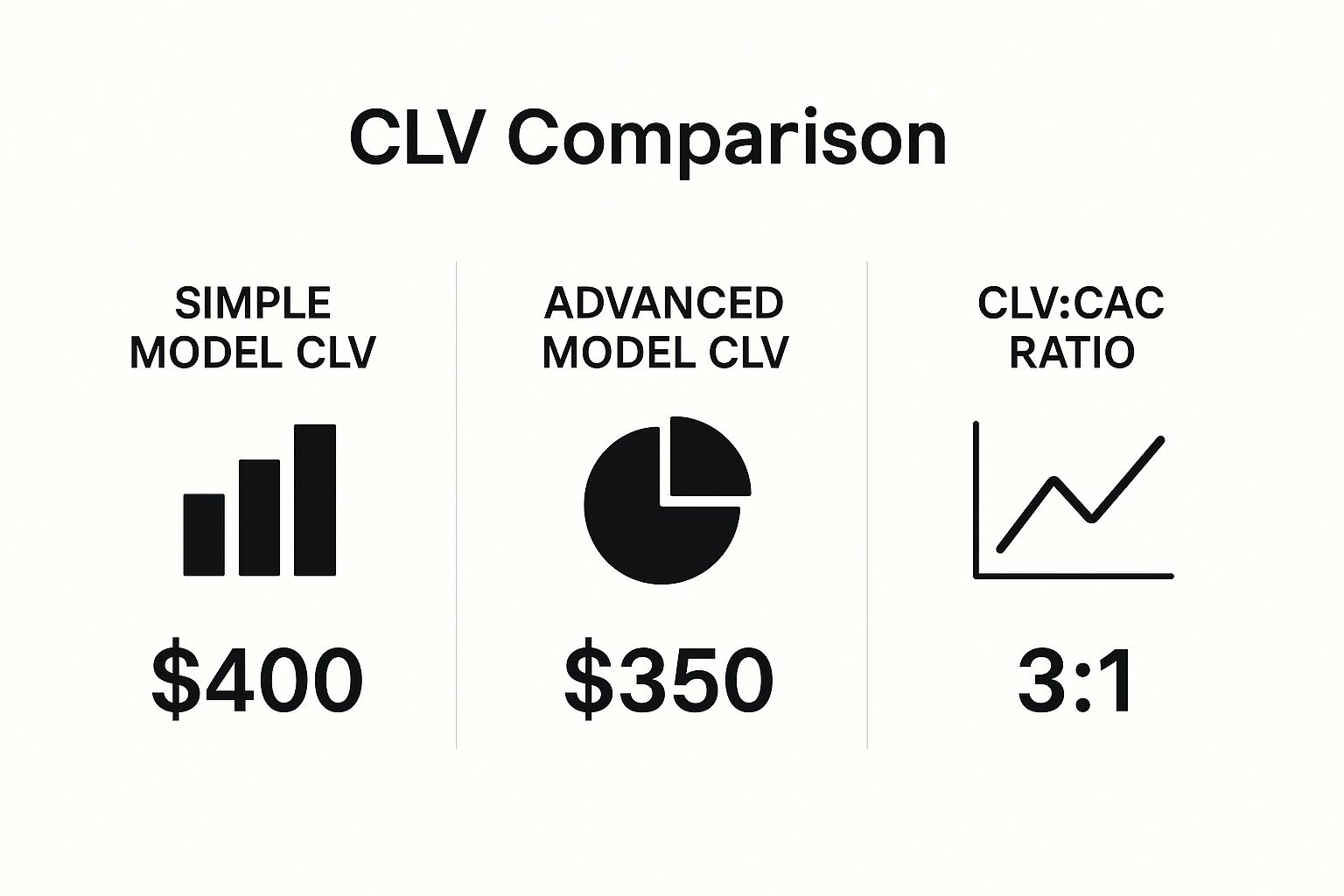
As you can see, understanding both profitability and acquisition cost gives you a much sharper view of your business's true health.
So, which calculation is right for you? It really depends on where your business is today and what data you have on hand.
This table breaks down the different models to help you pick the right starting point.
| CLV Model | Formula Breakdown | Best For | Key Limitation |
|---|---|---|---|
| Simple CLV | AOV x Purchase Frequency x Customer Lifespan | Startups and businesses new to CLV analysis. Quick, high-level estimates. | Doesn't account for profitability, which can inflate the perceived value of a customer. |
| Advanced CLV | (AOV x Purchase Frequency x Lifespan) x Gross Margin % | Growing businesses that can track profit margins accurately. Provides a profit-based view. | Still relies on averages and doesn't segment customers by behavior or value. |
| Predictive CLV | Complex statistical models using historical transaction data and machine learning. | Mature e-commerce brands with rich data sets and dedicated analytics resources. | Requires significant data, technical expertise, and specialized tools to implement correctly. |
No matter which method you choose, the key is to start somewhere. By calculating CLV, you create a baseline that allows you to accurately measure the impact of your efforts to build lasting customer relationships.

So, you've got a handle on what your CLV looks like. Now for the fun part: actually making it grow. This is where personalization stops being a buzzword and starts becoming your secret weapon for building a loyal customer base.
The days of one-size-fits-all marketing are long gone. To really boost that lifetime value, every interaction needs to feel like it was made just for them. It’s not just a nice idea—it’s what customers expect. In a recent survey, 53.9% of shoppers said the best form of personalization is getting recommendations based on things they’ve bought before.
It’s less about a huge budget and more about using the data you already have to be a little more thoughtful.
Before you can add that personal touch, you need a map. Understanding the path a customer takes—from their first visit to their fifth order—is crucial for finding those perfect moments to make a real impression.
Think about it from the perspective of a Jackpot Candles shopper:
Each of these steps is an opportunity. A generic pop-up on your site might get ignored, but what about a pop-up offering 10% off the exact candle scent they’ve looked at three times? Now that’s a game-changer.
With your customer journey mapped out, you can start putting real tactics into play. These are the little things that make someone feel like you get them, turning a simple purchase into a lasting connection.
Here are a few ideas you can start using right away:
Segment Your Email Lists: Sending the same email to every single person is a missed opportunity. Group your customers by their purchase history. If someone has only ever bought fruity-scented candles, don’t blast them with your new earthy collection. Instead, give them an exclusive heads-up about your upcoming “Summer Citrus” line. It feels less like an ad and more like a helpful tip.
Use Behavior-Triggered Messages: Pay attention to what your customers are doing on your site. If someone adds a bath bomb to their cart but gets distracted, a friendly email an hour later featuring that exact product is a powerful nudge. It shows you’re paying attention.
Celebrate Milestones: A simple "Happy Birthday!" email with a special discount is a classic for a reason—it feels personal and it works. It’s a small gesture that shows you see them as a person, not just an order number, and it often inspires them to treat themselves.
When customers feel like a company understands them, they stick around. An incredible 82.5% of people are more likely to buy again from a brand they feel "gets" them. Personalization is how you build that understanding.
The candle is just the beginning. For a brand like Jackpot Candles, the real magic is in the experience of the surprise. And personalization can make that moment even better.
Imagine a customer gets a follow-up email a week after their candle arrives. Instead of just asking for a review, what if it shared tips on "How to Make Your New Candle Last Longer" or asked what kind of jewelry they found inside? It changes the dynamic from a one-off sale to a genuine conversation.
Want to take it even further? Offer direct customization. Letting people create their own unique items is an amazing way to get them invested in your brand. To see how it’s done, you can explore how to personalize your candle for a truly special gift or keepsake.
Ultimately, a personalized journey is about a lot of small, thoughtful actions that create a big impact. Each tailored recommendation and perfectly timed message proves that you value their business, making them far more likely to become a loyal, high-value customer for life.
A well-built loyalty program is one of the most powerful tools you have for boosting customer lifetime value. But let’s be honest, a great program is so much more than just a punch card for discounts. It’s about creating a community and making your best customers feel like true insiders.
When you move beyond simple transactions and start building genuine brand affinity, that's where the magic happens.
It’s not just a hunch, either. Research shows that an incredible 80% of companies with a loyalty program see a positive return on their investment. Why? Because these programs give your biggest fans a concrete reason to keep coming back, which is the absolute bedrock of a high CLV.
The secret is making your program feel like an exclusive club that people are genuinely excited to join. It's less about saving a few bucks and more about getting access to something special.
Not all loyalty programs are created equal. The structure you land on should really feel like a natural extension of your brand and the way your customers already shop. For e-commerce brands, most models fall into a few key buckets.
Here are a few popular approaches to consider:
I've seen the most effective programs blend a few of these elements. A tiered system, for example, can still use points to track how customers move up the ranks. The key is to design a structure that feels both rewarding and achievable for your audience.
A loyalty program will live or die by its rewards. If the perks feel generic or cheap, you won't motivate anyone to change their buying habits. The best rewards are the ones that show you’re paying attention to what your customers really want.
Think beyond that standard 10% off coupon. How can you give them something that money can’t buy?
The magic happens when you create value beyond transactions. Imagine offering your top-tier members exclusive access to a limited-edition candle scent that will never be sold to the general public. That kind of insider status is what builds unshakable loyalty and gets people talking.
It’s a great idea to mix up your reward types to keep things fresh and exciting:
For a great real-world example of how to structure these perks, you can check out the details of the Jackpot Candles rewards program. Notice how it clearly lays out the benefits, making it super simple for customers to see what they get at each level.
While building a compelling loyalty program is vital, expanding your approach with other powerful customer retention marketing tactics can further solidify those long-term relationships and drive your CLV even higher. Ultimately, a successful program feels generous, is easy to use, and perfectly aligns with the brand experience you’re trying to create.
Your customers are holding the roadmap to a higher CLV. All you have to do is listen.
The best ideas for new products, service improvements, and marketing messages are often hiding in plain sight—scattered across reviews, social media comments, and support tickets. Turning this raw feedback into a growth engine is one of the most direct ways to increase customer lifetime value.
It shows customers you’re not just selling to them; you're building with them. This simple shift transforms one-time buyers into genuine brand advocates. When customers feel heard, they feel valued, and that sense of partnership is what keeps them coming back again and again.
Gathering feedback doesn't have to be a huge, complicated project. The key is to make it easy and unintrusive, meeting customers where they already are. This isn't about lengthy, ten-page surveys. It's about opening simple, accessible channels for them to share their thoughts.
Here are a few practical ways to collect valuable insights without being annoying:
By adding these small touchpoints, you create a constant stream of qualitative data. This tells you not just what people are buying, but why they’re buying it.
Okay, collecting feedback is only half the battle. The real magic happens when you close the loop—acting on what you've learned and then, crucially, telling your customers that you listened. This is where you build incredible trust and loyalty.
Let’s say several customers mention they wish Jackpot Candles offered a "Lavender and Chamomile" scent for relaxation. You have two options: file that feedback away in a spreadsheet, or actually do something about it.
If you choose to act, the process is simple:
This simple act of closing the loop makes your customers feel like co-creators. They're not just consumers anymore; they're valued partners whose opinions directly shape where your brand is going.
When customers feel like they are part of a brand's story, their loyalty deepens dramatically. They move from simply buying a product to championing a brand they helped build. This emotional investment is the cornerstone of a high lifetime value.
This whole process isn't just about making customers feel warm and fuzzy; it directly ties into the financial health of your business.
Listening to feedback helps you create products people actually want, which reduces the risk of failed launches and wasted inventory. More importantly, it helps you retain customers—which is always the most profitable path to growth.
Profitability here really hinges on your gross margin per customer combined with customer retention. A great way to track this is with Gross Margin Lifetime (GML), which is your gross margin percentage multiplied by the average revenue per customer over their lifetime. When you act on feedback to improve products, you boost retention and encourage future purchases, driving that GML number up. You can dig into more detailed analytical approaches on how GML is calculated over on owox.com.
Ultimately, a strong feedback system creates a virtuous cycle. You listen, you act, you improve, and your customers reward you with their long-term loyalty and a higher lifetime value. It’s one of the most sustainable growth strategies an e-commerce brand can possibly adopt.
Once you start digging into these strategies, you're bound to have some questions. Boosting your customer lifetime value is a long game, not a quick win, so hitting a few bumps in the road is totally normal. I've pulled together some of the most common questions brands have when they start focusing on building those long-term customer relationships.
Think of this as your go-to guide for gut-checking your progress and staying focused on what really moves the needle for sustainable growth.
This is the big one, and the honest answer is… it depends. A "good" CLV is never just a number floating on its own. It only really means something when you stack it up against what you're spending to get a customer in the first place. This is where the CLV to Customer Acquisition Cost (CAC) ratio becomes your north star.
A healthy e-commerce business typically aims for a 3:1 ratio. In plain English, for every dollar you put into marketing and sales to bring in a new customer, you should be getting at least three dollars back from them over their lifetime.
Let's make that real:
For most online stores, running the numbers on a quarterly or semi-annual basis is the sweet spot. It’s frequent enough to catch important trends and see if your new retention efforts are working, but not so often that you get bogged down in data paralysis.
Of course, there are exceptions. Say you just rolled out a brand-new loyalty program or a major personalization feature. In that case, you might want to check your CLV more often for a bit, just to get faster feedback on how it’s performing. The real trick is to stay consistent so you can make solid, year-over-year comparisons.
The biggest mistake I see companies make is defaulting to discounts to increase CLV. Sure, a sale can give you a short-term bump, but it rarely builds true loyalty. Real CLV growth comes from creating value beyond the transaction—through amazing service, experiences that feel personal, and a community people want to be part of.
Absolutely. In fact, small businesses often have a secret weapon: the ability to get personal. You don’t need a huge marketing budget or a complicated tech setup to make a real difference in your customer lifetime value.
Some of the most effective retention tactics are actually pretty low-cost and high-touch:
For a small brand, doubling down on amazing service and building a real community can have an outsized impact on CLV. It proves you don't have to outspend your competition—you just have to out-care them. That’s how you build a foundation of trust that keeps people coming back for years.
At Jackpot Candles, we believe the excitement of discovering a beautiful piece of jewelry is just the beginning of the experience. We're dedicated to crafting premium soy candles with unforgettable scents that create lasting memories. Explore our collection and find your perfect scent today.
Comments will be approved before showing up.