
free shipping at $99


We've all been there. You craft a candle that smells absolutely incredible in the jar, but the moment you light it, the scent just... disappears. It's one of the most common frustrations for candle makers, and it’s what really separates the beginners from the pros.
The secret isn't some magic trick. It's all about understanding how your core ingredients—your wax and your fragrance oil—play together.
Think of your candle wax as the delivery system for your scent. Different waxes like soy, paraffin, and coconut blends all behave differently. Some, like paraffin, are famous for their powerful hot throw—that's the scent you get when the candle is actually burning.
On the other hand, many all-natural soy waxes are fantastic at locking in fragrance, but they can be a bit shy about releasing it. Your choice of wax is the very first step that sets the stage for how strong your candle will ultimately smell.
This brings us to fragrance load. It’s simply the percentage of fragrance oil you mix into your wax, measured by weight. It’s so tempting to believe that dumping in more oil will give you a stronger scent, but that’s a classic beginner’s mistake that often leads to disappointment.
Every wax has a saturation point, usually somewhere between 6% and 12%. Pushing past this limit is a recipe for disaster. The oil won't bind properly with the wax, leaving you with a greasy, "sweating" candle that won't burn right and could even be a fire hazard.
For example, if I'm making a big, bold candle for a living room, I might push a parasoy blend to a 10% fragrance load because I know that wax can handle it and provides a stellar hot throw. But for a softer, more subtle bedroom candle, I’d probably go with a 7% load in a pure soy wax. Finding that perfect balance is everything. It's how you get candles that not only smell amazing but also burn cleanly and beautifully.
Now that we have the basics down, let's quickly summarize the most important elements that will give you that powerful scent you're after.
Here’s a quick-reference table to keep these crucial factors top of mind as you're making your next batch.
| Factor | Impact on Scent | Quick Tip |
|---|---|---|
| Wax Type | The wax's molecular structure determines how well it releases fragrance when hot (hot throw). | Parasoy blends and paraffin are known for a strong hot throw; some soy waxes need higher temps to perform. |
| Fragrance Load | The percentage of oil to wax. Too little is weak; too much causes performance issues. | Always check your wax manufacturer's recommendation, typically 6-12%. Don't exceed the max load. |
| Pour Temperature | Adding oil when the wax is too hot or too cool can ruin your scent. | Most waxes have an ideal temperature for adding fragrance, often around 185°F (85°C), but always check your supplier's guide. |
| Cure Time | This is when the fragrance oil fully binds with the wax molecules. | Skipping this step is a common mistake! Let your candles cure for 1-2 weeks for the best scent throw. |
Getting these four elements right is the foundation of a fantastic-smelling candle. Mastering them will take your candle making from a hobby to an art form.
Think of your candle's wax as the foundation for its fragrance. This is a crucial first step, because not all waxes are created equal when it comes to scent performance. The type of wax you choose will make a huge difference in both the cold throw (how it smells unlit) and the hot throw (the scent it releases while burning).
Some waxes, like good ol' paraffin, have a reputation for a seriously powerful hot throw. Their molecular structure is just really efficient at letting go of fragrance once a melt pool forms. But let's be honest, the candle world has made a big move toward natural waxes, and for very good reasons.
Natural waxes like soy and coconut blends have their own unique magic. Soy wax, for example, typically melts at a lower temperature. This is a huge advantage. It means the wax doesn't need to get scorching hot to create a melt pool, so the fragrance oils are released more gently instead of being burned off too quickly.
In fact, some studies among candle makers have shown that certain soy wax candles can throw a 15-25% stronger scent while burning compared to their paraffin counterparts. It really comes down to how the wax is built on a molecular level.
For instance, if you're making a container candle and want to fill a whole room with fragrance, a soft soy wax blend is a fantastic choice. But if you're making a pillar candle that needs to stand on its own, you’ll need a harder wax, maybe even a paraffin blend, to give it the structure it needs.
Key Takeaway: The relationship between your wax and your fragrance oil is everything. A wax with a great hot throw doesn't just hold onto the scent—it actively pushes it out into the room when you light the wick, creating that rich, amazing aroma we're all after.
To help you figure out what's best for your project, let's break down some of the most popular options out there:
If your candle wax is the stage, then the fragrance oil is definitely the star of the show. It’s what creates the magic. For a truly potent aroma, you have to start with high-quality oils specifically formulated for candle making. It's a common beginner mistake to grab an oil meant for a diffuser or soap, but they just can't handle the heat of a candle flame. The result? A weak, strange, or even burnt smell.
Think of it like cooking: you can’t expect a gourmet meal from subpar ingredients. A well-made fragrance oil gives you a clean, authentic scent that performs beautifully both when the candle is unlit (cold throw) and when it's burning (hot throw). These oils are complex, often built with a careful blend of top, middle, and base notes that reveal themselves over time. For a deeper dive, check out our guide to understanding candle fragrances and scent notes to help you pick the perfect profile for your next creation.
One of the most critical parts of the process is getting your fragrance load just right. This is simply the percentage of fragrance oil you mix into your wax, measured by weight. It might seem like more oil automatically means a stronger candle, but that’s not always true. Every type of wax has a maximum amount of oil it can hold before things get messy, typically somewhere between 6% and 12%.
So, what's the right number?
A key factor is the fragrance load—the percentage of fragrance oil relative to wax weight. A 2020 industry study found that candles with fragrance loads above 10% demonstrated a 20-30% stronger scent in both cold and hot conditions compared to those with loads around 6-8%. However, exceeding certain thresholds may negatively impact burn quality. Discover more insights about the scented candle market on grandviewresearch.com.
Finally, let’s talk about a crucial detail that often gets overlooked: the flash point. Every fragrance oil has a specific temperature where its delicate aromatic compounds start to evaporate—or "flash" off. If you add your oil to wax that's too hot, you're literally burning off the scent before it even has a chance to bind with the wax.
You can almost always find the flash point on the data sheet from your fragrance oil supplier. Make it a habit to check. As a rule of thumb, add your fragrance when the wax temperature is below the oil's flash point, but still hot enough to create a solid molecular bond. Getting this timing right is a simple step that makes a huge difference in preserving the strength and integrity of your final scent.
If you want a candle that fills the room with fragrance, you have to get your timing perfect. It's not as simple as just melting some wax and tossing in the fragrance oil. The single most important moment is when you add that oil to your melted wax—and the temperature of the wax at that exact moment is everything.
Get it wrong, and you'll be disappointed. Add the oil when the wax is scorching hot—way above the oil's flash point—and you'll literally cook off the beautiful, delicate top notes of your fragrance. All that aroma will just evaporate into thin air. But if you add it when the wax is too cool, the oil won't be able to mix in properly, leaving you with a weak scent and maybe even ugly little pools of oil on top of your finished candle.
So, what’s the secret number? For most soy waxes I've worked with, 185°F (85°C) is the magic temperature. It’s the sweet spot where the wax is hot enough for the fragrance oil to fully dissolve and bond, but not so hot that it starts to damage the scent itself. That said, always, always double-check the recommendations from your wax supplier. Different waxes behave differently, and they know their product best.
Once you hit that perfect temperature and add your oil, your next job is just as crucial: mixing. You need to stir, gently but consistently, for a full two minutes. I know it feels like a long time, but this step is non-negotiable. It's what ensures every last molecule of fragrance oil binds with the wax, giving you that strong, even scent from the first burn to the very last.
Here's a pro-tip: think slow, deliberate stirring, not aggressive whipping. If you whip it up like you're making a meringue, you're just introducing tiny air bubbles. Those bubbles can cause all sorts of problems, like lumpy tops on your candles and an uneven burn.
The final pieces of the puzzle are pouring your candle correctly and letting it cure long enough to lock in that incredible aroma. This whole temperature game plays a huge role in your final scent strength.
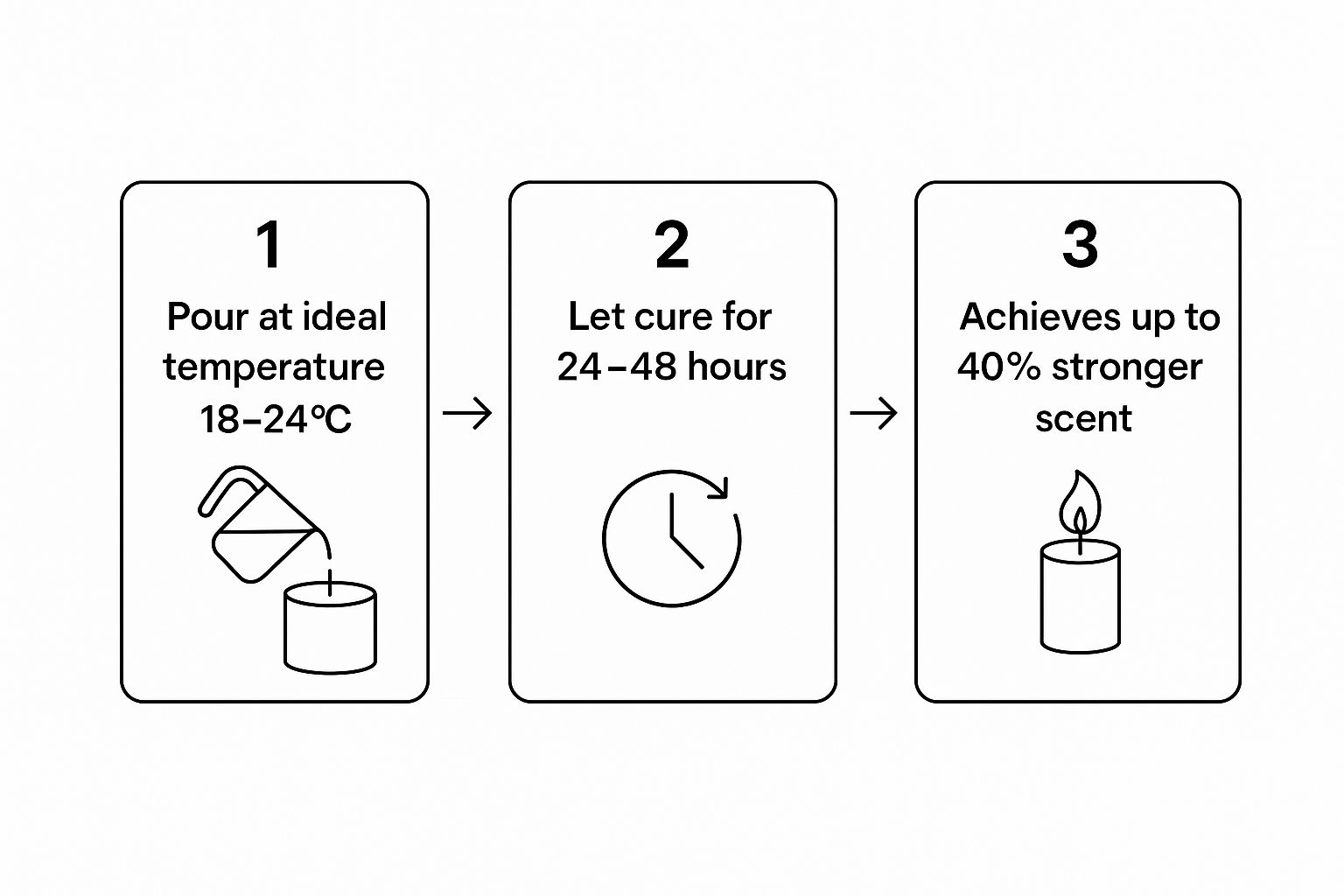
As you can see, nailing the pour temperature and giving your candles enough time to cure makes a world of difference. It’s what separates a weak, forgettable candle from one that truly smells amazing.
Here's the rewritten section, crafted to sound like an experienced human expert and match the provided blog post examples.
I'm going to let you in on a little secret. The most powerful, and most overlooked, ingredient in your candle-making arsenal is patience. I see so many beginners get excited and light their creations the second the wax looks solid. If you want a candle that actually fills the room with fragrance, that's a huge mistake.
Think of it like marinating a steak or letting a good chili simmer on the stove. The flavors don't just appear instantly; they need time to get to know each other and meld into something amazing. It's the exact same science with your candle.
This "curing" time is when the real magic happens. It's a quiet period where the fragrance oil and wax molecules are busy bonding, creating a stable, perfectly integrated structure. This molecular marriage is what ensures your fragrance is locked evenly throughout the entire candle. When you finally light it, the scent is released consistently and powerfully, not weak or spotty.
Letting your candle sit for at least a few days is non-negotiable, but the ideal time really depends on the type of wax you're using. Different waxes have their own unique structures and take different amounts of time to fully harden and trap that beautiful fragrance you paid for.
Here’s a quick cheat sheet based on my experience:
Rushing this is like pulling a cake out of the oven too early. It might look done, but the inside is a gooey, under-baked mess. Giving your candle that extra week to cure can be the single most effective thing you do to dramatically boost its scent.
Honestly, it’s the easiest step in the whole process. Just set your finished candles aside in a cool, dark spot and let science do the heavy lifting for you. You'll be so glad you waited.
Even when you follow all the rules, sometimes a batch of candles just doesn't turn out right. It’s incredibly frustrating, but trust me, every single candle maker has been there. Instead of tossing your hard work, let’s figure out what went wrong so you know exactly how to make your next batch smell amazing.
The most common complaint I hear is about a weak hot throw. This is when the candle smells fantastic when it's unlit, but gives off almost no scent when you burn it. Nine times out of ten, this is a melt pool problem. If your wick is too small for your jar, it just won't be able to melt the wax all the way to the edge. A small melt pool means less surface area, and that means less fragrance getting released into the air.
Of course, your process could also be the culprit. Think back: did you add the fragrance oil when the wax was scorching hot? You might have accidentally burned off those delicate top notes before they even had a chance to bind. Or maybe you didn't stir for the full two minutes, leaving you with pockets of unscented wax.
If your hot throw is a letdown, don't despair. Running through a quick diagnostic checklist can usually pinpoint the issue, which is the first step to fixing it for good.
A proper wick is essential not just for a great scent, but for the health and life of your candle. A wick that’s too small often causes candle tunneling—where the flame burns straight down the center, wasting tons of precious wax and fragrance. If you're seeing this happen, we have a whole guide on how to prevent and fix candle tunneling.
Sometimes the problem isn't the smell, but the look. An oily, "sweating" top or ugly cracks can ruin the appearance of your candle.
This sweating is usually a sign that the fragrance oil hasn't fully bonded with the wax. It can happen if you've used more oil than the wax can hold (exceeding its fragrance load) or if your pouring temperature was off. On the other hand, a cracked top usually means the candle cooled down way too fast. Try pouring in a warmer room next time and see if that makes a difference.
Ready to skip the troubleshooting and just enjoy a perfectly crafted candle every time? Explore the handcrafted, USA-made soy candles at Jackpot Candles and discover your new favorite scent—with a surprise piece of jewelry inside
Comments will be approved before showing up.