
free shipping at $99


You've opened a beautifully boxed candle, caught the first wave of fragrance, and noticed that the product promises more than ambiance. Somewhere inside the wax is a concealed jewelry item, so the purchase becomes part home fragrance, part gift, and part treasure hunt. The appeal is obvious, but the important questions come next: how does the hidden compartment work, what makes the wax premium, how safe is the burn, and does “luxury” describe the jewelry or only the experience?
A Jackpot Candles luxury jewelry candle makes the most sense when you understand all three layers at once: the candle's scent and burn behavior, the engineering of the hidden prize, and the evidence behind the jewelry's stated value. The reveal can be exciting without requiring you to accept vague claims.
The experience starts before the wick is lit. When you lift the lid, the fragrance should arrive first, with a clear scent profile rather than a flat burst of sweetness or smoke. The wax adds the visual appeal: a smooth surface, an intentional vessel, and the sense that you've bought a home-fragrance object rather than a disposable novelty.
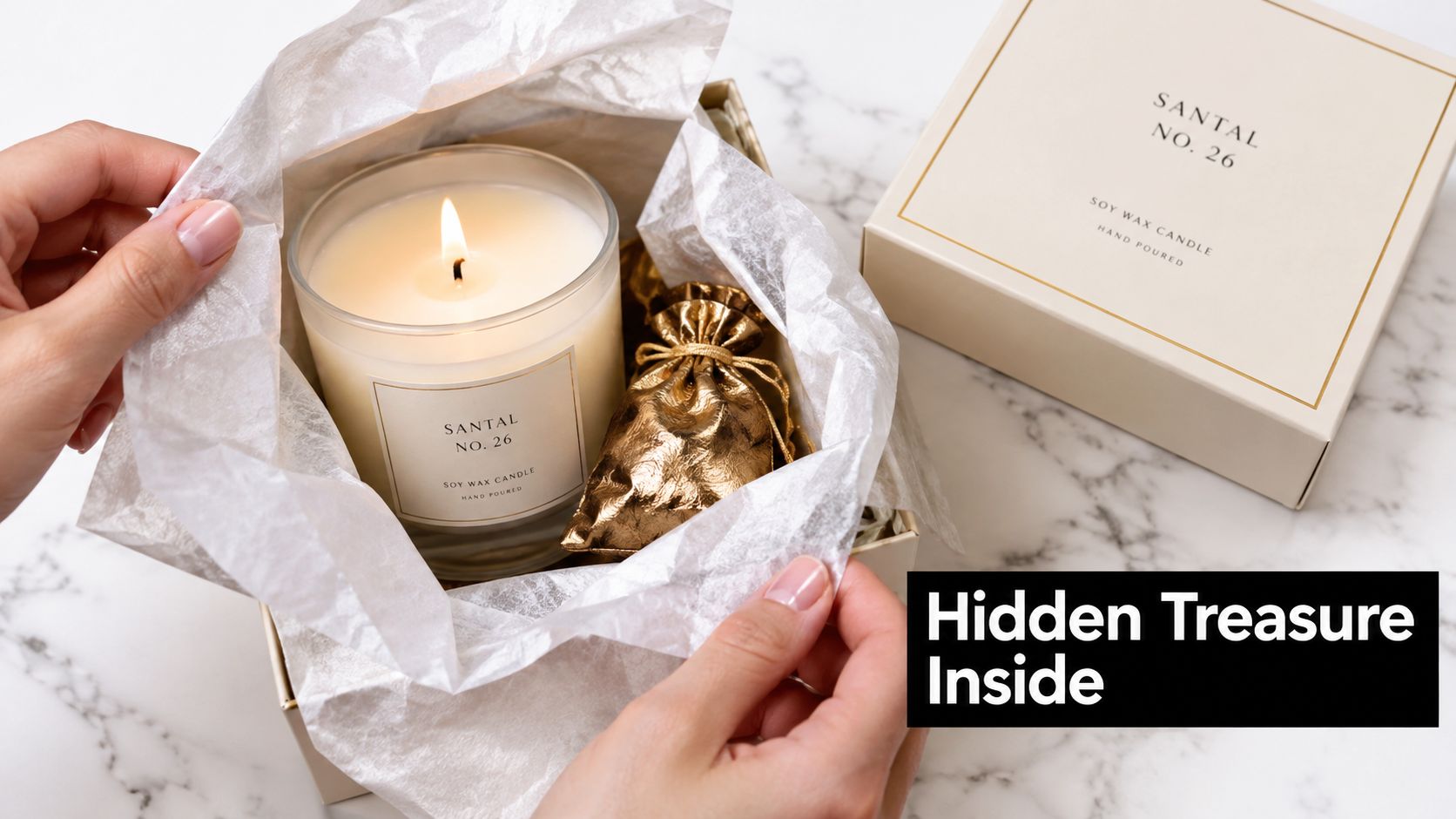
Once burning begins, the candle performs its familiar job. The wick creates a melt pool, the fragrance warms and disperses, and the room gradually takes on the character of the blend. The hidden jewelry changes the psychology of that routine. Instead of watching the wax disappear passively, you're paying attention to the moment when a protected pouch or capsule becomes visible.
That reveal should never be treated like a race. You aren't supposed to dig through liquid wax or reach toward a live flame. The safe sequence is to extinguish the candle when the package is accessible, allow the immediate heat to settle, and use a suitable tool to lift the pouch. The jewelry remains separate from the flame and wick through its protective containment, but the customer still has to handle the retrieval carefully.
A standard scented candle offers fragrance, glow, and atmosphere. A jewelry candle adds a delayed event. The product therefore serves two timelines:
That combination explains why these candles feel more interactive than ordinary décor. The item isn't only a vessel for fragrance. It creates a small story, from opening the box to discovering what the wax has been hiding.
The concept connects two established consumer categories, but the available market figures describe those categories separately rather than proving sales for hidden-jewelry candles. Grand View Research estimated the worldwide candle market at USD 14.8 billion in 2025 and projected it to reach USD 25.4 billion by 2033, with a 7.3% compound annual growth rate from 2026 through 2033. Grand View Research's candle-market overview also reported that North America represented 32.2% of global candle-market revenue in 2025, while scented candles represented 65.6%.
Scent is therefore not a minor feature added to a decorative object. It sits at the center of the category. A well-designed jewelry candle begins with the same reasons people buy premium home fragrance, such as atmosphere, relaxation, and a pleasing room identity, then adds a discovery mechanism that makes the gift more memorable.
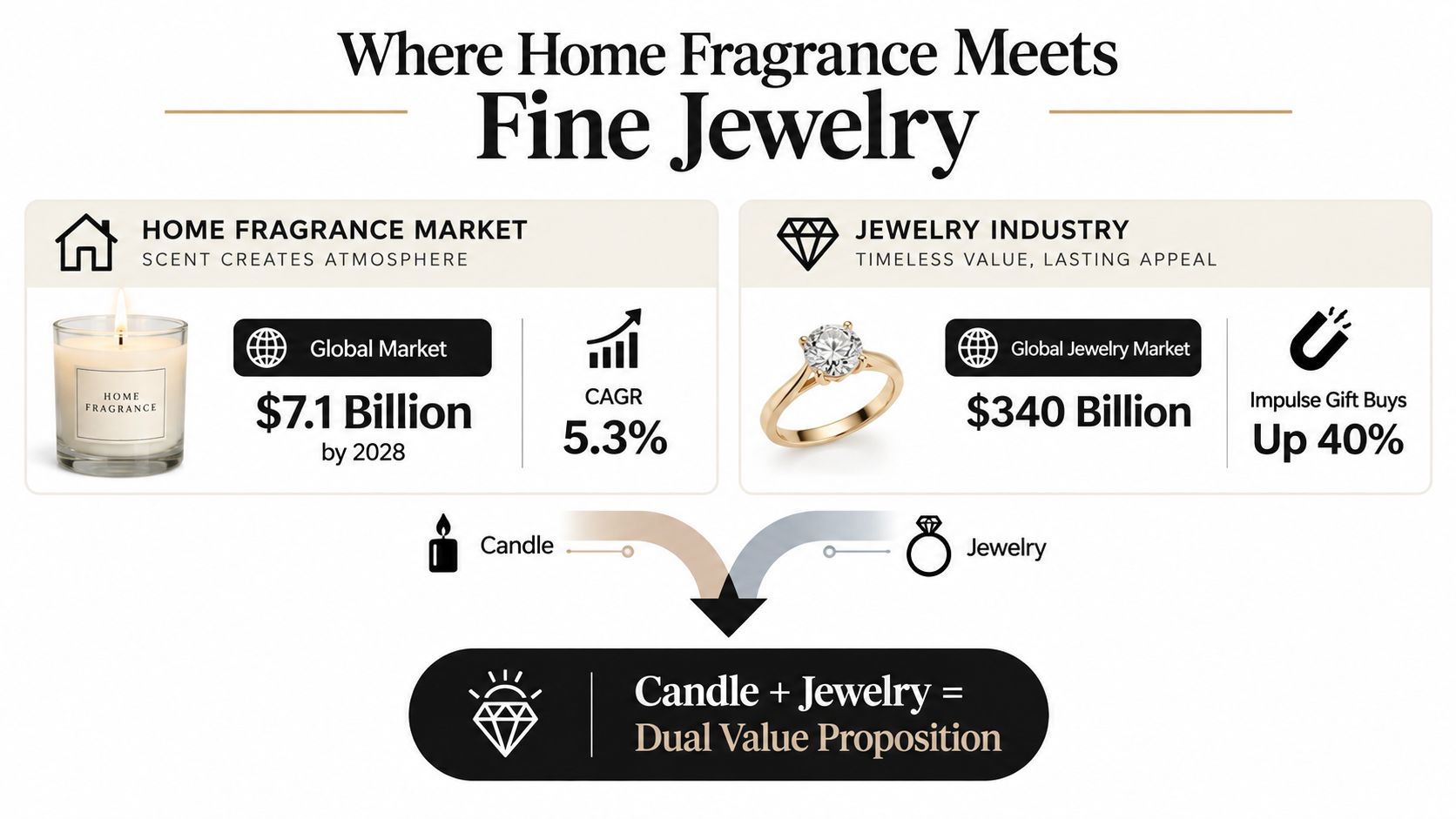
Jewelry contributes a different kind of appeal. IndexBox reported that worldwide jewelry consumption reached approximately 43,000 metric tons in 2024, up 2.4% from 2023, and projected the global jewelry market could reach USD 601.9 billion by 2030. Separately, Grand View Research estimated that global precious-metal jewelry generated USD 191.05 billion in revenue in 2024 and could reach USD 311.49 billion by 2030. These estimates cover broad jewelry markets, not jewelry concealed inside candles, so they don't establish a market share for Jackpot Candles. They do show why rings and necklaces carry strong recognition as personal and gifting products.
The candle supplies sensory value. Jewelry supplies personal and symbolic value. The hidden mechanism joins them through anticipation, which can make a gift feel more like an occasion than a product handoff.
A reader unfamiliar with jewelry materials may also benefit from a primer on precious metals and value guide from Carat 24, Trusted Gold Experts. Understanding plating, sterling silver, solid gold, and gemstone descriptions makes it easier to assess the item after the reveal rather than relying on the word “luxury” alone.
Wax controls more than appearance. It influences how the candle melts, how the wick behaves, and how fragrance moves from the solid candle into the room. A proprietary soy blend is generally selected for its lower melting point, fragrance-retention characteristics, and potential to support longer burn times. Plant-based wax can also give the candle a soft, creamy appearance that suits a premium presentation.
The phrase “soy wax” still needs careful interpretation. A blend is a finished formulation, not a single ingredient, and performance depends on the complete system. The vessel, wick, fragrance concentration, pouring process, room conditions, and embedded containment all affect what you experience.
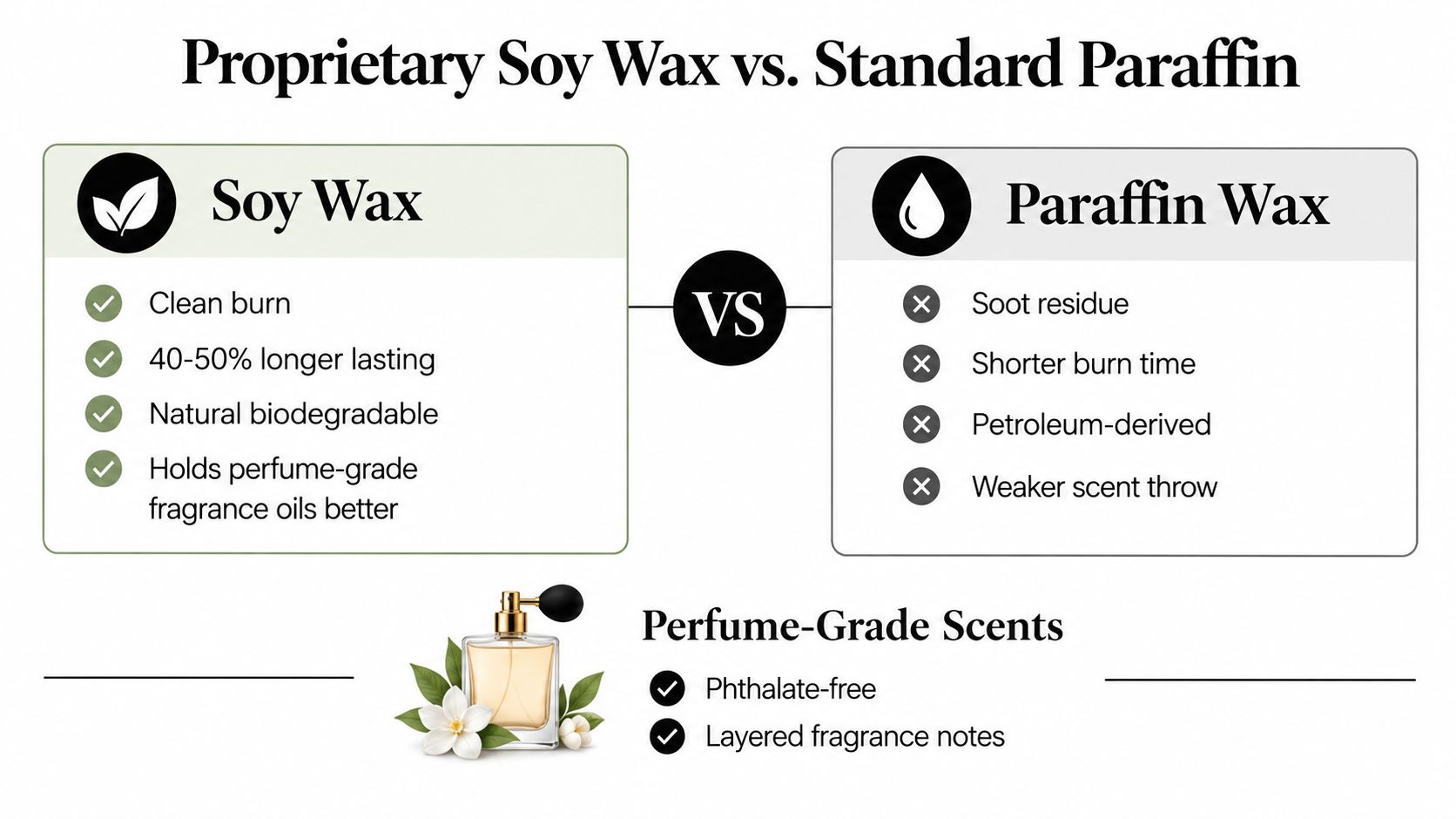
Perfume-grade fragrance oils aim to create a more structured scent journey. A blend may open with bright notes, develop into a fuller middle, and leave a softer base as the candle continues to burn. That layered effect is different from merely intensifying the scent. Excess fragrance can disrupt wax performance, so the formulator has to balance aroma with a stable melt pool and controlled flame.
The wick provides the heat that makes this possible. If it's oversized, the flame may become too tall and generate excess heat. If it's undersized, the candle may tunnel and leave wax around the vessel walls. For a jewelry candle, the wick also has to work predictably as the melt pool approaches the concealed item.
Material reality: Soy wax may support desirable fragrance retention, but the finished candle must be evaluated as a complete formulation, not judged by wax type alone.
An independent chamber-study summary reports that soy, paraffin, palm, and stearin candles produced broadly similar emissions under controlled conditions. The result makes wick design, fragrance load, and burn rate central to any claim about a clean-burning soy blend. ASTM F2326 provides a comparative method for collecting and analyzing visible candle emissions, including trimming the wick to approximately 6 to 7 millimeters before each burn cycle. The ASTM F2326 method is intended to compare formulations, not establish a universal emissions limit.
For the brand's own explanation of its material choice, read why Jackpot Candles uses soy wax. The useful buying question isn't whether soy automatically beats every alternative. Ask whether the finished candle burns evenly, releases a pleasant scent, keeps the flame stable, and includes clear instructions for the embedded item.
The most important question isn't “Could the jewelry be valuable?” It's what kind of value is being described. A ring can have emotional value because it marks a birthday, excitement value because the reveal is unexpected, or financial value because its materials and craftsmanship support a documented appraisal. Those three forms of value overlap, but they aren't interchangeable.
A responsible buyer should look for specific information after the pouch is opened:
The distinction matters because a maximum value can create an impression that doesn't describe the typical purchase. Mystery can add excitement, but it can also make the luxury claim harder to evaluate when the buyer can't compare the hidden item with a transparent product listing.
Research cited by consumer online-shopping statistics reports that 47% of consumers return to a brand's website to confirm product details after seeing social content, while 52% say authentic customer content influences their purchase decision. The same source reports that more than two-thirds of shoppers trust brands associated with high product quality and value. Those figures support a simple principle: product pages, packaging, and appraisal explanations should answer the questions that short reveal videos leave open.
Start with the jewelry itself. Inspect hallmarks, stone settings, clasp or band quality, surface finish, and any accompanying paperwork. If the item is described as precious metal or includes a significant gemstone, an independent jeweler can provide a more useful opinion than a promotional label.
You can also compare the surprise format with other thoughtful gifting options, including these inexpensive yet thoughtful presents from That Blanket Co. The comparison helps clarify what you're paying for. A jewelry candle offers fragrance, ceremony, and uncertainty. A conventional jewelry gift offers clearer material information before purchase. Neither is automatically more luxurious.
For a brand-specific explanation of how a ring's stated amount should be interpreted, see the Jackpot Candles ring value guide. Treat any stated value as a claim that deserves definition, not as a guaranteed resale amount or investment return.
An embedded item creates a safety responsibility that ordinary candle guidance doesn't fully address. The jewelry must remain isolated from the flame, wick, and overheated glass, and the customer needs a clear stopping point before attempting retrieval.
U.S. fire-safety statistics report an average of 5,830 home candle fires annually from 2019 through 2023, with about 70 deaths, 570 injuries, and USD 270 million in direct property damage each year. The summarized candle-safety statistics reinforce why a novelty mechanism doesn't reduce the ordinary risks of an open flame.
ASTM F2417-23 addresses minimum fire-safety requirements for candles and candle ensembles, including wick migration or leaning that allows the flame to contact the container for more than five seconds. The U.S. Consumer Product Safety Commission identifies ASTM F2058 labeling, ASTM F2326 emissions testing, and ASTM F2417 fire-safety specifications as relevant voluntary candle standards in its candle-safety guidance.
Never retrieve the capsule from a lit candle or reach through hot wax. Extinguish first, then let the tool do the work.
Ventilation also matters. A 2025 study cited in the available coverage found that one scented candle raised nearby PM2.5 to approximately 26 to 31 micrograms per cubic meter within 30 minutes. People with asthma or fragrance sensitivity should use caution, ventilate the room, and stop if the scent causes discomfort. For a brand-specific overview of the reveal process, consult the jewelry candle reveal guide, while still following the product's current instructions.
A luxury jewelry candle works best when the recipient enjoys both parts of the product. Someone who likes fragrance but dislikes uncertainty may prefer a conventional candle or openly specified jewelry. Someone who enjoys unboxing, surprise gifts, and a slow evening ritual may appreciate the delayed reveal.
For gifting, match the scent style to the person rather than choosing only by the jewelry promise. Warm woods, floral blends, fresh notes, and gourmand profiles create different moods. If you don't know the recipient's fragrance preferences, a less intense or broadly appealing profile may be safer than a highly distinctive blend.
Seasonal use deserves the same care as everyday burning. For additional practical guidance on placement, supervision, and household conditions, review this resource on seasonal candle safety advice. The central decision is straightforward: choose this format when the scent, atmosphere, and reveal are all part of the appeal.
Jackpot Candles offers scented soy-blend candles with a hidden jewelry reveal, combining home fragrance with an interactive unboxing experience. Explore the available scents and jewelry candle options at Jackpot Candles, then choose a product whose materials, value information, and safety instructions match what you want from the experience.
Comments will be approved before showing up.