
free shipping at $99


You've found the perfect jewel tone candle set for the coffee table, but the first burn raises practical questions. Will the deep color behave like the fragrance-rich wax promises? Should emerald and sapphire sit together, or will the display make a small room feel heavy? And does a more expensive candle automatically mean cleaner indoor air?
A well-made set answers those questions through balanced color chemistry, controlled fragrance, stable burning, and intentional placement. The best pieces look striking before they're lit, then deliver an even melt pool, a pleasant scent, and a display that feels considered rather than crowded.
A deep emerald vessel catches the last daylight on a shelf. Once lit, its amber flame turns the glass warmer, while a sapphire candle nearby releases a woody fragrance that makes the room feel quieter. An amethyst jar adds a softer note, its purple color shifting as the candlelight moves across the surface.
That collection is more than a group of brightly colored candles. A jewel tone candle set brings together vessels or waxes with the saturation and depth associated with gemstone colors, including emerald, sapphire, ruby, burgundy, cranberry, and amethyst. The visual effect comes from rich pigment, reflective glass or polished finishes, and the contrast between dark color and warm flame.
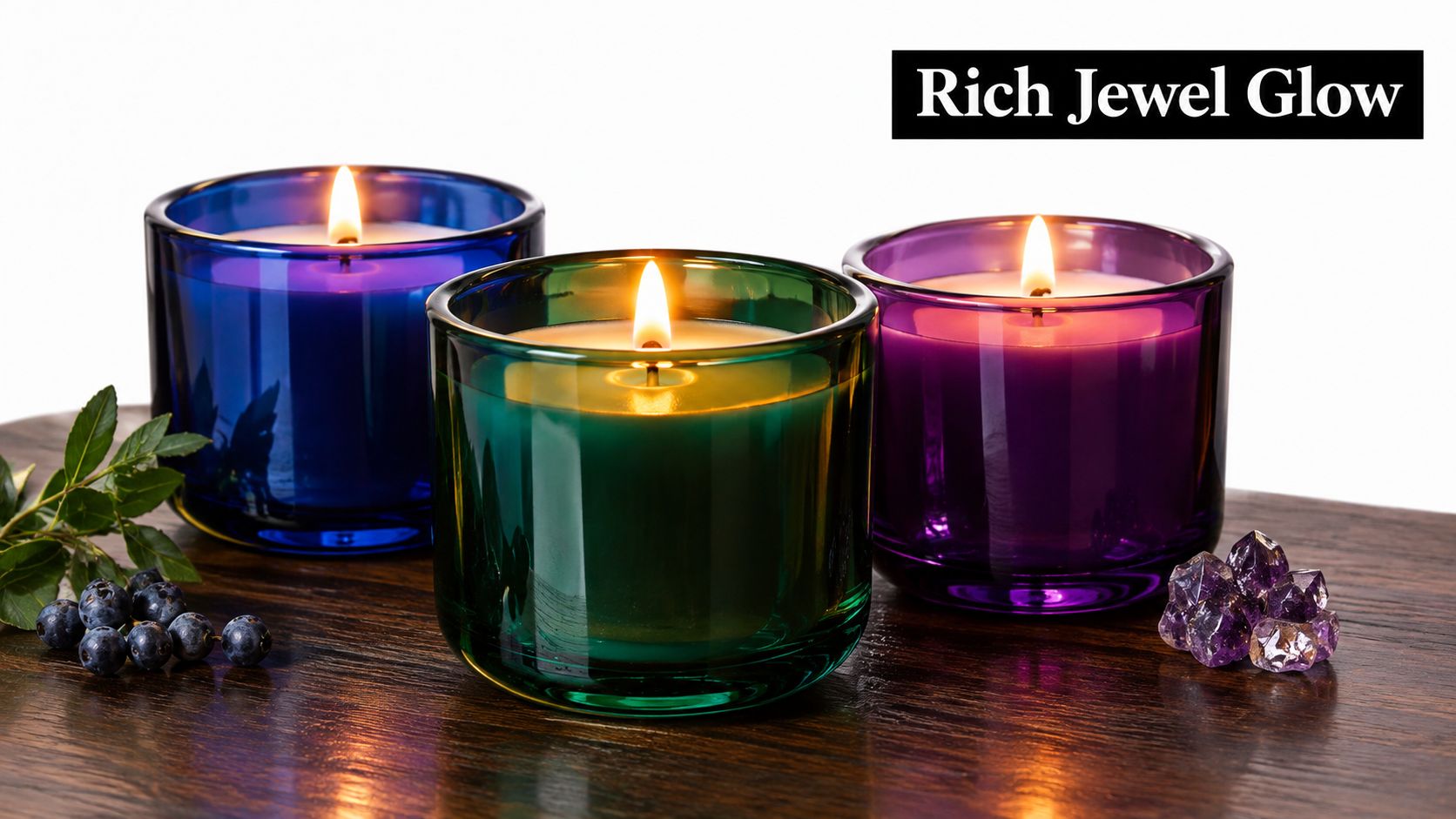
Standard decorative candles may rely mainly on shape or color. A considered jewel-tone collection adds a coordinated sensory experience:
The trade-off is that darker shades are less forgiving. A slightly uneven surface, fading near a sunny window, or a smoky wick is more visible against a premium jewel-colored finish. That's why luxury isn't created by intense color alone. It comes from consistency across the unboxing, the first light, the fragrance development, and the final burn.
Practical rule: Treat a jewel-tone set as both a decorative collection and a tested combustion product. If one side is neglected, the experience feels incomplete.
Pastel candles can achieve a soft visual effect with relatively subtle coloration. Ruby, emerald, and sapphire shades usually demand more concentrated dye or pigment, and that additive becomes part of the burn system rather than remaining a purely decorative detail. Candle colorants can influence melt-pool behavior, liquid-wax viscosity, wick loading, soot, and flame stability.
ASTM F2417-23 addresses additives used for color, scent, stability, and burn modification. Its requirements include a stable wick that doesn't migrate or lean in a way that allows the flame to contact the container for more than 5 seconds. That makes color validation inseparable from vessel and wick testing, particularly in a set where every shade may behave differently. (ASTM F2417-23 preview)
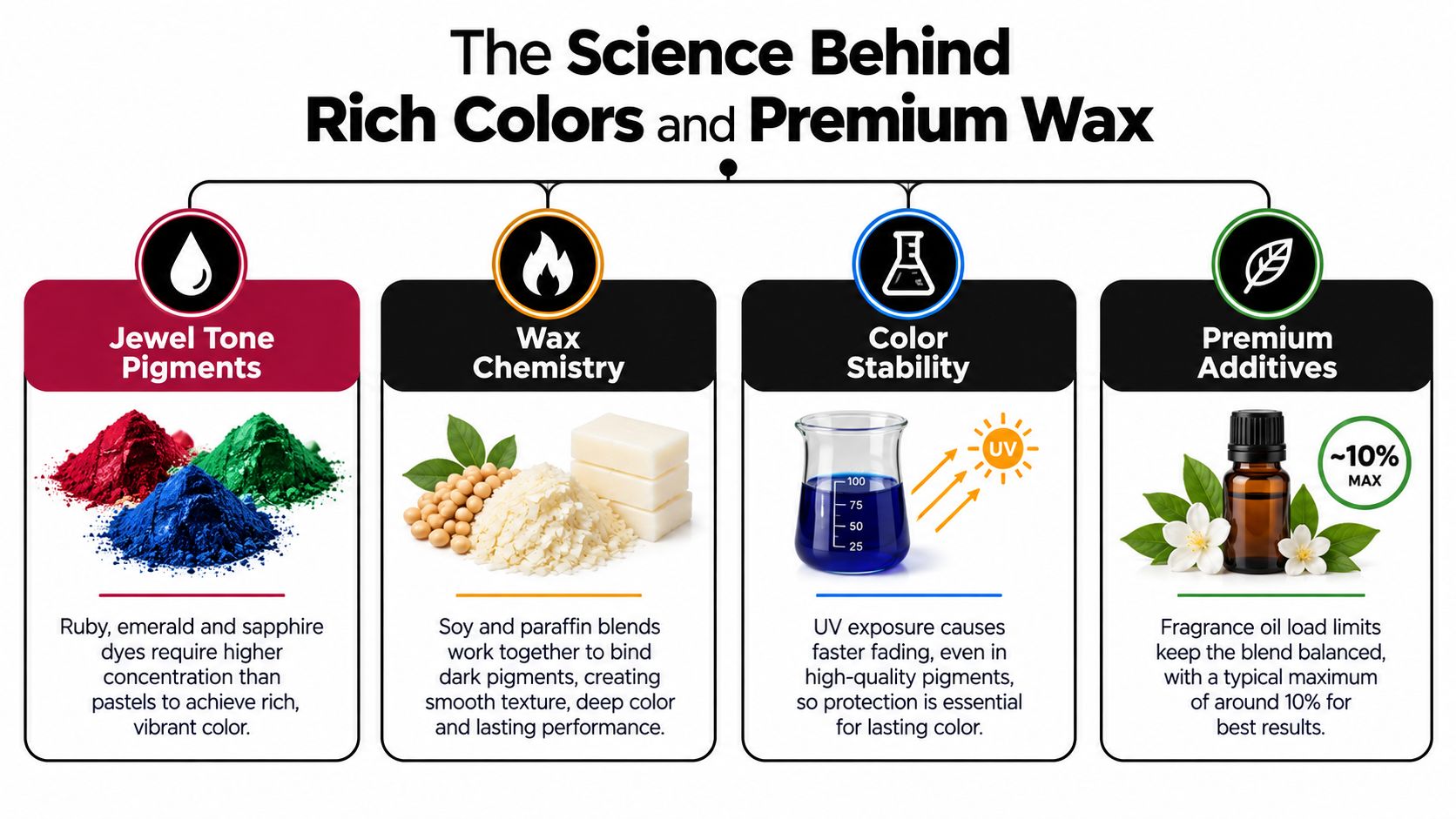
A soy-based wax blend can carry fragrance effectively, but its crystalline structure, cooling behavior, and interaction with dye all affect the finished candle. One color may form a smooth melt pool while another leaves residue around the vessel edge. A fragrance oil can also change viscosity and alter how quickly the wick consumes liquid wax.
A development team should approve each color and fragrance combination independently, not assume that a successful emerald candle proves the sapphire version will perform identically. The final vessel matters too, because glass thickness, diameter, and shape influence heat distribution.
Look for signs that the formula hasn't been fully validated:
Soy wax development also benefits from transparent batch records. A useful guide to this timeless ingredient illustrates the broader value of understanding an ingredient's characteristics rather than judging a finished product by appearance alone. For candle buyers, the equivalent question is simple: has the maker tested the actual wax, dye, fragrance, wick, and vessel together?
For more background on formulation choices, see this practical resource on soy wax for candles. The important distinction is that “soy” on a label doesn't eliminate the need for testing. A proprietary blend can perform well, but its quality depends on the full formula and the controls behind it.
Price offers little protection against poor candle emissions. Research in independent indoor-air-quality testing found that fragrance additives contributed to volatile organic compound concentrations, while unscented candles produced the fewest organic compounds among the tested options. Emissions also differed by fragrance category. Fresh and fruit scents produced higher formaldehyde and acetaldehyde levels than several other categories in the testing.
Scented candles remain usable. Fragrance strength, room size, ventilation, and burn habits matter more than a luxury label. A jewel-tone set should look intentional without leaving visible haze or an overpowering smell in the room.
Is the fragrance load controlled? Independent soy-wax testing found that the wax held tested fragrance oils at concentrations up to 10% by weight, with fragrance added at approximately 87.8°C. A technical guide places typical soy-wax limits around 10–12% by weight and warns that oversaturation can leave unbound oil on the surface. The soy wax testing notes provide the source data. A responsible maker should weigh fragrance against wax mass, stay within the supplier's validated range, and compare scent performance after both 24 hours and one week of curing.
Does the label support controlled use? Look for wick-trimming instructions, burn guidance, vessel warnings, and a clear recommendation to extinguish the candle before leaving the room or going to sleep. Vague directions place too much responsibility on the buyer. Clear instructions also help protect the visual finish of a colored vessel from soot and uneven burning.
Does the scent suit the setting? A powerful fruit or fresh fragrance may feel excessive in a compact bedroom, while a subtle wood or unscented candle can work better near food. People with asthma, children, and pets may call for a more conservative approach, including shorter sessions and stronger ventilation.
The National Fire Protection Association's candle safety data reports an estimated annual average of 5,894 U.S. home structure fires caused by candles, resulting in approximately 63 civilian deaths, 532 civilian injuries, and $286 million in direct property damage. More than half began when a combustible item was too close to the flame, and 36% began in bedrooms. The U.S. Fire Administration recommends keeping candles at least 12 inches from anything that can burn.
A decorative vessel surrounded by books, textiles, dried flowers, or wrapping materials needs deliberate placement. A premium-looking set still contains an open flame, so arrange it where clearance is obvious and safe use remains easy.
Color should respond to the room rather than compete with it. Emerald, sapphire, burgundy, and cranberry are identified as expanding 2026 interior design directions, with designers recommending jewel tones as smaller accent moments and encouraging mixed palettes instead of one saturated color taking over the entire room. (Good Housekeeping's 2026 design coverage)
| Space condition | Color approach | Fragrance direction |
|---|---|---|
| Dark walls or low evening light | Emerald, sapphire, or burgundy can add depth without looking out of place. | Woods, amber, resin, or restrained spice. |
| Bright room with pale walls | Vivid emerald, ruby, cranberry, or amethyst creates a stronger focal point. | Fresh, floral, or fruit notes, used with restraint. |
| Neutral wood, stone, or linen | Mix two jewel tones and let the neutral materials provide breathing room. | Pair one expressive scent with quieter supporting fragrances. |
| Small room | Choose fewer visual accents and avoid making every candle highly saturated. | Select a lighter or less persistent scent profile. |
A useful combination might place emerald beside sapphire, then soften the arrangement with cream ceramics, pale wood, or clear glass. Ruby and cranberry create warmth, but they can feel visually dense when surrounded by more dark red accessories. Amethyst introduces a cooler, more atmospheric note and often works as the bridge between blue and burgundy.
Don't match every color exactly. Variation gives the collection rhythm, while a repeated metal, neutral vessel, or material keeps it coherent. The same principle applies to fragrance. A set with three visually intense candles doesn't need three equally forceful scents.
Use this candle scent guide to compare fragrance families before choosing a set. Think about the room's job first. A living room can support a richer evening scent, while a dining area usually benefits from something subtle that won't interfere with food.
A set looks polished when the eye can move through it. Grouping every dark vessel tightly on one small tray often creates a heavy block of color, especially against a dark table. Spacing, height, and background determine whether the candles read as a composition or a pile of matching objects.
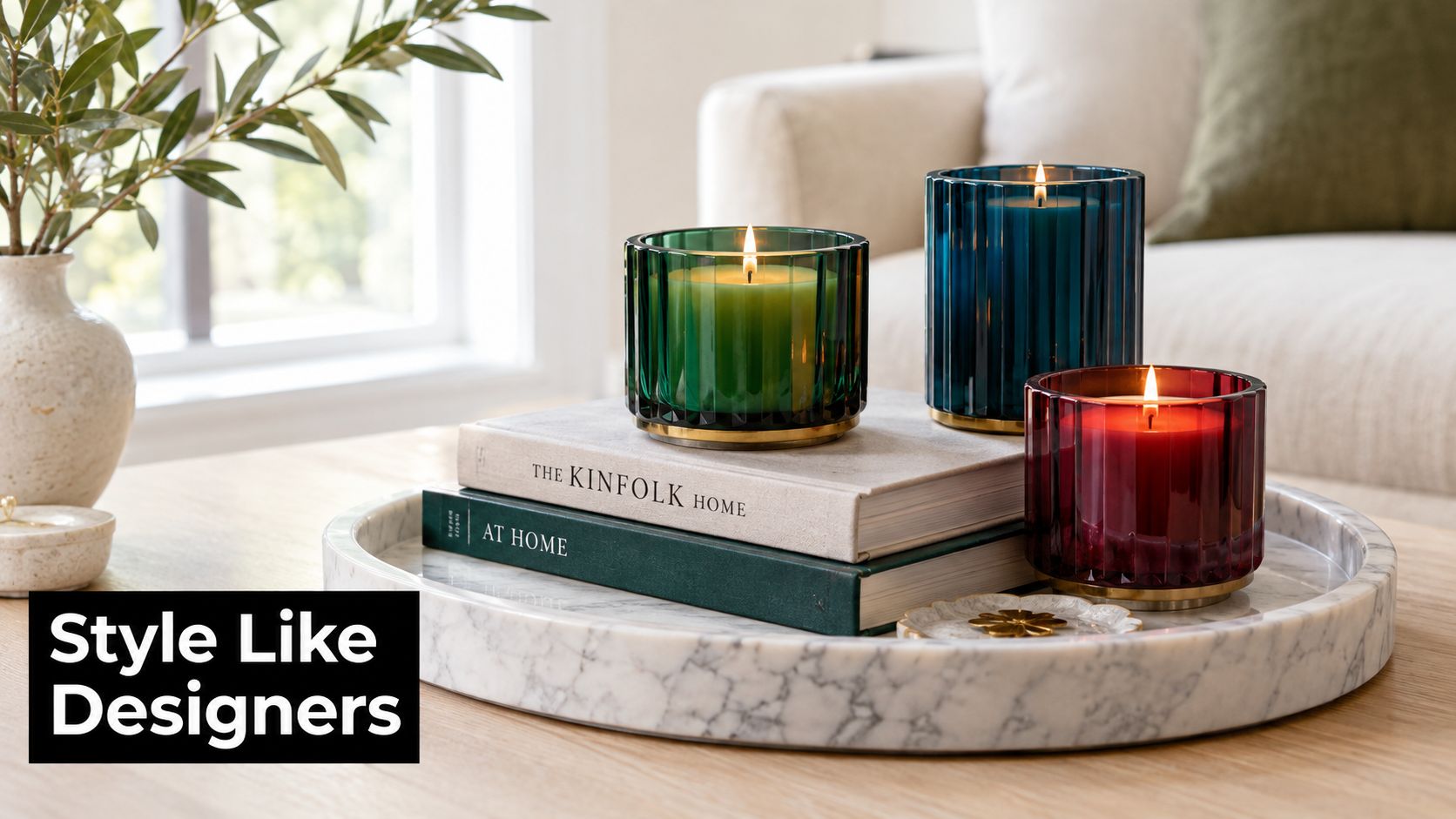
On a coffee table, place the set on a heat-resistant tray with one vessel slightly forward and the others offset behind it. Stack books underneath only if the surface remains stable and the flames sit well away from pages, fabric, and overhanging décor. Marble, ceramic, or a properly rated metal tray can create a visual boundary without competing with the colors.
For a shelf, avoid lining all the candles at identical height. Put the deepest shade near a neutral object, then separate another candle with a plant, pale sculpture, or open space. On a console table, a pair can anchor one side while a taller lamp, vase, or artwork balances the opposite side.
During daylight, saturated glass may appear almost opaque. In the evening, the flame reveals translucency and makes the color feel warmer. That shift is part of the appeal, so test the arrangement both lit and unlit.
Rich color needs visual breathing room. A neutral surface often makes a jewel tone look more luxurious than additional decoration does.
Renters can create the same effect without wall changes. Use a removable tray, a stack of stable books, and a small grouping that can move between rooms. In a bedroom or bathroom, keep the display especially restrained and never place a lit candle where bedding, towels, curtains, or toiletries can reach the flame.
A jewel tone candle set already creates anticipation through color, fragrance, and presentation. Add a hidden piece of jewelry, and the recipient has another reason to engage with the candle instead of treating it as a static ornament.
The unboxing unfolds in stages. First comes the visual impression of sapphire, ruby, or emerald packaging. Then the recipient chooses a scent, lights the candle, and waits for the concealed surprise to emerge as the wax is used. The gift becomes an event that can be shared, discussed, and remembered.
For a birthday, a mixed-color collection gives the recipient several moods to explore. A holiday gift can lean toward burgundy, cranberry, or emerald without being limited to seasonal use. As a hostess gift, a smaller coordinated set may feel more personal than a single generic fragrance, especially when the vessels can remain on display after the first burn.
Value perception also depends on the experience being credible. The jewelry reveal should complement, not rescue, a candle with weak fragrance or poor burn behavior. A beautiful container, a stable wick, clear instructions, and a thoughtfully chosen surprise all contribute to the gift's impact.
For placement inspiration beyond the usual tray arrangement, these accent styling tips for Atlanta homes offer useful perspective on using candlelight as part of a larger interior composition. The same principle applies here: the candle should fit the recipient's home before it creates its reveal.
Explain the experience before gifting it, particularly if the jewelry is concealed inside the wax. Guidance on what a jewelry candle is can help the recipient understand the process and avoid treating the hidden item as an unexpected defect.
Use a jewel tone candle set as a controlled sensory experience, with color, scent, and air movement working together.
A successful jewel tone candle set brings three decisions into alignment.
Selection means looking beyond saturated color. Check the relationship between dye, wax, fragrance, wick, and vessel. Strong fragrance isn't automatically better, and a premium price isn't proof of lower emissions.
Styling means giving the colors a setting that supports them. Mix emerald, sapphire, ruby, burgundy, cranberry, or amethyst with neutral materials, vary placement, and test the display in both daylight and candlelight. A small accent arrangement usually has more impact than covering every surface.
Use means protecting the experience through clearance, supervision, ventilation, and sensible fragrance choices. The flame is part of the product, so safe handling belongs alongside scent and appearance.
For another perspective on combining presentation with careful use, these styling and safety tips reinforce the value of treating the holder, surface, surrounding objects, and flame as one arrangement. That mindset prevents the most common mistake, buying a visually dramatic set without deciding how it will function in the room.
A jewel tone candle set earns its place when it remains beautiful unlit, burns predictably, smells considered rather than overpowering, and fits naturally into daily life.
Explore Jackpot Candles for scented soy-blend candles and bath bombs designed with a hidden jewelry surprise inside. Choose a jewel-toned gift that combines display-worthy color, fragrance, and the anticipation of a meaningful reveal.
Comments will be approved before showing up.