
free shipping at $99


You're standing in a candle aisle, comparing labels that all promise a beautiful fragrance and a better burn. One jar says soy, another says paraffin, and a third uses a blend. If you make candles yourself, the decision can feel even less certain: should you add more fragrance, change the wick, or choose a different wax entirely?
Soy wax for candles has moved well beyond its early niche. The broader soy wax market was valued at about USD 5.74 billion in 2024 and is projected to reach USD 6.15 billion in 2025, with forecasts reaching roughly USD 11.49 billion by 2034 at a 7.2% CAGR, according to Business Research Insights' soy wax market overview. Another market source projects the category at USD 14.3 billion by 2030, pointing to continued use across candles and personal-care products.
That popularity doesn't mean soy wins every performance test. A candle's results depend on the wax formulation, fragrance load, wick, vessel, and burning habits working together. This guide separates broad marketing language from practical performance, so you can understand when soy makes sense, when paraffin or a blend may perform better, and how to choose a candle that suits your room.
A new candle often looks simple enough. You remove the lid, catch the fragrance before lighting it, and expect the scent to fill the room once the wick is burning. Then the questions appear. Will it tunnel down the middle? Will the fragrance feel soft or powerful? Will the wax leave soot on the glass?
Soy wax became popular because it offers a plant-derived alternative to traditional petroleum-based paraffin. It has a creamy appearance, a relatively soft texture, and a natural connection to soybean oil that appeals to buyers looking for plant-based home fragrance. Makers can formulate it for container candles that melt gradually and release fragrance through a controlled pool of liquid wax.
The category is now mainstream rather than experimental. One industry summary reports that plant-based waxes account for about 30% of the candle market, while soy wax held a 42.8% share of the luxury candle segment in 2025. The same summary says more than 63% of US households bought at least one soy-based candle in 2022, showing how familiar soy candles have become in everyday purchasing Ringly's candle industry statistics summary.
The useful question isn't “Is soy clean?” It's “Does this specific soy candle match the way I want to use it?”
That distinction matters for both shoppers and candle makers. A small soy candle may perform beautifully on a bedside table, while a large jar needs careful wick testing to create enough heat and scent diffusion. A paraffin candle may provide a more forceful fragrance impression, while soy may suit someone who prefers a slower, gentler atmosphere.
The following sections focus on those practical choices. You'll learn what soy wax is, how it differs from paraffin and beeswax, why melting point and fragrance load matter, and how wick selection and container size influence the final experience.
Soy wax begins with soybean oil, not with a naturally occurring block of wax. Manufacturers extract oil from soybeans and then change its structure through hydrogenation, a process that makes the liquid oil firmer and more stable at room temperature.
A kitchen analogy helps. Vegetable oil stays fluid in a bottle, while a spreadable butter-like product holds its shape. Hydrogenation gives soybean oil a similar transformation. The finished material becomes a soft, creamy solid that can melt when heated and harden again as it cools.
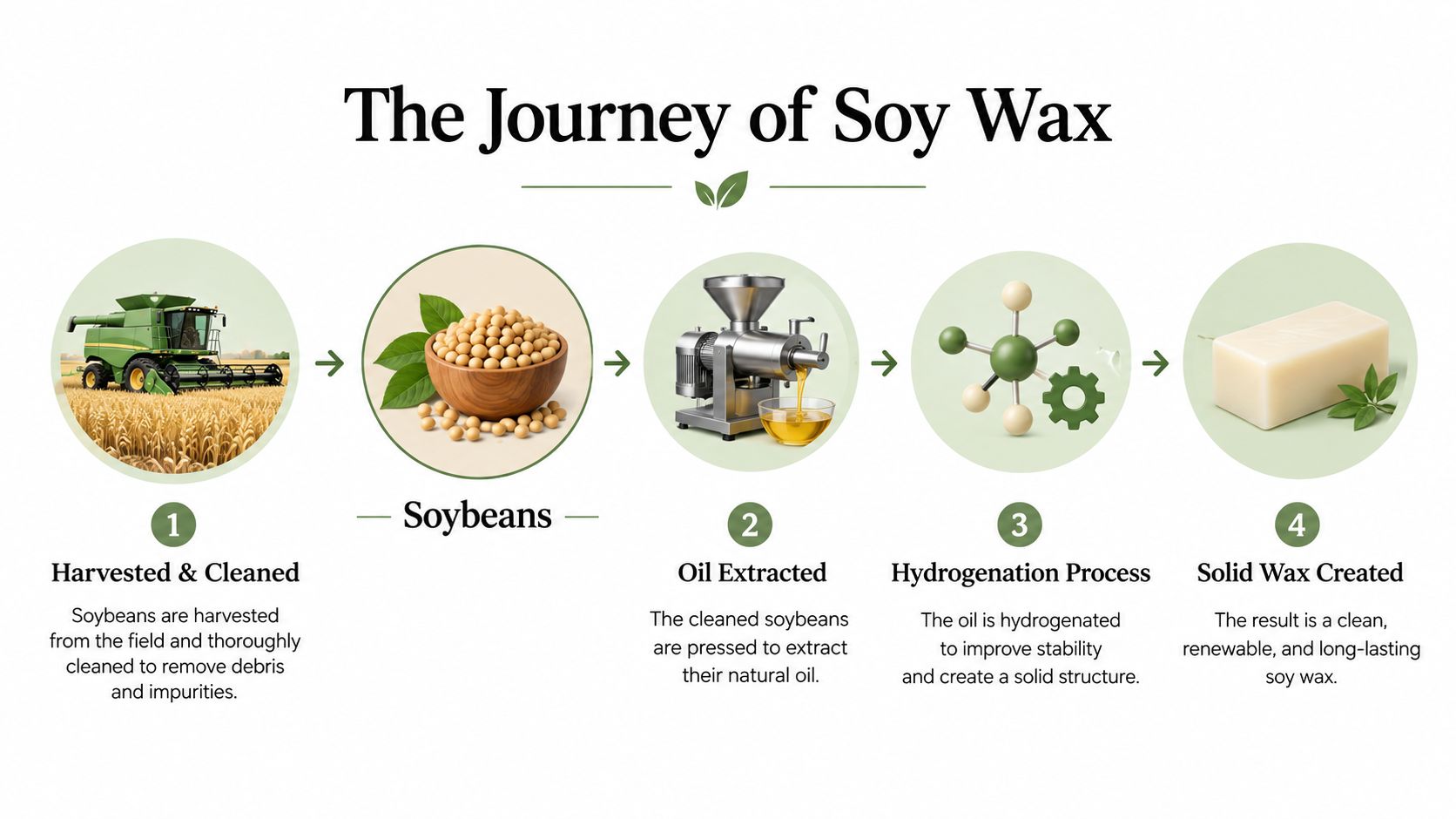
The process can be understood in four practical stages:
For home candle making, flakes are convenient because they're easy to weigh and pour into a melting vessel. Container waxes are formulated to adhere well to glass or metal and to create a suitable surface after cooling. Pillar waxes are firmer and designed to release from molds, while soy blends combine soy with another wax to adjust hardness, appearance, scent release, or burn behavior.
The label “soy wax” therefore doesn't describe one identical material. Different suppliers use different formulations, and a container blend may behave quite differently from a wax intended for molded candles. Jackpot Candles uses a proprietary soy wax blend, which is a formulation choice focused on balancing the softer character of soy with usable fragrance and burn performance. You can read a plain-language explanation in what soy wax candles are.
Soy wax often looks smooth and opaque when it sets, but it can develop frosting, uneven tops, or surface marks as it cools. Those changes aren't automatically signs of failure. Cooling speed, vessel temperature, room conditions, and the wax formula all affect the finish.
The same softness that makes container soy useful also creates handling considerations. A maker must control heating, mixing, pouring, and cooling rather than treating every wax like a hard paraffin block. That attention becomes especially important when adding fragrance, selecting a wick, or shipping candles through warm weather.
No wax is ideal for every candle. Paraffin often produces a strong scent impression and can work well in large, highly fragranced formats. Beeswax is naturally firm and has its own subtle character, making it attractive for unscented or lightly scented candles. Soy sits between those options, offering a plant-based container wax with a softer, more understated performance profile.
| Feature | Soy Wax | Paraffin Wax | Beeswax |
|---|---|---|---|
| Source | Hydrogenated soybean oil | Petroleum-derived wax | Wax produced by honeybees |
| Typical texture | Soft to moderately firm, depending on formulation | Commonly firm and adaptable | Firm and naturally dense |
| Scent impression | Often smooth and balanced, though it depends on formula and wick | Frequently strong and immediate | Can be gentler because of its own honey character |
| Container use | Well suited to many container formulations | Widely used in containers and molded candles | Often used for pillars, tapers, and specialty candles |
| Soot expectations | Can burn with little visible soot when properly designed and used | May produce visible soot if the wick or flame is poorly controlled | Can also produce soot when burning conditions are unsuitable |
| Sustainability appeal | Plant-derived and attractive to buyers seeking renewable feedstocks | Less appealing to buyers avoiding petroleum-based materials | Natural, but tied to beekeeping and agricultural sourcing |
| Main trade-off | Requires careful wick and heat matching | Strong performance, but not plant-derived | Firmness and natural aroma can affect fragrance design |
Soy's reputation for a slower, cleaner burn should be treated as a design outcome, not a guarantee attached to every jar. A wick that's too large can create excess heat in any wax. A wick that's too small can leave an incomplete melt pool and release little fragrance, regardless of the label.
Paraffin may have an advantage when the goal is a bold, room-filling scent from a large vessel. Soy can be a better fit when the buyer wants a plant-based material and a softer fragrance experience. Blends can narrow that gap by giving manufacturers more control over hardness and scent release.
Wax sets the starting conditions, but the wick determines how those conditions behave in the flame.
For a more focused discussion of the main trade-offs, see this guide to soy candles compared with paraffin candles. The most useful buying decision comes from matching the wax to your priorities, rather than assuming one material is automatically superior.
Soy wax used in candle making typically melts in the 45 to 53°C range, while some container formulations are specified around 42 to 48°C, according to a technical soy wax data sheet. That's lower than many people expect from a solid candle, and it explains both the appeal and the practical challenges of soy.
A low melting point helps a container candle form a liquid melt pool without requiring extreme heat. It also means the wax can soften during hot storage or summer shipping. A candle left in a hot car, near a radiator, or in direct sunlight may change shape or develop a soft surface before it's ever lit.
Think of wax as a sponge. It can absorb and hold fragrance, but the sponge has a limit. Adding fragrance within the wax's workable range can improve scent strength, while adding too much can leave oil that the structure can't hold securely.
Soy candle formulations commonly support around 6% to 10% fragrance by weight, with some refined blends holding up to 10% without visible leeching or separation, according to CandleScience's SimplySoy Artisan Wax lab notes. The exact limit depends on the wax and the fragrance oil, so makers should follow the supplier's technical guidance instead of treating the upper end as a universal target.
Fragrance is often incorporated at around 85°C, as described in the same technical notes. The wax must be hot enough for the oil to disperse evenly, but excessive heat can damage fragrance performance. Once the oil is mixed in, the maker still has to test the result because fragrance changes the wax's behavior.
A heavier fragrance load doesn't automatically produce a stronger hot throw. Too much oil can cause bleeding, frosting, separation, or unstable burning, and it may interfere with the way the wick draws fuel through the melt pool.
Burn time also resists simple promises. It depends on vessel diameter, wax weight, wick size, fragrance load, airflow, and how long each session lasts. A wide jar with a large wick will consume wax differently from a narrow tin with a smaller wick, even if both contain the same soy formula.
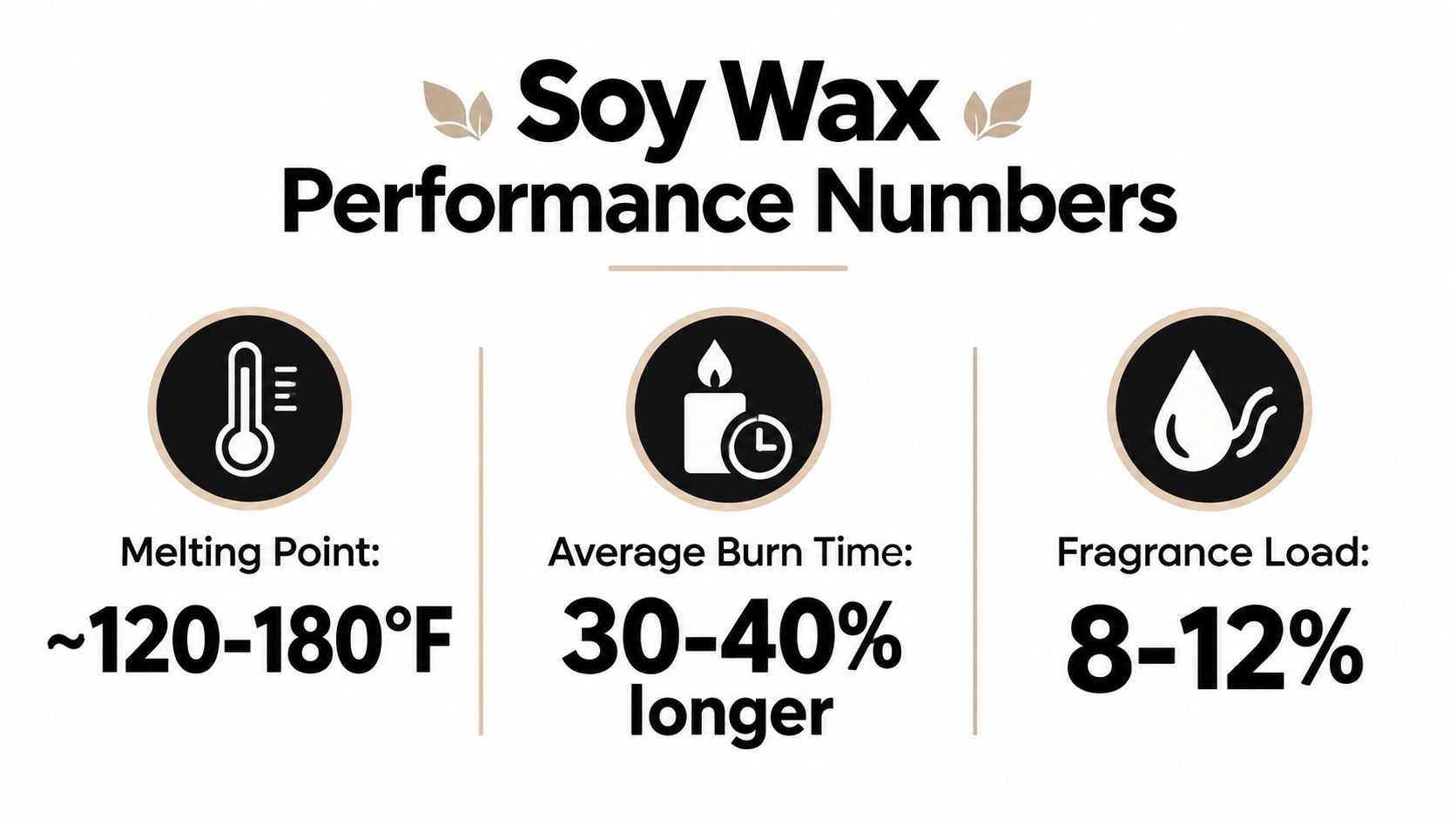
For buyers, the practical lesson is to judge the whole candle. Look for a stable flame, an even melt pool, and a fragrance level that suits the room. For makers, change one variable at a time during testing. Otherwise, you won't know whether a weak result came from the wax, fragrance, wick, or container.
A soy candle's scent throw begins before the wick is lit. Fragrance oil, wax temperature, wick diameter, vessel width, and curing time all influence how the candle releases aroma. If one part is mismatched, increasing fragrance alone usually won't solve the problem.
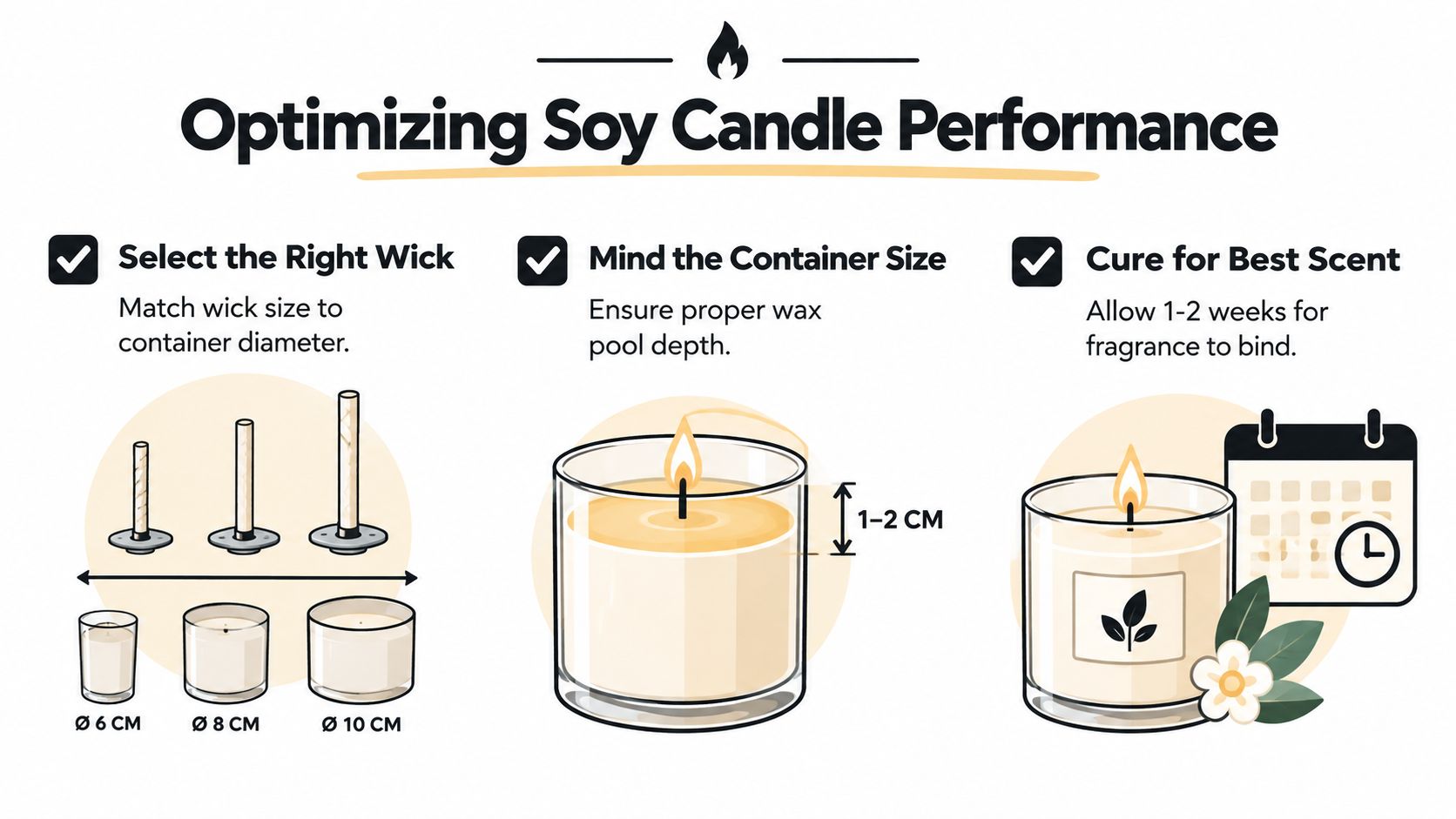
A small tin needs a different wick strategy from a wide jar. The small vessel may reach a useful melt pool quickly, while the wide jar needs enough heat to melt wax across its surface without creating an oversized flame.
Makers should test wick families rather than guessing from wick length alone. Compare flame height, melt-pool width, container temperature, mushrooming, and visible smoke. A wick that looks perfect in one fragrance may burn differently in another because fragrance changes the liquid wax's flow and fuel characteristics.
Container size matters just as much. A very wide vessel can spread the fragrance across a larger surface while demanding more heat from the wick. A narrow container may concentrate scent but can overheat if paired with an aggressive wick.
CandleScience's technical guidance places fragrance incorporation around 85°C, while the same source notes that successful results depend on balancing fragrance load against wax structure. Mix thoroughly so the oil disperses through the wax, then let the candle cool in a stable environment.
Curing gives the wax and fragrance time to settle into a more consistent structure. If a freshly poured candle smells strong in the jar but weak when burned, or if the surface looks oily, give the formula more time and review the fragrance percentage before making another change. For a practical explanation of fragrance performance, consult this guide to soy candle scent throw.
A 2026 study of soy-wax aromatherapy candles reported no visible soot under its test conditions and described the scent as softer and more harmoniously blended in the soy matrix the published aromatherapy candle study. That result is useful, but it doesn't mean every soy candle will behave identically in every room.
Clean-looking glass is the result of a suitable wick, sensible burn conditions, and basic candle care, not wax choice alone.
For a visual demonstration of candle performance and testing, use the following video:
Soy wax appeals to environmentally conscious buyers because it comes from soybean oil, a plant-derived feedstock rather than petroleum. That origin is meaningful, but it doesn't answer every sourcing question. Buyers who care about sustainability should also consider packaging, fragrance ingredients, farming practices, transport, vessel reuse, and how transparently a brand describes its materials.
“Plant-based” is a useful starting point, not a complete environmental scorecard. A candle can use soy wax and still create unnecessary waste through disposable packaging or a vessel that can't be reused. Makers can make better choices by buying wax from suppliers who provide clear product information and by planning batches carefully to reduce failed pours.
Use these habits to keep a soy candle performing consistently:
A clean burn also depends on the user. Drafts can make a flame flicker and produce smoke. A long, untrimmed wick can create a larger flame and deposit soot. Even a well-formulated soy candle needs sensible handling.
For a brand using a proprietary soy wax blend, the relevant questions remain practical. Does the candle have a stable flame? Does the scent suit the space? Does the vessel remain comfortable to handle? Answers to those questions tell you more about everyday value than a broad “natural” label by itself.
Choose soy wax when you want a plant-derived container candle with a creamy finish and a fragrance experience that can feel smooth rather than forceful. Choose paraffin or a paraffin blend when a strong, immediate scent throw is your main priority, especially in a larger room. Choose beeswax when you value firmness and its natural character, particularly in lightly scented or unscented formats.
Before buying, check four details:
Makers should apply the same framework during testing. Pair the wick with the container diameter, keep fragrance within the wax supplier's stated capacity, and record each trial. A proprietary soy wax blend, such as the one used by Jackpot Candles, represents one formulation route for balancing burn behavior with fragrance release.
If you're exploring candles for a calm evening ritual, a specialist product such as a CBD candle for relaxation may also be worth comparing for its scent profile and intended atmosphere. Read the product details carefully, especially if you're choosing between fragrance strength and a softer sensory experience.
Jackpot Candles offers scented candles made with a proprietary soy wax blend and perfume-grade fragrance oils, with surprise jewelry inside selected products. Visit Jackpot Candles to explore the available scents and choose a candle that fits your space, burn preferences, and gift plans.
Comments will be approved before showing up.