
free shipping at $99


You're standing in a boutique, holding a necklace that looks beautiful under the lights, wondering whether it's thoughtful or too much. Or you've got a ring in an online cart and no reliable idea of the recipient's size. Buying jewelry as a gift can feel like choosing both an object and a message, without knowing exactly how either will land.
My advice is to look past the reveal. Think about the next morning, when they try it on, choose an outfit, and decide whether it belongs in their life. That's where a good jewelry gift earns its place.
Jewelry offers something unusually personal: the recipient can carry a reminder of someone into an ordinary day. A pendant from a sibling might become part of a work outfit. A bracelet marking a graduation might accompany its owner into an unfamiliar chapter.
The appeal isn't that jewelry lasts. It's that the wearer can keep attaching memories to it. Flowers offer immediate pleasure; a gift card offers choice. Jewelry can offer a continuing connection, provided the person enjoys wearing it.
Jewelry has served as a relationship gift for centuries. Engagement rings appear in Roman-era records, and a documented milestone came in 1477, when Archduke Maximilian of Austria gave Mary of Burgundy a diamond engagement ring, as described in the history of engagement rings.
That history is useful for a practical reason: jewelry comes with associations. A ring can suggest commitment before you explain your intentions. A familiar family motif might communicate belonging. The object doesn't arrive emotionally blank.
Practical rule: Choose the message you want to send before choosing the piece that will send it.
I'd start with the recipient's life rather than the occasion's expected grandeur. Someone who wears a tiny pendant every day may appreciate another restrained piece more than a dramatic necklace reserved for formal events.
Think about the experience you're offering:
That last point matters. A gift shouldn't become an obligation to wear your taste. The strongest reason to choose jewelry is that you can offer something meaningful and welcome, not merely impressive in its box.
Their existing collection is your most useful style guide. Look at what they repeatedly wear, not what they admired once in a shop window. Treat those everyday choices as a signature uniform: metal color, scale, shape, and ornament all provide clues.
If they wear fine chains and small hoops, I wouldn't introduce a heavy statement cuff without a clear invitation. Stay near their preferences while changing something modest, such as the shape of a pendant or the texture of a band.
Follow their chosen metal tone rather than deciding what supposedly suits their skin tone. If they consistently reach for silver-colored pieces, that preference is more useful than your theory about whether gold would flatter them.
Also notice practical habits. Do they remove bracelets while typing? Do they wear earrings at all? A beautiful gift that conflicts with their routine gives them a problem to solve.
When you can't observe directly, ask someone close to them about a specific detail. “Do they wear long necklaces?” is more useful than “What jewelry do they like?”
These are shopping judgments, not guarantees. Confirm the actual dimensions and seller's terms.
| Jewelry Type | Fit Risk | Reversibility |
|---|---|---|
| Fixed-size ring | High when size is unknown | Confirm exchange and resizing eligibility |
| Adjustable bracelet | More forgiving within its stated range | Check adjustment limits and return terms |
| Necklace with an extender | Less dependent on precise sizing | Confirm available lengths |
| Earrings | Less size-dependent, but piercing and weight matter | Check hygiene-related exclusions |
| Engraved jewelry | Depends on the underlying piece | Confirm customization restrictions before ordering |
Don't guess a ring size from appearance. Use the women's ring size guide to understand measurement options, then check the seller's sizing system. If you're borrowing a ring for reference, confirm that it fits the intended finger.
For a distant recipient, I'd favor a necklace with a clearly stated adjustable range over a fixed-size ring. Adjustable doesn't mean universal, though. Ask for the minimum and maximum wearable dimensions.
Finally, check how the piece fastens. A clasp that's awkward for the recipient can make an otherwise suitable gift frustrating. Style gets their attention; usability determines whether they reach for it again.
Match the emotional weight of the gift to the relationship, not just the event. A graduation necklace from a parent and the same necklace from a new coworker can communicate very different things.
Jewelry isn't limited to romantic milestones. During the 2025 Thanksgiving-to-Cyber Monday period, 14% of shoppers purchased jewelry, 18% planned to give it, and 19% expected to receive it, according to the U.S. jewelry market overview. That supports treating it as a mainstream seasonal option, without assuming it suits every recipient.
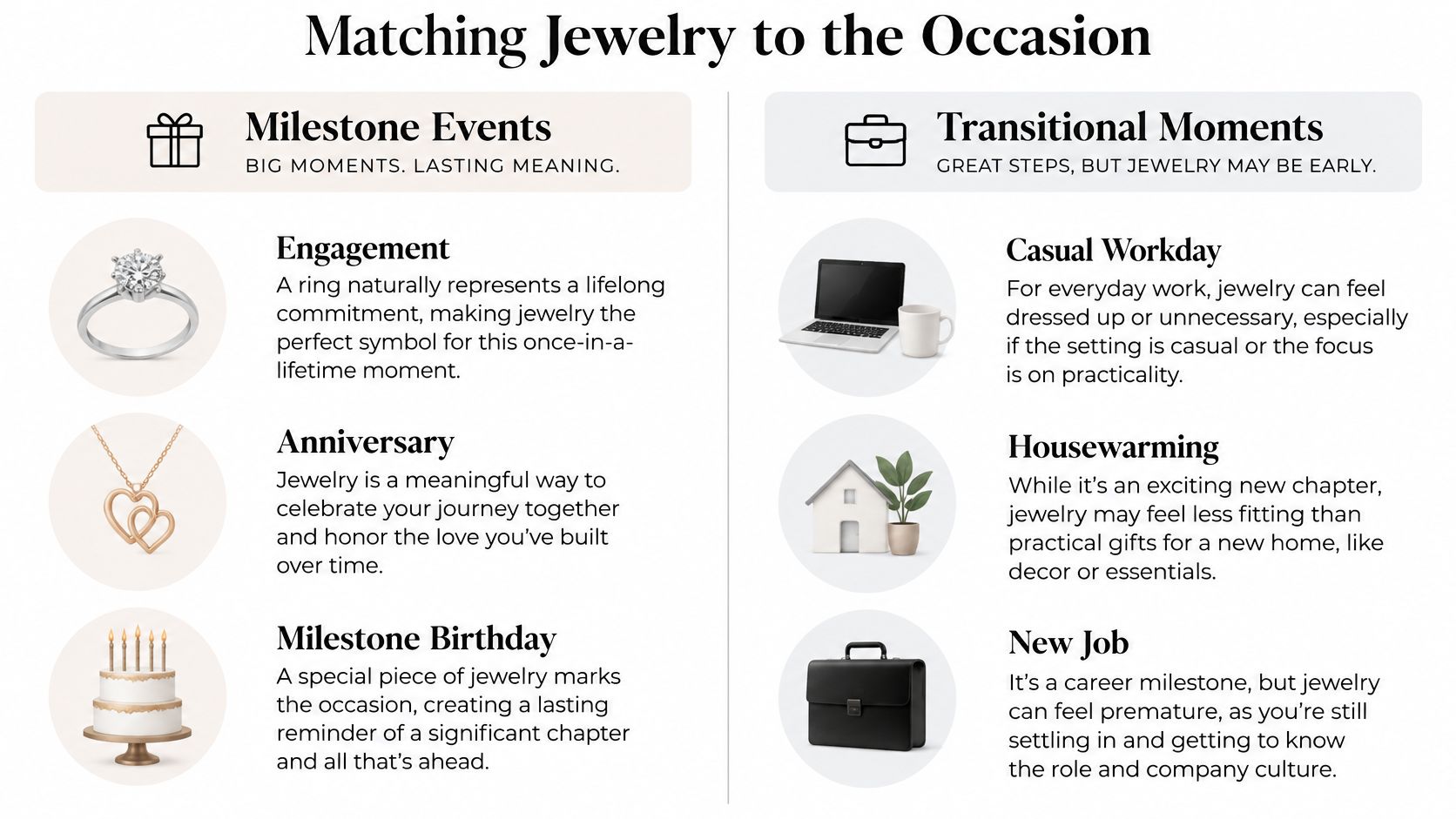
For an engagement, shared expectations should guide the purchase. For an anniversary, you have more room to draw on established memories and preferences. ECI Jewelers' ideas for personalized pieces for anniversaries can serve as a browsing prompt, but start with what your partner wears rather than what an anniversary gift is supposed to look like.
Transitional occasions need more judgment. A promotion may justify a substantial gift from a partner, while a professional acquaintance's new job usually calls for something less intimate.
| Occasion | My Starting Recommendation | What I'd Check First |
|---|---|---|
| Engagement or major anniversary | A jointly considered fine-jewelry piece | Expectations and established preferences |
| Graduation or significant birthday | An everyday pendant or bracelet | Whether it suits their next chapter |
| New baby | A piece chosen for the recipient | Whether they want a commemorative gift |
| Friendship or holiday | A familiar style with a personal note | Whether the gesture feels proportionate |
| Coworker's promotion or housewarming | Consider a non-jewelry alternative | Professional boundaries and closeness |
Fine jewelry makes sense when the recipient wants it and the relationship supports the gesture. It isn't an automatic requirement for a major event.
For everyday appreciation, I'd prioritize a clear explanation over a grand object. A short note about why you chose the piece can keep a modest gift from feeling arbitrary, without making the exchange emotionally heavy.
Personalization should prove you know someone, not show how much you can customize. Reported demand for customized jewelry has increased by about 40% over three years, according to the MarketIntelo jewelry market report. That's a reason to consider the options, not a reason to engrave everything.
The important distinction is between a detail the recipient can privately enjoy and a statement they must visibly wear.
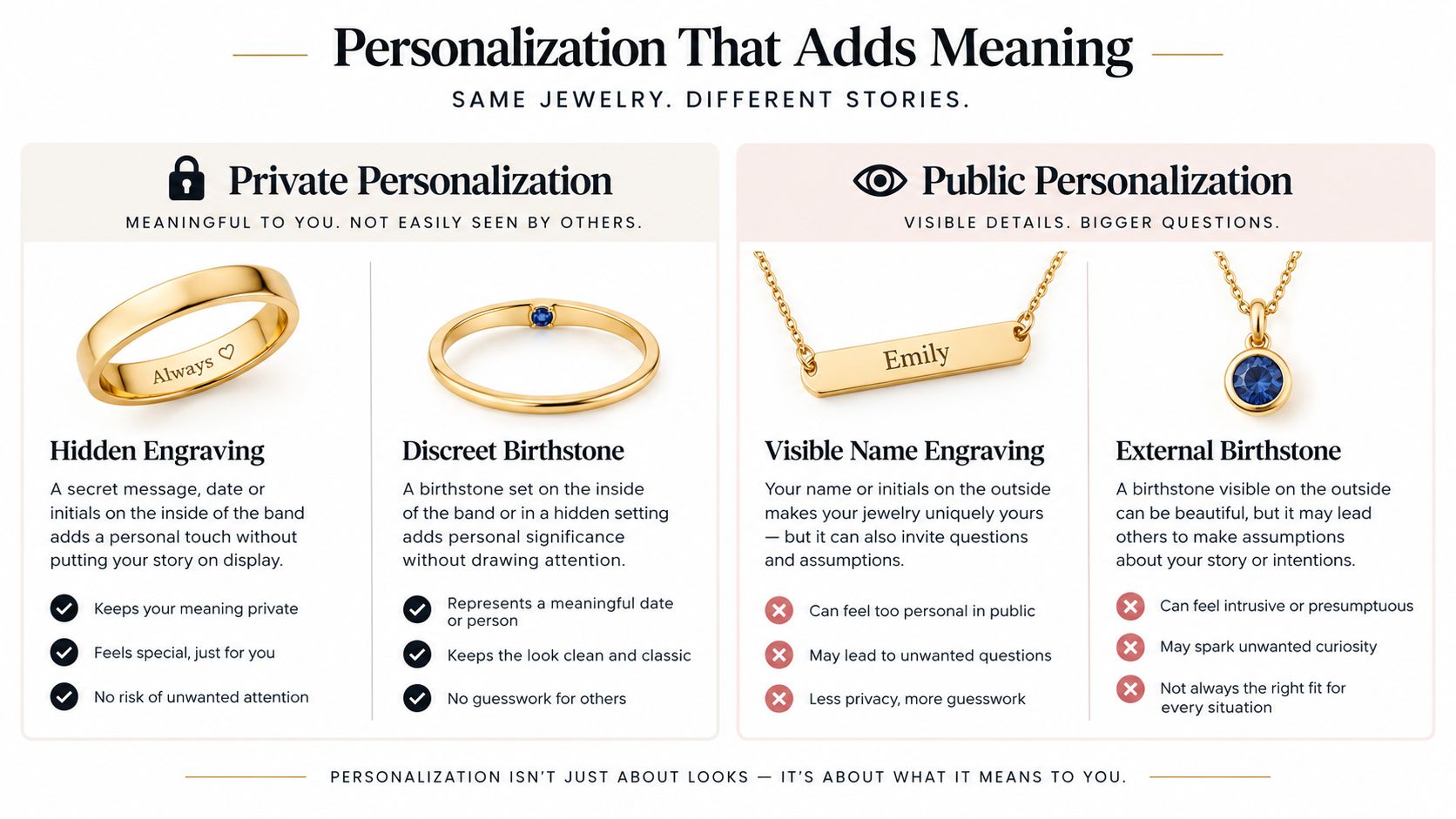
An engraving inside a band offers discretion. Initials across a pendant become part of someone's public appearance. Neither is automatically better, but visible customization asks more of the wearer.
Even a hidden inscription can misfire if the wording assumes a level of intimacy you haven't established. A birthstone is similarly not a shortcut to knowing someone's taste: they may dislike the color or prefer jewelry without personal symbolism.
A personalized gift should recognize the recipient's identity, not assign one to them.
I'd approve customization when you can answer the practical and emotional questions confidently:
For a newer relationship or colleague, I'd avoid permanently attaching your interpretation of the relationship to their jewelry. Choose a design they can enjoy independently of you.
The honest trade-off is that customization can deepen meaning while narrowing future use. If you're uncertain, give the unaltered piece first and offer to personalize it together afterward. That keeps the sentiment while giving the recipient a genuine say.
Set a spending ceiling before you browse. I wouldn't use a salary formula or stretch your finances to make a gift look serious. Start with what you can comfortably spend, then choose the most suitable piece within that limit.
Build your budget around relationship closeness, the importance of the occasion, and your present circumstances. Someone establishing financial stability doesn't need to buy like someone celebrating a long-planned milestone.
For lower-cost browsing, use these affordable jewelry gift ideas to develop a shortlist. Compare complete purchases, including delivery and any necessary adjustments, rather than the displayed item price alone.
Treat retail price, appraised value, and resale value as different questions. Ask what you're paying now, what any stated appraisal was prepared to assess, and what evidence supports a claim about selling the piece later. Don't treat a dramatic valuation label as money the recipient could readily recover.
I'd also reserve room for presentation and follow-up support. That might mean choosing a simpler pendant so you can afford an appropriate chain or any agreed alteration.
Online merchandise returns were estimated at 19.3% of online sales in 2025, compared with 15.8% across retail overall, according to the online returns discussion from Aitaca. Those are merchandise-wide figures, not jewelry-specific rates, but they're a useful reminder to inspect purchase terms.
Before paying, establish who can request an exchange, what documentation they'll need, and when eligibility expires. A slightly less elaborate piece with workable support would be my choice over a more impressive purchase that leaves the recipient stuck.
Choose packaging that lets the jewelry look intentional without exaggerating what's inside. A pendant laid neatly against an insert feels considered; the same pendant tangled in tissue gives the recipient a task before they can enjoy it.
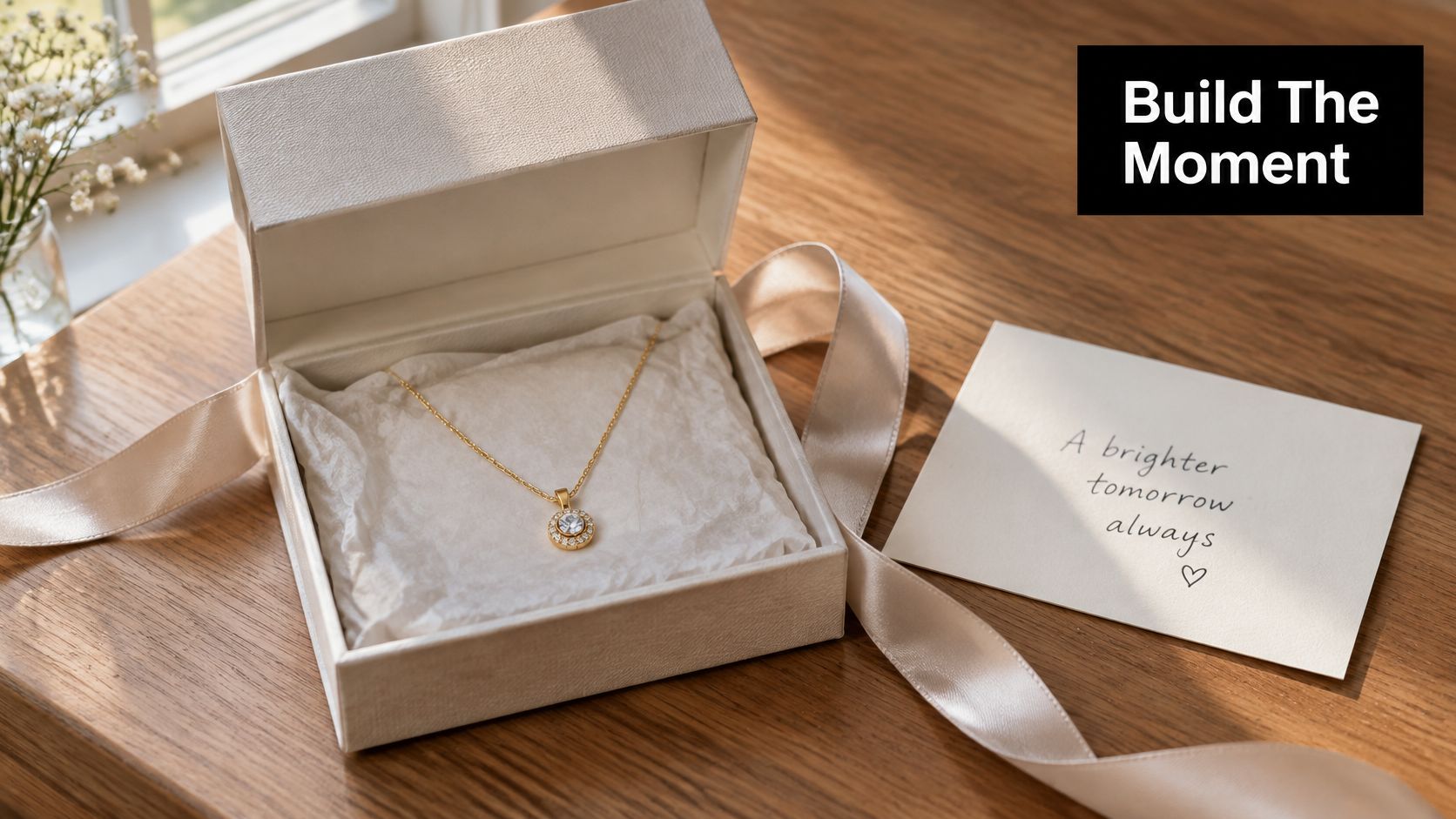
Start with a box or pouch suited to the piece. Secure the chain, separate earrings, and remove distracting shipping materials while retaining the documentation.
Then add tissue or ribbon sparingly. For a modest budget, I'd choose a tidy presentation and a handwritten note rather than elaborate outer packaging. For more inspiration, these jewelry gift box ideas offer a useful starting point.
In the United States, FTC guidance requires truthful representations of jewelry attributes, including metal type, quality, quantity, and origin; products described as silver must contain at least 925 parts per thousand silver, as explained in the FTC Jewelry Guides. Keep the seller's precise description rather than replacing it with a more flattering label.
Ask for documentation identifying the metal or plating, stone identity, relevant treatments, dimensions, and care requirements. If the recipient has sensitivities, don't substitute a vague reassurance for actual material information.
For the handover: Explain why you chose it, then give them space to respond.
For mailed gifts, include a note that doesn't require an immediate video call or public reaction. For an experience-led reveal, retain the product's instructions and make the jewelry information accessible afterward. Anticipation works better when the recipient can also understand what they've received.
The most expensive mistake isn't necessarily overspending. It's buying around an assumption you never checked. I'd challenge these familiar ideas before letting any of them guide the purchase.
“It has to be expensive to matter.” Consider a friend who treasures restrained everyday accessories. A modest pendant connected to a shared interest may feel more personal than an extravagant piece chosen mainly for its price. Give them a reason to love it, not a reason to worry about reciprocating.
“A larger piece will make a stronger impression.” Someone who wears tiny studs may find dramatic earrings unsuitable for their usual clothes. Compare the proposed piece with their actual wardrobe, not with the display beside it.
The alternative isn't to make gifting clinical. It's to direct your creativity toward details the recipient will appreciate: an apt note, an unexpected delivery, or a design they mentioned and assumed you'd forgotten.
Ask yourself whose pleasure you're prioritizing. If you're mainly imagining how impressive you'll look when the box opens, reconsider. Choose for the person who has to live with the gift after the audience, camera, and wrapping paper are gone.
Use this as a final purchase check, not another browsing exercise. If an important answer is missing, contact the seller or change the selection before paying.
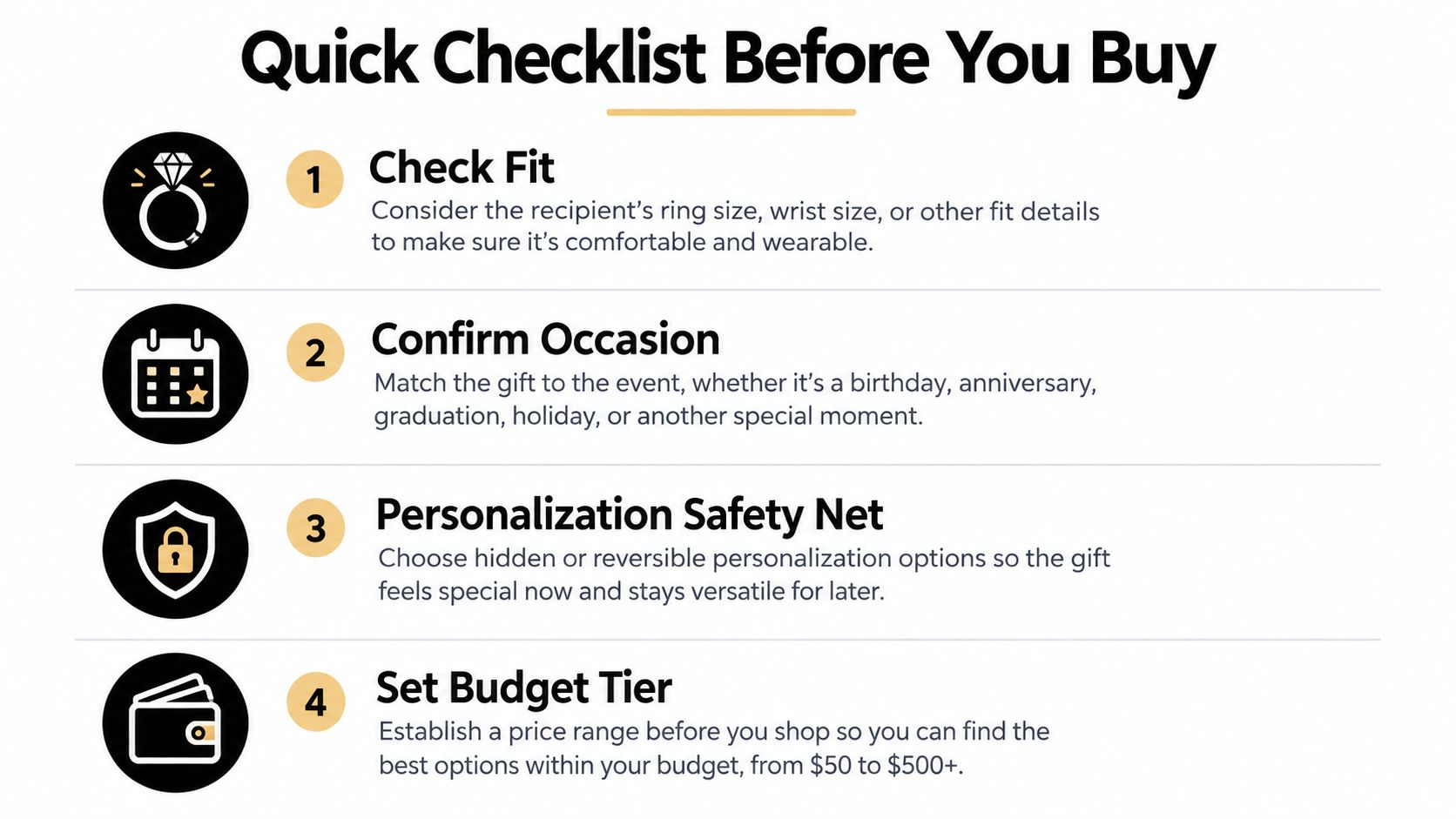
Before you close the order, save the listing and purchase terms somewhere accessible. Put any gift receipt where the recipient can find it without having to ask you for permission.
Jackpot Candles offers scented candles and bath bombs containing a surprise piece of jewelry, combining a gift experience with a wearable discovery. Visit Jackpot Candles to explore the options, and check the available jewelry selections, sizing information, and product details before choosing for your recipient.
Comments will be approved before showing up.