
free shipping at $99


You just pulled a ring from a jewelry box, or the wax of a candle burned low enough to show metal. It sits in your palm. The top may sparkle. What you keep turning over is the part that wraps the finger, and you aren't sure what to call that shape or why one band feels kind while another pinches.
A ring style band is that lower circle, and it does more work than a trend name suggests. Width, inside curve, and metal change comfort, how long the piece lasts, and whether a stone looks balanced. This guide walks those choices the way a jeweler would at the case, in plain comparisons, without assuming you already know the shop vocabulary.
A ring's band is the loop that circles the finger. Jewelers also call it the shank. On a ring with a center stone, the setting is the structure that holds the stone above the band. The band and setting may be joined as one piece, but they do different jobs: one wraps around the finger, while the other supports the stone.
A useful comparison is a picture frame and the wall beneath it. The setting frames the stone; the band supports the ring on the hand. In a jewelry case, you can see how the band's shape continues beneath the setting, sometimes straight and sometimes curving upward to meet it.
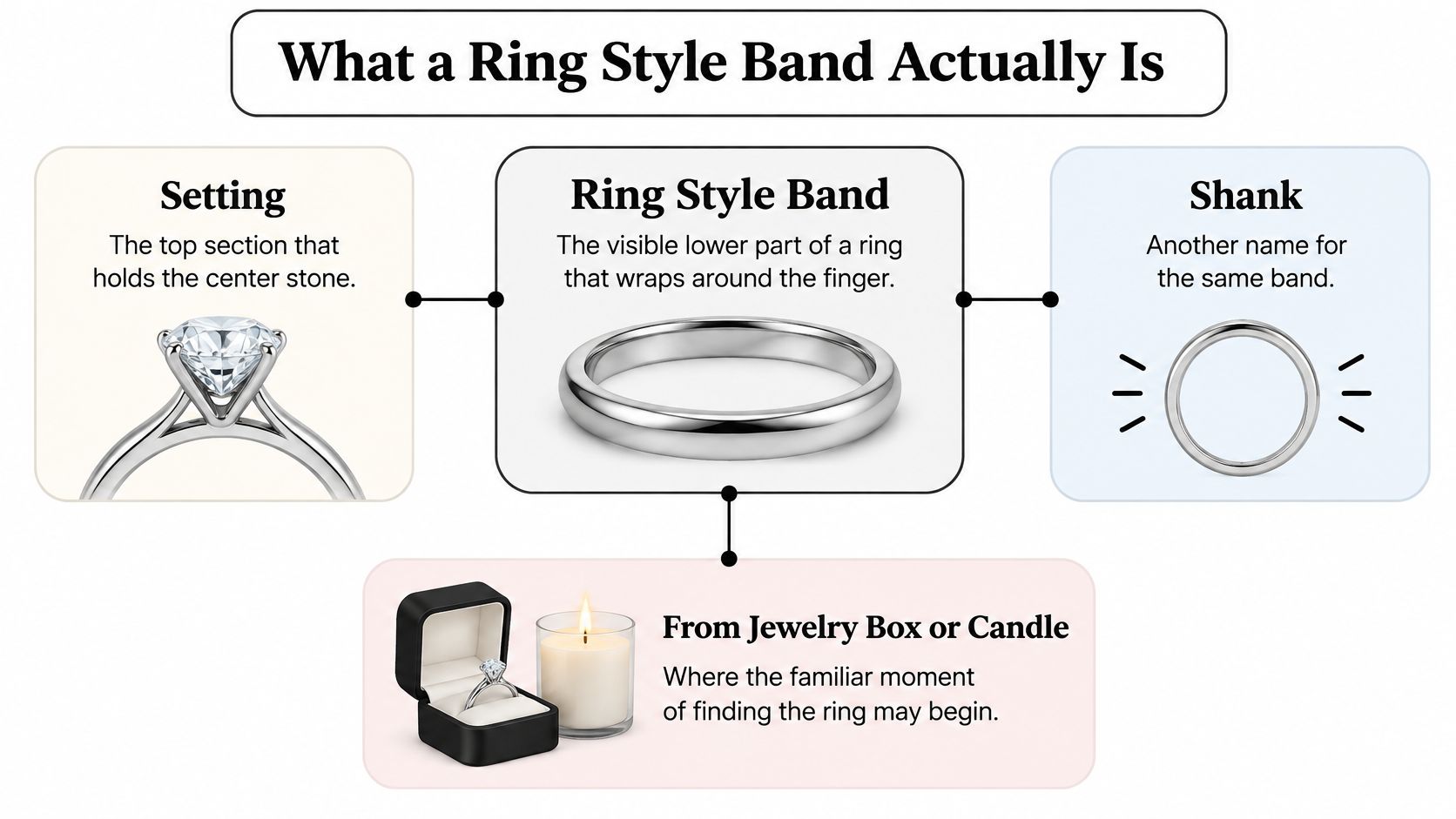
The band is more than a name for the ring's lower half. Its width and shape affect how much metal touches your finger and how the ring sits beside another one. A narrow shank can feel different from a broad one, even when both rings share the same size. That distinction can help explain why a ring feels snug or loose without the number on its size changing.
Material matters, too. The metal is in direct contact with your skin, so someone with sensitivity may want to check what the band is made from. For a surprise ring or a keepsake you already own, identifying the shank gives you a practical starting point: look at its shape, note how it meets the setting, and see whether the band feels comfortable on the hand.
The word “band” can also describe a simple ring with no center stone. In that case, the band is the whole visible ring rather than just its lower section. With a stone-set ring, the same word often refers to the loop beneath the setting. The context tells you which meaning applies.
A ring can carry personal meaning, but its band is a concrete part you can inspect. It is the circle that supports the piece and rests against your finger. For wedding-day inspiration beyond the ring itself, explore music for your Italian wedding celebration.
Shop cases group bands by silhouette. Each look below pairs with a kind of wearer, and each has a catch that photos hide.
Plain band. A smooth, unadorned circle in gold, silver, platinum, or steel. It reads as timeless and works for any gender. It is usually the easiest style to resize, because there are no stones in the way. The watch-out is boredom only if you wanted sparkle. On the finger, it is the most forgiving everyday shape.
Pavé. Tiny stones set so closely along the surface that the metal looks continuously bright. Say it "pah-vay." It suits someone who wants extra light around a modest center stone. Those small stones can loosen, and the surface can snag knits and hair.
Channel. Stones sit in a groove between two metal walls, with no prongs sticking up. The top stays smoother, which helps if you use your hands all day. A hard knock can still affect a whole row, because the stones share one track.
Bezel. A metal rim wraps the stone like a collar. It is the most protective common setting, and it suits active hands, workshops, and people who dislike prongs. The rim hides a little of the stone's edge, so the gem can look slightly smaller.
Cathedral. Arched metal shoulders lift the stone the way vaulted ceilings lift a roof. The ring looks taller and more formal. That height can catch on gloves, sleeves, and hair, and the arches need a careful check if you ever resize.
Tapered. The band narrows as it approaches the stone, which pulls the eye inward and can make a center stone look larger. It flatters a smaller gem. The thin spot near the head is a weaker point than a band that stays the same width.
Split shank. The band divides into two arms before it reaches the setting. It adds openness and a bit of drama without a huge center stone. Dirt collects in the split, and resizing is fussier than on a single rail of metal.
Eternity. Stones continue around the entire band, so sparkle shows from every angle. It is a strong anniversary or "I want light all the way around" choice. You generally can't resize it, because there is no plain metal gap to open.
Makers who build bands by hand, rather than from a single catalog shape, are worth a look when you want the metalwork itself to carry the design. Kailash Way's handcrafted rings are one place to see that range of profiles up close.
Ring Band Styles at a Glance
| Band Style | Look and Feel | Best For | Watch Out For |
|---|---|---|---|
| Plain | Smooth, quiet, unisex | Daily wear and easy resizing | Less sparkle if you wanted stones |
| Pavé | Continuous small-stone glitter | Extra light on a modest center | Loose stones and snagging |
| Channel | Stones between metal walls | Active hands, smoother top | A knock can affect the row |
| Bezel | Metal rim around the stone | Protection and low profiles | Stone edge looks slightly smaller |
| Cathedral | Arched shoulders, lifted stone | Formal height and drama | Catches on fabric and hair |
| Tapered | Narrows toward the stone | Making a center look larger | Thinner metal near the head |
| Split shank | Band divides into two arms | Open, airy drama | Harder resizing, traps debris |
| Eternity | Stones all the way around | Sparkle from every angle | Usually cannot be resized |
Two rings stamped with the same size can feel like different jewelry. The hidden variables are profile (the cross-section) and width (how much skin the band covers).
A flat inside is a straight wall against the finger. A court profile is gently domed on the outside, like a low D, so edges don't bite. A comfort-fit band rounds the inside as well, which helps it slide over a knuckle. A knife-edge comes to a peak on top and looks sharp in profile, though the inside should still be smooth enough to wear.
International ring sizing, under ISO 8653:2016, is the ring's inner circumference in millimetres, not the outside diameter or the band width. The ISO 8653 ring-size standard covers sizes 41–76, meaning 41–76 mm of internal circumference. The manufacturing check uses a metric ring stick, and the ring should slide down without being forced. In North American sizing, one full size changes internal diameter by about 0.81 mm and internal circumference by about 2.55 mm. A small error is a real fit change, especially on a wider band.
The measurement point depends on the inside profile. A comfort-fit band, with a rounded inner surface, can touch the finger differently from a flat interior even when both share the same nominal circumference. A broader or more curved band presents more contact area and often feels tighter than a narrow band at the same stamped size. Rounded edges spread pressure instead of digging in at the sides.
The gauge itself has to be controlled. The ISO 8653 measurement method specifies a ring stick with a 160.0 mm scale length and a ±0.5 mm tolerance, in wear-resistant metal or an equivalent material. If production and the sales counter use different sticks, "your size" drifts.
Practical rule: Write down inner circumference, profile, and width as three separate notes. A single US, UK, or EU size can hide a fit you won't like by evening.
If you are checking at the kitchen table, follow a careful guide to measuring ring size at home and then confirm on a real band of the width you plan to wear. Measure later in the day, when fingers are slightly larger, and don't trust a thin sizer to predict a wide band.
Shape is only half the daily question. If a ring lives on your hand, the metal matters as much as the silhouette, and most style roundups skip that.
Dermatology guidance treats rings as possible triggers for nickel allergy and points people toward nickel-free or hypoallergenic jewelry, including surgical-grade stainless steel, higher-karat yellow gold, pure sterling silver, or platinum, as described by the American Academy of Dermatology on nickel allergy. In the EU, jewelry meant for direct and prolonged skin contact must not release nickel above 0.5 micrograms per square centimetre per week. The limit covers rings, and it also covers nickel-free coatings, which can wear through.
Those words on a product page are not interchangeable.
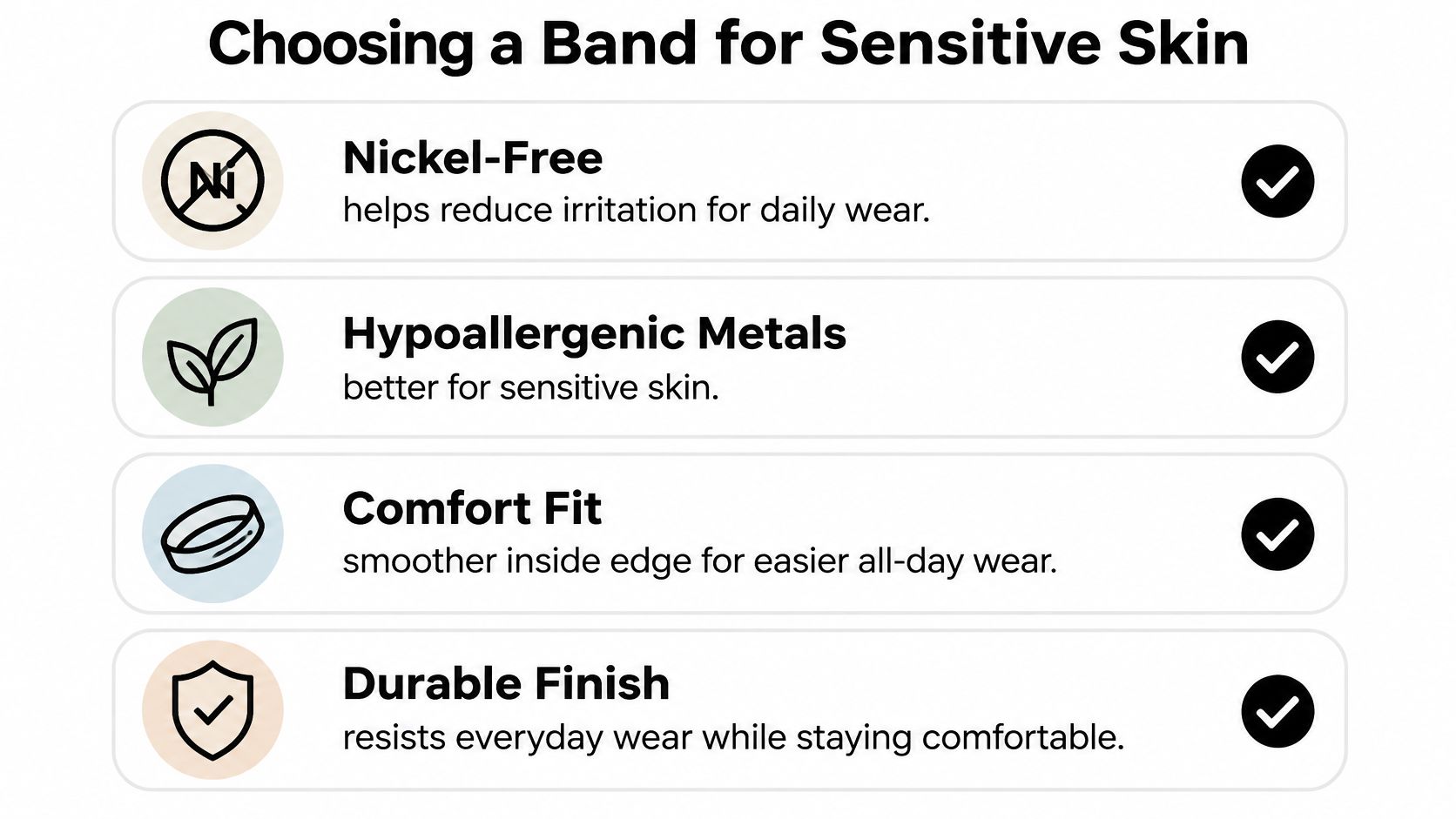
Moisture, friction, soap film, and trapped fragrance under a snug band can redden skin even when the metal is a good match. Take the ring off for washing, dry the finger, and don't sleep in a band that stays damp. A pretty low-cost finish isn't automatically a good everyday ring. Coating life and an honest base-metal disclosure matter more than the color you see on day one.
Before you assume a band is safe, ask for material composition and any compliance paperwork, not just a hangtag. A plain explanation of what nickel-free jewelry means helps you separate a real materials claim from a slogan.
Pairing is a proportion problem, not a personality quiz. Put the stone and the band in the same sentence and the choice gets clearer.
A slim pavé band adds light around a modest center, so a smaller stone doesn't look lonely. A tapered band narrows toward the head and visually enlarges whatever sits on top. A cathedral lift adds height and ceremony, and it also adds snag risk on gloves and hair. If your days include pockets, tools, or a keyboard, a bezel or a channel keeps stones lower and better protected. Delicate pavé wants gentler wear.
Width has to agree with the stone. A heavy band can dwarf a small gem. A whisper-thin band can look like it is struggling under a large one. As a working comparison, let the band's visual weight sit a step below the stone, not equal to it and not nearly invisible.
Shoppers are also asking for rings that aren't a fixed "plain, stack, or statement" menu. One 2025 analysis reported searches for personalized rings and name jewelry up 37% year over year, alongside interest in sculptural forms, colored stones, recycled metals, lab-grown stones, and designs tied to a personal story rather than a single tradition, as covered in Accio's look at newer jewelry demand.
That pull has a cost. A highly customized band can be emotionally right and still be harder to resize, resell, or recycle. A simpler band in recycled metal may live longer and pass to someone else more easily. Engraving, a birthstone accent, or a modular element is easier to love if you also ask whether that piece can be repaired or replaced.
Sustainability and personalization can tug opposite ways. Decide which one you would regret losing in five years.
If you are still mapping stone shape to a setting, a step-by-step approach to choosing an engagement ring keeps the center stone and the band in the same decision instead of treating them as separate purchases.
Not every ring starts as a counter visit. Some people meet a band because it was hidden in wax.
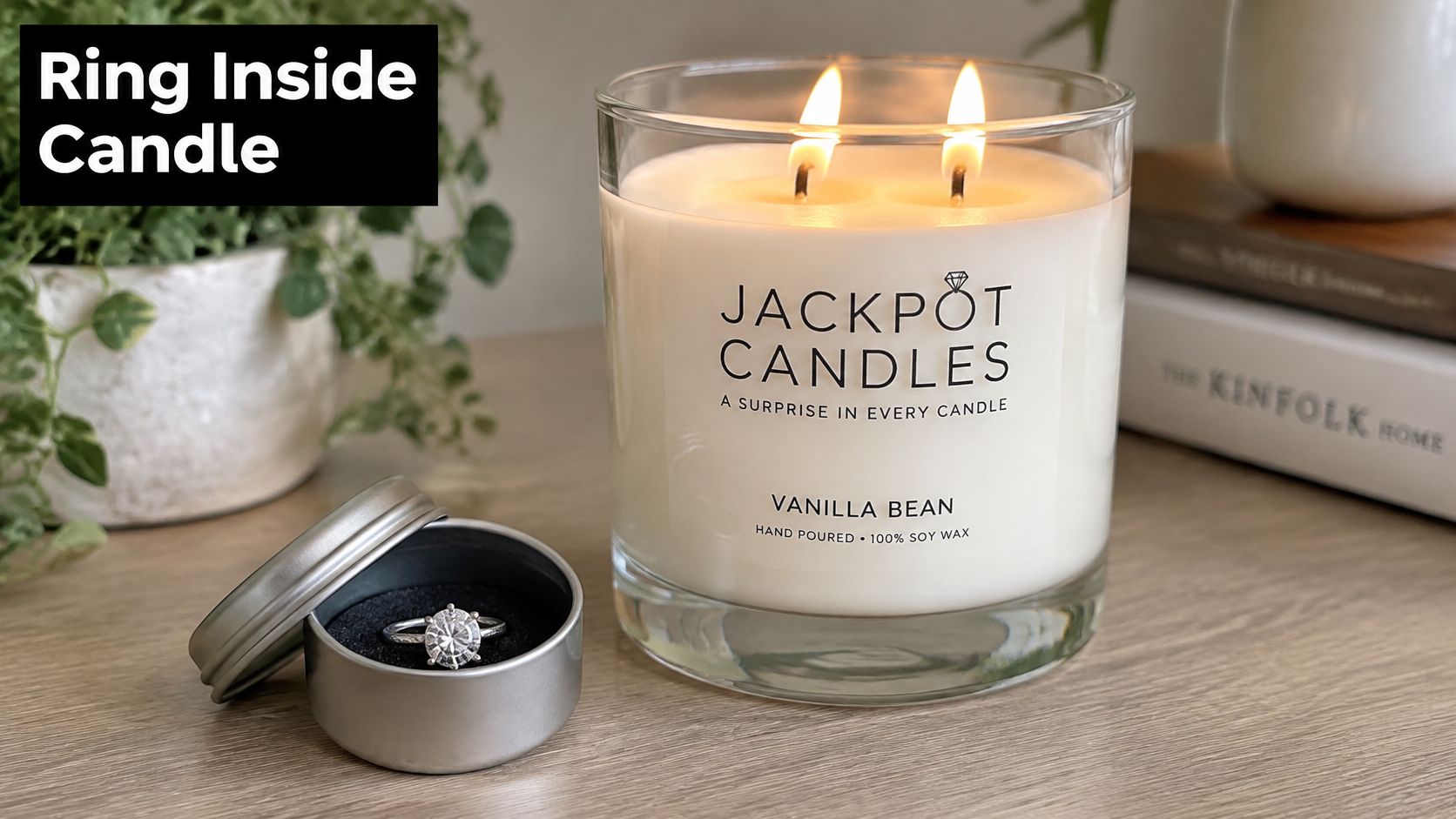
Jackpot Candles sells premium scented candles and bath bombs made with a proprietary soy wax blend that burns cleaner, slower, and longer than paraffin, with less soot, and the wax is chosen to carry fragrance well. Eligible pieces hide jewelry. As the candle burns down, a ring, necklace, or pair of earrings can appear. On ring candles, you can often select a size before you buy, which matters once you know width and profile change how a number feels.
A vanilla bean candle beside an open ring case is a fair picture of that moment. The scent is the wait. The metal is the reveal.
Once the ring is clean, use the same eye you would use in a shop. A smooth circle is a plain band. A glittering surface of tiny stones is pavé. Stones sitting between metal walls are channel-set. A collar of metal around a gem is a bezel. You don't need a new vocabulary for a found ring. You need the one you already have, plus a habit of checking marks.
Hallmarks are one of the oldest ways to read metal quality. In England, precious-metal hallmarking was mandated under Edward I in 1300, and a traditional mark can point to the maker or sponsor, the assay office, the metal standard, and the year, as explained in this beginner's guide to hallmarks and ring engravings. Fineness is in parts per thousand. 925 means 92.5% silver, 585 means 58.5% gold, and 750 means 75% gold. Those stamps won't name the style, but they stop you from guessing what the band is made of.
You can run the whole decision in one pass, in this order.
If a ring is already a keepsake, value isn't only the style name. Families who are selling an inherited 14k gold ring often need marks, condition, and metal content before a style label means anything to a buyer.
Whether you are shopping on purpose or waiting on a reveal, measure your inner circumference, write down the metals your skin tolerates, and decide if you want a band you can resize later. Then you can read whatever circle ends up in your hand.
Jackpot Candles hides jewelry inside scented soy candles and bath bombs, so the band you studied here can show up as a reveal rather than a case you already picked through. You can choose a ring size on eligible candles and then judge the style, fit, and metal with the same checks in this guide. Visit Jackpot Candles when you want that slower burn and a ring you will know how to read.
Comments will be approved before showing up.