
free shipping at $99


Why can a lavender candle smell gentle in the shop but feel sharp or overwhelming once you light it at home? The name on the jar tells you the fragrance family, not how sweet the blend is, how far it carries, or how comfortably it will fit your room.
When choosing scented candles, lavender is best treated as a fragrance choice first, not a promise of better sleep. Start with the herbal, creamy, citrus, or woody version you enjoy. Then consider the wax, wick, and room conditions that determine whether you'll still enjoy it during a real evening at home.
Choose a lavender style for the room you'll use, rather than searching for a single best lavender candle. These profiles are useful shopping descriptions, not guaranteed performance ratings. A maker's formulation can make a delicate fragrance surprisingly powerful.
Lavender candle profiles by room
| Style | What you smell | Typical throw | Best room |
|---|---|---|---|
| English lavender | Soft herbal floral | Medium | Bedroom |
| Lavandin or French lavender | Sharper, slightly camphor | Strong | Living room |
| Lavender vanilla | Herbal plus sweet cream | Medium to strong | Evening sofa or bedroom |
| Lavender eucalyptus or citrus | Bright, clean, green | Strong | Bathroom or daytime kitchen |
| Lavender cedar or sandalwood | Herbal with woody dry-down | Medium | Study or reading nook |
English lavender is a useful starting point if you want a recognizable herbal floral without much sweetness. Look for descriptions such as green, soft, or botanical. In a bedroom, that gentler direction can feel less intrusive than a rich perfume blend.
Lavandin often has a sharper, cooler character. You'll sometimes see it described commercially as French lavender, although that name alone doesn't reliably identify the plant or oil. Choose by the listed notes rather than assuming every French lavender candle will smell alike.
Lavender vanilla softens the herbal edge with creaminess. Eucalyptus or citrus takes the opposite route, keeping the impression brisk and green. Cedar or sandalwood makes lavender feel drier and more grounded, which can suit a desk or reading nook better than a sweet bedroom fragrance.
Cold throw is the scent you notice from the unlit candle. Hot throw is the fragrance you experience while it burns and develops a melt pool. A powerful sniff from the open jar doesn't guarantee equally powerful room fragrance, so treat an in-store test as a check of character, not a complete performance test.
In a compact room, ask whether you like the fragrance close up without wanting to pull away. For a larger living room, look for descriptions of the candle's intended room coverage rather than choosing the sweetest or sharpest jar available. Stronger isn't automatically more suitable.
According to Accio's compilation of scented-candle market data, luxury scented candles accounted for 89.7% of market revenue in 2024. That market share doesn't tell you which lavender suits your home. Price, decorative glass, and elaborate packaging are weak substitutes for choosing the right note family and intensity.
Say you want a candle for after dinner, but straight lavender reminds you of a linen cupboard. A companion note can change that association without removing the herb entirely. Use the blend as a menu of moods, then check how the actual candle develops when warm.
Lavender blends by moment
| Blend | First impression | Once the pool melts | Best moment |
|---|---|---|---|
| Lavender vanilla | Herbal then cream | Softer, dessert-adjacent | After-dinner gathering with guests |
| Lavender chamomile | Honeyed herb | Very quiet | Short wind-down, not a party |
| Lavender bergamot | Citrus over lavender | Stays bright | Late-afternoon reading |
| Lavender eucalyptus | Clean, slightly sharp | Fresh, less sweet | After cooking or a shower |
| Lavender cedar or sandalwood | Green then wood | Drier, longer-lasting feel | Desk or study session |
These are scent directions to look for, not a fixed sequence every formula follows. The balance of fragrance ingredients can make vanilla dominate immediately or keep cedar in the background throughout the burn.
For guests gathered around the sofa, lavender vanilla is an approachable option when a purely herbal fragrance feels medicinal. The first impression may still be leafy, while the warmer fragrance feels rounder and creamier. Check that you can still recognize lavender, otherwise you may end up with a dessert candle you didn't intend to buy.
For a quiet evening alone, lavender chamomile suggests a softer herbal direction. Place it where you can enjoy a subtle fragrance rather than expecting it to scent a busy gathering. Pair the ritual with putting away work, not with trying to make the room intensely perfumed.
Lavender bergamot suits a different scene: a book, daylight fading, and a preference for something fresher than vanilla. Look for a clear citrus opening with lavender underneath. If you're comparing ingredient descriptions, this guide to lavender fragrance oil for candles offers useful context for reading fragrance terminology.
After cooking or a shower, lavender eucalyptus can feel like a change of atmosphere. It doesn't remove cooking pollutants or replace bathroom ventilation. Use a stable, uncluttered surface away from towels, splashes, and anyone reaching across the flame.
At a desk, cedar or sandalwood gives lavender a woodier backdrop. That drier impression may suit someone who dislikes powdery florals, but it isn't evidence that the candle physically lasts longer.
Blending rule: Try one scented candle at a time before combining fragrances. Strong florals in a small room can become difficult to distinguish, even when you like each one separately.
For guests, start with balanced lavender vanilla. For a bath-adjacent setting, consider the greener eucalyptus direction. For a solo reading session, choose citrus or wood according to whether you want brightness or warmth.
Lavender has been studied as a sleep-supporting aroma. That doesn't mean burning a lavender candle is a proven sleep treatment. The distinction matters because the way fragrance is delivered is part of the intervention, not an incidental detail.
A systematic review and meta-analysis published in 2025 combined 11 randomized controlled trials involving 628 adults and found improved sleep outcomes with lavender essential-oil interventions, with a standardized mean difference of -0.56. Those findings concern lavender inhalation or aromatherapy, not proof that lighting a candle produces the same effect.
The useful interpretation is modest: lavender has a credible association with relaxation and sleep support. The result isn't a percentage improvement you can apply to your own sleep, and it doesn't establish an effective candle fragrance strength or burn duration.
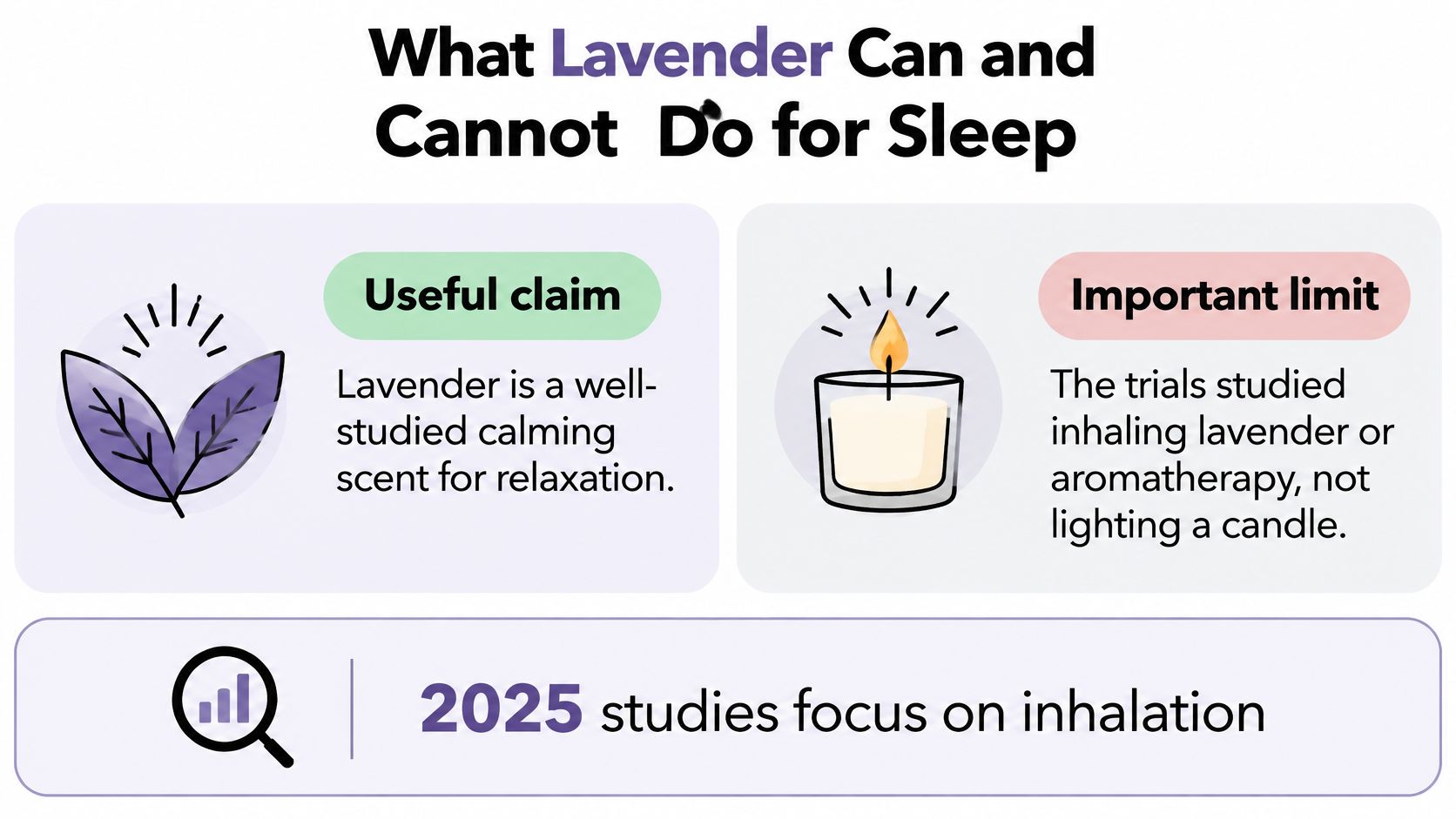
A candle adds a flame and combustion to the fragrance experience. You can't assume results from an essential-oil intervention transfer unchanged to a burning product, even if both smell recognizably of lavender.
Words such as therapeutic or sleep-enhancing can blur that boundary. For a candle buyer, relaxing aroma or part of a wind-down routine is a more reasonable expectation than treating insomnia. Ongoing difficulty falling asleep or staying asleep deserves attention beyond a home-fragrance purchase.
Choose lavender because you enjoy the atmosphere it creates, not because you feel you must tolerate the scent to sleep well.
A practical evening could include lowering the lights, setting aside tomorrow's tasks, and reading somewhere comfortable. Light the candle only while you're awake and able to supervise it, then extinguish it before you become drowsy. The routine should still feel complete on evenings when you skip fragrance.
For ideas that don't depend on scent, SleepHabits' guide to wind down activities before bed provides a useful starting point. A guide to candles for sleeping is best read with the same distinction in mind: a candle belongs before sleep, never burning through it.
If fragrance causes discomfort, leave it out. You don't need a candle, diffuser, or pillow spray to make a bedtime routine worthwhile, and switching delivery methods doesn't automatically make a fragrance suitable for everyone.
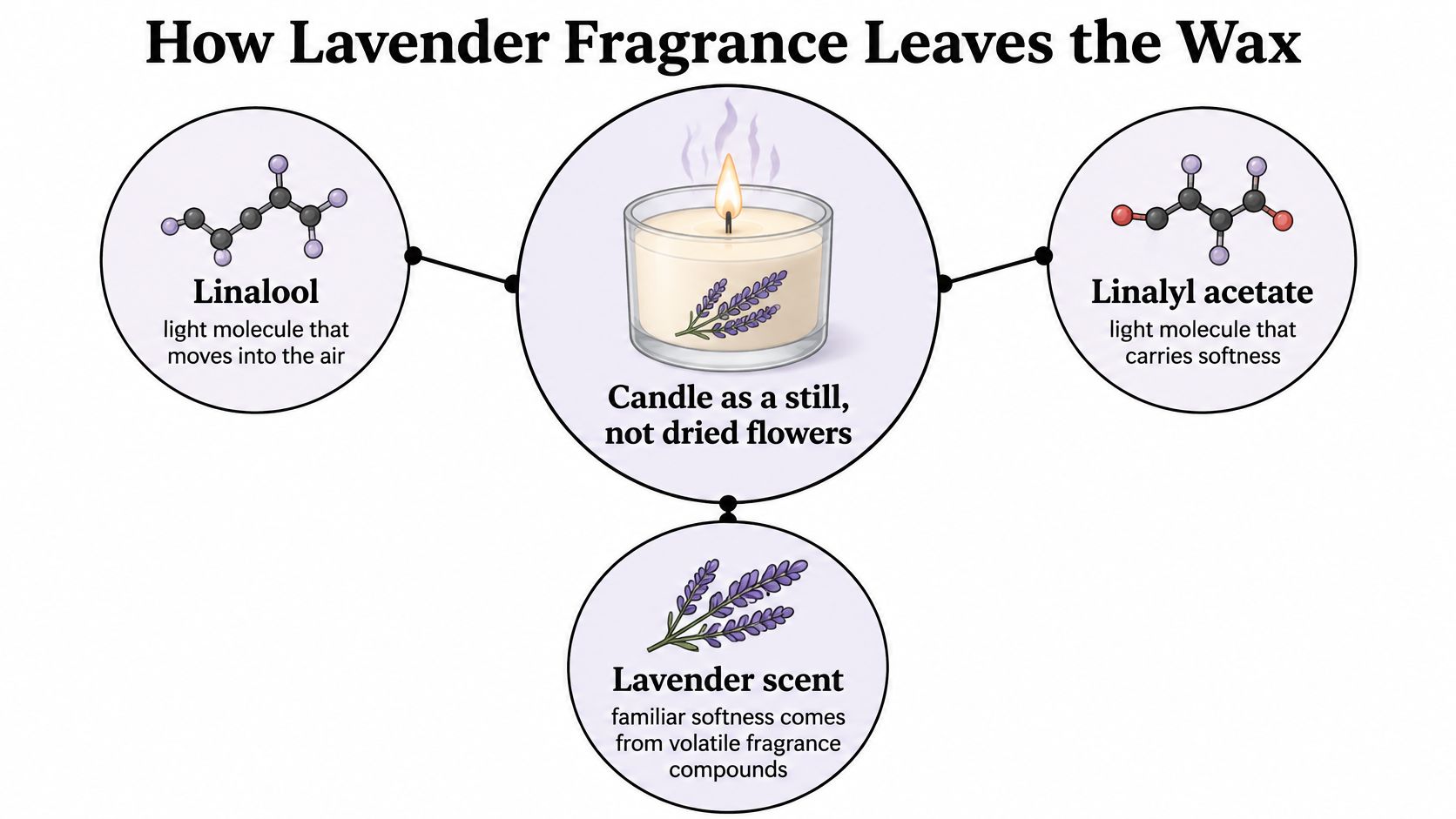
Think of a candle as a small perfume still, with an important limitation: it also burns fuel. The wax is a delivery system, not just a holder for lavender fragrance. As the candle warms, a connected process involving liquid wax, the wick, and heat determines what reaches the air.
The experimental lavender-candle formulation paper describes fragrance compounds including linalool and linalyl acetate, and reports that increasing essential-oil concentration can shorten burn duration while wick size and placement also affect combustion time. Fragrance strength and useful candle life therefore shouldn't be treated as separate design choices.
The familiar scent comes from volatile compounds, meaning compounds that can move into the air. Some fragrance escapes from warm wax, while liquid fuel also travels through the wick toward the hot flame region, where vaporization and combustion occur. It isn't accurate to describe the whole process as gentle evaporation.
Consider a maker increasing the lavender concentration because a test candle smells faint. That change may affect more than the fragrance. The maker needs to retest the wick and burn behavior rather than assuming the original design remains balanced.
A well-developed candle balances these controls. Adding more essential oil isn't a reliable shortcut to a better product, and adding oil to a finished candle at home isn't a sensible way to strengthen it.
Soy can serve as a fragrance-delivery material, but the wax name alone doesn't establish a longer or cleaner burn. A fair comparison would hold the vessel, wick, fragrance loading, and airflow constant. Otherwise, you may be comparing different candle designs rather than isolating the wax.
For makers, useful checks include melt-pool development, flame behavior, wax consumption, and fragrance performance throughout testing. For buyers, the practical lesson is simpler: a beautiful lavender description can't compensate for a poorly balanced candle. Look for clear care instructions and evaluate the burn, not just the perfume.
Shop for usable candle life, not just the largest burn-time claim. You want steady fragrance and controlled burning without wasting wax or continuing through smoke. The label and the first supervised use give you different pieces of that picture.
Start by examining what the maker tells you.
Place the candle on a level, heat-resistant surface and follow its specific lighting and burn-window instructions. Watch how the melt pool develops, but don't exceed the stated session limit just to force wax at the edges to melt. Some designs develop differently across successive burns.
Burn-check signs on a lavender candle
| Clue | Good sign | Reject sign |
|---|---|---|
| Flame | Steady and controlled | Persistently tall, unstable, or smoking |
| Wick | Properly positioned and burning evenly | Mushrooms into a carbon ball |
| Glass | No accumulating black deposits | Soot marks on the glass |
| Melt pool | Develops evenly within the instructed burn window | Persistent tunneling and unused wax at the sides |
| Label | States wax type, wick style, and burn window in hours | Gives only a large hour claim |
Use the video as a companion visual, while keeping the candle's own instructions as your reference.
Buying test: Prefer a clearly described candle that burns predictably over an impressive hour claim with no supporting care information.
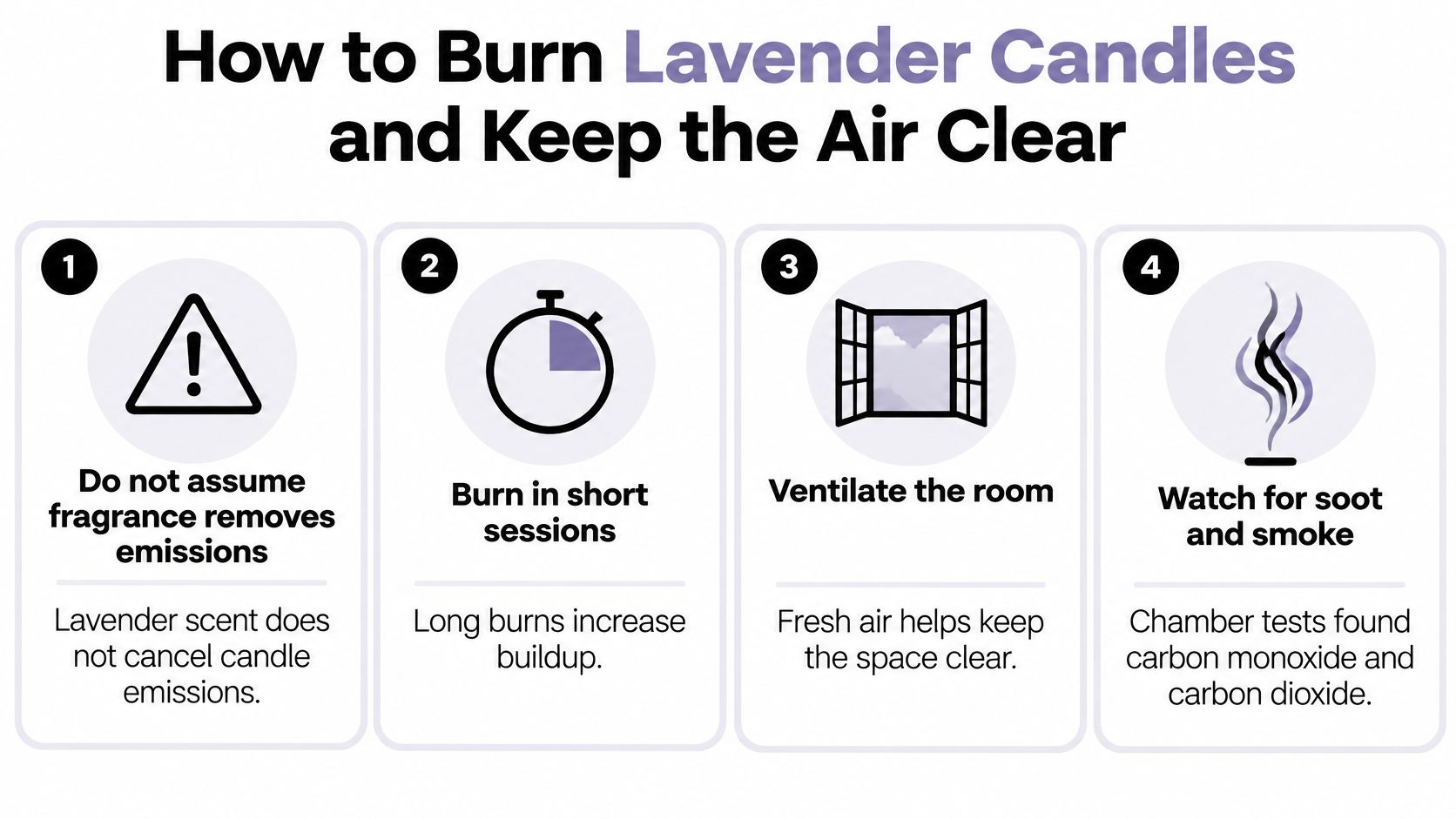
Lavender scent doesn't cancel candle emissions. Neither all candles are harmless nor all candle use is equally hazardous is a useful rule. Your exposure depends on the product, the room, ventilation, and how you use it.
Controlled chamber research on candle emissions detected combustion gases, fragrance-related compounds, and airborne particles, although calculated indoor concentrations were generally below applicable guidance values under the tested conditions. That finding supports proportionate precautions, not a promise that every product will behave the same way in a closed room.
A review of candle-emission evidence also highlights concerns under chronic, reasonable-worst-case exposure conditions. The practical question isn't whether you can smell lavender pleasantly at the jar, but whether everyone can remain comfortable in the room during use.
People with asthma or fragrance sensitivity may prefer to avoid scented combustion entirely. In homes with children or pets, placement and supervision matter, but so does recognizing that the fragrance may not suit everyone sharing the space. An unlit alternative removes the flame, though it doesn't guarantee freedom from fragrance irritation.
Descriptions such as clean burning need the same practical interpretation. This guide to clean-burning soy candles can help frame product comparisons, but no wax label replaces ventilation or careful use.
No visible soot doesn't mean no emissions. A comfortable room, appropriate airflow, and a controlled flame are more useful goals than trying to make the fragrance as strong as possible.
Choose the lavender you want to spend an evening with. If you prefer soft herbs, avoid buying a sharply camphor-like profile just because the label mentions relaxation. If straight lavender feels too austere, a balanced vanilla or woody blend may be more enjoyable.
Our Lavender Wooden Wick Candle is $29.95. We hand-pour our candles using 100% natural soy, and they burn for up to 80 hours. Treat that maximum as a product specification, not a reason to extend a session beyond the candle's care instructions.
Before lighting, clear a stable, heat-safe surface where nobody will reach over the flame. Read the care label, prepare the wick as directed, and choose an evening when you can stay nearby. Evaluate whether the fragrance feels comfortable from your normal seat, rather than repeatedly leaning over the jar.
Let the candle cool fully after extinguishing it before handling or inspecting it. Notice whether the jar developed soot, whether the wick needs attention, and whether the scent suited the activity you bought it for.
For a gift, choose herbal lavender when you already know the recipient enjoys botanical scents. Lavender vanilla can be a more approachable alternative for someone who likes sweeter home fragrance, but no scented gift is universally suitable.
The right choice doesn't need to dominate the room. It should fit the space, stay pleasant during use, and leave you happy to light it again.
We offer a Lavender Wooden Wick Candle for readers who want to try lavender as part of a supervised evening fragrance ritual. Visit Jackpot Candles to explore the lavender option, review its care details, and choose a candle that fits your room and scent preferences.
Comments will be approved before showing up.