
free shipping at $99


Stop choosing candles by sniffing the unlit jar. That's the most popular advice in stores, and it's the fastest way to buy a disappointment. A wax that hits hard under your nose can go quiet once it's lit, while a softer cold scent can fill a room for hours. If you want scented candles that smell, judge hot throw, the scent released from a warm melt pool, and judge it across repeated burns. One good first hour isn't enough.
The gap most shoppers miss sits between cold throw and hot throw. Cold throw is what you smell with the lid off. Hot throw is what the flame, wick, and melted wax push into the air. Heat changes which fragrance molecules evaporate, how fast they travel, and what else the candle produces as it burns. That's why a jar that smells almost too strong on a shelf can barely register from a sofa.
A controlled emissions study in an 8 m³ stainless-steel chamber examined four wax fuels, five fragrance formulations, and unscented control candles, and the 2021 measurement and evaluation of emissions from scented and unscented candles shows burning candles release both ordinary combustion products and evaporated fragrance constituents. In plain terms, performance doesn't come from fragrance concentration alone. The wax and wick system controls how cleanly and steadily that fragrance leaves the jar. A claim that a candle will fill a room means little without burn behavior to back it up.
Use the label to filter out weak candidates before you spend anything. Specifics beat adjectives every time.
| What to check | What a strong candle shows | Red flag |
|---|---|---|
| Fragrance load | About 6-10% fragrance oil by wax weight | Load not stated, or only vague scent names |
| Wax type | Soy or soy blend that holds fragrance well | Wax type not named on the label |
| Fragrance type | Named fragrance oils or perfume-grade blends | Only general 'natural' claims with no fragrance name |
| Wick | Cotton or wood wick sized to the jar diameter | No wick size given, or wick looks too thin for the jar |
| Reviews | Buyers describe scent from another room | Reviews mention only the unlit smell |
Fragrance load matters because too little oil gives you a faint, sharp smell that never builds. Too much can destabilize the burn, so a stated range tells you the maker has thought about the balance rather than pouring in oil and hoping. Wax type matters because the wax is the fuel and the carrier. If a listing won't name it, you can't judge how it will hold or release scent.
Named fragrance oils are another useful filter. "Fresh," "clean," and "cozy" describe a mood, not a formula. If you're comparing a specific profile, it helps to find Volcano-inspired fragrance oils and see how named notes are described, rather than relying on a label that gives you nothing to compare. A perfume-grade blend with identifiable notes gives you a better sense of what will lift first and what will linger.
First, check whether the listing names the wick size and burn behavior. A wick that's too small can't melt the surface properly, so fragrance stays trapped. A maker who states wick type and jar diameter has at least matched the parts deliberately.
Second, read reviews for distance, not adjectives. "Smells amazing" tells you nothing. "I could smell it from the hallway" tells you the candle throws. If every positive review describes opening the jar and none describes a lit room, treat that as a warning.
Shop rule: If the listing won't name the wax, the fragrance, and the wick, don't expect it to perform like a candle that does.
Start with those two checks, wick information and room-level reviews. They cost nothing, take a minute, and remove most weak candles before you ever light one.
A useful test measures a candle the way you'll use it, in its final container, in a real room, over a fixed burn. Holding a jar at arm's length in a shop tells you almost nothing about hour two. Run this sequence on one candle before you buy a set, a gift order, or a matching pair for a larger space.
The visual below summarizes the flow you'll follow, from lighting to decision.
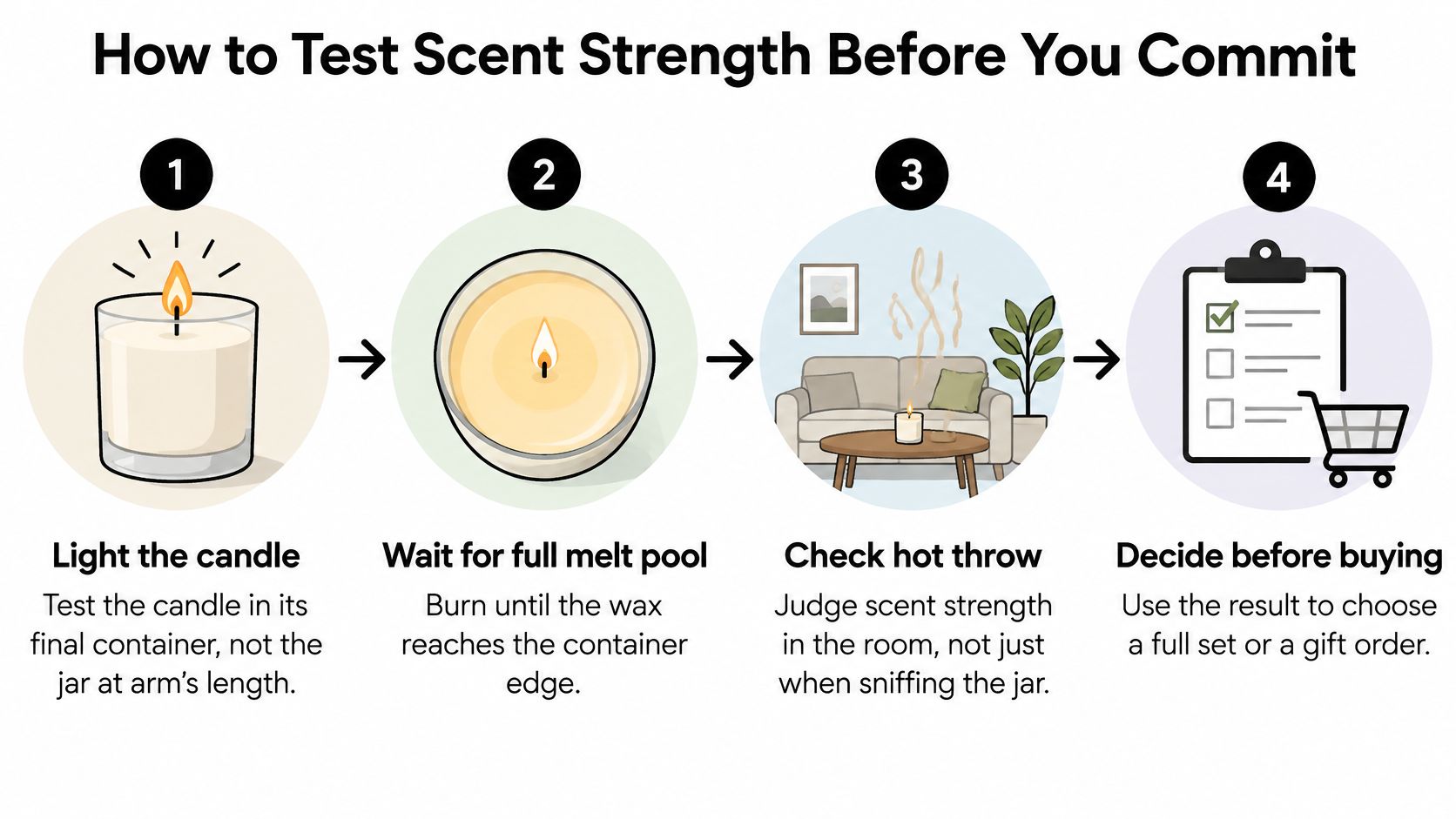
That repeat step is where most home testing falls down. Fragrance diffusion shifts with wick heat, vessel shape, wax composition, airflow, and cure history, so one candle can't prove a whole batch performs. Our guide to how soy candle scent throw works explains why those variables change what you smell from burn to burn.
Ask someone else to rate the lit candle without telling them the brand, the price, or what you hope they'll say. Blinded ratings strip out packaging bias and wishful thinking. If you've paid a premium, you'll work hard to smell a premium result. A second nose with no stake in the purchase won't.
Keep the setup identical for both candles. Same room, same placement, doors and windows in the same position, same burn length. Change one thing at a time or you won't know what caused a difference.
The ASTM F2417 candle fire safety specification treats candle fire testing as a controlled measurement of heat and flame response and cautions that it does not reproduce every real-world fire condition. That distinction matters here. Safety testing and scent performance are separate questions, and a candle needs to satisfy both.
A pass looks specific. You notice the scent at the room size you need, the flame stays steady without unacceptable visible emissions, and the second candle scores close to the first. Anything less is a sample result, not a buying decision.
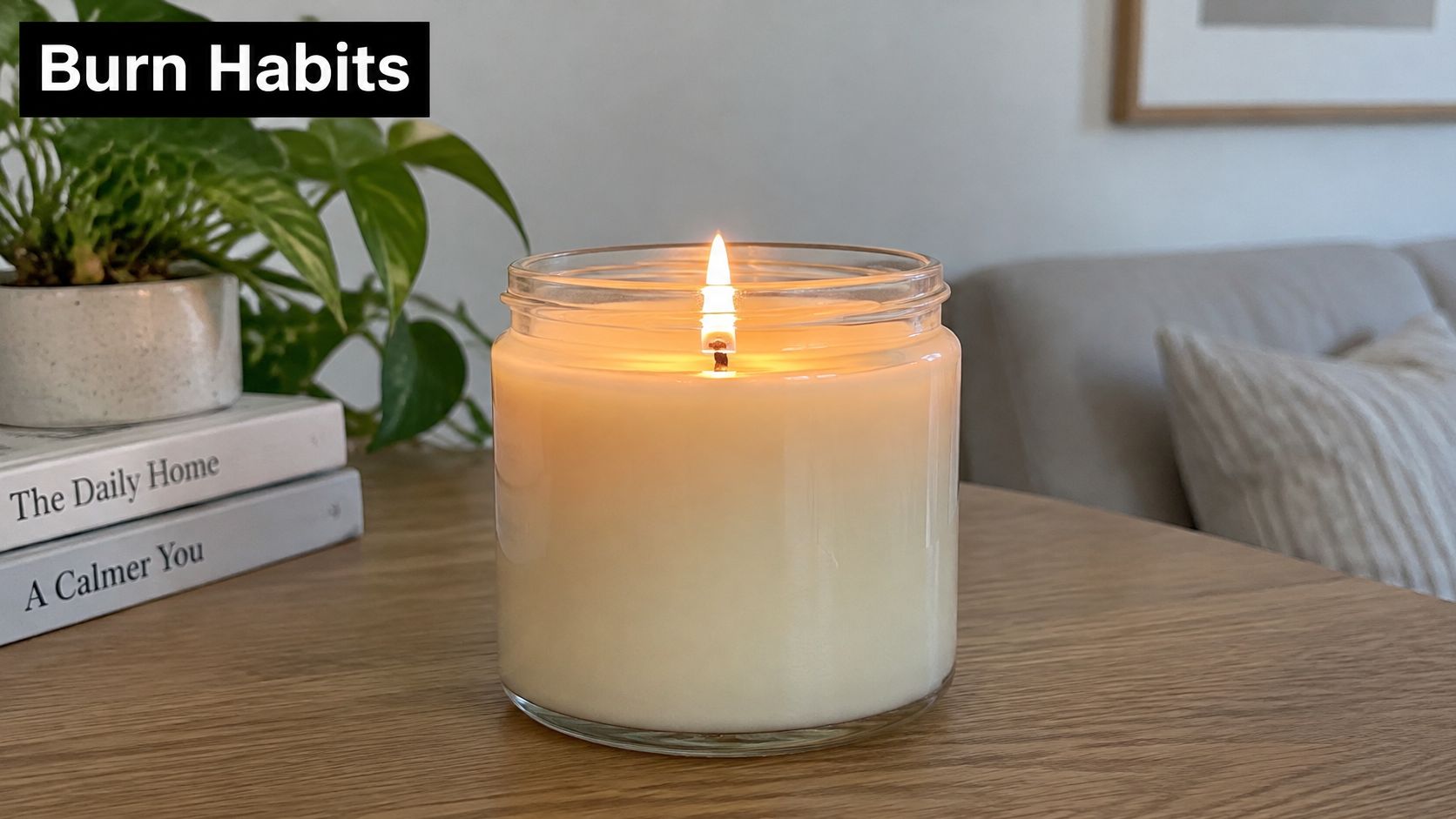
The burn habit that changes scent most is also the one people rush. Let the melt pool reach the container edge before you blow the candle out. A practical guide is about an hour per inch of diameter, though you'll watch the wax rather than the clock. A full pool releases fragrance from the whole surface. A narrow pool leaves scented wax stranded on the walls.
This is what a settled, usable burn should look like in a normal room setting.
Keep individual burns to a few hours and ventilate during prolonged use. That isn't fussy advice. Scent delivery and indoor air are linked, because the same flame that releases fragrance also produces particles.
A 2025 study of scented-candle use in homes in Seoul measured particles at the candle location, 3 metres away, and 6 metres away, and the 2025 Seoul homes study in Scientific Reports reports peak concentrations of up to 3.44 mg/m³ for PM10 and 2.01 mg/m³ for PM2.5, compared with Korean 24-hour indoor guidelines of 100 µg/m³ for PM10 and 50 µg/m³ for PM2.5. Larger PM10 particles peaked near the source, while finer PM2.5 and PM1 particles dispersed farther through the room. Those peaks don't describe every candle or every burn. Wax, wick, fragrance, flame conditions, room size, ventilation, and burn duration all change the result. They do show why a stable, smoke-free flame isn't cosmetic. It's part of performance.
Diagnose before you blame the fragrance. Most scent problems show up in the flame or the melt pool first.
| Symptom | Likely cause | Fix |
|---|---|---|
| Scent weak from the first burn | Wick too small for the jar, melt pool not reached | Burn until the pool reaches the edge, then choose a larger wick next time |
| Scent fades after an hour or two | Tunneling from short early burns | Burn long enough to melt to the edge on every use |
| Tall flame with black soot | Wick too long or too large | Trim to about 6 mm and burn away from drafts |
| Mushrooming wick | Carbon build-up on the wick from heat | Trim before each burn and check the wick size |
| Strong at first, then smoky | Fragrance load too high for the wax and wick | Choose a lower-load candle or a wick sized for the fragrance |
| Sharp smell but barely fills a room | Low fragrance load or light fragrance | Burn a larger candle or pick a richer scent |
Notice how many fixes involve the wick rather than more fragrance. That's deliberate. Raising fragrance load can intensify aroma, but it can also reduce wax and wick stability, create an oversized melt pool, or produce soot when the wick isn't matched to the fuel load. I would adjust the wick first and treat added fragrance as the last lever, not the first.
The video below is useful for seeing flame behavior and wick problems in motion rather than from a still description.
Making quality shows up clearly in emissions. Independent reporting summarizing university laboratory findings, in the HealthcareOnTime summary of candle emission risks, found well-made soy candles emitted approximately 6-10 µg/g of particulate matter, while poorly made soy candles reached about 146 µg/g. Same broad material, very different outcome. Soy on the label doesn't guarantee a clean burn. Wick sizing, fragrance matching, and repeat testing do the work.
A candle that smells powerful but smokes, mushrooms, or soots the glass hasn't passed. It has traded one problem for another.
Recognized standards help, but they don't finish the job. ASTM F2417 covers minimum candle fire-safety requirements and ASTM F2058 addresses safety labeling. Treat both as a floor that supplements product-specific burn testing, not as proof that a particular candle throws well in your room.
For day-to-day technique, our practical candle burning tips cover placement and care in more detail. Apply them consistently, then judge the candle over replicate burns at the beginning, middle, and later life of the jar. Reject combinations that show persistent smoking, excessive flame height, heavy mushrooming, soot deposits, tunneling, or an overheated container.
Consistency is the benchmark. A single exceptionally strong burn can flatter a weak product. Three steady burns with a clean flame and repeatable scent tell you what you're actually buying.
Say you buy a light, pretty fragrance for a bedroom and light it in a 20 square metre room. For the first few minutes near the nightstand it smells fine. From the doorway, there's almost nothing. The candle may not be badly made. It's just undersized and underpowered for the volume of air you're asking it to scent.
The fix isn't a longer burn. Burning a small, light candle for six hours mostly gives you a deep melt pool and the same faint result. Move to a larger candle or a richer fragrance that can hold its presence across the room.
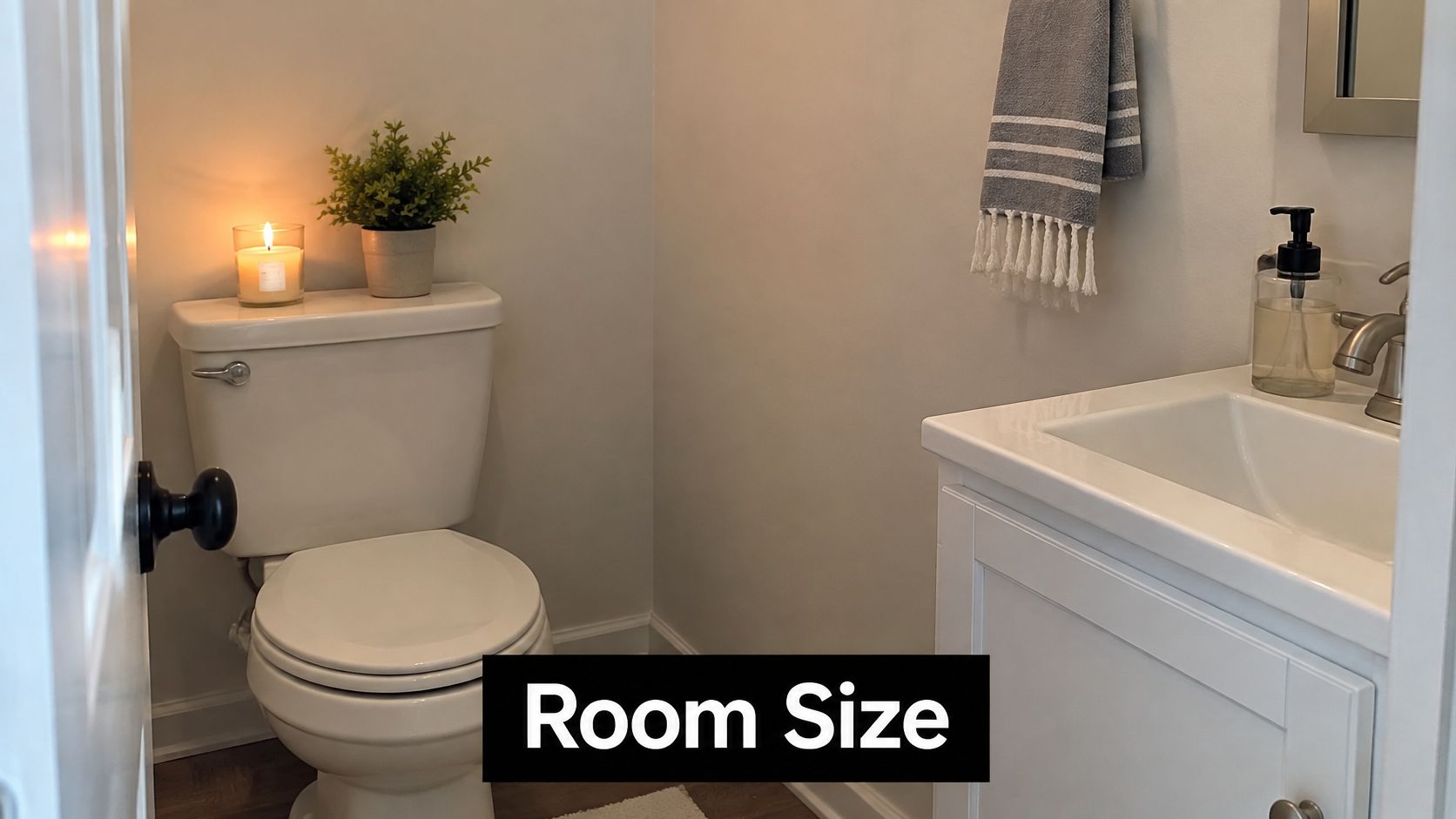
Small enclosed spaces behave differently, as this powder room setup shows.
| Room | Candle to use | Burn guidance |
|---|---|---|
| Small bathroom or walk-in closet | One jar candle | Burn for a few hours |
| Open-plan living room or kitchen-dining area | Larger jar, or two smaller candles placed apart | Burn two to three hours, spaced so scent doesn't stack in one corner |
| Light scents such as citrus or fresh linen | Lift quickly and fade sooner | Use in a smaller room and light shortly before you need the scent |
| Heavy notes such as amber, vanilla or woods | Linger longer in the room | Use in larger rooms and allow a full melt pool to develop |
Placement changes the result as much as size does. Our guide on where to place scented candles is worth checking before you assume a candle is weak. A jar tucked on a low shelf in a corner has to work harder than one placed where normal room air movement can carry scent without bending the flame.
Consider a host preparing for guests. Light the candle in the hallway about an hour before the door opens, let the pool form, then move it carefully to the dining area once it's throwing properly. Guests walk into scent that's already established rather than a freshly lit wick still warming up.
Fragrance character matters here too. Citrus and fresh linen lift quickly and read bright, but they fade sooner. Amber, vanilla, and woods build more slowly and linger after you extinguish the flame. Match that behavior to the job. A bathroom needs a quick lift. An open-plan living space needs staying power.
Pick the room you use most, test the candle there, and let that result decide. A candle that passes in your actual space beats a stronger-on-paper candle tested somewhere smaller.
Don't buy a full set this week. Buy one or two candles, test them properly, and let the results spend the rest of your money for you. A shortlist of two teaches you more than a shelf of untested jars, because you can compare burn behavior side by side while the details are still fresh.
The checklist below keeps the routine short enough for you to finish it.
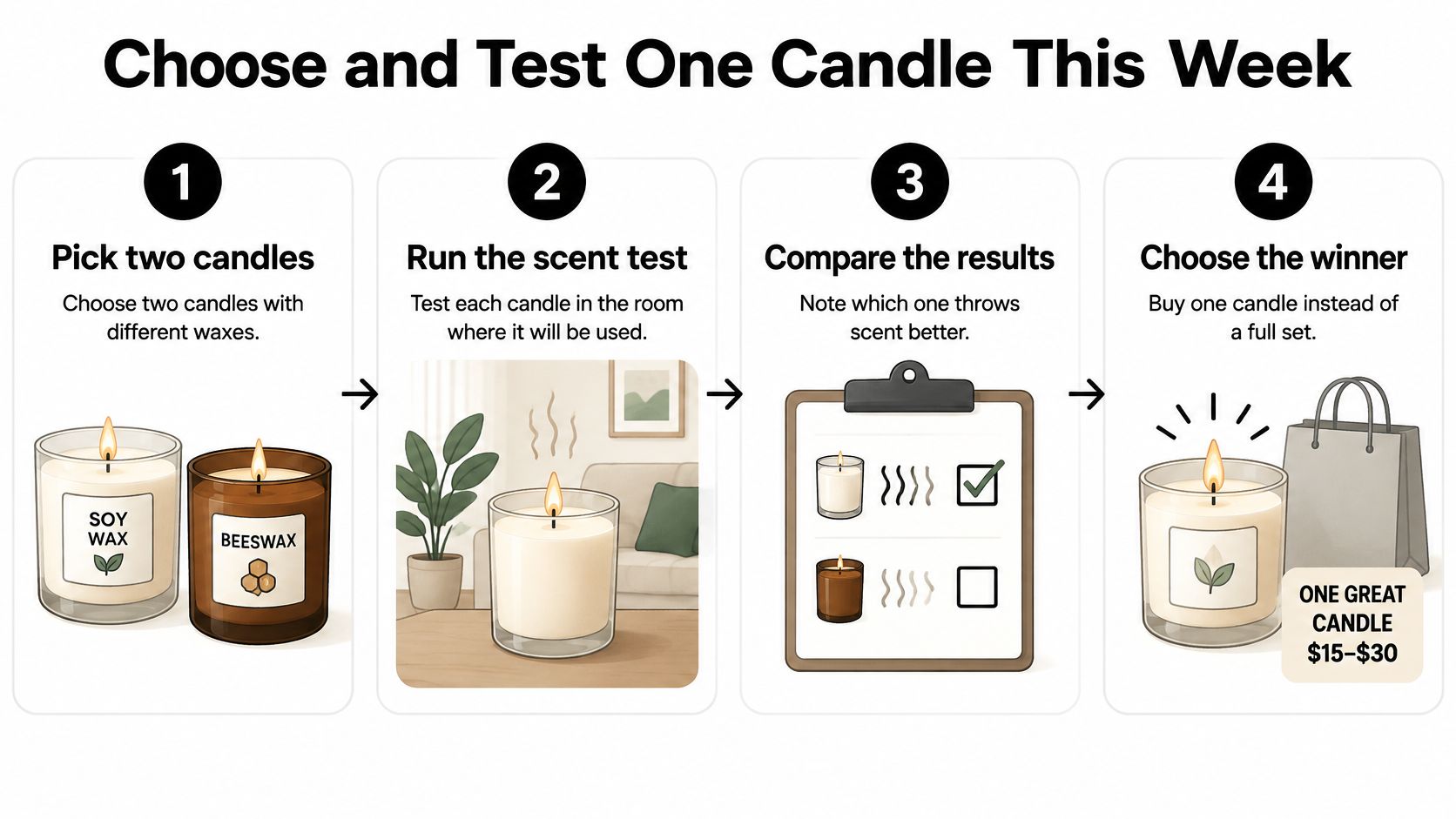
Pick two candles with different waxes or different fragrance styles. Don't buy two versions of the same idea, because that tells you which label you prefer, not which construction performs. Give each candle the same room, the same placement, and the same burn length on separate evenings.
Record three things for each burn. Write down the fragrance name, the room size, and the wick size if it's stated. Add your 1 to 5 rating at the same intervals each time, plus a note on flame height, soot, and whether the scent reached the doorway. That small record turns your next purchase into a repeat of what worked rather than another guess.
Pay closest attention to hour two and hour three. Many candles open well because the surface wax is fresh and the first pool releases a burst of fragrance. The keeper is the one that still scents the room later in the burn, with a steady flame and a wick that looks clean after you extinguish it. Check the wick after every burn. Heavy carbon, leaning, or a ragged tip predicts trouble before the scent rating drops.
Decision rule: If a candle passes in two separate burns, buy it again. If it doesn't, move to the next candle on the shortlist without negotiating with yourself.
Long burn life makes this kind of testing easier because you don't have to rush a verdict in one sitting. Our candles are hand-poured, made with 100% natural soy, and burn for up to 80 hours, so you can run the test over several evenings and still have most of the jar left for normal use. That fits the routine properly. You get a first burn, a repeat burn, and a later check without finishing the candle just to evaluate it.
Keep the notes with the jar or in your phone. Note whether the scent carried through the room, whether it suited the room size, and whether you'd choose a richer or lighter fragrance next time. Those three lines will save you more money than any sale.
The position is simple. Scented candles that smell aren't found by trusting the strongest cold sniff or the boldest label claim. They're found by testing hot throw, watching the flame, and demanding the same result twice. Do that with one candle this week and you'll know, rather than hope, what belongs in your home.
Ready to put a candle through a proper two-burn test instead of trusting the unlit jar? Visit Jackpot Candles to choose a hand-poured soy candle, test its hot throw in the room you use most, and keep the one that still performs in hour three.
Comments will be approved before showing up.