
free shipping at $99


You bring home a beautiful soy candle, lift the lid, and fall for the fragrance immediately. The cold jar smells rich and inviting. Later, you light it, wait, and realize the aroma barely travels beyond the table.
That disappointment has a name: soy candle scent throw. Scent throw describes how strongly and how far a candle projects fragrance into a room. It isn't controlled by fragrance oil alone. Wax structure, wick balance, curing, vessel design, fragrance chemistry, and the room itself all shape what your nose experiences.
The most useful way to understand the problem is to separate cold throw from hot throw, then connect both to the space where you burn the candle. Once you know the difference, a weak-smelling candle becomes easier to diagnose. By the end, you'll know what controls scent throw and how to judge whether a candle is properly matched to your room.
You light a candle after enjoying its rich jar scent, then notice that the fragrance fades a few steps away. The candle may still be burning correctly. What changed is the path from wax to nose: the flame warms the wax, a liquid melt pool forms, fragrance enters the air, and room airflow carries it outward.
Scent throw is best understood as communication range. A candle beside a bed has a smaller task than one expected to scent an open-plan living area. If its aroma stays near the vessel, it may suit a small room while seeming weak in a larger space.
Soy wax depends heavily on its formula and testing. Independent guidance commonly places the workable fragrance-load range for soy container candles at about 6% to 10% by wax weight, with some soy formulations tested up to 12% as an upper limit. More fragrance oil does not automatically create stronger room scent. The wax must hold the oil well, and the wick must release it through a steady burn. Independent soy candle testing guidance explains how load, wax retention, cure time, and wick balance interact.
The practical question isn't “How strong can this candle be?” It's “How much fragrance does this room actually need?”
Room fit often explains the disappointment better than a soy-versus-paraffin comparison. A fragrance built from lighter, more easily noticed materials may feel lively in a small bedroom but disappear in a drafty room. A heavier fragrance may travel more slowly and feel subdued until the wax pool becomes fully established.
Two terms help identify the gap between a promising jar and a quiet burn. Cold throw is the aroma from an unlit candle. Hot throw is the fragrance released while it burns. One candle can perform well in the first category and poorly in the second.
Cold throw shapes the first impression for shoppers and gift-givers. Hot throw determines whether the fragrance reaches you across the room. Separating those experiences helps you adjust the wick, cure time, room placement, or fragrance choice instead of adding more oil.
Cold throw is the scent you notice when the candle isn't lit. You smell it from the open jar, the wax surface, or the package. This is the fragrance that sells shelf appeal, helps someone choose a gift, and tells you whether the scent profile is appealing before use.
Hot throw begins after the flame warms the wax and creates a liquid pool around the wick. Heat helps fragrance molecules move out of the wax and into the air. The result is the aroma you experience while the candle burns, which is the more useful measure for filling a bedroom, kitchen, or living room.
A simple analogy helps. Cold throw is a poster on the wall. Hot throw is music playing through the room. The poster can be vivid when you stand close, but it doesn't travel. Music needs a working speaker and enough volume to reach the listener. In the same way, an appealing unlit aroma doesn't guarantee effective room fragrance.
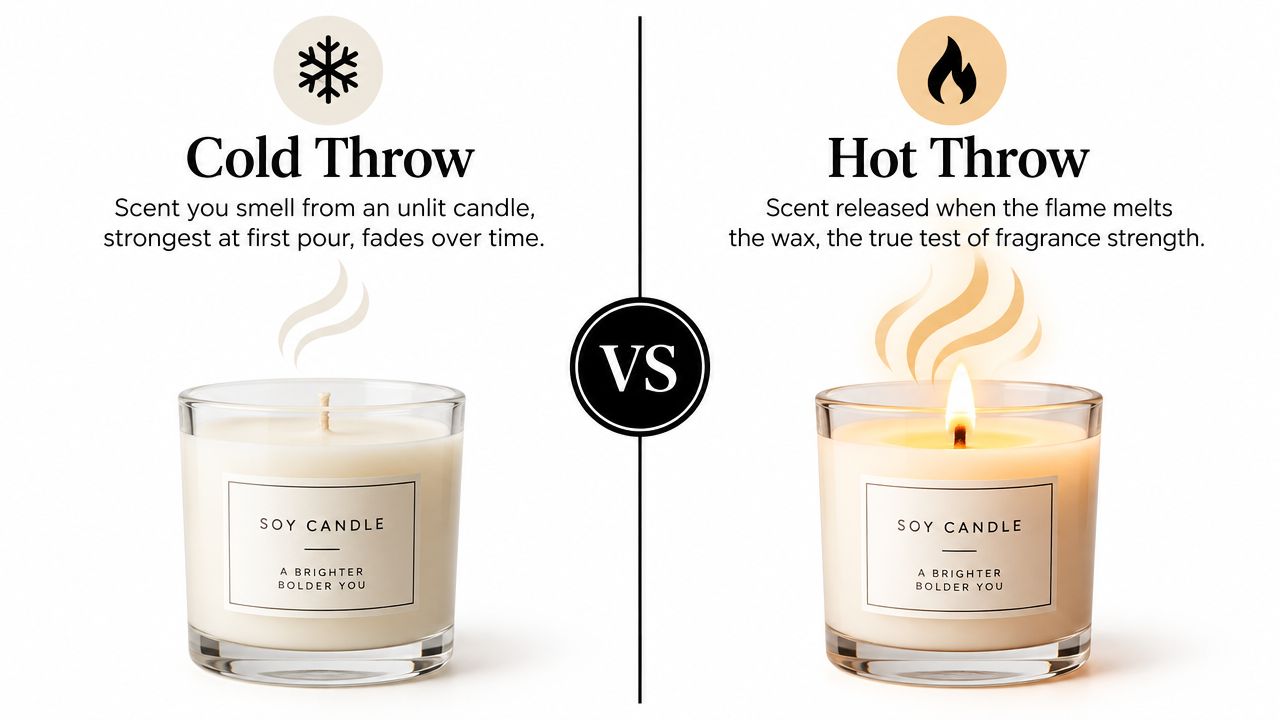
A strong cold throw with a weak hot throw often points to a problem with the burn system. The wick may be too small, the melt pool may be too shallow, the candle may need more curing time, or the fragrance may bind tightly to that particular wax.
The reverse can happen too. A candle may smell restrained in the jar but become pleasant and noticeable once lit. Some fragrance components need heat to evaporate efficiently, so a quiet cold impression doesn't always predict a poor burn.
Cold throw matters most when the candle is displayed, opened, or given as a present. Hot throw matters when you want the scent to occupy a space. Treat them as related but separate performance tests, not as two names for the same result.
A candle can smell excellent in the jar and still fade into a living room. The result depends on a connected system rather than one “strong” ingredient: wax blend, fragrance load, wick, cure time, and vessel. Each variable changes how fragrance is held, warmed, and released.
Wax blend sets the starting conditions. Pure soy wax often releases fragrance more softly and slowly than paraffin. Soy-coconut and soy-paraffin blends can melt differently and carry fragrance oil in different ways. That difference is not automatically a flaw. A gentler release may suit a bedroom, while a larger room may need a formula designed to spread farther. The chemistry of the oil matters alongside the wax, as explained in this guide to soy candle fragrance oils.
Fragrance load means the amount of fragrance oil mixed into the wax. More oil can make an unlit candle smell fuller, but it does not guarantee a stronger burn. If the wax cannot hold or release the oil properly, the result may include sweating, a poor surface finish, or inconsistent hot throw. Stay within the tested range for the specific wax and fragrance. For a relaxing evening profile, this guide to scents for a good night's rest can also help with fragrance direction.
Wick supplies the heat that opens the melt pool. A wick that is too small may leave too little liquid wax to release fragrance efficiently. A wick that is too large can overheat the container, produce an unstable flame, and use fragrance faster than intended. The right choice depends on the wax, oil, additives, vessel diameter, and the way the candle is meant to burn.
Cure time is the resting period after pouring. During that time, the wax structure settles and the fragrance integrates more fully. Soy candles often need several days before testing, and a longer cure can provide a more consistent comparison. Judge the candle only after it has had adequate time to rest, rather than treating an early weak impression as a final result.
Vessel controls the shape and area of the melt pool. A wide container can expose more liquid wax to the air, while a narrow or deep jar changes how heat moves through the candle. Material, diameter, and depth all affect performance. A wick that works in one jar may be poorly matched to another, even with the same wax and fragrance.
| Variable | What It Is | Effect on Cold Throw | Effect on Hot Throw | Practical Sweet Spot |
|---|---|---|---|---|
| Wax blend | The wax or wax combination holding the fragrance | Changes how readily fragrance remains near the surface | Controls melt behavior and release speed | Use a blend tested with the chosen fragrance |
| Fragrance load | Fragrance oil measured against wax weight | Can make the unlit candle smell fuller | Helps only while the wax can retain and release the oil | Stay within the supplier's tested range |
| Wick | The heat source that forms the melt pool | Little direct effect | Determines heat, melt-pool development, and diffusion | Match wick series to wax and vessel |
| Cure time | Resting period after pouring | Lets the aroma settle into the finished wax | Often improves consistency before testing | Test only after adequate curing |
| Vessel | The container's width, depth, and material | Shapes the exposed wax surface | Changes heat distribution and room projection | Test each vessel and wick combination |
These variables work together. A higher fragrance load cannot compensate for a wick that fails to form a suitable melt pool. A correctly sized wick cannot fix fragrance that separates from the wax. Evaluate the full combination, then adjust one variable at a time so the cause of any change remains clear.
The strongest possible candle isn't always the best candle. A small bedroom can become uncomfortable when fragrance accumulates near the bed, while a drafty open-plan room can make a normally balanced candle seem faint. Room fit should guide the formula before you chase intensity.
Use the table as a starting framework, not a universal recipe. Fragrance suppliers and wick manufacturers still need to guide final testing because vessel diameter, wax blend, and fragrance behavior vary.
| Room Type | Suggested Fragrance Load | Wick Width Hint | Expected Throw |
|---|---|---|---|
| Small bedroom or reading nook | Lower to middle part of the tested soy range | Narrower wick, tested for the vessel | Close, calm fragrance with less risk of overload |
| Medium bedroom, office, or kitchen | Middle to upper part of the tested soy range | Medium wick matched to vessel diameter | Noticeable aroma across the immediate room |
| Large or open-plan living area | Upper part of the tested range, only if the wax supports it | Wider vessel or wick system tested for stable heat | Broader projection, influenced strongly by airflow |
A cozy bedroom usually benefits from restraint. Keep the candle away from bedding and drafts, and choose a fragrance that remains comfortable at close range. If the scent feels overpowering within minutes, reducing load or choosing a smaller vessel may solve the problem more effectively than changing wax.
A busy kitchen has competing odors from food, ventilation, and cleaning products. A candle with moderate throw may disappear during cooking but become noticeable afterward. Place it where air can circulate without putting the flame in a direct draft.
An open-plan living room asks more of the candle. High ceilings, stairwells, fans, and connected spaces dilute fragrance. A larger tested vessel or more than one candle may be more sensible than overloading a single container.
The same room-matching principle applies to other indoor setups. Someone planning plant care, for example, may need a suitable light kit for indoor gardening, but a candle still needs its own safe, draft-free position.
If a candle isn't noticeable within roughly ten minutes of lighting, first suspect a mismatch between candle, room, and airflow. Don't assume the soy wax is defective.
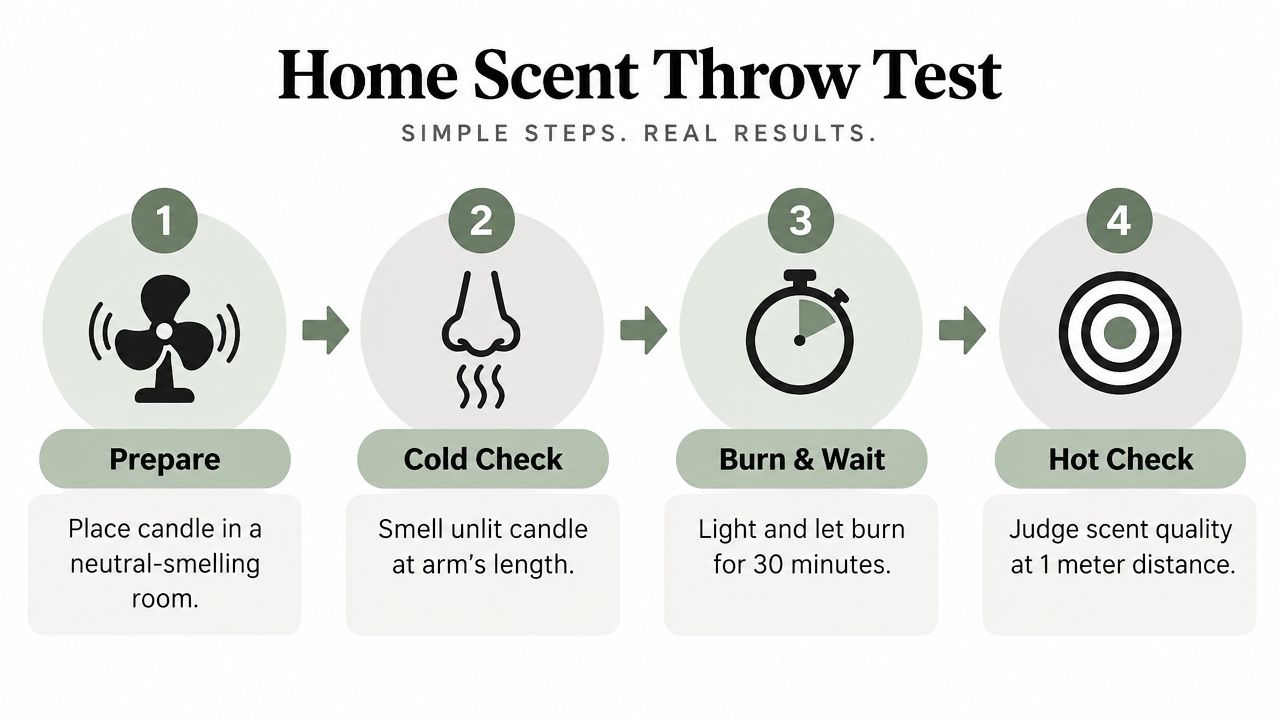
You don't need laboratory equipment to compare candles. You need a neutral room, a consistent routine, and notes that separate cold impressions from burning performance.
Choose a room without cooking smells, perfume, air fresheners, or strong cleaning products. Close windows if outdoor air is changing the result, but maintain safe ventilation while burning. Trim the wick according to the maker's instructions before lighting, and keep the candle on a stable, heat-safe surface away from drafts and combustible materials.
Start with the cold check. Smell the unlit candle from close range, then at arm's length. Walk gradually toward the doorway or another fixed point and note where the scent becomes unclear. You're not trying to prove an exact distance. You're creating the same reference point for future candles.
For the hot check, light the candle and observe it without moving it. Evaluate the aroma around the one-hour and three-hour marks, provided the candle's safety instructions allow that burn duration and you remain present. Keep the room conditions consistent, because an open door or running fan can change the result.
Use simple categories rather than dramatic language:
Write down the wax type, fragrance name, load if known, vessel, wick, room conditions, and result. A notebook turns “this feels weak” into a comparison you can use when buying another candle or adjusting a batch.
Two candles can share soy wax, vessel style, wick size, and fragrance percentage yet produce different rooms of scent. The hidden variable is often the fragrance oil itself.
Imagine a room full of singers. Some have powerful voices that carry across the room. Others sound beautiful close up but lose energy quickly. A fragrance blend behaves similarly. Its molecules differ in volatility, size, evaporation behavior, and attraction to the wax. Those differences influence whether the scent stays in the solid wax, emerges gradually from the melt pool, or travels readily through the air.
Essential oils, nature-identical oils, and synthetic fragrance oils aren't interchangeable because they share a scent description. Each contains a different collection of aromatic materials, and those materials can interact differently with soy wax. A fragrance that performs beautifully in a diffuser may not produce the same result after it has been mixed into wax, cured, heated, and released through a wick.
Flash point is another term that causes confusion. It describes the temperature at which a material can produce ignitable vapor under specified conditions, not a direct ranking of candle scent strength. Polarity, solubility, and the way individual components evaporate can still affect how smoothly a fragrance incorporates and how it develops during a burn.
The fragrance supplier's design priorities matter too. Some blends make a strong first impression from the jar, while others seem restrained cold but open up with heat. Change the supplier and you may change the candle's behavior even when the label uses the same fragrance name.
Recent independent discussion also points to a major difference between fragrance families, reporting a 46-fold swing in volatile organic compound emissions in soy candles depending on scent family. That does not mean every high-emission fragrance is better, safer, or more pleasant. It means that wax and load alone can't explain every performance difference. This comparison of candle waxes and scent throw is useful when you want to consider wax, curing, hot throw, and cold throw together.
Small process changes often matter more than dramatic formula changes. Use this checklist when you pour, purchase, or test a soy candle.
A fragrance's staying power also depends on how volatile its aromatic components are. For a broader explanation of preserving fragrance longevity, you can read Essentia Perfume's cologne longevity guide, while remembering that candles and skin fragrances have different use conditions.
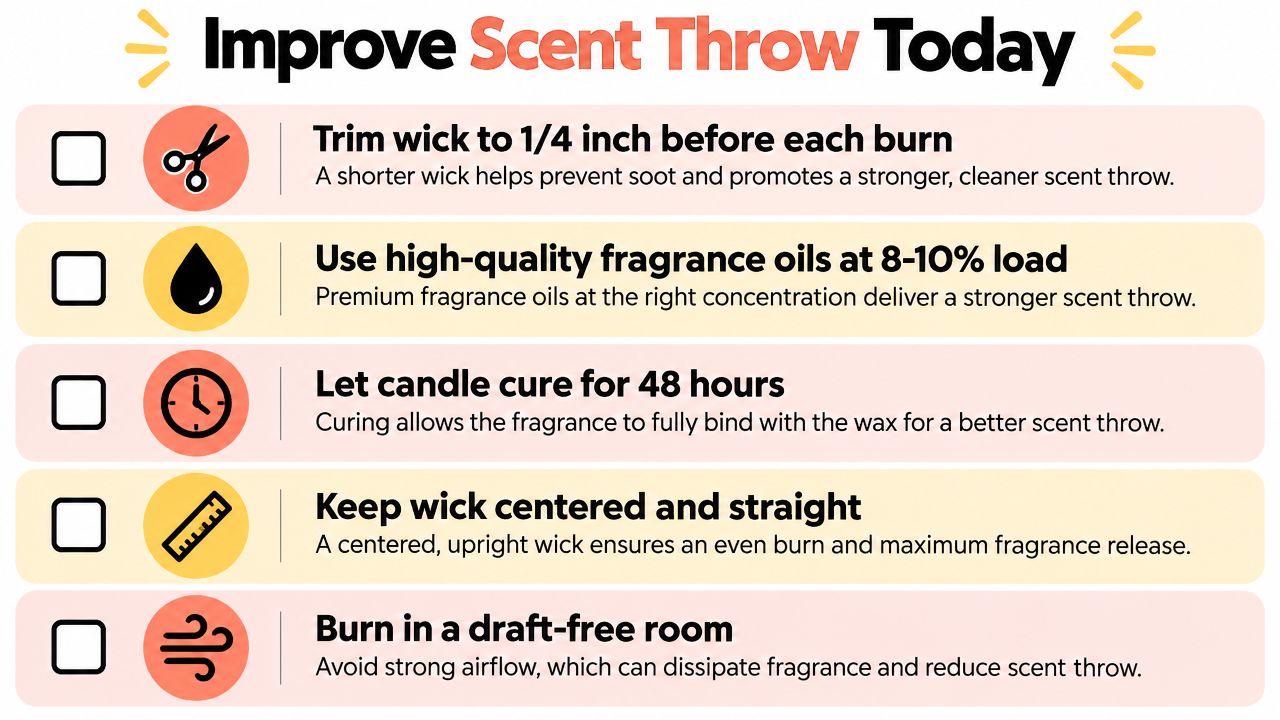
For a concise visual reminder of the core adjustments, watch the following guide:
For more practical guidance on diagnosing weak fragrance, explore how to make candles smell stronger. Jackpot Candles offers scented candles made with a proprietary soy wax blend, exclusive fragrance oils, and a hidden jewelry surprise, giving shoppers a product option where scent and the unboxing experience are part of the same purchase.
Visit Jackpot Candles to explore scented soy-blend candles and bath bombs with hidden jewelry surprises. Choose a fragrance for the room you use, then apply the cold-throw, hot-throw, and curing checks to make your next candle purchase more informed.
Comments will be approved before showing up.