
free shipping at $99


You light a small candle in the bathroom or bedroom, expecting the whole space to smell warm and cozy within minutes. Instead, the flame looks lovely, the wax softens, and the scent stays close to the holder like it's shy. That's the moment most first-time buyers realize scented soy votive candles don't behave like big jars, and that the difference between “nice little candle” and “real fragrance source” comes down to a few small details.
The first surprise is usually scale. A votive looks simple, almost like a sample candle, so it's easy to assume it should act like a miniature version of a larger jar. In practice, the tiny wax pool, the narrow wick, and the snug holder all work together to decide how much scent escapes into the room.
A friend might light one on a bathroom counter, step out, and expect the doorway to catch the fragrance. Sometimes it does, but often it doesn't, because a votive has less wax to heat, less surface area to release fragrance from, and less room for error if the wick is off-center or too small. That's not a defect. It's the natural tradeoff of a small format.
Practical rule: if a votive smells great only right next to the flame, the problem is usually the burn pattern, not your nose.
The good news is that votives are predictable once you know what to watch for. The rest of this guide breaks down the parts that matter most, from what a soy votive is to how to choose a scent that works in a tiny melt pool. It also shows the habits that help a small candle smell stronger, burn more evenly, and last closer to its full potential.
A soy votive is a small-format candle made with soy wax and designed to burn inside a holder. In everyday use, that usually means a compact candle that sits in a glass or metal cup, with a single wick that's sized for a narrow melt pool. The key idea is simple, a votive is not meant to stand alone like a pillar, and it's not built like a wide jar candle either.
Soy wax matters because it behaves differently from paraffin. Soy wax was first developed in 1991 as a cheaper alternative to beeswax, then brought to a broader retail audience in the mid-1990s, with the Body Shop reported as the first major retail chain to offer soy candles in 1995 and soy wax formulations largely replacing costly beeswax in those products by 1996 votive candle history and commercialization. That history helps explain why soy is now associated with a cleaner, plant-based candle experience.
| Attribute | Soy Votive | Paraffin Votive |
|---|---|---|
| Wax feel | Softer, plant-based | More traditional, petroleum-derived |
| Burn behavior | Usually slower and cleaner | Often hotter and quicker |
| Scent release | Can feel softer, more gradual | Often gives a stronger first impression |
| Best use | Small rooms, calm fragrance profiles | Stronger scent punch in compact formats |
The small-format part matters more than people expect. In a votive, heat and fragrance have a tight relationship, so the wax has to melt evenly enough to release scent without drowning the wick or wasting wax at the edges. That's why a soy votive can feel refined and clean, but also a little unforgiving if the wick, holder, or fragrance load is off.
Burn time sounds like a simple number, but a votive earns that number a little at a time. A well-made soy votive won't behave exactly like the next one, because burn time shifts with wick size, fragrance load, additives, drafts, and how long you let each session run. The candle doesn't just “last,” it lasts by melting evenly and using the wax in a steady ring.
A short burn often wastes the outer wax edge, which means the next lighting has less usable surface to work with. A longer, cleaner burn lets the melt pool reach farther across the top, so more wax gets consumed in a controlled way. That's why a votive that's lit for a full melt pool on each use usually performs better than one that's snuffed too early.
You can think of burn time as a chain of small decisions, not one fixed outcome. A slightly oversized wick can speed the burn and shrink total life. A fragrance-heavy wax blend can also change how quickly the candle consumes itself. Drafts do the same thing by tilting the flame and making one side of the pool work harder than the other.
For a beginner, the simplest way to judge burn quality is to watch the edge. If the wax reaches the holder evenly, the candle is using its fuel well. If it tunnels or leaves a thick wax wall, the candle is giving up usable life before it should.
If you want a broader consumer-side overview of candle duration, this internal guide is a useful companion: how long scented candles last.
A votive that burns in a steady, even pool usually gives you more useful hours than one that's rushed in short sessions.
Fragrance load and wick choice do most of the work here. Soy wax candles typically support a fragrance load of about 6 to 10% by weight, and technical guidance says performance is often best around 8 to 9% because too much fragrance can clog the wick, increase mushrooming, and slightly speed up the burn fragrance load guidance. In a votive, that balance matters even more because the melt pool is small and the wick has less room to compensate.
Cold throw is the scent you smell before lighting. Hot throw is the scent released while the candle burns. A votive can smell lovely on the shelf and still feel quiet once lit, especially in a room with open airflow or competing smells. Small-format candles also tend to work best in compact spaces, where the fragrance doesn't have to travel as far.
The wick tells you a lot. If the candle struggles to melt the surface all the way to the edge, some fragrance stays trapped near the rim instead of releasing evenly. If the wick mushrooms or smokes, the candle is probably carrying too much fuel for the wick size or burn conditions. If it drowns, the wick is too weak for the melt pool it's trying to maintain.
| Fragrance Load | Melt Pool Behavior | Expected Scent Throw | Wick Stability |
|---|---|---|---|
| Light | Cleaner, but sometimes faint at the edges | Subtle | Usually stable |
| Balanced | More even, fuller melt pool | Noticeable in small rooms | Usually best |
| Heavy | Can overload the wick or cloud the burn | Strong at first, then inconsistent | More likely to struggle |
For a small votive, the rule of thumb is straightforward. If it fully pools across the surface within the first hour, it'll usually throw more scent than one that tunnels. For a deeper dive into scent behavior in candles, this resource is useful: soy candle scent throw.
Some scents fit a votive better. In a tiny melt pool, the top of the fragrance pyramid can disappear fast, while deeper notes keep hanging around and feel more complete. That's why citrus can seem bright for a moment, then vanish, while richer blends feel steadier from start to finish.
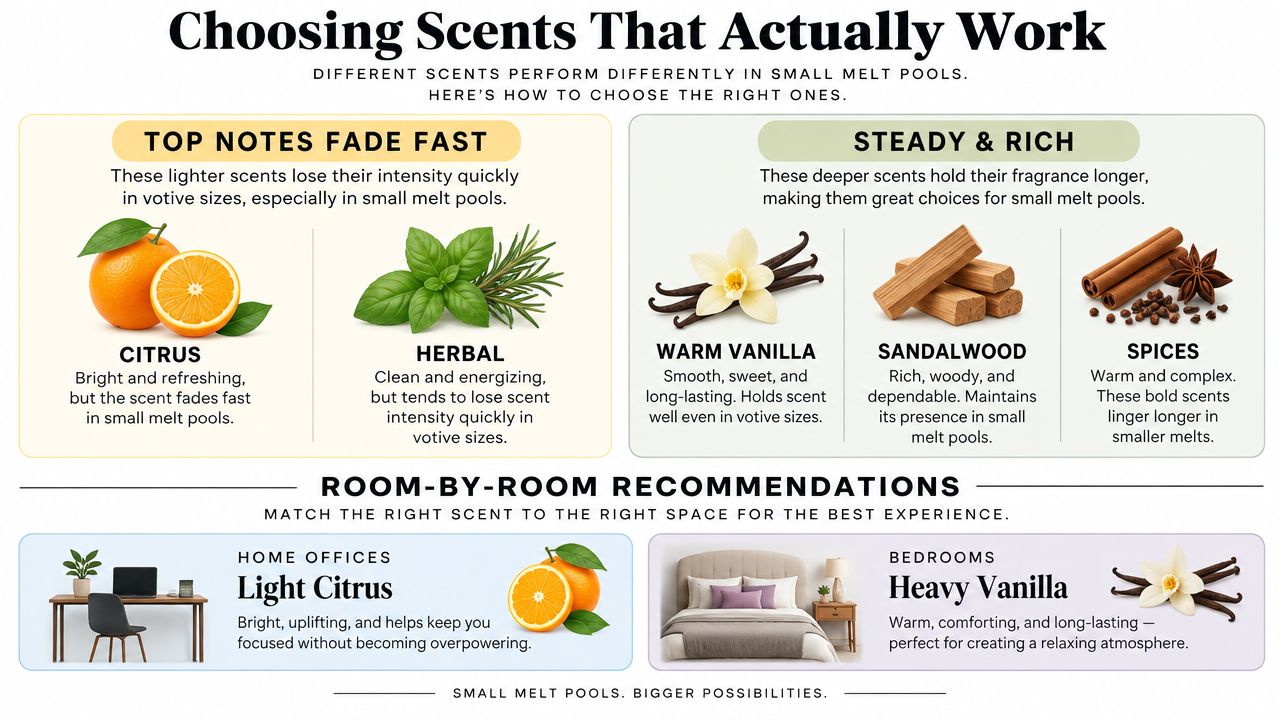
Citrus and herbal scents can work beautifully when you want a clean, quick first impression, but they tend to fade faster in votive size. Lavender, rose, vanilla, sandalwood, and warm spice blends usually feel more dependable because their base notes linger longer in a small wax pool. If you want to test how a popular fragrance profile translates into a small-format blend, a useful comparison is to compare Volcano fragrance oil dupes and think about how bold, layered notes behave when the wax pool is limited.
Here's an easy room-by-room approach:
One common mistake is layering too many clashing scents on the same tray. Two strong votives can fight each other and make the room feel messy instead of fragrant. A better approach is to pair complementary notes, like citrus with herbal, or vanilla with spice, so the overall scent feels wider without asking one tiny candle to do everything.
A votive is small, but it still deserves the same caution you'd give any open flame. The safest setup starts with the holder and surface. Keep it on a stable, heat-resistant base, away from curtain edges, papers, and the kind of table corner where someone might bump it while walking past.
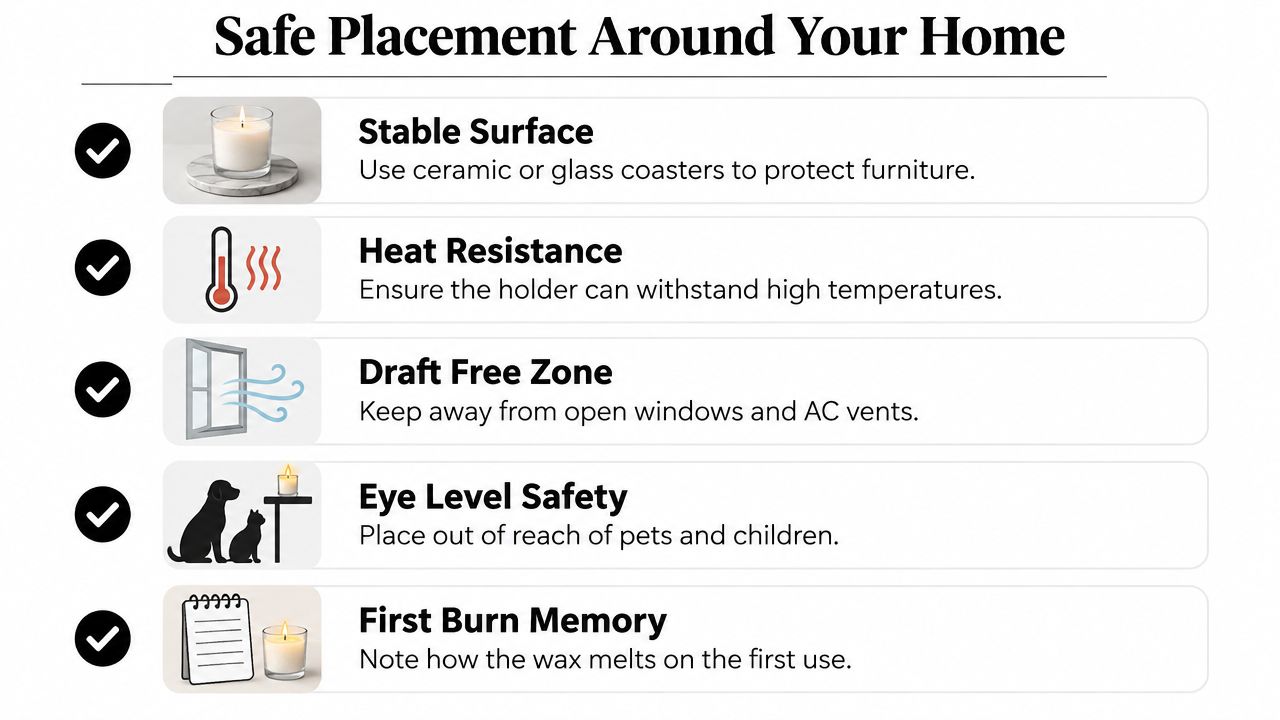
The first burn sets the memory of the candle. If you let the wax reach a full surface melt pool before extinguishing, the candle is far less likely to tunnel later. If you blow it out too soon, the next burn starts with a smaller opening and the scent never gets the same chance to spread.
Wick trimming helps too. Keeping the wick around a quarter inch before each lighting usually reduces mushrooming and excess smoke, which protects both the flame and the room. That small trim also helps the candle burn in a cleaner, more controlled way.
Burn length matters as well. Short sessions can leave the surface uneven, while very long sessions can overheat the wax and make the flame harder to manage. For everyday use, it's smarter to treat the votive like a short, focused burn rather than an all-evening fixture. The same goes for placement near walls, pets, children, or anything flammable. A little distance keeps heat from building where it shouldn't.
If you want a fire-safety refresher alongside candle-specific habits, this guide is a helpful companion: fire hazard prevention.
Keep it simple, stable, and out of the way. Safe burning usually looks boring, and that's a good thing.
A complicated system isn't necessary. A short routine that gets repeated is what matters. For scented soy votive candles, the habits that matter most are the ones that protect the melt pool, keep the wick centered, and stop the candle before it starts wasting wax.
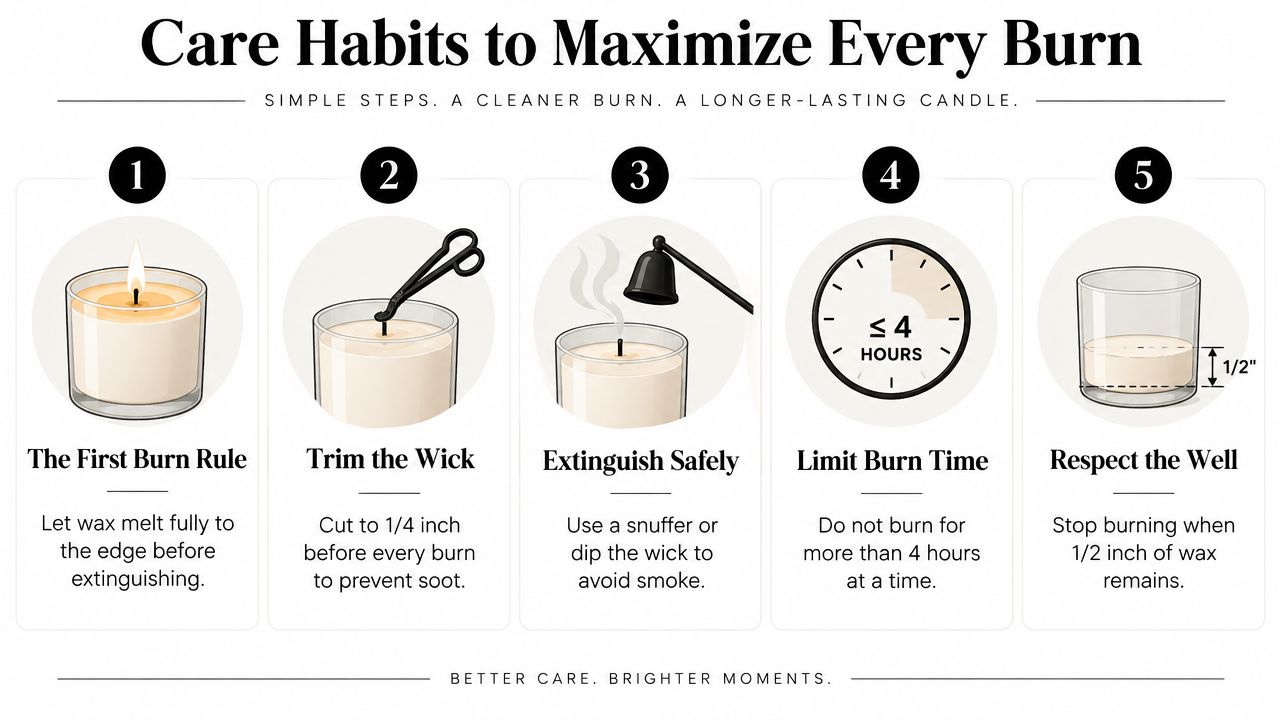
Start with the first burn rule, let the wax reach the edge before you extinguish it. Trim the wick before every lighting so the flame stays tidy. Limit each session so the candle doesn't overheat or dig itself into a tunnel. Stop using the votive when only a small amount of wax remains, because that last bit gets unstable and harder to burn cleanly.
Those steps matter extra for soy votives because the melt pool is so small. One sloppy burn can permanently shrink the usable surface, and once the candle starts tunneling, it often keeps that shape. If the wick shifts a little off-center, you can sometimes nudge it back gently once the wax softens, but the cleaner fix is prevention.
Store unused votives in a cool, dark place so the fragrance stays protected. Heat and light can dull the scent over time, even before the candle ever gets lit. That's why a votive on a sunny shelf can age faster than one tucked away in a drawer or cabinet.
Quick checklist: trim, light, wait for a full melt edge, burn in a safe spot, and stop before the wax gets too low.
If you want a scented soy candle that's made with the same kind of clean-burning, fragrance-focused approach discussed here, take a look at Jackpot Candles. They offer scented candles made with soy wax and a range of fragrance options, so it's easy to compare styles while keeping the basics of burn quality in mind.
Comments will be approved before showing up.