
free shipping at $99


You light a new candle expecting vanilla, cedar, or citrus to fill the room. Instead, the flame leaves a dark mark on the jar, the wax melts only in a narrow circle, or the fragrance seems to disappear after the first few burns. The scent name may be appealing, but the wax, wick, fragrance, and handling determine whether that promise reaches your room.
That's why soy wax blend scented candles deserve a closer look. A blend isn't soy wax with a fashionable label. It's a wax system designed to balance softness, fragrance retention, melt behavior, appearance, and stability. When the formulation is well matched to its wick and fragrance, it can create a slower, more even burn with less visible soot and a steady scent release. When it isn't, heat, shipping, and excess fragrance can expose weaknesses such as sweating, frosting, tunneling, or weak throw.

The most useful way to judge a candle is to look beyond the fragrance description. Two candles can both promise vanilla and still behave very differently because their wax structures, wick pairings, fragrance oils, and manufacturing methods aren't identical.
Soy wax blends sit in the middle of that practical conversation. They retain the plant-based character associated with soy while using another wax or carefully chosen additive to improve qualities that pure soy can struggle to deliver. The result may feel smoother on the surface, release fragrance more evenly, or hold its shape better during transport.
A candle has to perform several jobs at once. The wax must support the wick, form a controlled melt pool, dissolve the fragrance oil, and release that fragrance as the candle warms. If one part is out of balance, adding more perfume won't necessarily fix the problem. A wick that's too small may leave unmelted wax around the edges, while a wick that's too large may create excessive heat and visible soot.
Scientific research summarized in this overview of candle emission studies found that both wax composition and wick composition influence emissions such as black carbon, PM2.5, and particle-phase polycyclic aromatic hydrocarbons. The same source also discusses research reporting lower smoke points for paraffin candles than for vegetable-oil candles. These findings don't mean every soy candle performs perfectly, but they do show why material selection affects the burn.
Soy wax is a relatively modern candle material. It was developed in 1991 by Michael Richards as a cheaper alternative to beeswax, and The Body Shop became the first major retail chain to offer soy candles to the general public in 1995, according to the documented history of soy wax. That transition helped move soy from an invention into a familiar retail material.
The key lesson is simple: a candle's everyday performance comes from the whole formulation, not the word “soy” alone. Understanding how the blend works will help you interpret labels, spot realistic quality signals, and care for the candle in a way that protects its scent and burn.
Think of wax blending like making a cake. Flour provides structure, oil adds tenderness, and sugar affects texture and browning. You could bake with one ingredient, but you wouldn't expect flour alone to produce the texture you want. Candle makers use a similar approach when they combine waxes.
Soy wax comes from hydrogenated soybean oil. On its own, it can offer a soft, creamy material with a plant-based origin, but its softness and cooling behavior can create challenges for appearance, fragrance handling, and transport. A soy wax blend combines soy with another wax or additive to adjust those characteristics.
A harder wax can give the candle more body and improve shape retention. A softer wax can help create a smooth melt pool and support fragrance release. Additives may influence how the wax cools, adheres to the vessel, or handles the fragrance oil. The exact result depends on the materials, their proportions, the container, the wick, and the production process.
That's why “soy blend” doesn't describe one universal recipe. One blend may be developed for a glass container, while another is intended for molded candles. A container candle needs to melt predictably inside its vessel and reach the sides without becoming dangerously hot. A freestanding candle needs enough firmness to keep its shape.
Practical rule: Treat “soy blend” as a starting point, not a complete performance guarantee. The blend's design and testing matter more than the label alone.
Some buyers assume that a candle made from 100% soy wax must outperform a blend because it contains fewer materials. That conclusion misses the purpose of formulation. A blend can preserve soy's desirable qualities while correcting weaknesses that appear under real conditions, such as warm shipping routes, temperature swings, or difficult fragrance oils.
A useful product description should tell you more than the source wax. Look for information about the intended use, fragrance quality, burn testing, and care instructions. You can also learn more about the practical differences in this comparison of soy and paraffin candles.
The history of the material helps explain its popularity, but the modern buyer's question is more practical: does this formulation stay stable from production to the final burn? That's where blend engineering becomes important. A candle can be plant-based and still need careful control of heat, wick size, fragrance load, and storage.
Wax choice involves trade-offs rather than a single winner. Paraffin is a petroleum-derived wax known for strong fragrance performance and dependable structure. Soy leans toward a plant-based positioning and can support a slower, cleaner-looking burn when properly formulated. Beeswax and coconut-based materials bring their own characteristics, and they're often blended because a single wax may not provide every quality a candle maker wants.
The table below offers a practical starting point. It describes general tendencies, not a promise that every candle made with a particular wax will behave identically.
| Feature | Soy Wax Blend | Paraffin | Beeswax / Coconut |
|---|---|---|---|
| Material profile | Soy combined with another wax or additive for balance | Petroleum-based wax used widely in candle production | Beeswax is naturally firm, while coconut wax is soft and commonly blended |
| Burn behavior | Can support a slower, even burn when the wick and formulation are matched | Often offers predictable, strong performance, though the wick still controls the flame | Beeswax can provide structure; coconut-based waxes can help with a creamy melt profile |
| Fragrance release | Designed to hold and release fragrance without relying only on a high oil load | Often associated with strong scent release | Coconut can contribute to fragrance release, while beeswax may affect structure and aroma |
| Surface appearance | May be smoother and more stable than pure soy, depending on the blend | Can cool consistently but may show cooling-related imperfections | Beeswax and coconut blends vary considerably by formulation |
| Heat and shipping resilience | Depends heavily on the blend's hardness and stability | Usually more structurally resistant than softer plant waxes | Softer coconut-rich formulations may need extra care in warm conditions |
| Main buying question | Was the blend tested for the intended vessel, fragrance, and wick? | Does the performance fit your preferences about material origin and emissions? | Is the wax being used alone or as part of a balanced blend? |
The emission research discussed earlier reinforces an important point: both wax and wick composition matter. A buyer shouldn't judge a candle by wax category alone. Flame size, wick trimming, airflow, fragrance load, and vessel design all affect what happens during burning.
Soy blends are often chosen because they can combine a plant-based wax with improved structure or fragrance handling. That doesn't make every soy blend automatically cleaner, longer lasting, or stronger smelling. The formulation has to be compatible with the wick and the intended burn conditions.
A practical evaluation should therefore include four questions:
This framework is more reliable than choosing based on “natural” or “clean” language alone.
A candle's scent performance begins before the wick is lit. Fragrance oil has to mix evenly into the molten wax, remain held in the cooled candle, and then release at a controlled rate as the melt pool warms. The process is closer to managing a slow-release system than pouring perfume into a container.
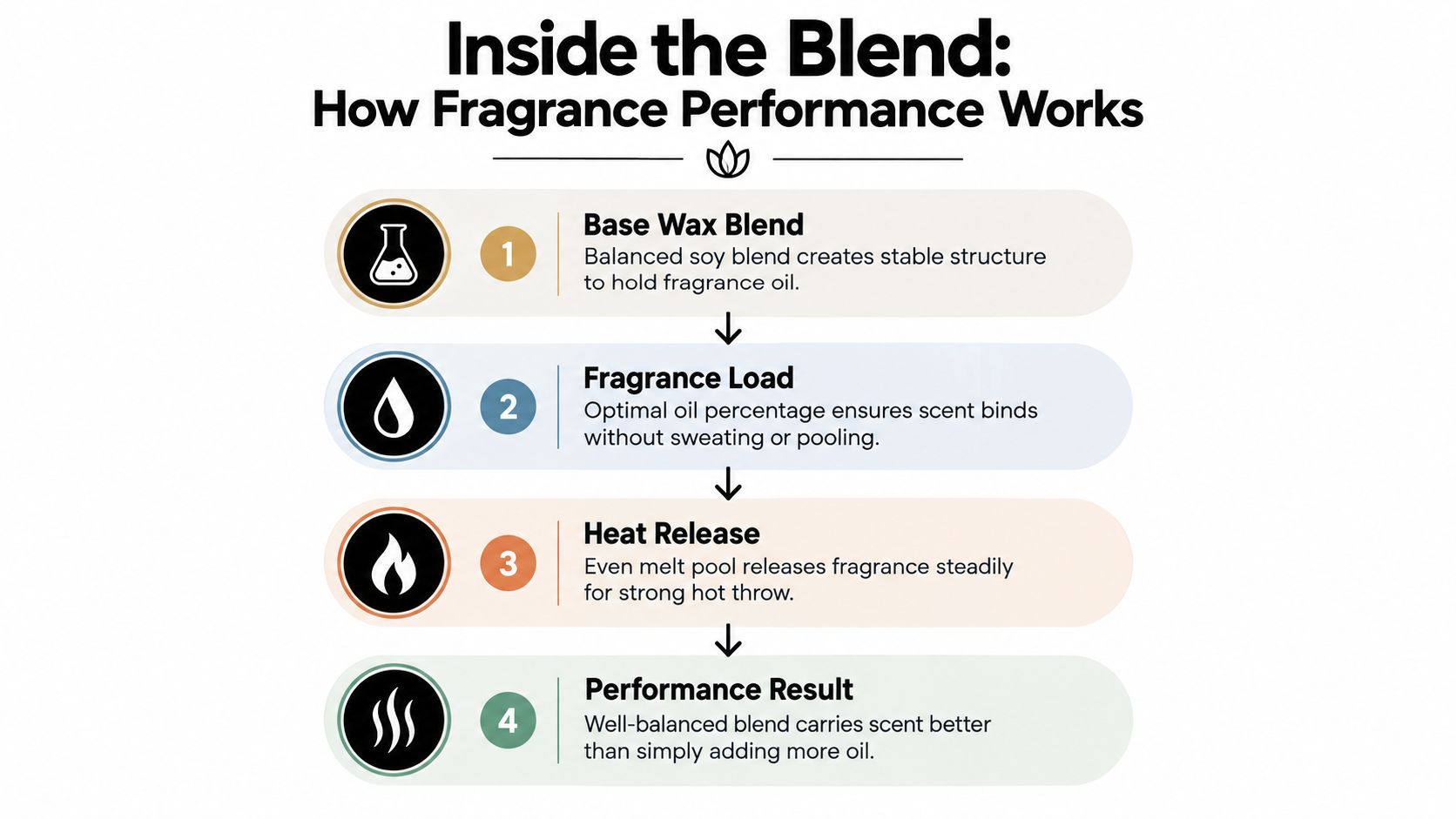
For soy wax blends used in scented candles, the practical fragrance-load window is typically 6% to 10% by weight, with many wax makers recommending 6% to 8% as a stable balance between scent throw and burn quality, according to Bramble Berry's soy wax guidance. Pushing beyond roughly 12% can lead to oil pooling, wick clogging, and increased soot, rather than producing a stronger room scent.
The phrase by weight matters. Measuring fragrance by volume can create inconsistent results because oils have different densities. A candle maker who weighs wax and fragrance can reproduce a formula more accurately and adjust it during testing.
Imagine trying to add extra water to a sponge that's already saturated. The water doesn't become more useful. It runs out. Fragrance oil behaves differently from water, but the practical lesson is similar. Once the wax can't hold the additional oil reliably, the excess may migrate to the surface, interfere with the wick, or alter the burn.
A balanced formulation also needs the right wick. A wick that's too small may not create enough heat to open the melt pool and release the fragrance. A wick that's too large may burn too hot, consume the fragrance too quickly, or produce soot. For readers who want to understand fragrance combinations more, Aroma Warehouse's pro tips on blending fragrance oils offer useful formulation context.
Formulation insight: Strong scent comes from compatibility and controlled release, not from filling the wax with as much oil as possible.
You can explore the relationship between wax and scent in this guide to candle fragrance oils. A reputable maker should test the complete system, including wax blend, fragrance, wick, vessel, cooling conditions, and burn behavior.
The final result is hot throw, the fragrance you notice while the candle burns. Cold throw, or the scent from an unlit candle, can be appealing, but it doesn't guarantee a satisfying lit experience. The wax structure and wick have to work together to turn stored fragrance into an even room aroma.
A proprietary blend matters because real candles face conditions that a product description may not mention. A candle can leave a cool factory, spend time in a warm delivery vehicle, sit on a sunny doorstep, and then enter an air-conditioned home. Each temperature change can affect the wax and the way it holds fragrance.
Independent FAQ content from this discussion of soy candle problems notes that soy blends may release excess fragrance oils during temperature swings in shipping. It also notes that softer blends can melt in warm weather. Those changes can appear as sweating, softening, frosting, or altered shape. The candle may still be usable, but its appearance and scent consistency can differ from what the buyer expected.
“Proprietary” generally means the maker uses a specific formula that isn't fully disclosed to the public. That label alone doesn't prove quality. Its value comes from the choices behind it, such as how the wax balances softness and stability, how much fragrance it can hold, and whether the maker tests the wick and vessel together.
Jackpot Candles states that it uses a proprietary soy wax blend designed for a cleaner, slower, longer-lasting burn with minimal soot, along with exclusive perfume-grade fragrance oils intended to carry and release a rich aroma. That description illustrates the role a tuned blend can play, but the result still depends on proper use and the conditions around the candle.
Many candle pages emphasize plant-based materials and fragrance variety. Buyers also need answers to more ordinary questions:
These questions reveal the performance gap between marketing language and lived experience. A candle maker who tests only a freshly poured candle in a controlled room may miss problems that appear after shipping. A proprietary blend can solve some of those problems when its formulation and quality checks are designed around the full journey from production to home.
Even a carefully formulated candle can perform poorly if it's burned in a draft, left with a long wick, or stored beside a heat source. Care isn't about ceremony. Each habit controls the flame, the melt pool, or the way the wax responds to its surroundings.
For a fuller walkthrough, use this guide to burning a candle properly. The following checklist focuses on the reasons behind the main practices.
During the first burn, give the melt pool time to move broadly across the surface without rushing the flame. If you extinguish the candle too soon every time, the wax can begin forming a narrow channel around the wick. That pattern is commonly called tunneling, and it leaves usable wax along the sides.
Don't place the candle near an open window, fan, vent, or busy walkway. Moving air can make the flame flicker, heat one side of the vessel more than the other, and create an uneven melt pattern.
Trim the wick before lighting, especially if it has formed a dark, mushroom-like tip. A shorter, stable wick helps manage flame height and reduces the chance of unnecessary soot. Never trim or move the wick while the wax is still liquid and hot.
Use a snuffer or gently blow out the flame when you're finished. Avoid dropping debris into the melt pool, because bits of wick or match material can interfere with the next burn.
Store soy wax blend candles in a cool, shaded place away from radiators, sunny windows, hot vehicles, and warm shelves. If the candle arrives with a small amount of fragrance oil on the surface or appears softened after transport, let it return to room temperature before lighting it. Sudden attempts to cool or heat the candle can make surface imperfections worse.
Care principle: A stable environment protects both the candle's appearance and the way its fragrance remains distributed through the wax.
A good soy wax blend scented candle should make sense as a complete system. The wax provides structure, the fragrance oil supplies the aroma, the wick controls heat, and the vessel shapes the melt pool. If one component is poorly matched, the label's promises won't overcome the resulting burn problems.
Use this buying lens:
The most useful takeaway is that performance is engineered, not promised by a single ingredient. A proprietary soy blend can be a practical choice when the maker has tuned it for steadier fragrance release, controlled burning, and better resilience during handling. Your part is to choose a transparent product and give it the conditions it needs.
Jackpot Candles offers scented candles made with a proprietary soy wax blend and exclusive perfume-grade fragrance oils, including candles designed around the discovery of hidden jewelry. Visit Jackpot Candles to explore the collection and choose a soy blend candle for your next relaxing burn.
Comments will be approved before showing up.