
free shipping at $99


Ever wondered what that heirloom ring tucked away in your jewelry box is really worth? A jewelry appraisal is a professional, documented assessment of a piece's value, put together by a certified expert. It’s the official step that replaces guesswork with a solid, defensible number for all sorts of important financial and personal matters.
Think of a proper appraisal as a detailed biography for your jewelry. It’s so much more than just a price tag; it's a comprehensive report that captures the story, quality, and substance of your piece.
Just like a home appraisal determines a property's value before you get a mortgage, a jewelry appraisal provides an official valuation for very specific purposes. This document is absolutely essential anytime you need an objective, expert opinion on value.
An appraiser basically acts like a detective. They meticulously examine every single facet of your item—from the quality of the gemstones and the purity of the metal to the level of craftsmanship and even its historical significance. The final report they produce gives you the power to properly insure, sell, or divide your most precious assets with total confidence.
So, why go through the trouble of getting an appraisal? It turns out there are a handful of very common, and very important, reasons. Here’s a quick look at why you might need one.
| Purpose | Why It's Important |
|---|---|
| Insurance Coverage | Ensures you can replace an item for its full value if it's lost, stolen, or damaged. |
| Estate Planning | Provides a fair market value to help divide assets equitably among heirs. |
| Selling an Item | Establishes a realistic asking price and gives you negotiating power with potential buyers. |
| Divorce Settlement | Offers an unbiased valuation for the fair distribution of marital assets. |
| Charitable Donation | Determines the value of your donation for tax deduction purposes. |
From protecting your investments to navigating major life events, a professional appraisal provides the clarity and documentation you need.
You might think an appraisal is just a piece of paper with a price tag, but it's so much more than that. Think of it as a vital document that gives you real protection and clarity when life throws you a curveball. Without one, you're basically just guessing what your jewelry is worth, and that can lead to some serious financial headaches and stress.
The number one reason to get an appraisal? For insurance purposes. Seriously. Imagine your engagement ring is lost or stolen. Your standard homeowner's policy might only offer a tiny payout, but a professional appraisal spells out the ring's full replacement cost for your insurance company. This is your shield against being underinsured, making sure you can replace your most treasured pieces with something of the same quality.
An appraisal also becomes incredibly important during major life events, especially when family is involved.
A formal appraisal document turns a sentimental item into a clearly defined asset. It’s a simple step that can head off years of family conflict by getting rid of any guesswork and setting a transparent, agreed-upon value.
This whole process of formal valuation is what keeps the global jewelry market ticking. That market was recently valued at around USD 366.79 billion, and appraisals are a huge part of it. They're especially crucial in the fine jewelry sector, which makes up about 68% of the total market. These trusted assessments are the backbone for insurance, sales, and estate settlements all over the world. If you want to dive deeper into the numbers, you can explore the latest jewelry industry statistics and trends.
And finally, if you ever decide to sell an item, an appraisal is your secret weapon. It gives you a solid, realistic starting point for negotiations and shows potential buyers that they're paying a fair price, all backed by an expert's official opinion. It just makes the whole process smoother for everyone.
When you ask, "What is my jewelry worth?" there isn't just one simple answer. The value can swing wildly depending on why you're asking in the first place.
Think of it like selling a car. The amount you'd get for insurance replacement is going to be high. The price you could sell it for privately is a bit lower, and what a dealership offers as a trade-in is often the lowest of all. Jewelry works the same way.
Each type of appraisal has a very specific job, which means it ends up with a different final dollar amount. It's so important to get the right one for your situation, otherwise, you could end up confused or with documents that don't actually help you.
The three most common appraisal types are built for completely different scenarios. If you ask for the wrong one, you could wind up seriously underinsured or have totally unrealistic expectations when you try to sell a piece.
Here’s a quick breakdown:
Replacement Value: This is almost always the highest number you'll see. It’s used pretty much exclusively for insurance purposes. This value reflects what it would cost to walk into a retail jewelry store and buy a brand-new, identical replacement today.
Fair Market Value (FMV): This is a more middle-of-the-road figure. It represents the price a willing buyer would realistically pay a willing seller when neither one is in a huge rush. You’ll typically see this value used for estate planning, tax situations, or divorce settlements.
Liquidation Value: This is the lowest valuation, and it represents what you could get if you needed cash fast. Think of it as the price a pawn shop or a jewelry dealer would offer on the spot. It’s based on the item’s wholesale or scrap metal and gem value, not its fancy retail price tag.
Understanding the difference is everything. For example, an insurance appraisal might value a ring at $10,000, but its fair market value for an estate could be closer to $6,000. If you needed to sell it quickly, its liquidation value might only be $3,500.
To help you keep these straight, here’s a simple table that lays out what each appraisal is for and the kind of value you can expect.
| Appraisal Type | Primary Purpose | Typical Value |
|---|---|---|
| Replacement Value | Insurance coverage | Highest (full retail cost) |
| Fair Market Value | Estate planning, taxes, divorce | Moderate (private sale price) |
| Liquidation Value | Quick cash sale, pawn | Lowest (wholesale/scrap value) |
Choosing the right appraisal ensures you have the correct documentation for your specific goal, whether it's protecting your assets or preparing for a sale.
For those curious about how these values are determined, you can get some great information by exploring a free jewellery appraisal online.
So, what actually happens when you hand over your precious item for a jewelry appraisal? It's a whole lot more than a quick glance. Think of it as a meticulous, non-destructive scientific process where a gemologist plays detective, carefully uncovering the full story and value of your piece.
The journey starts with an initial consultation. This is where you'll present the item along with any paperwork you have, like old sales receipts or previous appraisals. The appraiser will ask a few key questions about the item's history and, most importantly, why you need the appraisal. Is it for insurance, estate planning, or a potential sale? Knowing the purpose is crucial to making sure the final report gives you exactly what you need.
Next up is the hands-on analysis. Using a set of specialized tools, the gemologist meticulously examines every single detail of your jewelry.
This detailed infographic shows how the reason for your appraisal—whether it's for insurance or estate planning—shapes the entire process.
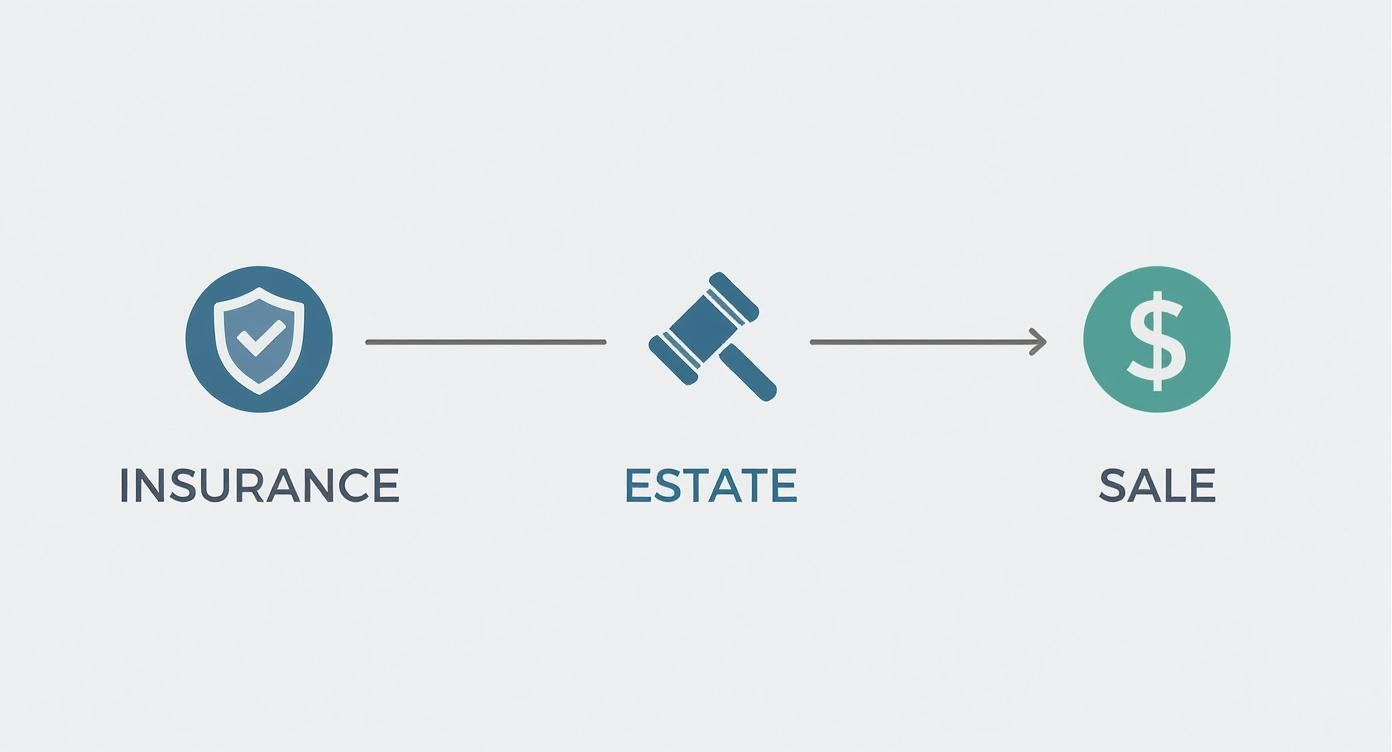
As you can see, each path leads to a different kind of valuation, tailored for a specific outcome. The appraiser then takes all these physical findings, combines them with current market research, and compiles everything into a comprehensive report.
The global demand for these services is stronger than ever. The jewelry appraisal market was valued at around $3.3 billion and is projected to hit $5 billion by 2030. This boom really highlights how much people rely on authentic valuations, especially for insurance and resale.
If you want to dig a bit deeper into the specific methods and steps, this expert guide to accurate appraisal offers some great insights into how professionals identify, grade, and value precious collectibles.
When an appraiser looks at your jewelry, they're not just admiring its sparkle. They're diving deep into a specific set of characteristics that give the piece a solid, provable value. It’s a lot like a recipe where every single ingredient matters. For jewelry, the star ingredients are the quality of the gemstones and the precious metals that hold everything together.
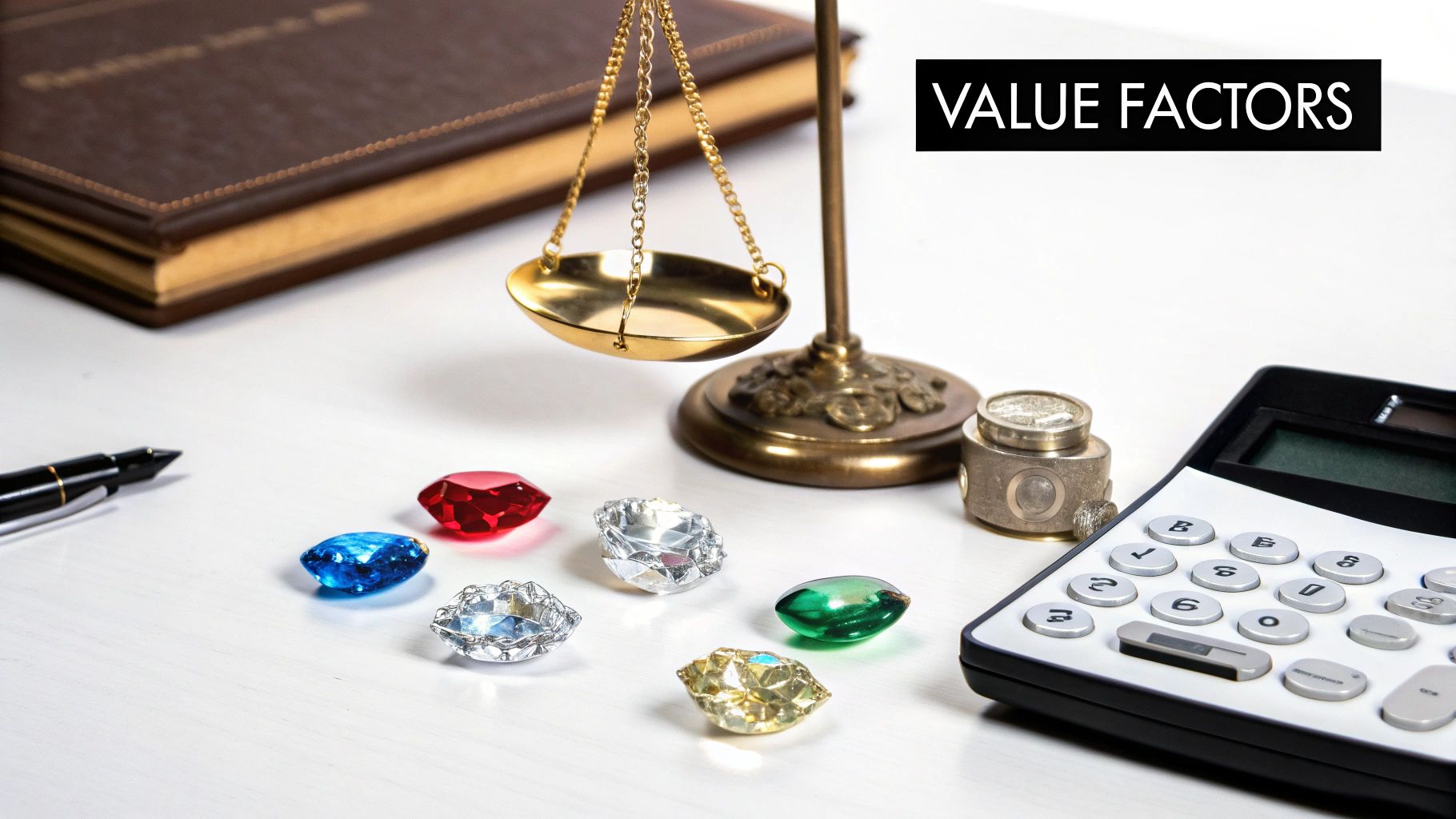
With diamonds, this whole process is famously broken down into the "4 Cs":
These aren't just rules for diamonds. The same core ideas apply to colored gemstones and precious metals, too. For gems like emeralds or sapphires, things like color saturation, tone, and overall rarity become the main event. Beyond the basic classification, the characteristics that define the best gemstones for jewelry play a huge role in the final appraisal number. Likewise, the value of the metal comes down to its purity (think karat for gold) and its total weight.
But an appraisal goes way beyond just the raw materials. The history and artistry of a piece—what experts call its provenance—can send its value soaring.
The story behind a piece of jewelry is a powerful value multiplier. An antique ring from the Art Deco period or a necklace signed by a famous designer like Cartier will be appraised for far more than the sum of its parts.
Why? Because these elements add a level of rarity and desirability that you just can't get from the materials alone. An appraiser also looks very closely at the craftsmanship—how skillfully the piece was made—and its overall condition. A piece that’s been well cared for with minimal wear will always fetch a higher price.
If you'd like to dive even deeper into how all these factors come together, you can learn more about how to value jewelry in our detailed guide.
Okay, let's talk about the single most important decision you'll make in this whole process: picking the right expert. An accurate valuation hinges entirely on the appraiser's skill, their ethics, and their real-world experience. So, how do you find someone you can actually trust with your most treasured pieces?
Your first move should be to look for credentials. You're looking for professionals who have certifications from highly respected organizations like the Gemological Institute of America (GIA) or the American Society of Appraisers (ASA). These aren't just fancy acronyms; they prove the appraiser has gone through some serious training and is committed to a strict code of ethics.
This part is crucial: you want an appraiser who is truly independent. That means their business should be appraisals, not buying and selling jewelry. This simple distinction removes any potential conflict of interest, ensuring their valuation is based purely on the quality of your piece, not on whether they can buy it from you on the cheap.
If you need a hand getting started, our guide on finding jewelry appraisal services near me can point you toward some local options.
A truly independent appraiser's only goal is to provide an accurate, unbiased assessment of value. They work for you and you alone, which is essential for a trustworthy report.
You've probably also seen online jewelry appraisal services pop up. Thanks to high-resolution imaging and sophisticated analysis, it's now possible to get a valuation remotely, which is super convenient. If you're curious about this route, you can learn more about the online jewelry valuation market and how it works.
Before you hand over your jewelry, it’s a good idea to have a little chat with a potential appraiser. Think of it like a mini-interview. Asking the right questions will tell you everything you need to know about their professionalism and expertise.
Here’s a quick checklist to get you started:
Alright, let's get into the nitty-gritty. As you get ready to have your own pieces looked at, a few questions always seem to pop up. Knowing the practical details, like what it's going to cost and how long it'll take, makes the whole thing feel a lot less mysterious.
Here are the straightforward answers to the questions we hear most often.
You can generally expect an appraisal to cost somewhere between $75 and $150 per hour, though some appraisers charge a flat fee for each piece. The key thing to look for is that a reputable appraiser will always charge based on their time and the complexity of the work—not as a percentage of your jewelry's value.
This is a huge sign that you're working with a true professional. It keeps their valuation completely unbiased, since they have no financial stake in the final number. A simple gold wedding band will be on the lower end of the cost spectrum, while a detailed antique necklace with several different gems is naturally going to take more time and expertise to evaluate properly.
It's a really smart idea to get your valuable pieces reappraised every three to five years. Why? Because the markets for gold, platinum, and gemstones are constantly moving up and down. That means the value of your jewelry can change a whole lot over a few short years.
Getting an updated report is the only way to be sure your insurance policy reflects the current replacement cost. This simple check-up protects you from being underinsured if something is ever lost, stolen, or damaged. It's all about making sure your coverage is actually enough to cover you when you truly need it.
Think of reappraisals as routine check-ups for your insurance policy. They keep your coverage healthy and aligned with current market realities, preventing any costly surprises down the road.
A real, professional jewelry appraisal is a serious legal document. It's so much more than just a price tag on a piece of paper.
Your final report should be incredibly detailed and must include:
At Jackpot Candles, we believe in the magic of discovery. Each of our premium soy candles holds a surprise piece of jewelry just waiting for you to reveal it. Explore our collection and find your hidden treasure today
Comments will be approved before showing up.