
free shipping at $99


You're standing in the candle aisle or scrolling a supplier page, and two bottles keep pulling your attention in opposite directions. One says essential oil and feels simple, plant-based, almost wholesome by default. The other says fragrance oil and sounds more engineered, maybe less romantic, but often more practical. If you're making candles for yourself, gifts, or a small shop, that choice changes far more than the label.
It affects how the candle smells before you light it, how well it fills a room once the wax pool forms, how the wick behaves, what safety paperwork you need, and how predictable each batch feels. Many beginners assume the decision is mostly about natural versus synthetic. In candle making, that's usually the wrong starting point.
A better question is this: What happens to the oil when it meets hot soy wax and a live flame? That's where difference shows up.
A beginner usually notices the problem after making a first test candle. The wax looks smooth. The jar is cute. The scent from the finished candle seems promising when you sniff it cold. Then you light it, wait, and get almost nothing. Or the candle starts tunneling, the wick struggles, or the fragrance seems sharp in one batch and faint in the next.
That outcome often starts with the oil choice.
Here's the quick comparison that helps most makers get oriented early:
| Factor | Fragrance Oils | Essential Oils |
|---|---|---|
| Origin | Formulated aromatic blends, often designed for product use | Extracted from plants |
| Candle performance | Typically more reliable in wax | More variable in wax |
| Scent range | Broad, including scents nature doesn't produce | Limited to plant-derived profiles |
| Heat behavior | Commonly engineered for candle processing and burn conditions | Can lose aroma more easily under heat |
| Documentation | Often paired with candle-use guidance and IFRA limits | Still needs safety review, even though plant-based |
| Best fit | Strong throw, consistency, repeatable batches | Subtle plant-based positioning, small experiments |
Don't get confused because you lack interest. Get confused because candle advice online often blends perfume language, wellness language, and craft language into one messy answer. A candle isn't a diffuser. It isn't skincare. It isn't raw aromatherapy. It's a heated wax system with a wick.
A scent can smell beautiful in the bottle and still perform poorly in a candle.
That's why the fairest way to compare candle fragrance oils vs essential oils is through real maker concerns. How well does it mix with soy wax? How much scent survives the pour? What happens during a long burn? What paperwork or usage guidance supports the choice? Those questions cut through a lot of marketing fast.
Three assumptions cause most early mistakes:
If you keep those three points in mind, the rest of the comparison starts making a lot more sense.
The first step is getting the definitions right. Once you understand what each material is, a lot of the performance gap becomes easier to predict.
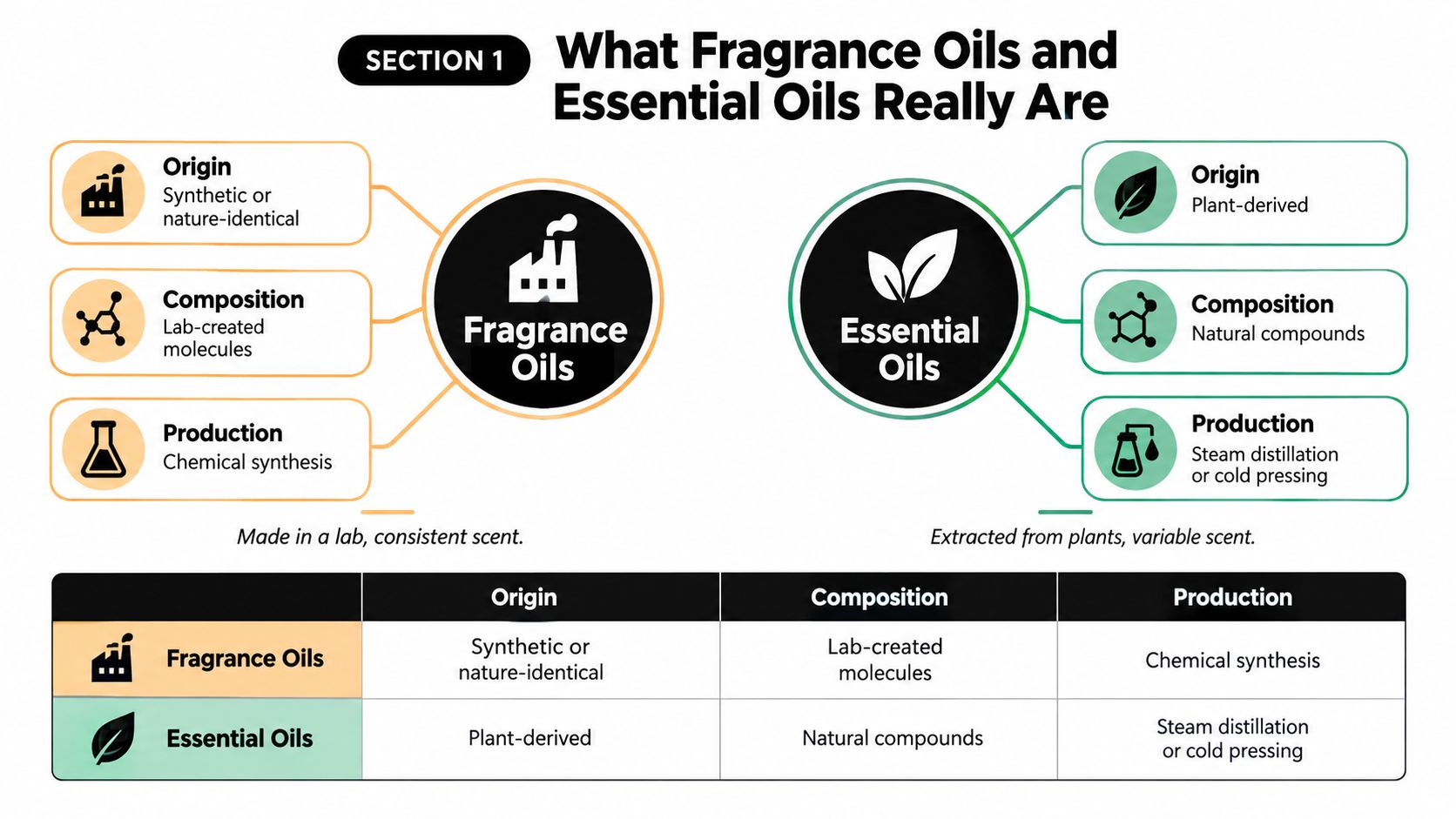
Fragrance oils are blended aromatic materials. In candle making, the important point isn't just that they can contain synthetic or nature-identical ingredients. It's that they're often built with product performance in mind. They can be formulated for better wax solubility, more stable scent release, and more consistent batch results.
That's also why fragrance oils can create profiles like bakery scents, ocean blends, or layered perfumes that no single plant naturally produces. If you want a better primer on how these blends are built, this overview of what fragrance oils are made of gives useful background.
Essential oils are aromatic extracts taken from plants, commonly through steam distillation or cold pressing. They're older as a category than modern candle fragrance oils. Their commercial history is tied to extraction advances in the 19th century, while modern safety standardization came later with the creation of the International Fragrance Association in 1973 and the IFRA Standards framework, as explained in this guide to understanding IFRA sheets and fragrance safety.
That history matters because essential oils weren't originally developed for candle wax performance. They come from nature, but they also come with natural variability. Harvest conditions, plant source, and extraction differences can all shift the aroma.
Many makers take a wrong turn. They compare the romance of a plant extract with the industrial sound of a formulated blend, then stop there. But candles ask a more technical question: how does the aromatic material behave in melted wax and under flame?
Think of it this way:
Neither approach is morally better. They solve different problems.
Practical rule: A candle ingredient should be judged by wax compatibility, heat behavior, and safety documentation before it's judged by whether it sounds natural.
Regulation also explains part of the confusion. Different product types have different safety limits. A candle doesn't sit on skin, so it falls into a different use category than lotion or perfume. That means a material might be restricted tightly in one product and used differently in another.
For a candle maker, that's useful because it shifts the conversation away from labels and toward use conditions. When you understand that, “natural versus synthetic” stops being the whole debate. It becomes one detail inside a bigger formulation decision.
Most beginners care about one thing first: “Will this candle smell strong when it's burning?” That's the right question. In practice, performance comes down to cold throw, hot throw, and how steadily the fragrance behaves across the burn.
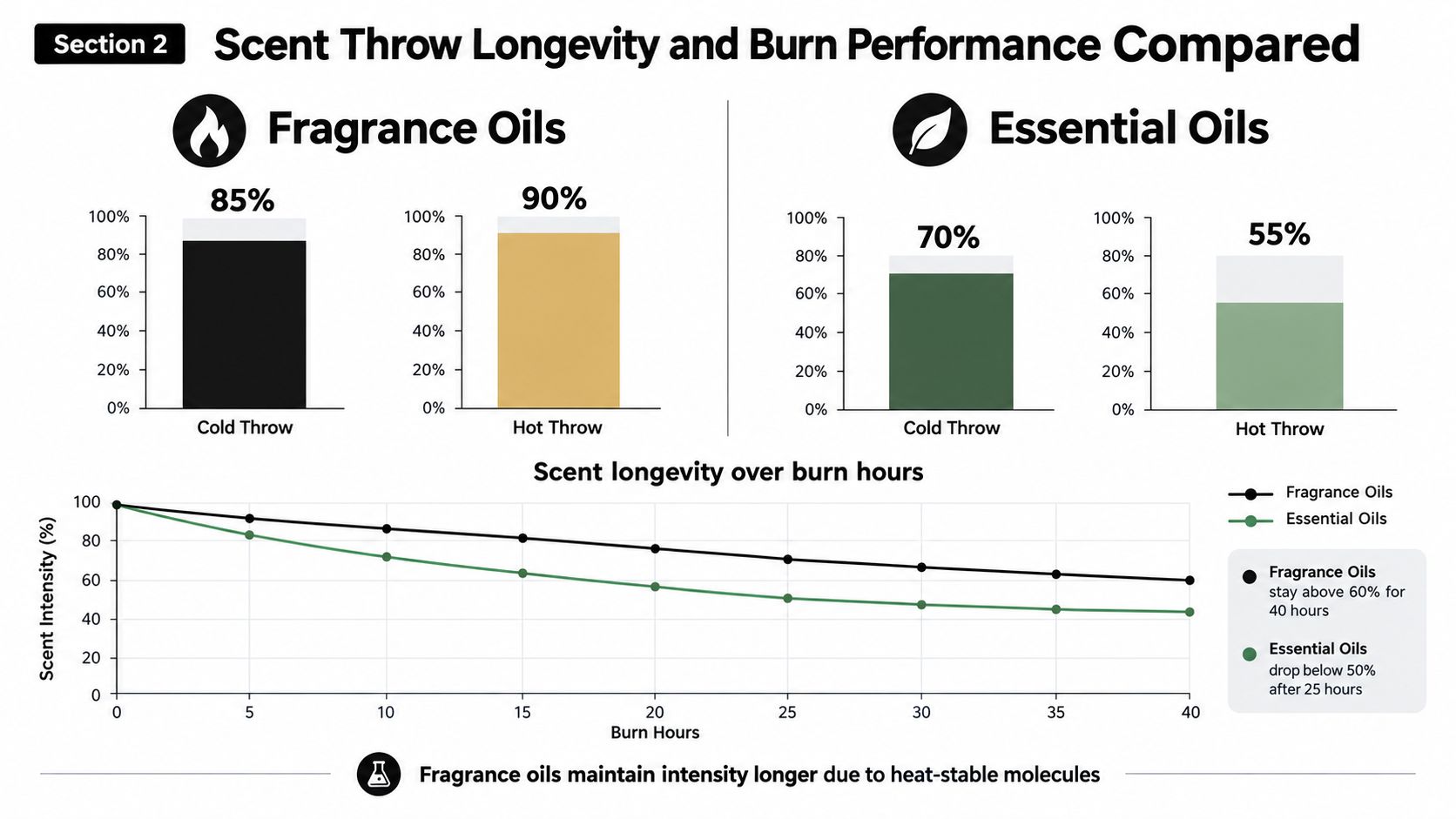
Independent candle-making guidance describes fragrance oils as the stronger option for candle scent performance because they're engineered for wax solubility and heat stability. That same guidance notes they typically deliver a more reliable cold throw and hot throw than essential oils, while essential oil candles are more prone to weak aroma, inconsistent burn behavior, and wicking issues, as outlined in this breakdown of fragrance oil vs essential oil for candles.
That wording lines up with what many makers observe at the bench. Fragrance oils usually disperse through wax in a more predictable way. Essential oils can smell lovely in the bottle, but once heat enters the equation, many don't project as steadily.
For a practical companion on this point, Jackpot Candles has a helpful article on soy candle scent throw that focuses on how wax and fragrance choices affect what people smell in the room.
A lot of disappointment comes from mixing these two up.
Some essential oils do fairly well on cold throw. The jar smells fresh and convincing. But the hot throw can drop off because the aroma compounds are more volatile and less suited to sustained heating in wax.
Fragrance oils usually perform better across both stages because they're designed with that exact use case in mind.
If your goal is a room-filling candle, hot throw matters more than how nice the jar smells on the shelf.
Scent isn't the only issue. Oil choice can affect how the candle burns.
With essential oils, makers more often run into:
With fragrance oils, the experience is often simpler:
That doesn't mean fragrance oils make testing unnecessary. Wick size, vessel shape, cure time, and wax blend still matter. But they usually give the maker a more stable starting point.
If you're choosing between candle fragrance oils vs essential oils for a soy candle and your top priority is performance, fragrance oils usually win. Not because they're trendy, and not because “synthetic” is somehow superior in every context. They win because the material is commonly built to survive the environment inside a burning candle.
You pour a soy candle with a citrus essential oil because it feels like the safer choice. A customer lights it, loves the smell, then asks a fair question: what exactly is in it, and how do you know it is appropriate for a candle? That is where candle safety becomes practical. The useful questions are not “natural or synthetic?” They are “How does this material behave under heat?” and “What paperwork supports the use level?”
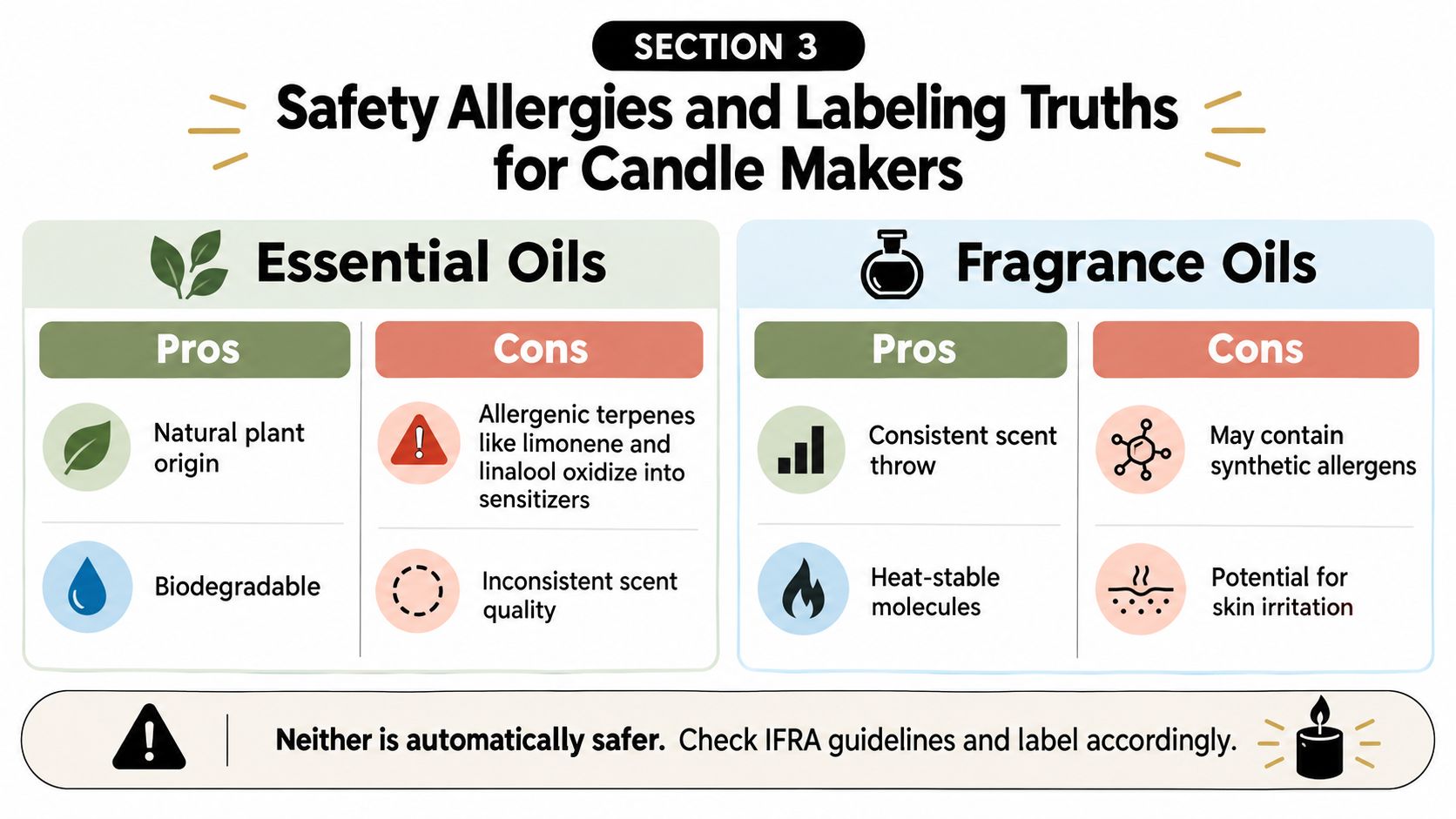
Essential oils are natural extracts, but natural origin does not cancel out allergy risk. Many contain compounds such as limonene and linalool. Once exposed to air, those compounds can oxidize and become more likely to irritate sensitive users, as discussed in this research document on fragrance sensitization and oxidation.
For a candle maker, that matters because a candle is a heated air product. You are not judging an oil by how wholesome the bottle sounds. You are judging how predictably it performs after blending into wax, curing, and sitting near a flame.
Fragrance oils often have an advantage here. Suppliers commonly build them for a specific end use, then document that use. In candles, that usually means better heat stability and clearer usage guidance.
IFRA matters because it organizes fragrance safety by product type. Candles fall under IFRA Category 12, the category used for products such as candles and some other air-freshening formats, according to the IFRA Standards Library and guidance framework.
That category-based approach solves a common beginner misunderstanding. A material is not “safe” or “unsafe” in the abstract. It may be acceptable at one level in a candle and restricted much more tightly in a product that stays on skin.
In other words, the label on the bottle is only the starting point. The answer lives in the documentation.
A good supplier should give you enough information to make a plain yes-or-no decision.
Look for:
That paperwork is one reason engineered fragrance oils often work better for small candle businesses. They usually come with cleaner documentation, and documentation is what helps you choose a realistic load, test consistently, and describe the finished candle.
Plain language works best. If a candle contains fragrance oil, say fragrance oil. If it contains essential oils, say essential oils. If it is a blend, say that.
Avoid turning “natural” into a safety promise. Customers with sensitivities do not need marketing language. They need accurate information so they can decide what they are comfortable burning in their home.
A careful candle maker treats labels the way a baker treats an ingredient list. The goal is not to sound cleaner. The goal is to be clear.
A beginner usually notices this section at the testing table, not on a product page.
You melt soy wax, stir in an expensive oil, pour a clean-looking candle, and wait. A week later the scent is faint, the burn feels uneven, or the formula only works if you keep adjusting the wick. That is the cost question. Price per bottle matters, but so does how well the oil behaves in hot soy wax.
Fragrance oils give candle makers a clearer starting point because suppliers often publish candle-safe usage guidance for the specific oil. For example, CandleScience explains fragrance load as the percentage of fragrance used relative to the wax, and notes that many candle makers test within a common range for container candles depending on the wax and fragrance itself, as outlined in its guide to how much fragrance oil to use in candles.
For a beginner, that matters more than the natural-versus-synthetic label. A known starting range helps you measure, compare, and repeat a test. You are not guessing how much the wax can hold.
Essential oils can be harder to plan around. Some perform softly in soy wax, some fade under heat, and some reach their practical limit before you get the scent strength you wanted.
| Factor | Fragrance Oils | Essential Oils |
|---|---|---|
| Typical candle use approach | Usually tested within supplier guidance for candles | Often tested more cautiously because performance varies widely by oil |
| Math in soy wax | Easier to calculate around published load ranges | Harder to predict without extra rounds of testing |
| Cost predictability | Usually simpler to estimate per batch | Often rises fast if stronger scent requires more trial batches |
| Soy wax compatibility | Commonly built for better hot and cold throw in wax | Can smell pleasant but weaker or less stable once burned |
| Batch repeatability | Usually more consistent from bottle to bottle | More variation by botanical source, harvest, and oil type |
A useful comparison is this guide to soy wax candles with essential oils, which shows why soy wax attracts makers who want a plant-based direction but still need to test for real candle performance.
Soy wax already has its own personality. It can be picky about cure time, wick size, and pour temperature. Add an oil that changes character under heat, and you now have two moving parts instead of one.
That is where engineered fragrance oils often win. Many are designed for higher heat stability and are sold with candle-specific documentation, including IFRA limits and application notes from the supplier. In plain terms, the oil is made for the job it is being asked to do.
Essential oils were not created with candle combustion as the main target. They are distilled or expressed plant materials, and their aromatic compounds do not all react the same way in melted wax or in a flame-heated melt pool. Eden Botanicals explains in its article on flash points and what they mean for formulators that volatile materials can evaporate more readily under heat. For candle makers, that can translate into lost aroma during pouring or a weaker hot throw later.
A fragrance oil that works at a realistic soy wax load and keeps its character through burn tests is often the cheaper option in practice, even if the bottle does not sound as romantic.
You buy fewer extra materials. You rerun fewer batches. You get a formula you can document and repeat.
Essential oils still have a place, but soy wax usually asks more of them. If your goal is consistent scent throw, cleaner testing decisions, and paperwork that supports the formula, fragrance oils often give better value than the word natural suggests.
Once you stop treating this as a winner-takes-all argument, the choices get easier. Different projects want different things.
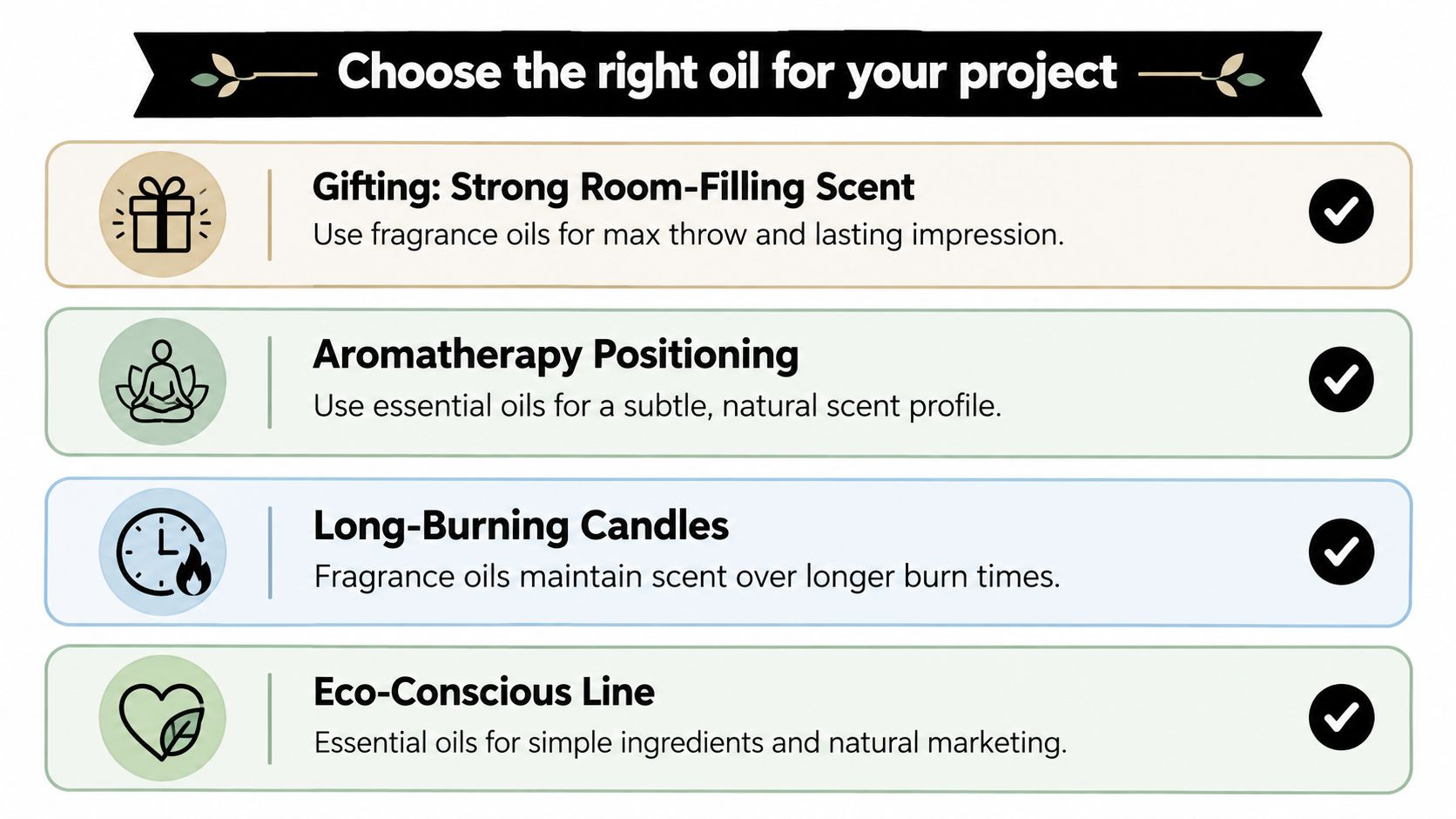
If the candle needs to impress people quickly, fragrance oils usually fit the job better.
This is also where a product example fits naturally. Jackpot Candles uses a proprietary soy wax blend with perfume-grade fragrance oils, which reflects this performance-first approach to scent throw and consistency in a finished candle product.
Essential oils usually fit a narrower, more intentional lane.
A maker may choose them for a candle line that emphasizes plant-derived ingredients, a softer aromatic profile, or a more minimalist scent identity. Lavender, eucalyptus, or citrus-led concepts often appeal to customers who care strongly about ingredient storytelling.
That said, expectations need to stay realistic. A subtle essential-oil candle can be pleasing without being loud. If the customer expects a strong, whole-room throw, that softer profile may feel underpowered rather than refined.
Some candle projects are built to fill a room. Others are built to sit closer to the body and create atmosphere. Those aren't the same job.
Many makers eventually land somewhere in between. They may use a fragrance oil that captures a natural profile well, or they may work with a blend strategy when appropriate for the formula and documentation available.
That approach can help when you want:
A simple way to choose is to ask what promise the candle is making.
If the promise is strength, projection, and consistency, use fragrance oils.
If the promise is plant origin, subtle aroma, and a simple ingredient story, essential oils may fit.
If the promise is vague, the product usually ends up vague too.
When beginners compare candle fragrance oils vs essential oils, they often hope for one universal answer. There isn't one. But there is a reliable decision path.
Ask yourself five questions:
For most hobbyists and most sellers, engineered fragrance oils are the stronger candle-making tool. They tend to behave better in soy wax, produce more dependable scent throw, and come with the kind of documentation that makes decision-making less murky.
Essential oils still have a place. They make sense when the project is intentionally subtle, plant-centered, and tested with that goal in mind. They just shouldn't be chosen because of the assumption that “natural” automatically means better for candles.
Choose the oil for the burn environment, not for the romance of the bottle.
If you're making your next candle and want the fewest surprises, start with a candle-safe fragrance oil, test it in your wax, and evaluate the result with a lit candle, not just a cold sniff. That one habit will save you a lot of second-guessing.
If you want to see how this looks in a finished product, Jackpot Candles offers scented candles made with a proprietary soy wax blend and fragrance-forward scent design, which is exactly the kind of pairing discussed here. It's a useful reference point if you're comparing how strong, consistent fragrance oils can perform in real soy candles, not just in theory.
Comments will be approved before showing up.