
free shipping at $99


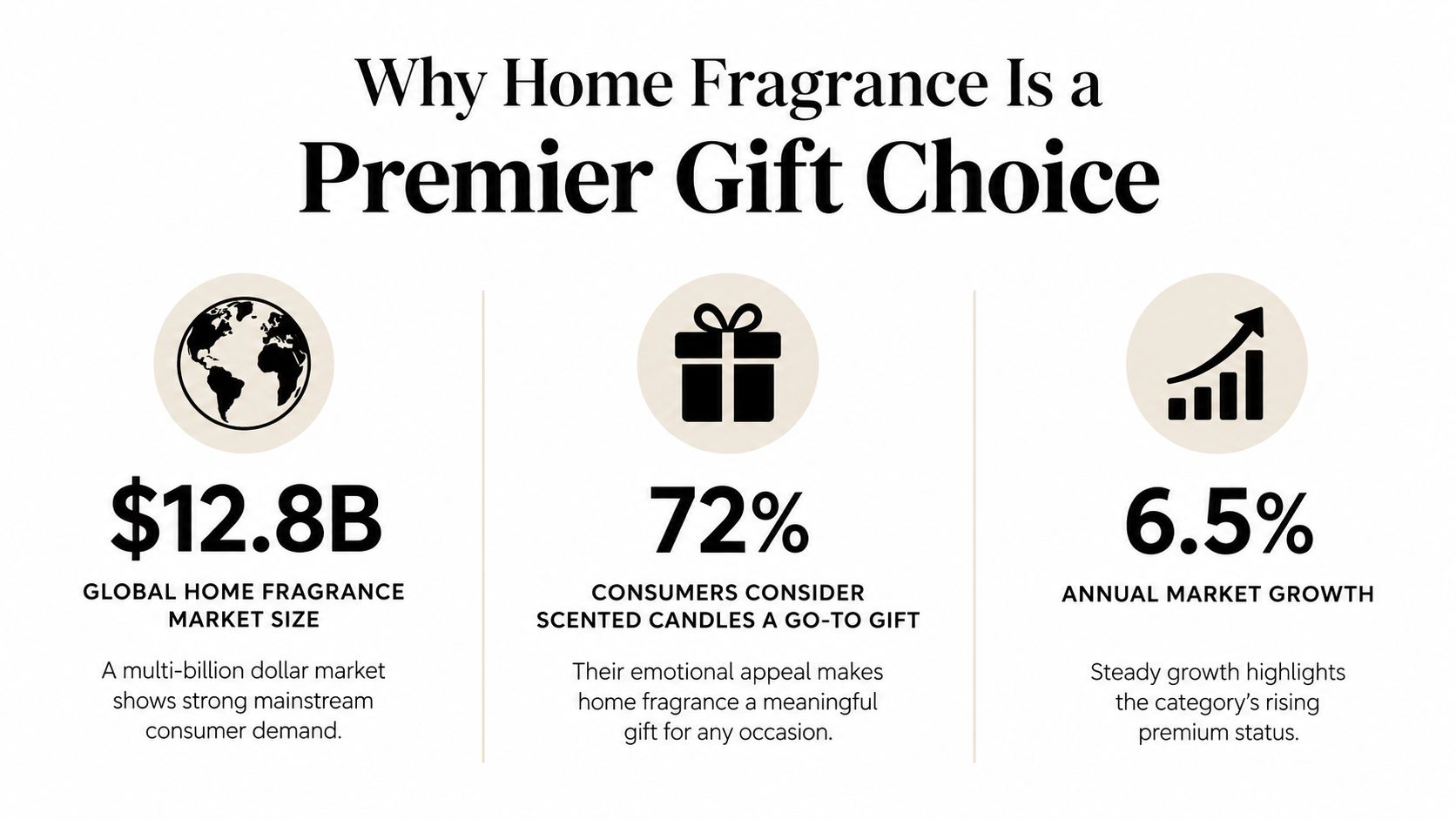
The global home-fragrance market is projected to reach USD 47.98 billion by 2034, making home fragrance gifts part of a premium, high-growth category rather than a niche décor purchase. The strongest gift combines a recognizable scent, a format that suits the recipient's routine, and an experience that feels personal without creating unnecessary risk.
You're standing in a shop or scrolling through a gift page, comparing candles, diffusers, bath products, and beautifully packaged sets. One scent sounds comforting, another sounds elegant, and a third has the kind of dramatic name that tells you almost nothing about how it will feel in someone's home.
The solution isn't to guess harder. It's to understand the olfactory ecosystem, the way fragrance, vessel, room size, burn behavior, ventilation, décor, and personal habits work together. A home fragrance gift succeeds when those parts support one another.
Home fragrance occupies an unusually useful place in gifting. It's decorative enough to feel special, practical enough to earn regular use, and sensory enough to create a memory. A mug may be appreciated once and placed in a cupboard. A candle or diffuser can become part of an evening routine, a workspace, a guest room, or a new home's first impression.
The category's scale reinforces that cultural role. One industry estimate valued the global home-fragrance market at approximately USD 26.00 billion in 2025 and projected it to reach USD 47.98 billion by 2034, with a 7.31% compound annual growth rate from 2026 through 2034. Fortune Business Insights' home-fragrance market analysis includes candles, sprays, oils, and diffusers, so these figures describe the wider ecosystem rather than candle sales alone.
North America represented 34.79% of global revenue in 2025, while candles were forecast to remain the leading format with an estimated 30.50% share in 2026, according to the same market estimate. That combination matters for shoppers in the United States and Canada, but it also shows why a scented candle feels familiar as a gift. Consumers already understand it as an accessible household luxury, not merely a source of light.
Scented candles add atmosphere, visual warmth, and a repeatable ritual. Reed diffusers provide a quieter decorative presence. Bath products extend fragrance into a personal-care setting. A thoughtfully assembled set can therefore communicate more than taste. It can say, “I know how you like your space to feel.”
That makes home fragrance gifts a useful alternative to generic household goods. They can be intimate without being overly personal, especially when the giver chooses a broadly appealing scent family and leaves room for the recipient to control when and where it's used.
The same principle applies when fragrance is only one part of a wider present. Someone comparing sensory gifts with wearable pieces may find a resource such as smart jewelry gifts by recipient useful for thinking about how personal a present should feel without relying on guesswork.
For more ideas across candles, diffusers, and related formats, browse this guide to the best home fragrance products. Details and product availability can change, so always check the current product page before buying.
The vessel is part of the fragrance experience. Two products can use similar scent notes but feel completely different because one asks the recipient to light it, another releases aroma continuously, and a third belongs in a bath or body-care routine.
Start by matching the format to the recipient's level of involvement. A candle suits someone who enjoys a deliberate pause. A diffuser fits a person who wants the room to smell inviting without remembering to turn anything on. A bath product works best when the gift should feel private, restorative, and separate from the décor.
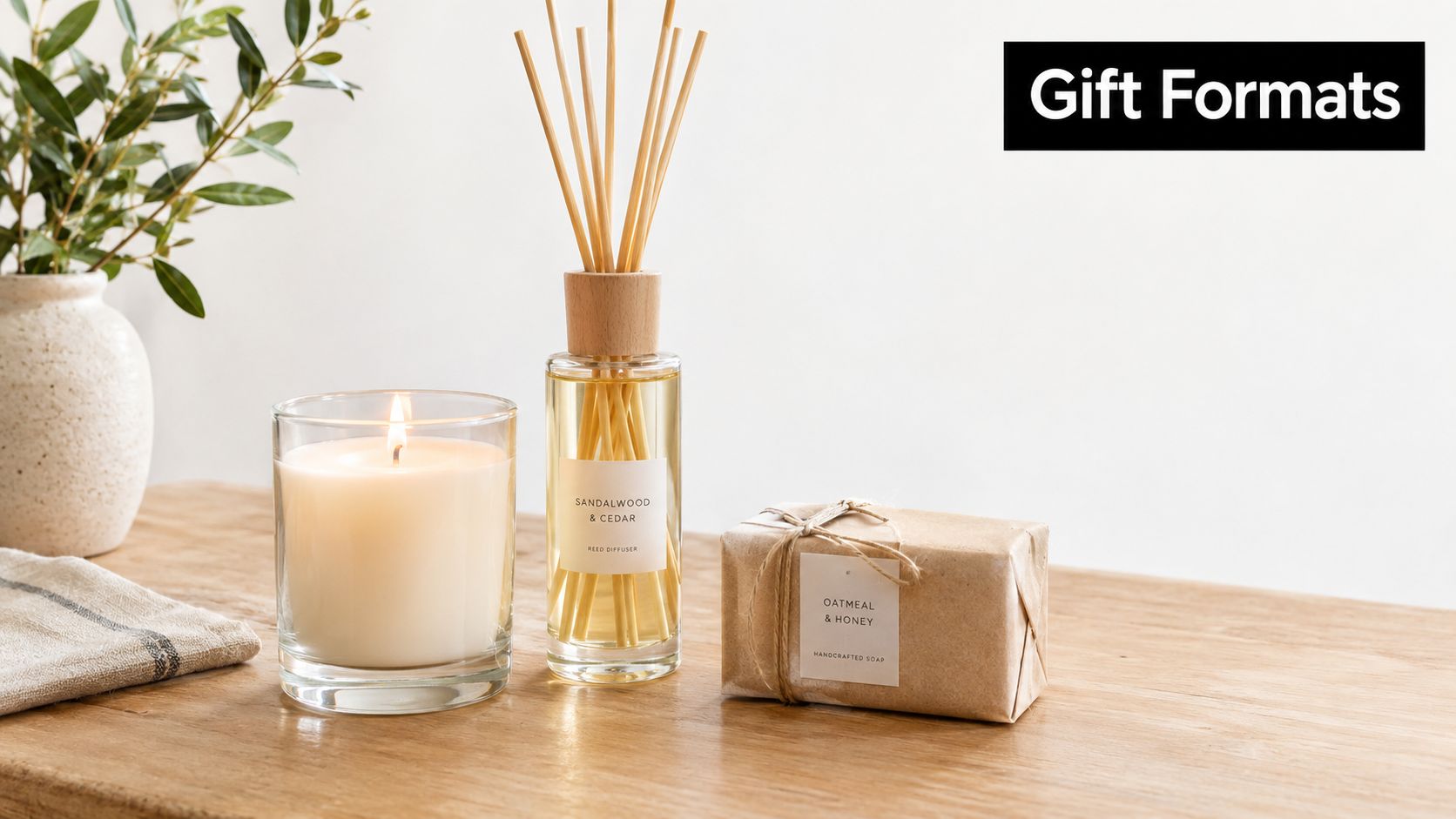
Candles combine fragrance with flame, glow, and a visible change in the room. That makes them effective for recipients who enjoy evening routines, entertaining, reading, or creating a specific atmosphere before dinner.
The candle's performance depends on more than the fragrance oil. The wax, wick, vessel diameter, and fragrance load form one operating system. A scent that works well in one candle may behave differently in another vessel because the melt pool and fuel delivery change.
Look for a stable container, an upright wick, clear care instructions, and packaging that protects the wick during delivery. The recipient should know how to trim the wick and how to stop using the candle when it reaches the end of its useful life.
Reed diffusers work through passive evaporation. The reeds draw fragrance from the vessel and release it into the surrounding air, so the recipient gets a steady presence rather than the concentrated rise associated with a newly lit candle.
They suit entryways, bathrooms, desks, and rooms where a flame would be inconvenient. They also make sense for people who prefer décor that works in the background. A diffuser doesn't create the same visual ritual, but it can become part of the room's identity without asking for active attention.
Choose the vessel with the room in mind. A small arrangement may feel proportionate on a bedside table, while a larger decorative design may belong on a console or sideboard. The recipient's existing décor matters just as much as the fragrance.
Wrapped soap, bath bombs, dried flowers, and small fragrance accessories can turn one product into a more complete gift. These formats shift the experience from “how should this room smell?” to “how can this person relax or care for themselves?”
A housewarming present can combine a decorative diffuser with a candle. A birthday set can pair a personal bath product with a scent chosen for the recipient's mood. If the gift is for someone moving into a new home, EasyRegistry's guide to housewarming registries offers useful context on balancing practical items with gifts that shape the atmosphere of a space.
Use a simple selection test:
The right format reduces friction. A gift feels more thoughtful when the recipient can use it naturally, rather than having to redesign a routine around it.
Scent names can be misleading. “Midnight,” “escape,” or “serenity” describes a mood invented by the marketer, not necessarily the experience inside the vessel. Scent families provide a more reliable vocabulary because they identify the structure of the fragrance.
Think of a scent family as the color palette of a room. A floral profile may use several different flowers, just as a blue room can feel coastal, formal, or playful depending on the materials around it. The family gives you direction, but the supporting notes determine the final character.
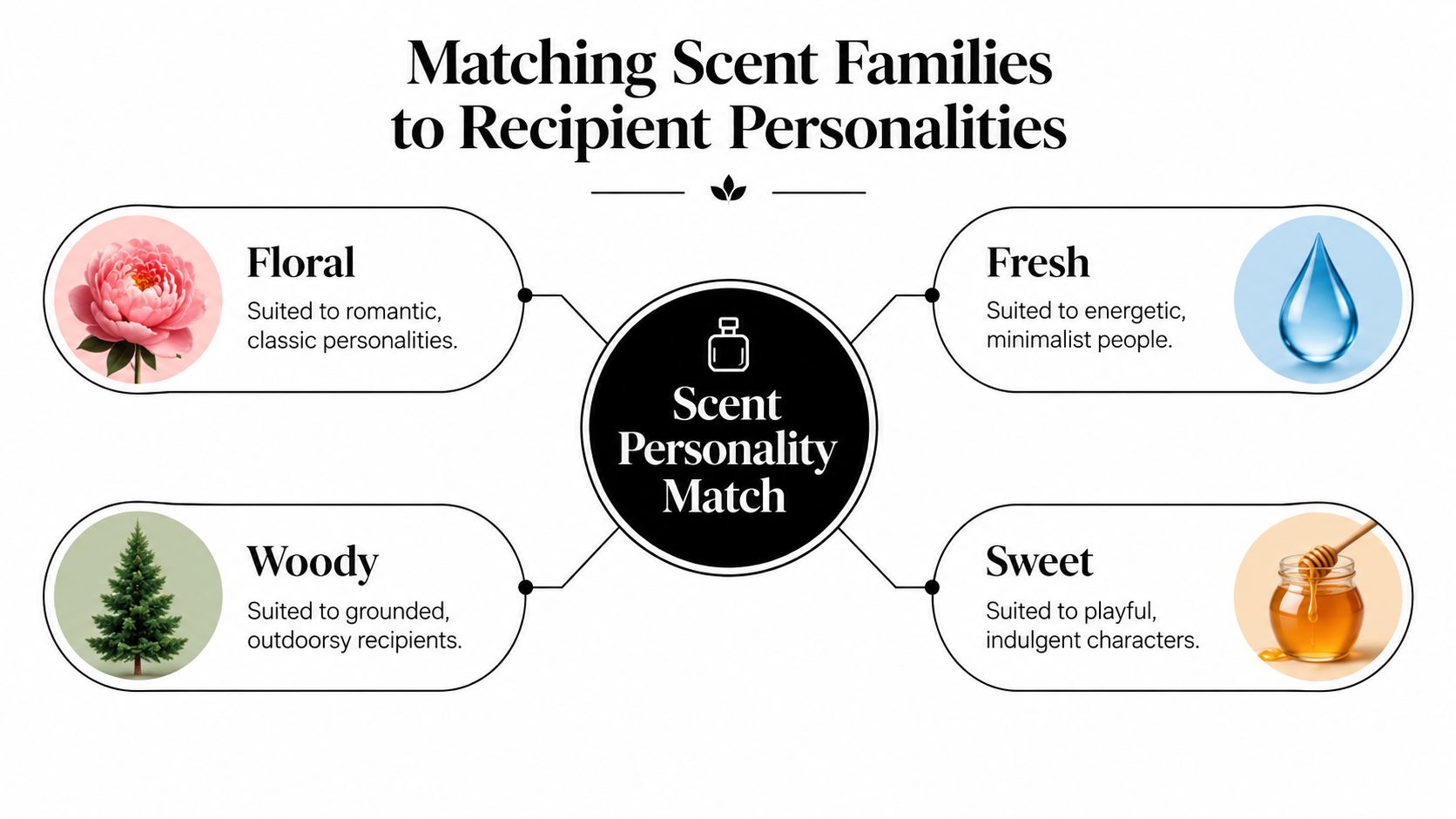
Floral scents often feel expressive, graceful, and recognizably gift-like. Rose can suggest classic romance, jasmine can feel more dramatic, and lavender may read as calm or herbaceous depending on what surrounds it.
Choose floral when the recipient enjoys flowers, polished interiors, romantic details, or traditional fragrance. For someone who dislikes powdery scents, look for floral notes paired with citrus, green leaves, or woods. Those supporting notes can make the fragrance feel cleaner and less sweet.
Fresh profiles often include citrus, aquatic, green, or airy impressions. They can make a room feel bright and orderly, which is why they suit energetic recipients, minimalist spaces, kitchens, offices, and people who prefer subtle fragrance.
A fresh scent isn't automatically weak. Citrus can feel vivid, while green notes can feel crisp and textured. The key is to distinguish freshness from intensity. A strong lemon or eucalyptus fragrance may be too forceful for someone who wants only a quiet background aroma.
Woody profiles are useful when you want a gift to feel grounded, refined, or less obviously sweet. Cedar, sandalwood, and related dry or resinous notes can suit recipients who like natural materials, outdoor settings, neutral décor, or understated luxury.
Woody scents also make good bridge choices. A woody-floral blend can soften the floral side, while a woody-amber composition can add warmth without becoming sugary. For an unfamiliar recipient, this flexibility can lower the risk of choosing something that feels too narrowly styled.
Vanilla, caramel, honey, cocoa, and fruit notes can create a cozy, indulgent impression. They work well for recipients who enjoy baking, warm interiors, playful packaging, or dessert-like fragrances.
Sweetness needs calibration. A light vanilla can feel familiar and gentle, while a dense sugary composition may dominate a small room. If you're unsure, choose a sweet note balanced by woods, spice, or fresh fruit rather than a single heavy accord.
A practical matching rule: Choose the recipient's preferred mood first, then select the scent family that expresses it.
Before buying, ask three quiet questions:
The best home fragrance gifts don't force a personality onto the recipient. They make an existing preference easier to enjoy.
A premium label doesn't automatically answer every question about indoor air. Candles involve controlled combustion, and fragrance changes what enters the surrounding air. A responsible gift therefore includes both an attractive product and enough information for the recipient to use it sensibly.
Controlled chamber research found that scented candles produced more volatile organic compounds than unscented candles, with measured pollutants including formaldehyde, benzene, polycyclic aromatic hydrocarbons, fine particles, and ultrafine particles. The results also varied by candle make, fragrance, and burn duration, so “natural,” “premium,” or “soy” should not be treated as complete air-quality guarantees. The measurement and evaluation research on scented and unscented candle emissions supports a more careful approach.
A wick controls how quickly the candle draws fuel into the flame. If it's too large, the flame may become tall and combustion may produce more soot or smoke. If it's too small, the candle may struggle to create a sufficient melt pool, leading to weak fragrance release or tunneling.
ASTM F2417 evaluates flame height, secondary ignition, stability, and end-of-useful-life behavior through repeated burn cycles. Its earlier test criteria identify a flame exceeding 95.3 mm, or 3.75 inches, as a failure threshold. The ASTM F2417 candle safety standard sample explains why manufacturers should test each wax, fragrance, wick, and vessel combination rather than assuming one successful formula transfers to every scent.
Give the recipient practical instructions:
A 2025 residential study found that PM10 near a scented candle peaked at 1.52 times baseline after five minutes, while PM2.5 and PM1 stayed higher at locations three and six metres away over time. The residential study indexed by PubMed also makes clear why room size and ventilation belong in a gift conversation.
Flame-free doesn't always mean air-quality-friendly, either. Separate 2025 research reported that scented wax melts can generate nanoparticle pollution comparable to candles when fragrance terpenes react with ozone. For recipients with asthma, allergies, respiratory sensitivities, or strong reactions to fragrance, ask discreetly before choosing a highly scented product.
A useful alternative is to make the jewelry or bath experience the emotional centerpiece and keep the fragrance intensity moderate. For additional product-selection considerations, consult this guide to non-toxic home fragrance, then follow the product label and treat medical concerns as a reason to seek professional advice, not as a marketing checklist.
Some gifts are remembered because of the scent. Others are remembered because the recipient discovers something unexpected while using them. A hidden-jewelry candle combines those two timelines, the immediate pleasure of fragrance and the later moment of reveal.
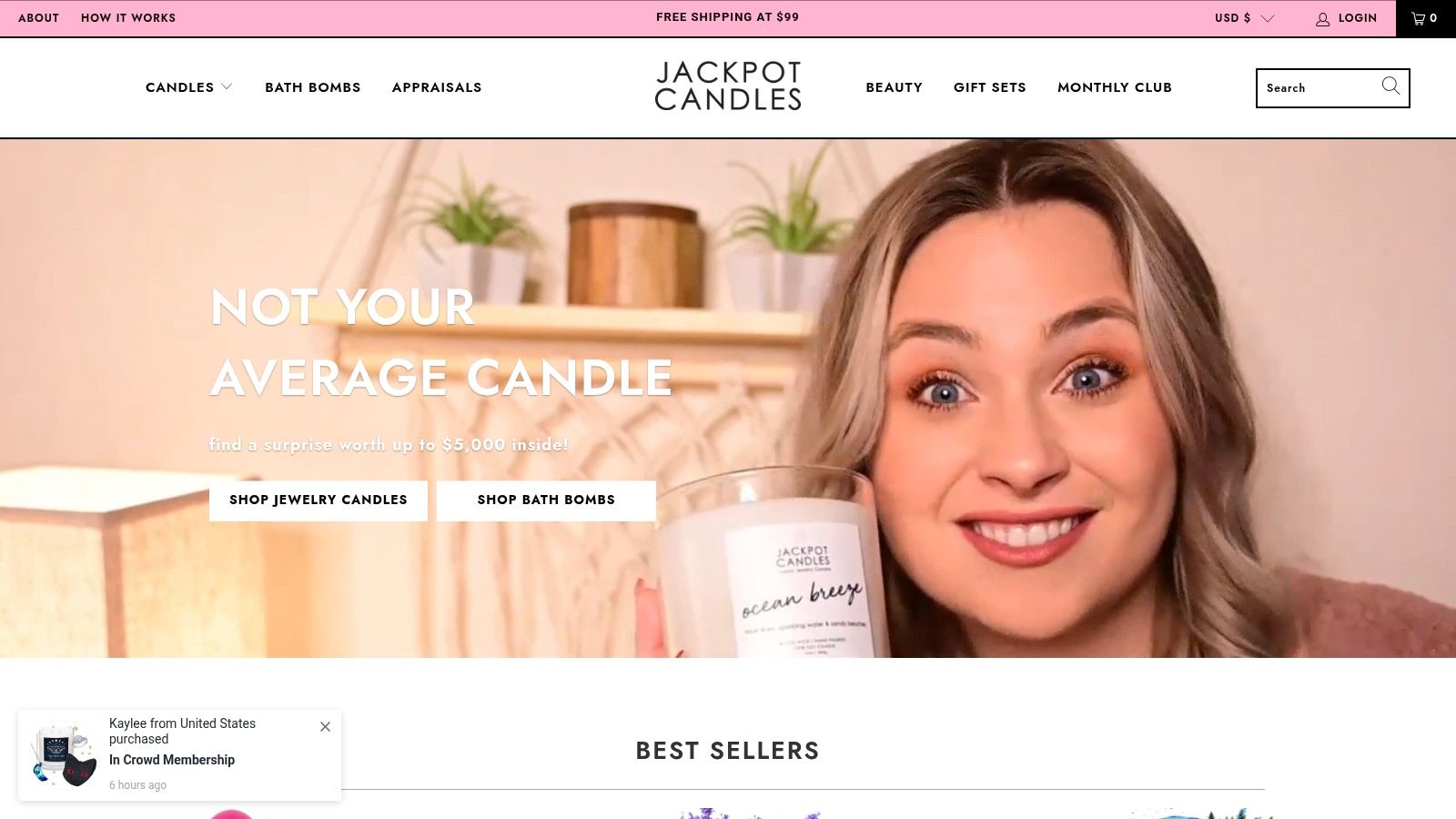
The experience begins before the wick is lit. The recipient opens a gift that looks like a home-fragrance product, notices the vessel and fragrance, and then learns that a ring, necklace, or other jewelry piece is concealed inside. That discovery changes the candle from a consumable object into a small narrative. The gift has an opening scene, a period of anticipation, and a physical keepsake at the end.
The surprise also gives the giver a way to personalize the present without needing perfect scent knowledge. A recipient may not choose the same fragrance you would have selected, but the reveal creates another point of connection. This is especially useful for birthdays, anniversaries, holiday exchanges, and gifts where the emotional gesture matters as much as the décor.
The hidden element shouldn't distract from the candle's basic performance. The product information describes a proprietary soy wax blend designed to provide a slower, longer-lasting burn with minimal soot while carrying and releasing fragrance effectively. It also describes exclusive, perfume-grade fragrance oils intended to create a rich room aroma.
Those claims still need to be considered alongside ordinary candle-care guidance. Keep the wick upright, follow the label, burn in a suitable location, and provide ventilation. A surprise inside the wax adds excitement, but it doesn't remove the need for stable combustion and responsible use.
This is also why the product can work in a broader home-fragrance gift set. A candle-and-bath-bomb combination makes the reveal feel more playful, while a multi-candle set can offer variety if the recipient enjoys changing scents across rooms or moods. Personalized labels can add an occasion-specific detail without requiring a complicated custom gift.
A visual demonstration can help shoppers understand the product experience before they choose it:
For a clear explanation of the reveal process, read how Jackpot Candles work. The central idea is simple: the fragrance establishes the daily ritual, while the concealed jewelry gives the recipient a reason to remember the gift after the candle is gone.
Unknown scent preferences call for a low-regret choice, not the most dramatic fragrance on the shelf. Start with a familiar profile that can live comfortably in several rooms, then add personalization through the format, packaging, message, or surprise element.
A 2026 trade-survey summary reported that floral and botanical profiles led preferences across generations, selected by 74% of Gen Z, 75% of millennials, 60% of Gen X, and 58% of baby boomers. Fresh profiles ranked second in the same summary. The 2026 candle-trend survey coverage provides useful context, but it shouldn't turn a percentage into a guarantee. Personal taste still varies.
Use this comparison:
| If you know the recipient likes... | Consider... | Why it lowers the risk |
|---|---|---|
| Flowers or gardens | A light botanical or floral blend | Familiar without requiring a highly specific perfume taste |
| Clean rooms and minimal décor | A fresh profile | Usually reads as airy and unobtrusive |
| Warm interiors | A balanced woody or soft vanilla scent | Adds comfort without relying on intense sweetness |
| Almost nothing about their preferences | A gift card, exchange option, or adjustable format | Lets the recipient control the final choice |
Avoid assuming that a stronger scent feels more luxurious. A moderate fragrance with clear usage guidance can suit more rooms and more routines than an overpowering formula. If the recipient has respiratory sensitivities, ask privately before gifting anything fragranced.
The hidden-jewelry format can also reduce dependence on scent alone. The giver can choose a recognizable botanical or fresh profile, then let the discovery supply the individuality.
The strongest home fragrance gifts align format, scent, room, safety, and presentation. Choose a candle for ritual, a diffuser for steady background fragrance, or a bath product for private relaxation. Select a family that reflects the recipient's habits, check the wick and care guidance, and avoid treating premium materials as a substitute for ventilation or responsible use.
Then add one memorable detail, such as a personalized label, coordinated packaging, or a concealed keepsake. A good fragrance gift doesn't demand perfect prediction. It gives the recipient an appealing first impression and enough flexibility to make the experience their own.
Jackpot Candles offers scented candles and bath bombs with surprise jewelry inside, along with gift-ready options suited to birthdays, anniversaries, holidays, and thoughtful home-fragrance gifting. Visit Jackpot Candles to explore the current collection and choose a scent-and-surprise experience for someone special.
Comments will be approved before showing up.