
free shipping at $99


Bringing your customer acquisition cost (CAC) down really comes down to two things: getting smarter with your marketing money and making every customer you win more valuable in the long run. It's a balancing act. You need to fine-tune your ad campaigns for better results while also building a brand that keeps people coming back for more.
Before you can start trimming your customer acquisition cost, you've got to know your number. Flying blind is the quickest way to blow your budget. Your CAC is simply the total cost of everything you spend on sales and marketing, divided by the number of brand-new customers you brought in over a certain time. Think of it as your baseline for growth—it tells you if your marketing is a well-oiled machine or if it's springing leaks.
Getting this number right is the foundation for everything else. A solid Google Ads conversion tracking setup is non-negotiable for accurately seeing what you're spending on paid ads. Without clean data, you're just guessing.
To get a real, "fully loaded" CAC, you need to count every single penny spent on getting those new customers through the door. This is way more than just what you pay for ads.
Here’s a look at what should be in your calculation:
This simple visual breaks down the basic formula.
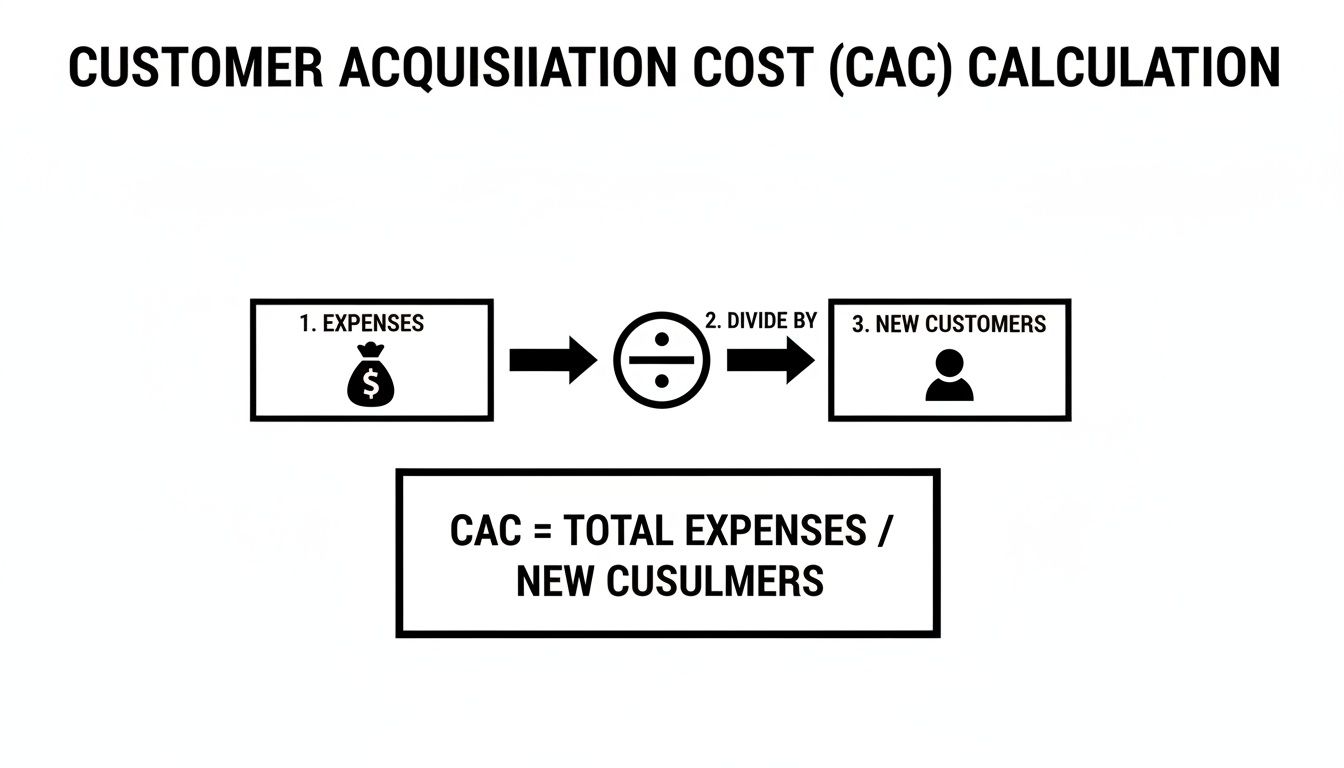
As you can see, you just divide all your acquisition expenses by the number of new customers you've won. Easy enough, right?
Here’s a quick table to show how this might look for a typical month.
| Expense Category | Monthly Cost | Description |
|---|---|---|
| Ad Spend (Meta & Google) | $15,000 | Direct cost of running paid advertising campaigns. |
| Marketing Team Salaries | $5,000 | Prorated salaries for staff working on acquisition. |
| Creative & Content | $2,000 | Cost for freelancers (design, video) for ad creative. |
| Marketing Software | $500 | Subscription fees for email, analytics, and CRM tools. |
| Influencer Marketing | $2,500 | Fees paid to influencers for promotional posts. |
| Total Acquisition Cost | $25,000 | Sum of all expenses to acquire new customers. |
If this brand acquired 500 new customers in the month, their CAC would be $50 ($25,000 / 500).
Okay, so knowing your CAC is step one. But that number doesn't mean much on its own. The metric that truly tells you if your business is built to last is the Lifetime Value (LTV) to CAC ratio. This compares how much a customer is worth to you over their entire relationship with your brand versus what you spent to get them.
For a healthy, growing e-commerce business, you want to see an LTV to CAC ratio of 3:1 or higher. This means for every dollar you spend bringing a customer in, they generate at least three dollars in profit over their lifetime.
If your ratio is dipping below 3:1, it's a red flag that you're probably spending too much to get each customer, and you might even be losing money on every sale. That's a huge problem, especially as it gets tougher and tougher to win new business.
Make no mistake, acquiring customers has gotten brutally expensive. In 2013, brands were losing an average of $9 per new customer; by 2025, that's expected to jump to $29—a massive 222% increase. For brands like Jackpot Candles, where the average CAC can be anywhere from $68–$78, this trend is a major challenge. It's all fueled by more ad competition and privacy updates that make targeting harder. This is why understanding and improving your LTV to CAC ratio is more important than ever.
So you've got your CAC number. Now it's time to put on your detective hat. A high customer acquisition cost is just a symptom, not the actual problem, and your job is to find the real source of the pain. More often than not, the biggest leaks are hiding in plain sight right within your marketing channels.
One of the most common traps is spreading your budget way too thin. It’s tempting to be everywhere at once—Facebook, TikTok, Pinterest, you name it—but this "spray and pray" approach is a quick way to burn through cash with little to show for it.
Instead of being just okay on five different platforms, your goal should be to absolutely crush it on one or two. This is a core part of any smart strategy to reduce customer acquisition cost. Focusing your energy lets you truly master the channels where your ideal customers—the ones who will love finding a jewelry surprise in their candle—actually hang out.
First things first: you need to do a ruthless audit of every single marketing channel. Pull the data and look at the CAC for each platform you're on, from Meta and Google Ads to TikTok and Pinterest.
You’re hunting for the outliers. Is your Facebook CAC double what you’re paying on TikTok? Is Google Search bringing in amazing customers for a fraction of what your display ads cost? The numbers don't lie.
Once you spot your top one or two channels, it’s time to double down. For a brand like Jackpot Candles, this might mean pulling budget away from generic Facebook ads and pouring it into a hyper-focused TikTok strategy built around viral unboxing videos. That single move could make your ad dollars work so much harder.
Don't be afraid to pause or even completely cut the cord on underperforming channels. I know it feels weird to shrink your marketing footprint, but reallocating that budget to a proven winner is one of the fastest ways to see a real improvement in your overall CAC.
Even on your best-performing channels, sloppy audience targeting can drain your budget fast. Especially in the post-iOS 14 world, finding the right people has gotten trickier, making it a very common reason for a high CAC.
Start by digging into your ad platform analytics. Look for specific audiences or interest groups that have a high cost-per-click (CPC) but a really low conversion rate. These are your budget vampires—they’re clicking all day but never actually buying.
Turn off those low-converting ad sets right away. Your next move is to refine your targeting to focus on these high-intent micro-audiences. It’s always better to reach 1,000 people who are genuinely excited to buy than 100,000 who are just scrolling by.
The last piece of the puzzle is your ad creative. You could have the perfect channel and the perfect audience, but if your ad doesn't connect, you're just throwing money away on impressions. An ad that falls flat is a direct leak in your budget.
Pull up your best- and worst-performing ads and look at them side-by-side. What's different?
| Creative Element | High-Performing Ads | Low-Performing Ads |
|---|---|---|
| Visuals | Authentic user-generated content (UGC), fun unboxing videos, lifestyle shots. | Generic product photos, overly polished studio images. |
| Headline | Asks a question, highlights a key benefit (e.g., "Find Your Surprise"). | Just states the product name (e.g., "Scented Soy Candle"). |
| Call to Action | Clear and urgent ("Shop the Reveal," "Get Yours Now"). | Vague or passive ("Learn More"). |
The patterns usually jump right out. Ads with real people enjoying your product almost always outperform those sterile, boring product shots. For a brand like Jackpot Candles, which is all about the thrill of discovery, a video of a customer's genuine, excited reaction to finding a beautiful ring is infinitely more powerful than a static image of the candle itself.
By methodically checking your channels, tightening up your audiences, and making your creative shine, you can plug the leaks that are inflating your CAC and start building a much more efficient, profitable way to win new customers.
Once you’ve spotted where the money is leaking, it's time to get hands-on and start lowering your customer acquisition cost right where it counts: your paid ad channels. This is where modern tools, especially artificial intelligence, can be a total game-changer, making every single ad dollar work harder for you.
The old days of manually guessing at bids and audiences are pretty much over. AI-powered platforms can now automate bidding with a precision we just can't match, adjusting on the fly to grab the best clicks at the lowest price. This means your budget is constantly being pushed toward the opportunities most likely to convert.
One of the biggest hurdles for any brand is finding new customers who look and act just like their best existing ones. This is where AI really shines. By crunching thousands of data points from your current customer base, machine learning algorithms can build high-value lookalike audiences with scary-good accuracy.
This is worlds away from the broad "interest" targeting that often sends costs through the roof. Instead, AI can spot subtle behaviors and patterns, helping you reach people who are already primed to fall in love with your products. The result? Less cash wasted on the wrong audience and a direct line to a lower CAC.
In the glittering world of surprise jewelry candles, where every burn reveals potential treasure, customer acquisition costs have skyrocketed. We're talking an increase of 40-60% from 2023 to 2025 alone, pushing the e-commerce average to $78 per customer. But AI is the secret weapon that’s flipping the script, delivering up to a 50% CAC reduction for brands that embrace it. Think about it—advanced, AI-driven personalization can lead to a 5-15% lift in revenue and 10-30% gains in marketing efficiency. Those numbers speak for themselves. You can dive deeper into these e-commerce benchmarks over at Deliberatedirections.com.
While AI handles the technical heavy lifting, your creative is what actually connects with people. To really make a dent in your customer acquisition cost, you have to ditch the sterile, generic product photos. Today's shoppers are craving authenticity; they want to see real people using and loving your stuff.
The single biggest creative mistake I see brands make is relying on polished studio shots. An authentic, slightly imperfect video from a real customer will outperform a perfect, soulless ad 9 times out of 10.
Start shifting your creative budget toward formats that tell a story and build that all-important trust.
Great creative doesn't just grab attention; it also boosts engagement. Social media platforms love that and will reward you with better reach at a lower cost. If you're stuck for ideas, our guide on how to increase social media engagement has tons of tips to get you started.
Let's be real: your first attempt at a new creative ad won't always be a smash hit. The secret is to build a system for constant testing and tweaking. Don't just launch a campaign and forget about it. You need to be actively testing different pieces to see what really clicks with your audience.
Here’s a simple framework you can follow:
By pairing the precision of AI-driven targeting with authentic, must-watch creative, you build a seriously powerful system for your paid advertising. This two-pronged approach ensures you’re not just reaching more people, but you’re reaching the right people with a message that truly connects, driving down your CAC and clearing the path for profitable growth.
Pouring money into ads is only half the battle. If all those visitors land on your site and leave without buying anything, you've just paid for a click, not a customer. This is why digging into your Conversion Rate Optimization (CRO) is one of the most powerful ways to directly reduce customer acquisition cost.
Every little improvement you make to your website experience helps convert more of the traffic you've already paid for. It's the ultimate efficiency play.
Let's break it down. Say you spend $100 to get 100 visitors, and two of them buy. Your conversion rate is 2%, and each customer cost you a hefty $50. Now, what if you could convince four of those same 100 visitors to buy? Your conversion rate doubles to 4%, and your CAC gets sliced in half to just $25—all without spending a single extra cent on ads.
One of the biggest leaks in any e-commerce funnel is a clunky checkout process. The average cart abandonment rate is hovering around a staggering 70%. That’s wild! For every ten customers who add a product to their cart, seven of them are walking away before paying.
This is a massive opportunity staring you right in the face. Every single customer you can win back from that abandoned cart pile is a direct blow to a high CAC.
Your website's performance is completely non-negotiable today. In a world of instant gratification, a slow-loading site is a death sentence for your conversion rates. Did you know even a one-second delay in page load time can lead to a 7% drop in conversions?
This is especially true for mobile, where most of your e-commerce traffic is probably coming from. If your site is awkward, slow, or hard to use on a smartphone, you are actively pushing paying customers out the door.
A fast, seamless mobile experience isn't just a nice feature anymore; it's a fundamental requirement for a healthy conversion rate. Test your site constantly on different phones and tablets to make sure the path to purchase is effortless for everyone.
For online stores specifically, following proven e-commerce SEO best practices can also do wonders for your site performance and organic traffic, creating a powerful, low-cost way to get new customers.
Here’s a simple truth: people trust other people way more than they trust brands. Social proof—things like reviews, ratings, and customer photos—builds the confidence a potential buyer needs to finally click that "purchase" button. It answers the little question in every shopper's mind: "Is this product actually as good as it looks?"
Integrating social proof right on your product pages is a game-changer. For a product like a Jackpot Candle, seeing a real customer’s photo of the beautiful ring they found inside is so much more compelling than any professional product shot we could take.
If you want to go deeper on this, our guide on improving e-commerce conversion rates has even more actionable tips.
By zeroing in on these practical CRO tactics, you stop wasting the valuable traffic you've worked so hard to get. You turn more browsers into buyers, which directly and powerfully lowers your customer acquisition cost and sets your brand up for sustainable growth.
While sharpening your ad campaigns is a great start, the real secret to solving a high customer acquisition cost is making every single customer more valuable over time. This means you have to stop thinking about just that first sale and start focusing on the entire relationship.
When you boost your Customer Lifetime Value (LTV), the initial cost to bring someone in becomes a much smaller piece of the puzzle.
Think about it this way: if you spend $50 to get a new customer who only makes one $60 purchase, your profit margin is razor-thin. But what if that same customer comes back three more times? Suddenly, that $50 you spent looks like a brilliant investment. A higher LTV gives you the breathing room to compete for ad space without tanking your profits.
For a brand like Jackpot Candles, where the thrill of discovering jewelry inside a candle creates a truly memorable experience, this focus on retention is everything. It has to be. Data shows brands could lose an average of $29 per new customer in 2025—a huge jump from just $9 in 2013. The math is pretty clear.
Most e-commerce experts agree that a healthy 3:1 LTV-to-CAC ratio is the gold standard for sustainable growth. This isn't just a nice-to-have; it's a survival metric.
Your email and SMS lists are your most powerful tools for raising LTV. Unlike paid ads where you're constantly renting an audience, these are channels you own. You have a direct line to people who already like your brand.
Use these channels to build a real relationship, not just to push sales. A thoughtful email or SMS campaign can turn a one-time buyer into a lifelong fan.
A great loyalty program is one of the most direct ways to encourage customers to come back again and again. It makes shopping feel like a fun game and gives people a real reason to choose you over a competitor. The trick is to make the rewards feel both achievable and genuinely desirable.
You don't need to overcomplicate it. A simple points-for-purchase system is often the most effective. For example, a customer could earn five points for every dollar spent, which they can then redeem for discounts, free shipping, or exclusive products.
A loyalty program does more than just drive repeat sales; it creates an emotional connection. When customers feel valued and rewarded, they transition from being mere buyers to becoming genuine brand advocates.
This is how you get ahead of rising ad costs for the long haul. Loyal customers not only spend more over their lifetime but also become your cheapest and most effective marketing channel: word-of-mouth. To go deeper on this, check out our guide on how to increase customer lifetime value.
Finally, turn your happiest customers into your very own sales team with a referral program. Think about it—people trust recommendations from friends and family way more than they trust an ad. A good referral program makes it ridiculously easy for customers to share their love for your brand and get a little something for it.
Try a "give-get" offer. For example, give the person referring a $10 credit and give their friend 10% off their first order. This two-sided reward motivates everyone and brings in new, high-intent customers for a fraction of what you'd pay for ads.
It's helpful to see how different marketing activities stack up. Some are designed purely to bring in new faces, while others are all about keeping your current customers happy and coming back for more.
| Marketing Strategy | Primary Goal | Typical Cost | Impact on LTV to CAC Ratio |
|---|---|---|---|
| Paid Social Ads (Prospecting) | New Customer Acquisition | High | Primarily increases CAC |
| Search Engine Marketing (SEM) | New Customer Acquisition | Medium to High | Primarily increases CAC |
| Email & SMS Marketing | Customer Retention | Low | Significantly increases LTV |
| Loyalty & Rewards Program | Customer Retention | Low to Medium | Significantly increases LTV |
| Referral Program | Both Acquisition & Retention | Low | Lowers CAC, increases LTV |
| Influencer Marketing | Both Acquisition & Retention | Varies | Can lower CAC and build trust |
By focusing on these retention strategies, you're not just saving money—you're building a more resilient business that thrives on genuine customer loyalty, not just a constant churn of new acquisitions.
Diving into customer acquisition can feel like navigating a maze. It's totally normal to have questions as you start tuning your marketing for better efficiency. Let's walk through some of the most common questions we hear from e-commerce brands trying to get their CAC down, with clear answers you can actually use.
Honestly, there’s no magic number that fits every brand. A "good" CAC is completely relative and really comes down to two things: your product's price and, more importantly, your customer lifetime value (LTV).
The real metric to obsess over is the LTV to CAC ratio. For most e-commerce businesses, a healthy, sustainable ratio is 3:1 or higher. Think of this as your growth benchmark. It means for every dollar you put into acquiring a new customer, you’re getting at least three dollars back over their lifetime with your brand.
Let's make it real. Say your average order is $50, and a customer typically buys from you three times. That gives you an LTV of $150. In this world, a $50 CAC is fantastic! But if your LTV was only $60, that same $50 CAC means you're on a fast track to going out of business.
The takeaway? Stress less about the dollar amount of your CAC and focus way more on keeping it comfortably below your LTV.
The timeline for seeing a drop in your CAC really depends on what you change. Different strategies work on different schedules.
Some fixes can deliver results almost overnight. Technical CRO tweaks, like speeding up your site or simplifying the checkout process, can lower your CAC in just a few days. You're just removing friction for people who already want to buy, so the impact is immediate.
Other tactics need a little more breathing room. Fine-tuning your paid ad campaigns by testing new creative or audiences might show promise in a couple of weeks, but you’ll probably want a full month of data before you can make truly confident decisions.
Longer-term plays are where you build lasting efficiency. Things like building a killer loyalty program or investing in SEO are incredibly powerful, but they demand patience. You’re looking at 3 to 6 months—sometimes longer—to see a meaningful dent in your overall blended CAC from these efforts.
The smartest move is to tackle a mix of short-term wins and long-term investments. You get the quick victories to build momentum while laying the groundwork for sustainable, low-cost acquisition that will pay off for years.
As a general rule, the channels with the lowest CAC are the ones that don't involve paying for every single click or impression. They tap into organic interest and leverage the customers you already have.
Organic Search (SEO): Sure, SEO requires an upfront investment in great content and technical optimization. But once you start ranking for your keywords, you get a steady stream of high-intent visitors for free. Its long-term CAC can be incredibly low.
Email & SMS Marketing: Talking to your own list is one of the most cost-effective moves you can make. The cost to send a campaign is tiny, and you’re reaching people who already know and trust you, which means higher conversion rates.
Word-of-Mouth Referrals: A great referral program can turn your biggest fans into your best marketers. This channel often has the lowest CAC of all, since the main cost is just the incentive you offer—way cheaper than finding a new customer from scratch with ads.
Paid channels like Google Ads and Meta ads will almost always have a higher CAC. That’s just their nature. But what they offer is speed and scale that organic channels can't match. A truly great marketing strategy finds the right balance, blending the slow-and-steady growth from organic channels with the on-demand traffic you get from paid advertising.
At Jackpot Candles, we believe in creating moments of surprise and delight that keep our customers coming back. Discover our premium soy candles and bath bombs, each with a hidden jewelry surprise inside. Experience the thrill of the reveal at https://www.jackpotcandles.com.
Comments will be approved before showing up.