
free shipping at $99


So, you're ready to turn that candle-making passion into a real-deal business? It’s an exciting jump to make, and it all starts long before you melt your first flake of wax. The real magic happens when you lay down a solid foundation.
This initial planning stage is what separates a fun hobby from a business that actually thrives. Let's get into it.

You're stepping into a great market. People are more focused than ever on creating a cozy home vibe, wellness, and self-care, and candles are a huge part of that. The global candle market was valued at a whopping USD 14.06 billion and it's still growing, especially online. That means there are plenty of customers out there looking for what you have to offer.
But with a big market comes big competition. To stand out, you need a plan.
Let's be real: trying to compete with the big-box stores on price is a race to the bottom. Your strength isn't in being the cheapest; it's in being special. That's where finding your niche comes in.
A niche is your specific corner of the market. It's about getting super clear on who you're selling to and why they should choose you. When you have a defined niche, your marketing becomes a million times easier, and you attract customers who will happily pay for the unique quality you provide.
Don't just sell "scented candles." Go deeper. Who are you making these for?
Don't let the words "business plan" scare you. This isn't some hundred-page document you write once and forget. For a small maker like you, it’s a simple roadmap to keep you on track. It helps you figure out your money, set goals, and see challenges before they pop up.
A strong business foundation is everything. For a broader look at how to approach this, this actionable guide on how to start a boutique business has some great insights that apply here, too.
Your plan just needs to cover a few key things:
Figuring out your startup costs is a huge step. To give you a realistic picture, here’s a breakdown of what you might expect to spend when you're just getting started.
| Expense Category | Estimated Cost Range (Low End) | Estimated Cost Range (High End) | Notes |
|---|---|---|---|
| Basic Equipment | $150 | $400 | Includes pouring pots, scale, thermometer, heat source. |
| Initial Supplies | $300 | $700 | Wax, wicks, fragrance oils, vessels for a small batch run. |
| Business Registration/Legal | $50 | $500 | Varies widely by location (LLC vs. Sole Proprietorship). |
| Packaging & Shipping | $100 | $300 | Warning labels, boxes, packing materials, mailers. |
| Website & Branding | $50 | $500 | Includes domain, simple Shopify/Etsy fees, logo design. |
| Initial Marketing | $50 | $250 | Basic social media ads, samples, local market fees. |
| Total Estimated Startup | $700 | $2,650 |
This table shows that you can get started without breaking the bank, but it's important to budget for quality from the beginning. These numbers can shift based on your choices, but they provide a solid starting point for your financial planning.
The biggest mistake I see new makers make is underpricing their candles. You have to account for more than just wax and fragrance. Your time, your skill, the packaging, the marketing—it all has value. Price your work with confidence!
By taking the time to define your niche and map out your plan, you're building the sturdy foundation your business needs to shine. This is the work that turns a dream into a successful reality.
The very soul of a fantastic candle is in its ingredients. This is one of those non-negotiable steps if you want to build a brand people trust and come back to again and again. Every choice you make—from the wax to the wicks to the fragrance oils—directly shapes how your candle performs and, just as importantly, how customers feel about what you've created.
Think of your materials as the foundation of your house. Using high-quality, reliable components from the start is the only way to guarantee a consistent, safe, and beautiful candle that earns you glowing reviews and loyal fans.
Your first big decision is the wax. This choice ripples through everything else, affecting burn time, how well the scent fills a room, and even your brand's core values. Each type has its own personality and quirks.
Your wick and fragrance oils are just as critical. A wick that’s too small will "tunnel," leaving a frustrating ring of unused wax around the edge of the jar. Go too big, and you'll get a scary-high flame and a lot of black soot. You absolutely have to test your wick size with your specific jar and wax/fragrance combo.
When it comes to fragrance, please, please invest in high-quality oils from reputable suppliers. Cheaper oils can smell chemical-like when burned or fade into nothing after a few hours. According to the National Candle Association, fragrance is the #1 reason people buy candles, so this is not the place to try and save a few bucks.
Okay, you know what you need. Now, where do you get it? Building solid relationships with reliable suppliers is a true cornerstone of a successful candle business. You need partners who deliver consistent quality without breaking the bank.
A great way to start is by ordering sample kits from a few different suppliers. This lets you test drive their waxes, fragrances, and wicks without having to commit to a massive, expensive order. Pay attention to everything—not just the quality, but also how fast they ship and how helpful their customer service is.
I see so many beginners make this mistake: they buy in bulk right away to save money, but it ends up being a trap. You risk getting stuck with a gallon of a fragrance that nobody buys or a case of wax that’s a nightmare to work with. Start small, test everything, and only scale up your orders once you have proven best-sellers.
You don't need a giant factory to get started. Honestly, some of the most successful brands I know began in a corner of a kitchen or a cleared-out space in the garage. The real key is creating a space that is organized, efficient, and, above all, safe.
Try to dedicate a specific area just for candle making. This helps you avoid cross-contamination with food or other household stuff.
Essential Workspace Elements
Setting up your space the right way from day one helps build good habits that will make it so much easier (and safer!) to scale up as your business grows.
Anyone can follow a basic recipe, but making a truly great candle? That’s where the real craft comes in. It’s a delicate dance between art and science, and mastering the little details is what separates a forgettable candle from one that gets rave reviews and turns customers into lifelong fans. This is where you build your reputation.
It all boils down to the relationship between three key elements: the wax, the fragrance oil, and the wick. Getting this trifecta just right is the secret to a candle with an amazing scent throw, a clean, even burn, and that smooth, professional finish you’re after.
The infographic below gives you a bird's-eye view of how these pieces fit together.
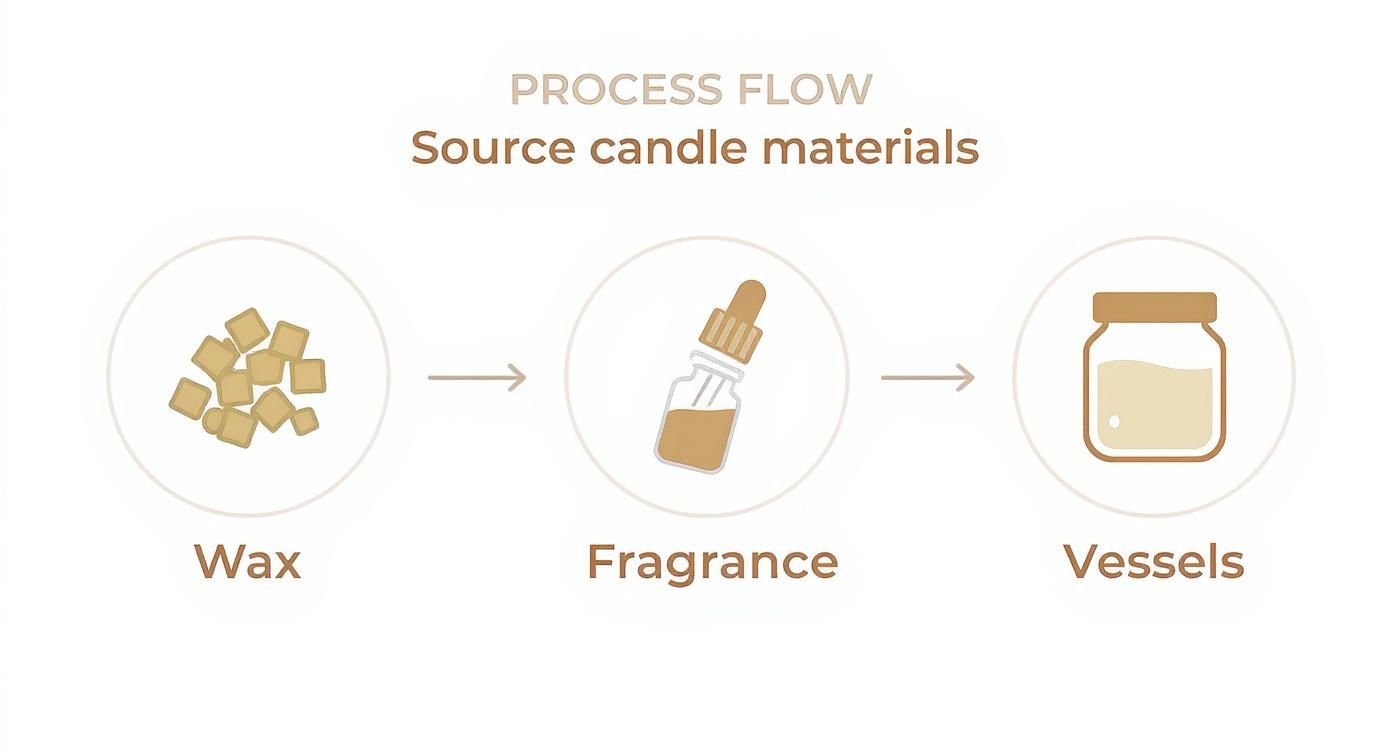
As you can see, every choice you make—from the wax you select to the vessel you pour it in—affects the others. They all have to work in harmony to create a high-quality candle you can be proud of.
Let's be honest, the scent is usually what makes or breaks a candle. That's why understanding scent throw—how well the fragrance fills a room—is so important. The magic here lies in your fragrance load, which is simply the percentage of fragrance oil you mix into your wax.
For most waxes, a 6-8% fragrance load is a great place to start. Some can handle up to 10-12%, but be careful. Pushing it past the manufacturer's limit can cause the oil to literally sweat out of the wax, which is not only messy but can be a fire hazard.
My biggest tip: Ditch the measuring cups and get a digital scale. Weighing your wax and fragrance oil is the only way to get consistent, repeatable results. Precision is everything in candle making.
Temperature is also a huge deal. Add your fragrance oil when the wax is scorching hot, and you'll burn off all the delicate top notes. Add it when it’s too cool, and it won’t bond properly, leading to a weak scent. I find the sweet spot is usually between 180-185°F (82-85°C), but always, always check the specific guidelines from your wax supplier first. If you want to dive deeper, this guide to the best fragrance oils for candle making is a great resource for understanding why certain scents perform better than others.
There’s nothing more satisfying than a candle with a flawless, smooth top. It’s a true sign of craftsmanship, and it all comes down to your pouring temperature. If you pour wax when it’s too hot, it cools too fast, which can cause ugly cracks, sinkholes, or that chalky-looking "frosting" you sometimes see on soy candles.
Here’s what I’ve learned works best:
Don’t get discouraged if you run into problems! Troubleshooting is part of the game. Seeing air bubbles? You probably poured too fast or from too high up. Try pouring slowly, keeping the spout of your pitcher close to the rim of the jar.
Choosing the right wick is probably the single most important decision you'll make for both safety and performance. The wrong wick can cause "tunneling" (where a frustrating core of wax burns down the middle, wasting the rest) or, even worse, a flame that’s dangerously large.
There's no one-size-fits-all answer here. Your perfect wick depends on a combination of factors:
The only way to know for sure is to do a burn test for every new candle you create. Yes, every single one. Light it and let it burn for a few hours. You're looking for a full melt pool—where the liquid wax reaches all the way to the edges of the jar—without any black soot or a flickering, oversized flame. This is how you ensure your candles are safe and burn beautifully for your customers, every single time.
You’ve poured the perfect candle. That’s a huge win, but it's really just the beginning of the journey. In a crowded market, what makes a customer pick your candle off the shelf (or click 'add to cart')? It all comes down to your brand.
A powerful brand isn’t just a slick logo. It’s the entire feeling you create for your customer—from the first photo they see on Instagram to the experience of unboxing their order. It's your story, your values, and your promise, all wrapped up into one. This is how you build a community of loyal fans, not just a list of one-off sales.
Think of your brand identity as the personality of your business, brought to life through visuals. Every piece—your logo, your colors, your photos—needs to work together to tell a story that connects with your ideal customer.
This isn’t just about looking good. When your branding is consistent, people start to recognize you. That recognition builds trust, and trust turns into sales.
Key Branding Components
Figuring out what to charge is often the scariest part. It feels personal, but you have to treat it like a business decision. Price too low, and you'll burn out working for pennies. Price too high before you have a reputation, and you might scare customers away.
Let's break it down with a simple formula. First, calculate your Cost of Goods Sold (COGS). This is every single penny that goes into making one finished candle: the wax, wick, fragrance oil, vessel, and label. Don't forget to add a little extra to cover your packaging.
Got your COGS? A solid starting point is to multiply that number by 3 or 4 to determine your retail price. So, if your COGS for one candle is $6, you should be looking at a retail price between $18 and $24. This covers your materials, pays you for your time, and—most importantly—leaves you with enough profit to grow your business.
Stop trying to be the cheapest. Compete on quality, your unique story, and an amazing customer experience. People will happily pay more for a product that feels special and is crafted with care.
Okay, so where are people actually going to buy your amazing candles? The platform you choose shapes everything from your marketing to how you connect with customers. Each one has its own vibe, and there's no single right answer.
This decision is a major milestone in starting your candle business, and the best choice really depends on your goals, budget, and how much time you can commit.
To make it a bit easier, here’s a quick comparison of the most popular options for new candle makers.
| Sales Channel | Best For | Key Advantages | Potential Challenges |
|---|---|---|---|
| Etsy | Beginners and makers who want a built-in audience that loves handmade goods. | Super easy setup, low upfront costs, and immediate access to millions of shoppers. | Fierce competition, platform fees can eat into profits, less control over branding. |
| Shopify | Makers ready for full creative control over their brand and customer journey. | Complete customization, powerful marketing tools, and you keep more of your revenue. | You have to drive your own traffic, and there's a monthly subscription fee. |
| Local Markets | New businesses that want to build a local buzz and get face-to-face feedback. | In-person connection is powerful, you get paid instantly, and it's great for networking. | It can be physically exhausting, sales can depend on the weather, and you need to haul inventory. |
Ultimately, you might use a mix of these! Starting on Etsy or at local markets can be a fantastic way to validate your products before investing in your own Shopify store.
You absolutely do not need a huge ad budget to get the word out. The trick is to show up where your ideal customers are already hanging out and to focus on creating content that stops them mid-scroll.
For candle makers, Instagram and Pinterest are your best friends. They're highly visual platforms perfect for showcasing your products. Share behind-the-scenes videos of your process, post beautiful photos of your candles in different settings, and encourage customers to share their own pictures.
Don't underestimate the power of finding your niche. The luxury candle market alone was valued at USD 603.2 million and is expected to soar to USD 1.367 billion by 2032. This growth is largely driven by a demand for high-quality, sustainable materials like soy wax. Shoppers in this space aren't looking for the cheapest option; they're looking for eco-friendly products with a compelling story. That's a huge opportunity for small brands like yours. For more insights, you can explore more data on the luxury candle market and see how these trends can shape your strategy.
Alright, let's get into the nitty-gritty. While dreaming up gorgeous candles and scents is the fun part, setting up the legal and safety side of your business is what turns that dream into a legitimate, sustainable reality.
Getting this stuff right from the very beginning is a game-changer. It protects you, your customers, and the brand you’re working so hard to build. Think of it as the strong foundation that lets you focus on the creative stuff without worry.
First up, you've got to make your business official. This sounds way more complicated than it actually is. For most new candle makers, it boils down to two main paths:
Honestly, if you're planning to sell to the public, forming an LLC is the smartest move for the long haul. The small upfront cost is well worth the peace of mind.
Once your business is officially registered, your very next task is getting insurance. I can't stress this enough: product liability insurance is non-negotiable. You're selling a product designed to be set on fire inside someone's home. You have to be covered if an accident happens.
Many farmers' markets, pop-ups, and craft fairs won't even let you set up a table without proof of insurance. It's a standard cost of doing business, and it's what keeps you protected.
Don't just see insurance as another bill to pay. It’s an investment in your business's credibility and future. It tells everyone—from event organizers to your customers—that you're a serious professional who stands by their product.
Your warning label is your first line of defense and a non-negotiable part of selling candles. In many places, it’s a legal requirement, but more importantly, it shows you’re a responsible maker who cares about customer safety.
A proper warning label needs to be clear, easy to read, and contain a few universal safety instructions. Every single candle you sell should have a label with these warnings at a minimum:
Beyond the big three warnings, you should also include some simple burning instructions so your customers have the best (and safest) experience. Add tips like, "Trim wick to 1/4 inch before every lighting," and "Do not burn for more than 4 hours at a time."
For a really thorough approach, check out these detailed candle safety tips to make sure your labels are top-notch. And while you're at it, looking into guidelines like the Australian workplace safety standards can offer fantastic insights, no matter where you're located. Taking these steps seriously builds trust and shows your customers you've got their back.
Diving into the world of candle making is exciting, but it definitely brings up a lot of questions. It's totally normal to wonder about everything from startup costs to the nitty-gritty of warning labels.
We've pulled together some of the most common things new makers ask. Think of this as your quick-reference guide to get the straight answers you need to move forward.
One of the best things about starting a candle business is that you don't need a massive investment to get off the ground. For a home-based setup, you can realistically get going for somewhere between $500 and $2,000.
So what does that cover? This range usually includes a starter kit with the essentials—think a good wax melter, pouring pots, and a digital scale. It also covers your first batch of supplies like wax, wicks, fragrance oils, and jars. Don't forget to factor in business registration fees, some basic packaging, and the cost of setting up a simple online shop on a platform like Etsy or Shopify.
The biggest variables here are the quantity and quality of your first supply order. My advice? Launch with just 3-5 core scents. It’s a smart way to test the market without sinking a ton of cash into inventory right away.
From what I've seen, luxury and niche candles are where the real profit is. Why? Higher price points and a much stronger perceived value. We're talking about candles made from premium, sustainable waxes like soy or coconut blends, those with unique and complex fragrance profiles, and products with gorgeous, reusable packaging.
Shoppers in this market are happy to pay more for that artisanal quality, eco-friendly ingredients, and a brand story that resonates with them.
When you focus on a specific niche—like aromatherapy candles for wellness junkies or personalized candles for special gifts—you start building a loyal customer base that will pay a premium because your product feels like it was made just for them.
Yes, you absolutely do. Getting product liability insurance is non-negotiable for any candle business, no matter how small you think you are. At the end of the day, you're selling a product that involves an open flame, and that comes with risks.
Product liability insurance is your safety net. It protects your business from financial ruin if a customer's property gets damaged or, worse, someone gets hurt by your product. It’s a necessary investment to protect your personal and business assets.
Plus, you'll find that most craft markets and event organizers won't even let you set up a booth without proof of insurance. It's just a standard cost of running a responsible, professional business.
A proper warning label is your first line of defense, both for your customers' safety and your own legal protection. It's how you communicate the right way to use your product safely. Your label needs to have key safety symbols and clear, easy-to-read text.
Every single candle must include these essentials:
You should also include specific burning instructions to make sure your customers get the best and safest experience from your candle. This isn't just about good performance; it shows you've done your due diligence as a maker.
Best Practices for Burning Instructions
Ready to create a candle that's more than just a light? At Jackpot Candles, we combine high-quality, clean-burning soy wax and exquisite fragrances with the thrill of discovering a surprise piece of jewelry inside. Explore our collection and see how a candle can be a truly unforgettable experience.
Comments will be approved before showing up.