
free shipping at $99


A luxury jewelry candle is a premium scented candle made with quality wax and fragrance oils, containing a concealed piece of jewelry that customers discover as the wax melts away. The surrounding luxury-jewelry market was estimated at USD 54.27 billion in 2025 and projected to reach USD 116.17 billion by 2034, giving the hidden jewelry component a meaningful context beyond simple novelty.
You may be considering one as a birthday gift, a self-care purchase, or an unusual way to add anticipation to an ordinary evening. The appeal is easy to understand: the room fills with fragrance, the candle becomes part of the decor, and a ring, necklace, or pair of earrings eventually appears inside. The less obvious question is just as important, though: how can you verify what you've received, and how do you retrieve it safely?
Most guides celebrate the reveal. A careful buyer also checks the jewelry material, documentation, packaging, burn instructions, and value language before lighting the wick. That approach makes the experience more rewarding because excitement doesn't have to replace evidence.
The moment usually starts without a sound. You light the wick after dinner, let the fragrance settle into the room, and notice the candle becoming part of the evening rather than merely providing light. Later, as the wax level drops, a protected pouch becomes visible. The reveal adds a second experience to the first one, turning home fragrance into a small discovery ritual.
A luxury jewelry candle combines premium scent, decorative design, and concealed jewelry in one product. The candle still needs to perform as a candle, with a stable flame, an even melt pool, and a fragrance that remains pleasant as it warms. The jewelry also needs protection from heat, fragrance oils, molten wax, and accidental handling.
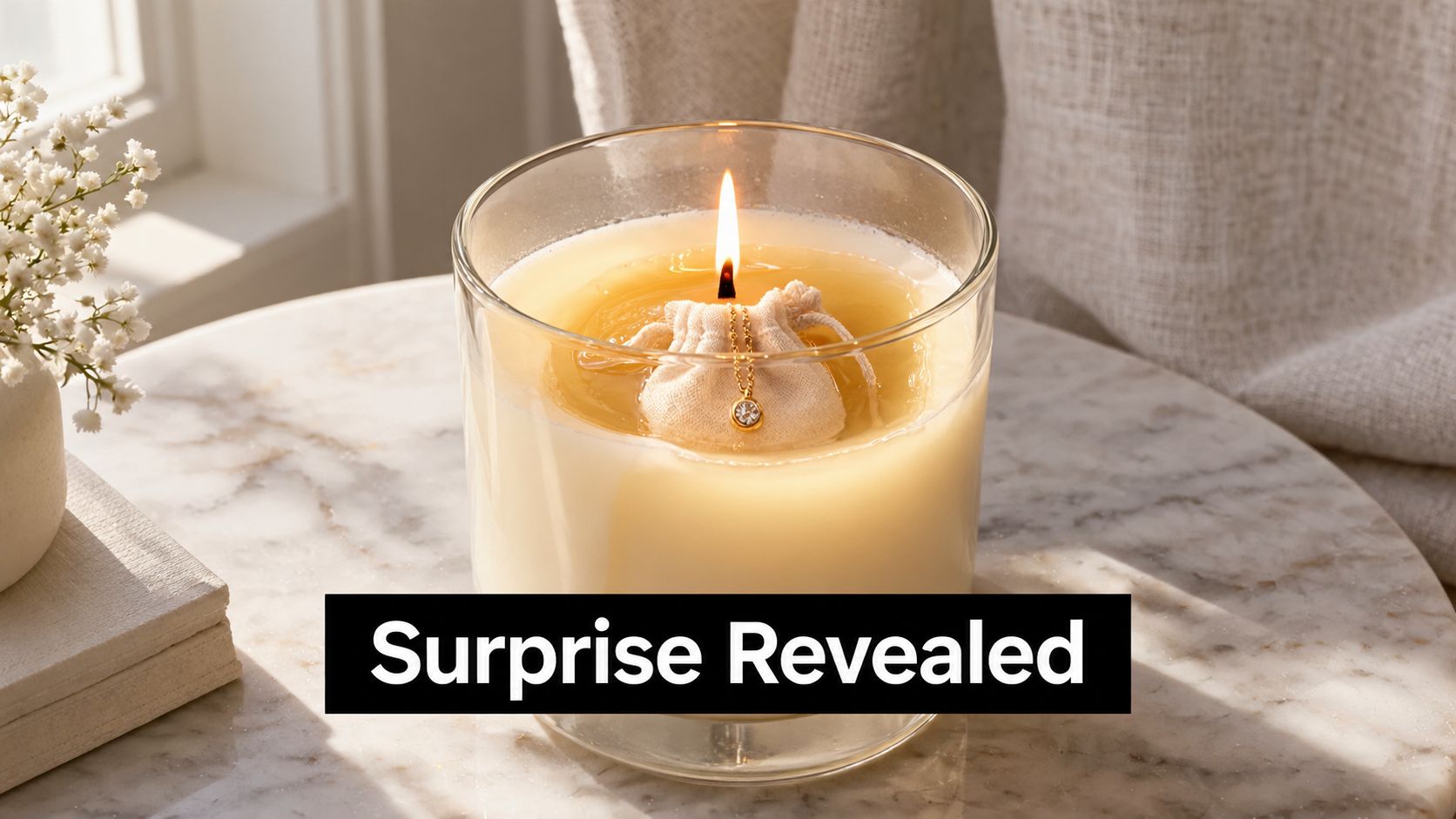
The category connects two established forms of consumption. Scented candles have developed from basic illumination into products associated with home fragrance, gifting, wellness, and decoration. The hidden jewelry adds collectability and a tangible object that can remain after the wax is gone.
Market estimates differ because researchers define luxury jewelry in different ways. One estimate valued global revenue at USD 54.27 billion in 2025 and projected USD 116.17 billion by 2034, while another placed the 2025 figure at USD 54.2 billion and forecast USD 99.9 billion by 2033. Both estimates describe a large, expanding premium-accessories category, as explained in this luxury jewelry market overview.
That context matters. A concealed ring isn't automatically valuable, but the product format can connect a sensory candle purchase with an established jewelry economy. For buyers who enjoy objects with atmosphere and meaning, the vessel, fragrance, reveal, and final jewelry piece can work together as one experience. Decorative details, such as finding selenite candle holders online, can also help create a setting that makes the ritual feel intentional.
For more background on premium scent design, explore Jackpot Candles' guide to premium scented candles.
The mechanics are straightforward, but the safety depends on careful placement and packaging. A manufacturer places the jewelry inside a sealed, heat-resistant, fragrance-compatible barrier package, then positions that package away from the wick and the hottest part of the melt pool. The wax hides the insert until the candle burns down to the intended reveal level.
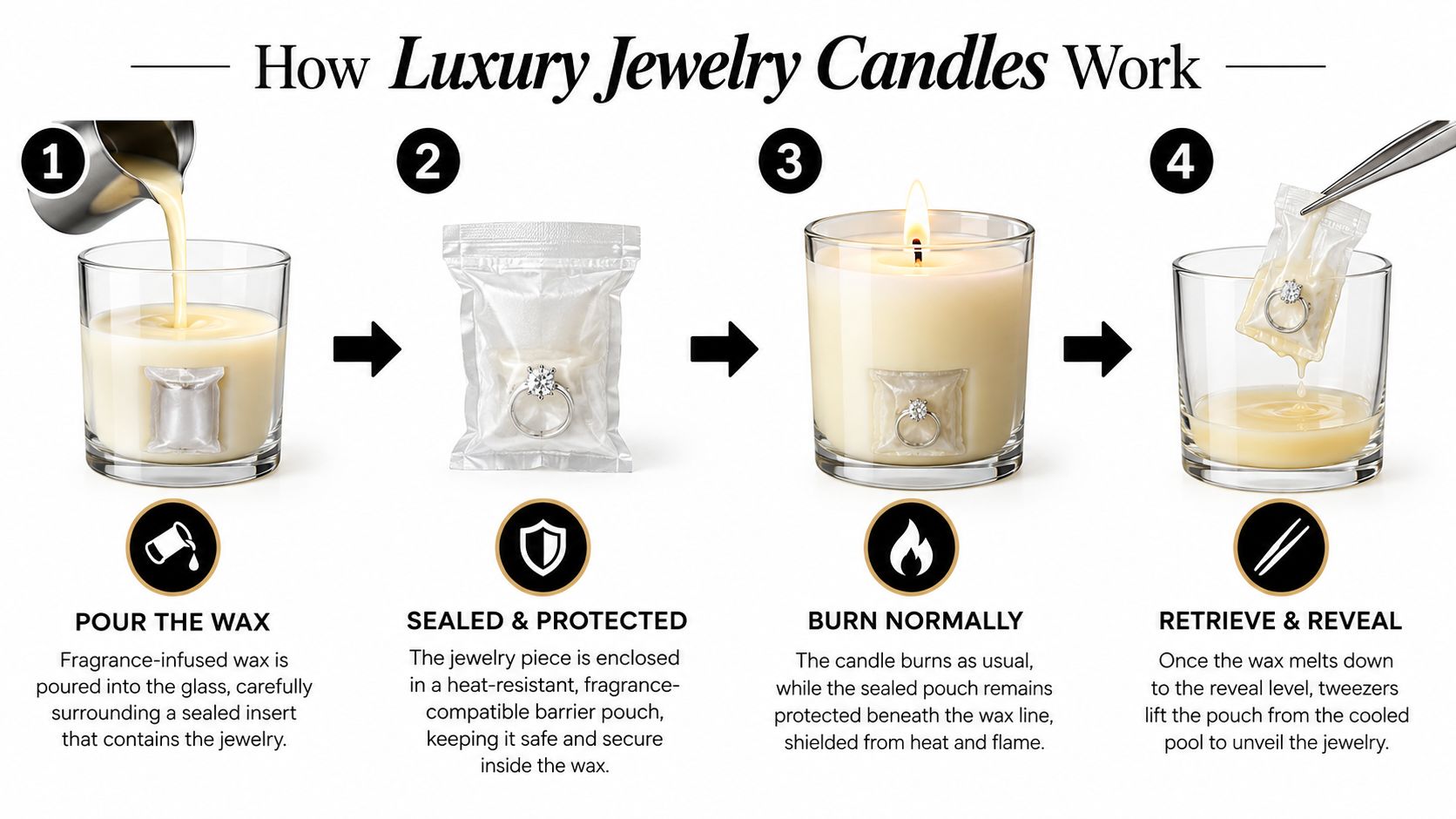
A typical session follows a simple sequence:
An uneven melt can expose the pouch sooner on one side, while a poorly trimmed wick can create excess heat and soot. Ventilation matters too. Research on candle emissions found that stressed burning is associated with soot or black carbon, and that wax and wick composition can affect fine particles and particle-bound compounds. The findings support treating the hidden insert as a heat-and-contaminant control issue, not as an ordinary packaging detail. For a broader explanation of the format, see what a jewelry candle is.
Practical rule: The reveal is successful when the jewelry is recovered without placing hands, tools, or the pouch near an active flame.
A premium candle isn't defined by a strong scent alone. The wax, wick, vessel, fragrance chemistry, and jewelry packaging must behave as one system. A soy blend can carry fragrance effectively, but the final result still depends on testing the exact formula in the exact vessel.
The scented-candle category was estimated at USD 4.26 billion in 2025 and projected to reach USD 6.64 billion by 2034, while Europe represented 45.89% of global revenue in 2025 in that estimate. A separate estimate valued the broader candle market at USD 14.8 billion in 2025, with scented candles representing 65.6% of that market. These figures aren't interchangeable because the market definitions differ, but they show why fragrance performance is central to the product category. See the scented-candles market estimate for the underlying context.
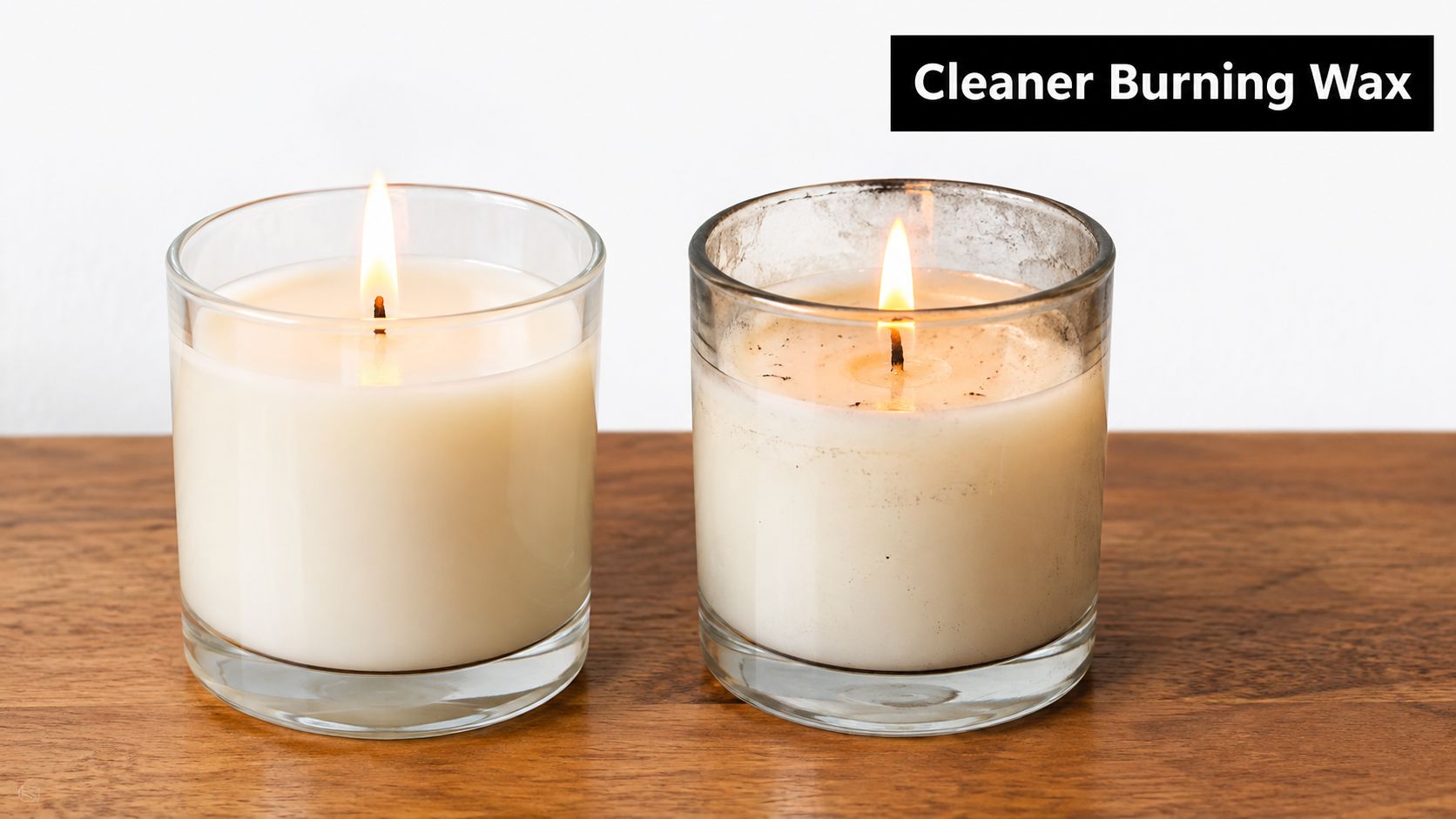
Independent formulation testing found that approximately 6% to 9% fragrance by wax weight produced strong hot throw in one soy-wax system, with performance improving after a curing period of at least three weeks. Another soy formulation held fragrance successfully up to 10%, but still required wick and melt-pool testing. Those figures are useful screening points, not universal recipes, because each wax, oil, wick, vessel, and insert changes the result. The testing is documented in Soy wax formulation lab notes.
Fragrance changes viscosity, melt behavior, and fuel delivery to the flame. Too much can cause oil leaching, poor wax cohesion, an unstable wick, or increased soot. Too little can produce weak aroma. A responsible formulation process screens several loads in the finished vessel and measures cold throw, hot throw, melt-pool diameter, flame height, residue, burn time, and stability after curing.
Don't assume soy wax is automatically soot-free. Wick size, airflow, fragrance chemistry, and over-wicking all influence combustion. Buyers should look for clear ingredient information and practical care instructions rather than relying on broad claims such as “clean burning” without an explanation of how the candle was tested.
The most important buying question is not just, “What jewelry might I find?” Ask instead, “What can the seller prove about the candle and the jewelry?” A transparent listing should describe the wax type, fragrance approach, insert protection, jewelry category, and documentation supplied after discovery.
Fragrance concentration can provide useful context, but it shouldn't be treated as a quality score. The formulation evidence above shows why a tested range may perform better than an aggressive loading strategy. Buyers should also check whether the seller provides burn guidance for the specific vessel and explains what to do when the pouch appears.
| Criterion | Budget Option | Premium Standard |
|---|---|---|
| Wax | Basic wax with limited formulation detail | Clearly identified soy blend or other specified wax system |
| Fragrance | General scent description | Named fragrance profile, quality description, and tested formulation approach |
| Jewelry material | “Jewelry included” without a clear tier | Metal type, plating or purity information, and gemstone disclosures |
| Insert protection | Packaging not explained | Sealed, heat-resistant, fragrance-compatible barrier package |
| Value statement | Advertised value with no definition | Clear explanation of whether value means retail replacement, wholesale, or appraisal value |
| Documentation | Product card only | Hallmark or assay information, supplier records, and appraisal guidance where applicable |
| Vessel and care | Generic burn advice | Instructions covering wick care, ventilation, reveal timing, and safe retrieval |
Start with the metal. Plated jewelry has a surface layer over another material. Vermeil generally refers to gold over sterling silver, while gold-filled construction uses a mechanically bonded gold layer. Sterling silver and solid gold require different evidence, so look for a hallmark, assay information, or a clear manufacturer specification rather than assuming the appearance proves purity.
Gemstones need the same discipline. Ask whether the stone is natural, laboratory-grown, simulated, treated, or only described by a trade name. If the jewelry is presented as valuable, request documentation that identifies the method behind that value.
The advertised value isn't automatically the resale value. Condition, purity, branding, appraisal method, liquidity, and local demand can lead to very different outcomes.
Independent appraisal can help after the reveal, especially when the item is represented as a high-value piece. Sustainability claims deserve scrutiny as well. Supplier documentation, third-party audits, independent certifications, and accessible supply-chain records are stronger than an unqualified “eco-friendly” label. Guidance on recycled-content claims in jewelry also shows why sellers should explain exactly what “recycled” refers to. This sustainable jewelry market discussion offers useful context for the verification questions buyers should ask.
A hidden object changes the normal candle routine. You aren't only managing flame, wax, and vessel temperature. You're also protecting a sealed package and preventing the excitement of the reveal from encouraging unsafe handling.
Research on candle emissions links imperfect or stressed combustion with soot and particulate concerns, while scented candles can be more likely to produce soot than unscented candles under those conditions. Keep the room ventilated, follow the manufacturer's maximum burn interval, and stop using the candle if the flame becomes unusually large, unstable, or smoky. The candle safety tips from Jackpot Candles provide additional care guidance.
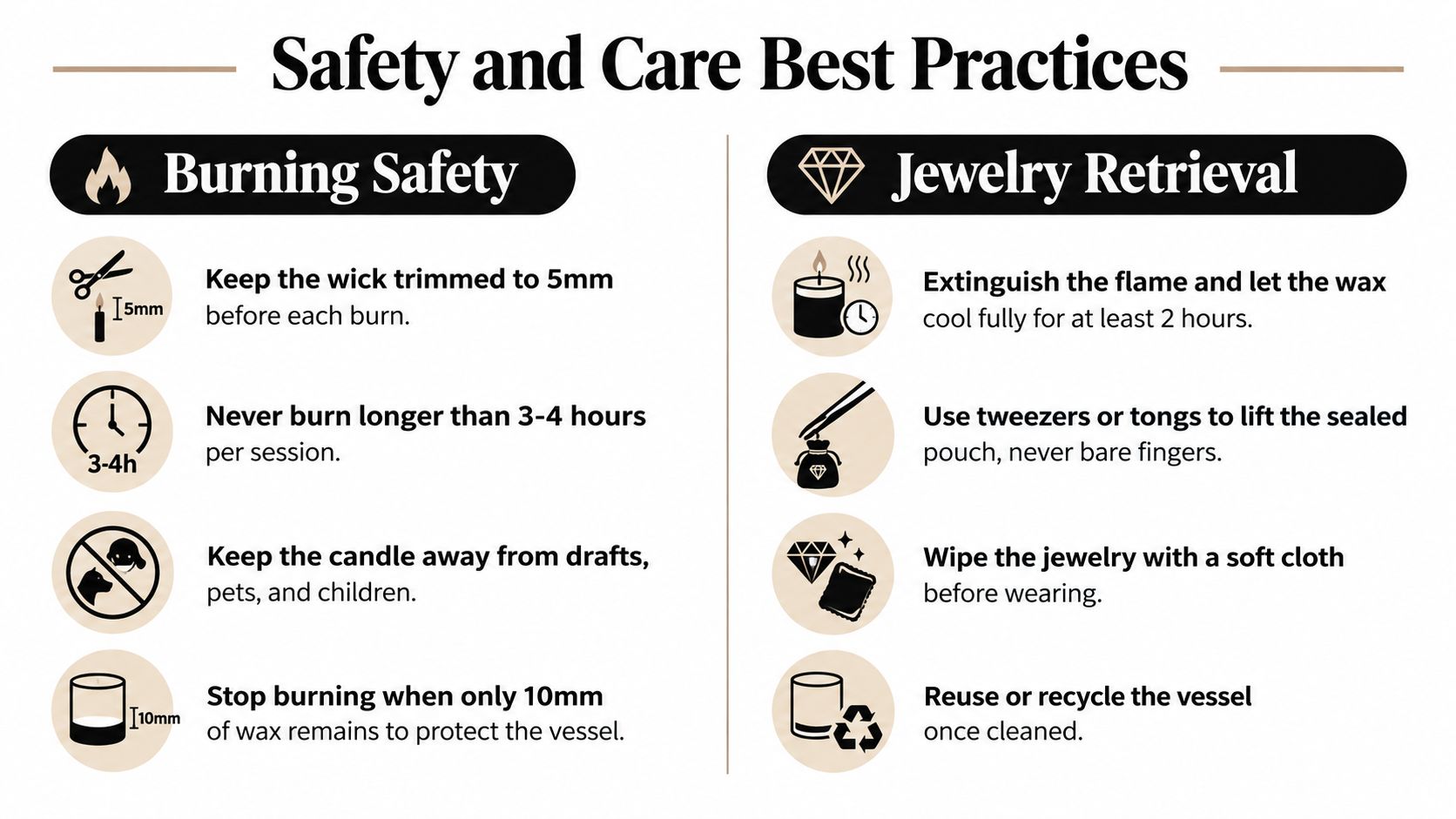
When the pouch appears, extinguish the flame before reaching toward it. Let the wax cool fully, then use blunt tweezers or small tongs to lift the sealed package. Never use bare fingers on hot wax, and don't use a knife, pin, or other sharp tool that could puncture the barrier.
Keep the cooling vessel away from combustible surfaces and supervise children and pets. Don't microwave the container or place it on a hob to speed up extraction. Rapid heating can damage the vessel, disturb the insert, and create a burn hazard.
After removal, wipe the jewelry with a soft cloth and inspect it for wax, residue, loose stones, damaged plating, or a compromised package. Photograph the piece, its markings, and any documentation before cleaning it aggressively or wearing it. Those records can support an appraisal or a future conversation with the seller.
Separate remaining wax from household recycling unless local guidance says otherwise. A cleaned vessel may be reusable, but only after all wax and fragrance residue have been removed and the container shows no heat damage. A slower retrieval process protects more than safety. It can preserve the presentation, jewelry condition, and useful second life of the vessel.
A luxury jewelry candle works as a gift because it unfolds in stages. The recipient first receives a decorative object and fragrance, then experiences a reveal, and finally keeps a piece of jewelry. That sequence gives the gift more emotional texture than an item that is fully understood the moment its box opens.
For a birthday, choose a scent that matches the recipient's home or daily routine. An anniversary candle can pair the reveal with a piece suited to the recipient's existing jewelry style. For a bridal shower, a ring or delicate necklace may fit the celebratory theme, while a personalized label can make the presentation feel more intentional.
A practical selection framework helps avoid overpromising:
Jewelry itself is personal, so a buyer can also use a precious stone rings guide from Evo Dyne Products to think through gemstone styles and gifting preferences.
The strongest presentation sets expectations clearly. Tell the recipient that the jewelry is concealed, explain that the candle must be handled normally, and point out that the value statement should be verified after discovery. That keeps anticipation high without turning an unconfirmed claim into a promise.
A premium jewelry candle has to satisfy two different expectations at once. It should create a pleasant fragrance experience before the reveal, then provide enough information for the buyer to understand and verify the jewelry afterward. A polished vessel or dramatic unboxing can't compensate for unclear material descriptions or unsafe extraction instructions.
Jackpot Candles offers scented candles with a concealed jewelry item, including pieces such as rings, necklaces, or earrings. Its product positioning uses a proprietary soy wax blend and exclusive perfume-grade fragrance oils. Those materials are intended to support a slower burn and effective fragrance release, but the final result still depends on wick selection, vessel design, fragrance chemistry, and correct use.
The verification standard is simple to state:
That process benefits both careful buyers and responsible sellers. It separates the emotional excitement of discovering a hidden object from the practical question of what the object is made of and what it may be worth.
The best luxury jewelry candle experience therefore has three parts: a well-formulated candle, a safely protected reveal, and accessible evidence about the jewelry. When those parts work together, the product feels less like a gimmick and more like a considered gift with a sensory beginning and a verifiable ending.
If you want a candle that combines premium fragrance with a concealed jewelry reveal, explore the scented candles and jewelry options available from Jackpot Candles. Choose a design that suits the recipient, review the care instructions before burning, and keep the material and value documentation so the final piece can be properly verified.
Comments will be approved before showing up.