
free shipping at $99


You've got a new scented candle on the counter, a pretty holder from another shelf, and a quick thought that they should work together. Then the candle rattles in the cup, or it sits so low the rim crowds the flame. That mismatch is where most problems start, not with the scent itself. A scented candle holder isn't just décor around the wax. It's part of the burning system, shaping how steady the flame stays, how heat builds up, how air moves, and how much soot ends up on the glass and in the room.
Say you buy a wide glass cup for a tealight and it slides around every time you nudge the table. Or you set a heavy pillar on a narrow saucer and it tips when you reach past it. Both mistakes come from matching by eye instead of by diameter. If you're unsure what you're holding, this explanation of how big candles are, including jar dimensions helps you name the format before you shop for its base.
Use the table below as your starting point. It pairs common formats with a base wide enough to keep them steady.
| Candle format | Minimum holder base | Clearance above wick |
|---|---|---|
| Tealight (about 1.5 in / 38 mm) | About 2 in (5 cm) cup or ring | At least 1 in (2.5 cm) from wick to rim |
| Votive (1.5 to 2 in / 38 to 50 mm) | About 2.5 to 3 in (6.5 to 7.5 cm) cup | At least 1 in (2.5 cm) from wick to rim |
| Small pillar (2 to 3 in) | About 3 to 4 in (7.5 to 10 cm) flat base | At least 1 in (2.5 cm) of open air above the wick |
| Large pillar (3 to 4 in) | About 4 to 5 in (10 to 12.5 cm) flat base | At least 1 in (2.5 cm) of open air above the wick |
| Jar candle (3 to 3.5 in) | Flat base matching the jar footprint | Jar rim 1 to 2 in (2.5 to 5 cm) above the flame zone |
Measure the widest diameter of the pillar or container, not the narrow wick end and not the label. Lay a ruler across the bottom or the widest belly of the jar, whichever is larger. That's your true width.
Then add about 1 in (2.5 cm) of base width beyond that measurement. That extra inch is what gives you a margin if wax melts unevenly or someone bumps the table. A 3 in pillar on a 3 in plate has no margin at all. On a 4 in plate, it has room to sit centered and catch a drip.
Tapers work a little differently because they're tall and narrow, usually 0.75 to 1 in (2 to 2.5 cm) at the base. They need a snug socket that grips the bottom without forcing it, plus a weighted base below. A loose taper leans, and a leaning taper drips and burns unevenly.
Quick stability check: Press the candle lightly from the side. If it rocks, or if the holder rim sits closer than 1 in to the wick, move up to a larger base or choose a different holder.
Don't force a fix with foil shims or by melting the bottom to stick it down. Those tricks hide a bad fit and make removal harder later. You're better off with a plain, correctly sized base than a decorative one that's almost right.
Most shoppers meet a tabletop design first, which matches the market. Desktop candle holders represented 28.5% of the global candle-holder market in 2025, according to Dataintelo. That doesn't make a desktop holder right for every candle. The shape and material decide how it handles heat and air.
| Holder type | Common materials | Heat tolerance | Airflow | Best use |
|---|---|---|---|---|
| Glass votive cup | Tempered or annealed glass | High if rated for candles | Enclosed, limited | Votives and tealights |
| Ceramic or stoneware | Glazed ceramic, stoneware | High | Open top | Pillars and everyday use |
| Metal lantern | Iron, brass, steel | High; exterior gets hot | Perforated, good | Pillars and jar candles |
| Wooden tray | Solid or engineered wood | Low to moderate; needs liner | Open | Decorative use with drip liner |
| Resin or plastic | Epoxy resin, PVC | Often unknown; check rating | Open if flat, restricted if cupped | Avoid unless heat-rated |
| Glass hurricane | Thick glass chimney | High, but traps heat | Restricted | Tall pillars only, with clearance |
| Tiered candelabra | Metal, sometimes wood | High | Open | Grouped candles with spaced flames |
Glass and glazed ceramic handle sustained heat well when they're made for candles. They don't conduct heat as fast as metal, so the outside usually stays easier to approach, though you still shouldn't grab a hot vessel. Thick glass also lets you see the melt pool and spot a wick that's drifting off center.
Metal conducts heat, so a lantern frame or cup can become uncomfortable to touch even while it's protecting the table. That's not a defect, it's how iron, brass, and steel behave. Plan to move a metal holder only when it's cold, and keep its hot sides away from where hands naturally reach.
Wood looks warm and natural, but it isn't a heat barrier on its own. A wooden tray needs a metal or ceramic liner between the candle and the wood to catch drips and block heat soaking down. Without that liner, you're relying on a combustible surface to do a non-combustible job.
Resin and plastic cause the most confusion. Many decorative pieces don't publish a temperature limit, and a smooth finish tells you nothing about heat resistance. If the maker doesn't state that it's rated for candle use, treat it as a display piece for unlit candles, not as a working holder.
A material label won't tell you how cleanly a candle will burn. Two glass holders can behave very differently if one is open and the other is a tall, narrow hurricane that traps heat around the flame. Look at the design, the clearance, and where you'll set it down. Those three things predict performance better than finish or color ever will.
Think of the holder as a seatbelt and a barrier at the same time. It doesn't make a candle risk free, but it does three specific jobs that a bare candle on a table can't do for itself.
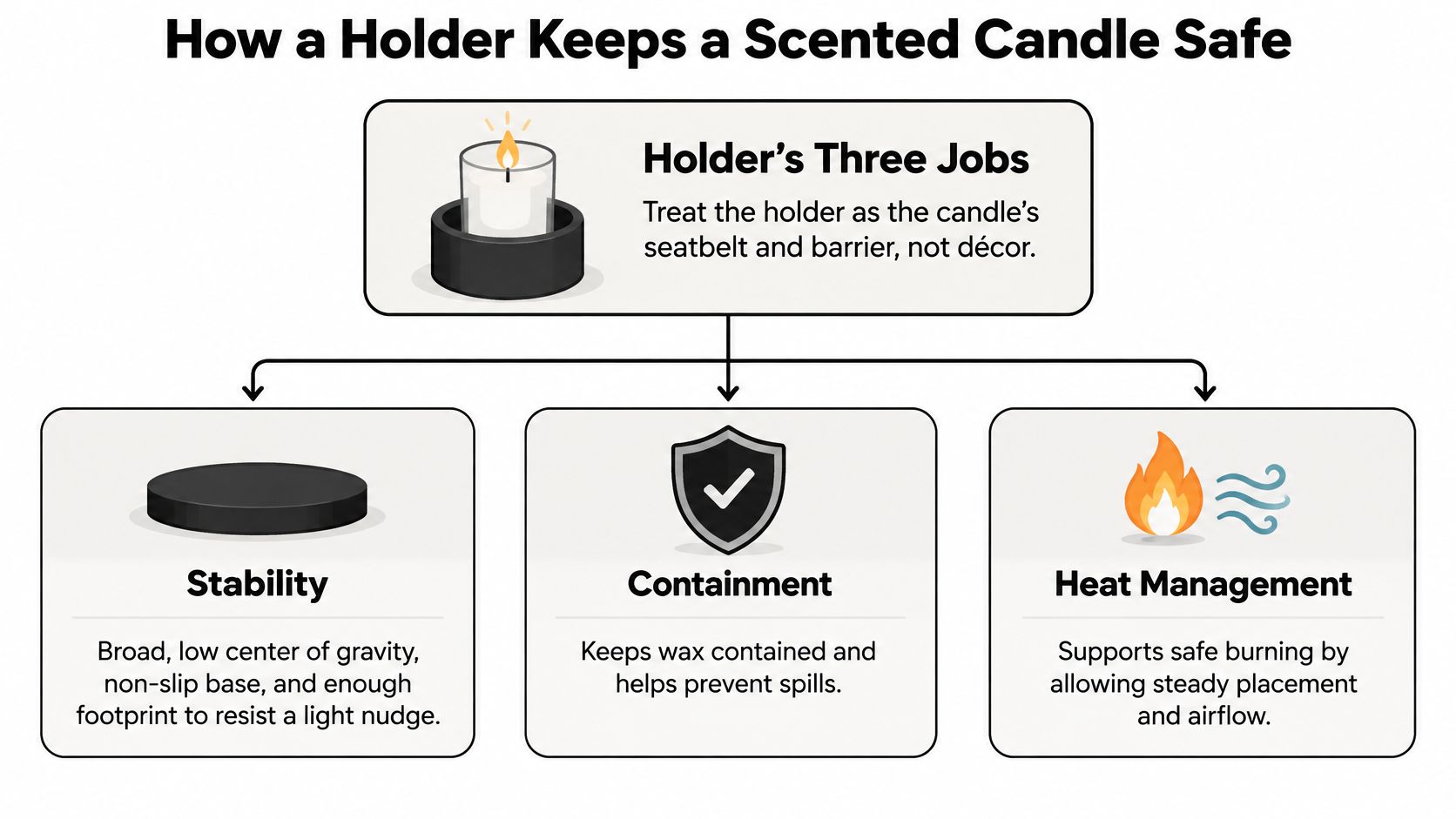
Stability comes first. A broad base, a low center of gravity, and a non-slip underside keep a pillar or jar from tipping under a light nudge. Height works against you here, so a tall candle needs a proportionally wider footprint, not just a prettier stem.
Containment is the second job. A rim, recess, or cup catches melted wax before it runs onto wood, fabric, or paper. That matters because a wax spill isn't only a mess. Liquid wax carries heat with it as it spreads.
Heat control is the third. The holder puts distance and a heat-resistant layer between the flame and whatever sits below or beside it. It also keeps the flame from sitting directly against a combustible surface where heat can soak in unnoticed.
The U.S. Consumer Product Safety Commission identifies candle holders as part of the broader candle-safety system because holders help contain heat, wax, and flame, as explained in the CPSC guide to candle voluntary standards. In its review of national fire-loss estimates for 1999 to 2002, the CPSC reported an annual average of approximately 12,500 potentially addressable, fire-department-attended candle fires. Those incidents were associated with about 110 deaths, 1,100 injuries, and $248.6 million in property damage each year.
Those numbers explain why standards exist for accessories, not just candles. ASTM guidance cited by the agency includes F-1972-99 for terminology, F-2058-00 for warning labels, and F-2179-02 for annealed glass containers. For everyday habits that sit alongside a good holder, these practical candle safety tips cover placement and supervision in plain language.
Failure is usually easy to spot once you know the three jobs. A base that rocks fails stability. A flat decorative disc with no rim fails containment for a votive. A pretty paper liner or dried flower tucked against the glass fails heat control because you've placed something ignitable in the flame zone.
A usable holder lets the candle sit level without touching the sides, stays put when nudged, and is only handled after the wax has cooled.
Once the fit is right, burn it the same way every time. A repeatable routine prevents most tunneling, smoking, and overheated holders.
Stop the burn early if the flame mushrooms into a bulbous shape, smokes steadily, or makes the holder exterior uncomfortable to touch for even a second. Those are signs the wick is too long, the air around the flame is disturbed, or heat is building faster than the holder can shed it. Put it out, let it cool completely, trim the wick, and only relight once you've fixed the cause.
Don't move a holder while wax is liquid. Even a stable base can slosh hot wax over the rim if you carry it mid-burn. Wait until the surface is firm and the vessel feels comfortable in your hand.
Most holder guides stop at looks and size and never mention the air in the room. That's a real gap, because the holder influences whether the flame burns steadily or struggles, and a struggling flame produces more soot and particles.
A 2025 study found that scented-candle burning significantly increased indoor particulate matter and altered airborne microbial communities, with fine particles dispersing several metres from the candle, according to research published in Scientific Reports. Separate findings in that discussion put unstable or disturbed burning at roughly 20 times higher particle concentrations than more stable conditions. Fine-particle concentrations during candle use could also reach 15 times World Health Organization guideline limits in underventilated rooms, with levels taking time to return to normal.
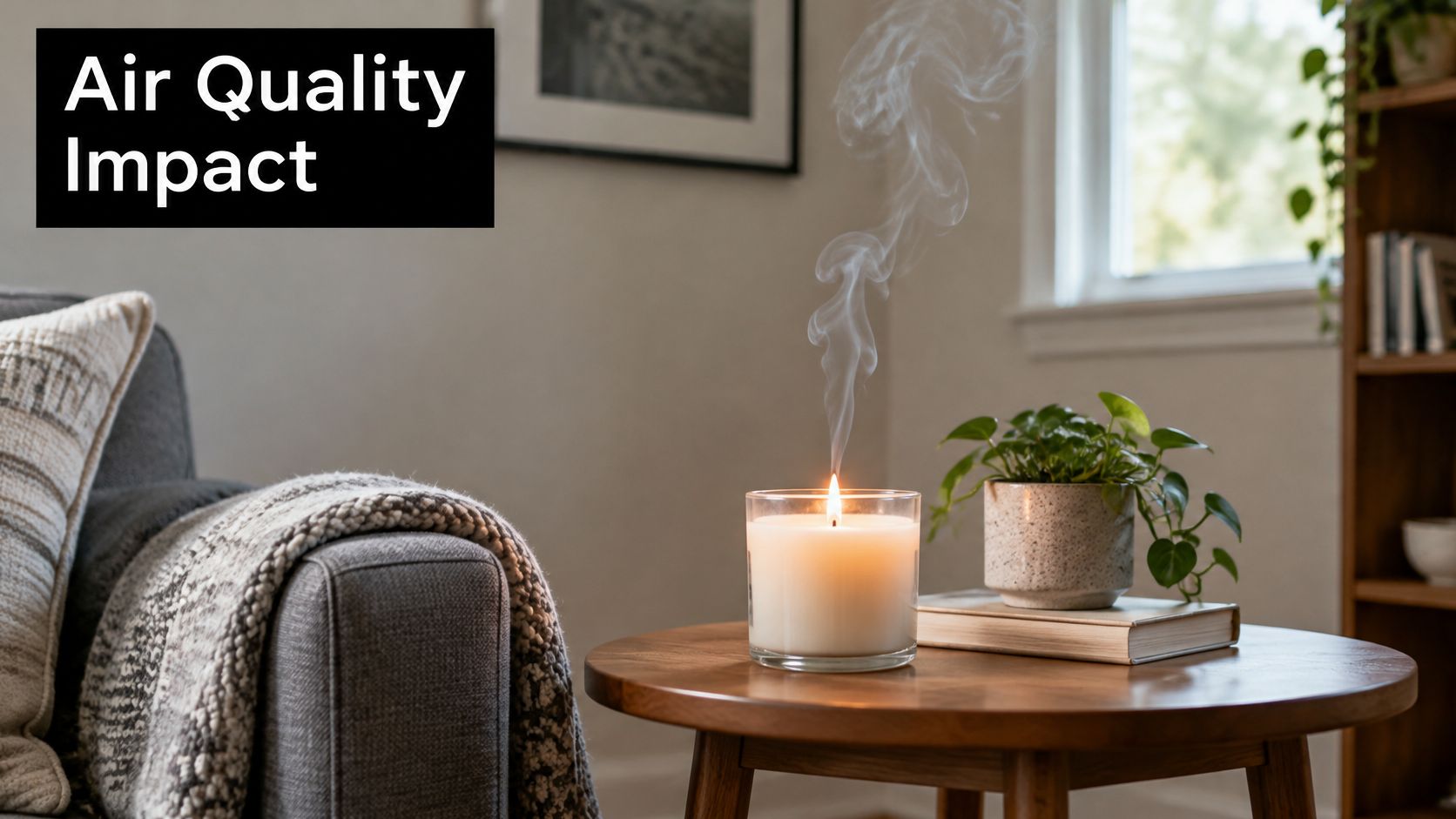
An open or perforated holder with clear space above the flame supports steady burning. Air can reach the flame at a predictable rate, and heat can rise away instead of circling back down. That's the setup most likely to keep the flame upright and quiet.
A narrow vessel or an enclosed lantern can do the opposite. It may look protective, but if it traps heat and restricts airflow, the flame flickers, stretches, and smokes as it hunts for oxygen. A decorative cover that worsens combustion isn't protecting your air, even if it's shielding the flame from a draft.
Room ventilation matters just as much as the holder. If you're thinking through what fragranced products add to indoor air more broadly, Purified Air Duct Cleaning on VOCs is a useful companion read. For candles specifically, fresh air exchange during and after a burn helps particles clear instead of lingering.
A wax described as clean doesn't guarantee low emissions in a poor setup. The holder, the wick length, the room size, and the airflow decide what you breathe.
Styling works when you treat it as composition within limits. The candle is the focal point, and everything else has to leave air and clearance around the flame.
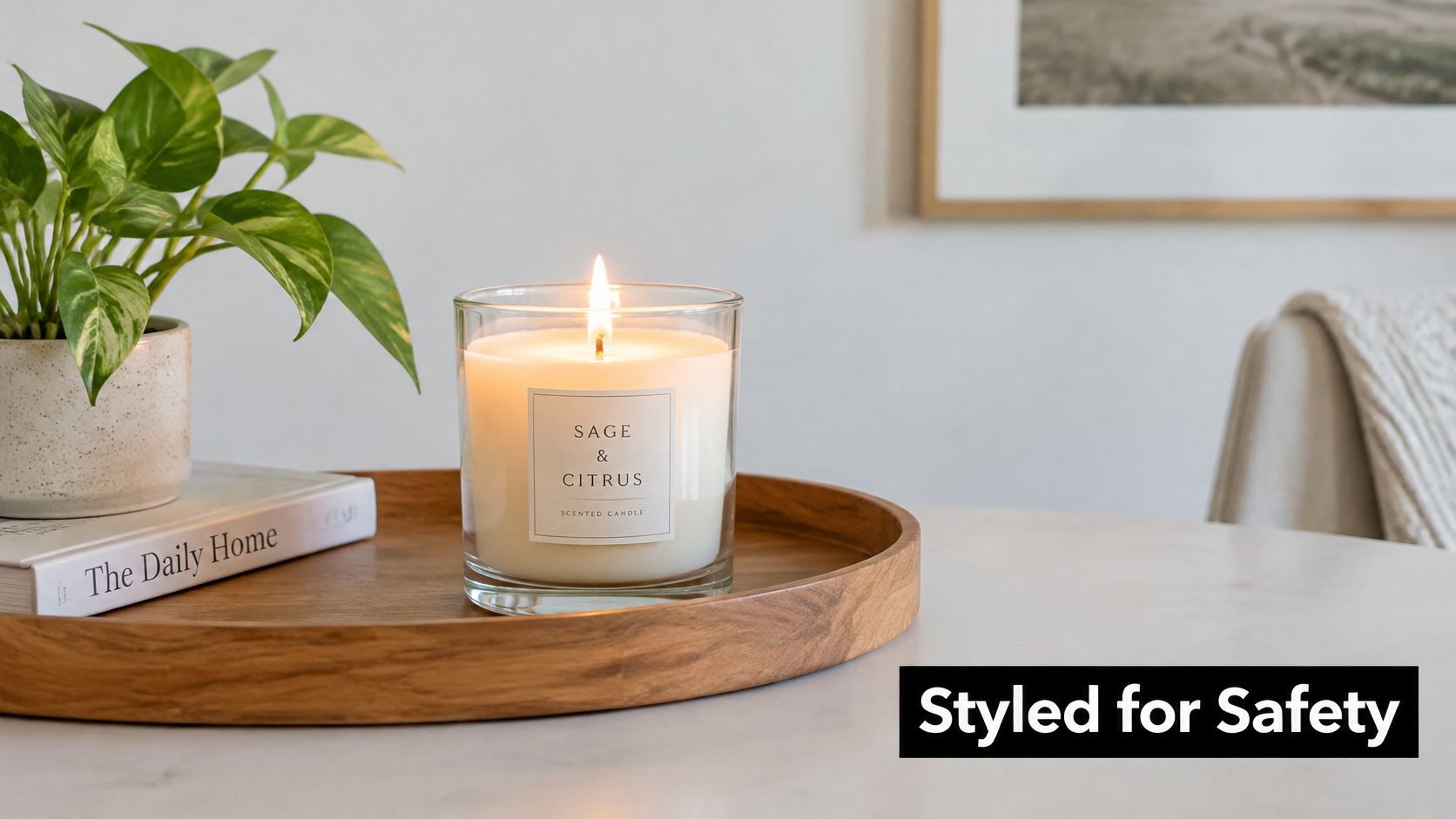
A tray of mixed-height votives on a ceramic base gives you layered light without a single large flame. Space them at least 2 in (5 cm) apart so their heat doesn't combine and soften neighboring wax. The ceramic base underneath catches drips and protects the table in one move.
A metal lantern on stone or ceramic suits a porch table or a hearth where drafts are common. Keep the flame well below the top vents so heat exits upward instead of pooling inside. Remember the frame itself gets hot, so style it where guests won't grab it to make room for a drink.
If you want to see how spacing and height look in a real arrangement before you copy it, watch the short demonstration below and notice where the open space sits.
A tiered candelabra works for a dining table when the flames are spaced so their heat doesn't meet. Tapers at different heights look elegant, but crowding them makes the middle candles melt faster and lean. Give each flame its own column of rising air.
A wooden tray can anchor a cozy arrangement, but only with a metal or ceramic liner beneath each candle. The liner is the functional part, the wood is the visual frame. Without that layer, you're styling on a combustible surface.
Final styling test: If the arrangement makes the flame harder to see or the candle harder to reach with a snuffer, simplify it until both are easy.
A surprise-jewelry candle hides a ring or necklace in the wax, which adds a step most candles don't have. The holder has to keep the vessel perfectly still for the whole burn and then allow a calm, cool retrieval. Rushing that last part is where burns and spills happen.
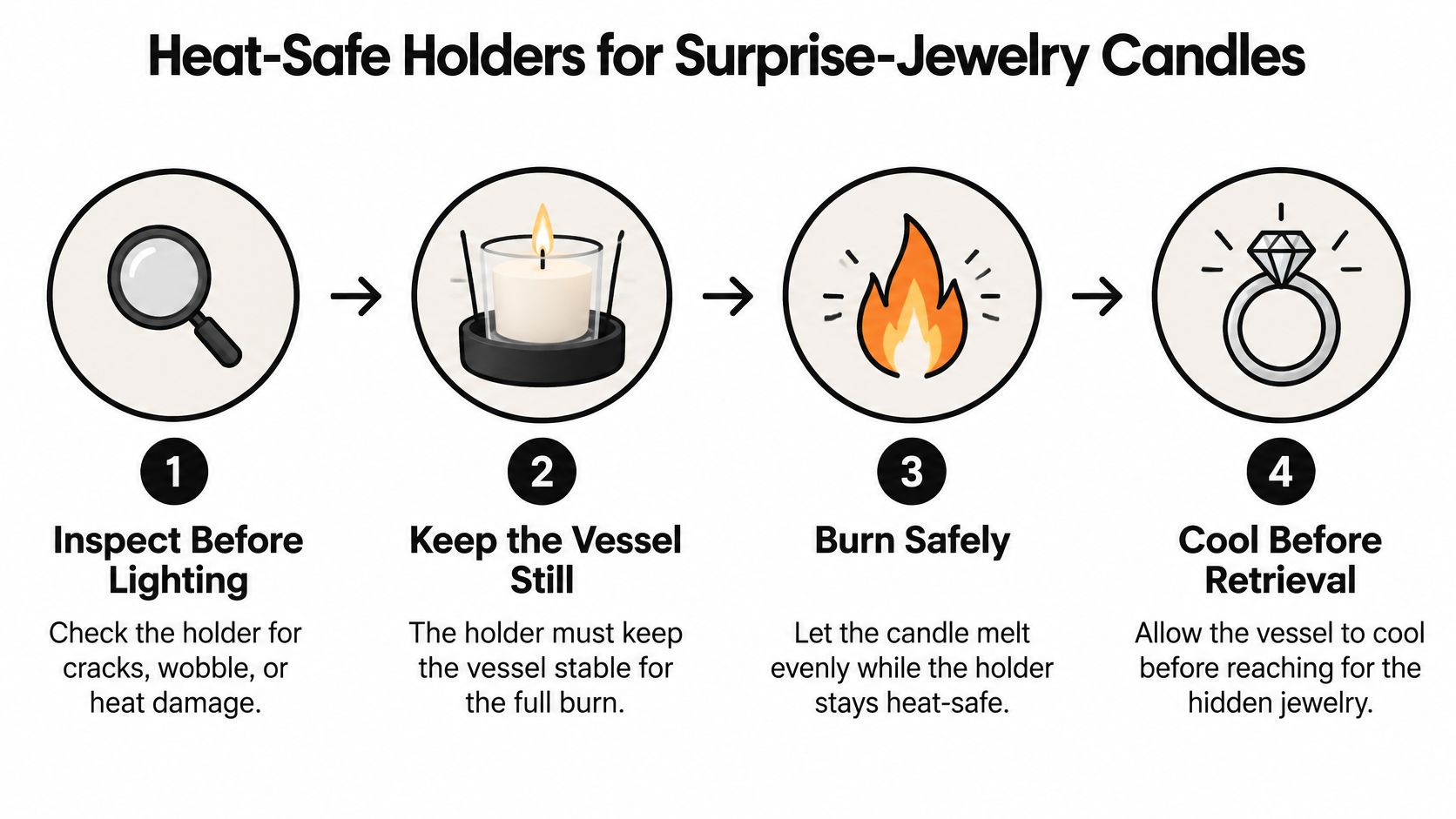
Research on candle emissions shows that wax and wick composition strongly influence soot, PM2.5, and particle-phase PAH emissions, while flame disturbance and burn duration also affect pollutant output, as reported in Indoor Air. That means the holder isn't passive. If it concentrates heat or restricts airflow, it changes both safety and combustion quality for the entire burn leading up to the reveal.
A soy label or another premium wax description doesn't skip the cool-down. Wax type doesn't make hot wax safe to touch, and it doesn't make an unrated holder heat resistant. Clearance, a stable base, and a heat-safe surface are what make the surprise safe to retrieve.
A holder only does its job if it stays in the condition you bought it for. Wax buildup changes how a candle seats, and small damage changes how it handles heat.
Look for cracks, chips, a rocking base, and a charred liner before you light anything in it again. A hairline crack in glass can open under heat, so a damaged holder isn't a holder anymore, it's a display piece at best. Stop using any holder that fails that check.
Set the clean holder back on a hard, heat-safe surface with the wick area unobstructed. If the glass is still sooty after washing, read that as information about the last burn. The flame was unstable, so trim the wick and give the next burn more open air rather than enclosing the candle further.
When you're ready to put a properly fitted, heat-safe holder to work, explore the scented candles with a hidden ring or necklace inside at Jackpot Candles and choose a fragrance you'll enjoy burning slowly, session by session. Pick your candle, set it on a stable base with clear space above the flame, and let the reveal wait until everything has cooled.
Comments will be approved before showing up.