
free shipping at $99


You've opened a rose candle, loved the scent beneath the lid, and started wondering whether it will smell just as good across your living room. Or you're comparing candles online, where nearly every description promises fresh petals, romance, and a room-filling fragrance.
The useful question isn't whether a candle smells like rose. It's how that rose changes from unlit wax to warm wax to room air, and whether the candle burns comfortably in the space you use.
Two candles sold as rose can smell like entirely different perfumes. One suggests a freshly cut bouquet; another recalls face powder, sweet vanilla, or dark wood. Neither description necessarily means the maker got rose wrong.
Even the flower isn't consistent: a large study described by the American Rose Society found that 25% of rose varieties had no scent, 20% were strongly scented, and the remaining 55% varied in fragrance intensity. Candle makers therefore select fragrance materials and build blends rather than reproduce an imaginary universal rose smell.
Think of rose as the central voice in a small musical group. Supporting notes can make it brighter, softer, sweeter, or drier without removing its floral identity. Geranium can reinforce a leafy floral impression, while woods give a bouquet a more grounded finish.
If you dislike sugary fragrances, start by excluding vanilla-led blends rather than rejecting rose altogether. If you enjoy cosmetic fragrances, powdery rose may feel more familiar than a sharply green interpretation.
Descriptions of top, middle, and bottom notes in candles help you distinguish a bright opening from the fuller floral centre and lingering base. These note names describe the intended scent impression, not necessarily a list of botanical ingredients.
The settings below are styling suggestions, not guarantees about strength or suitability. A fresh fragrance can still be powerful, and a deep woody blend can be restrained.
Rose candle blend families and their notes
| Blend family | Main notes | Character | Best setting |
|---|---|---|---|
| Classic rose | Rose with geranium and soft woods | Traditional, full bouquet | Bedrooms and romantic dinners |
| Fresh rose | Rose with green stem and bergamot | Bright, clean, airy | Bathrooms and daytime rooms |
| Powdery rose | Rose with iris and musk | Soft, warm, make-up-like | Gifts and evening lounging |
| Rose and oud | Rose with oud, cedar and amber | Deep, dry, grown-up | Living rooms and cold evenings |
| Rose and vanilla | Rose with vanilla and tonka | Sweet, comforting, gourmand | Winter cosiness and reading |
| Rose and fruit | Rose with raspberry, peony or pear | Juicy, playful, light | Spring and summer décor |
Choose the row that matches the atmosphere you want, then read the full description for anything you already know you dislike. The supporting notes are often more useful than the word rose alone.
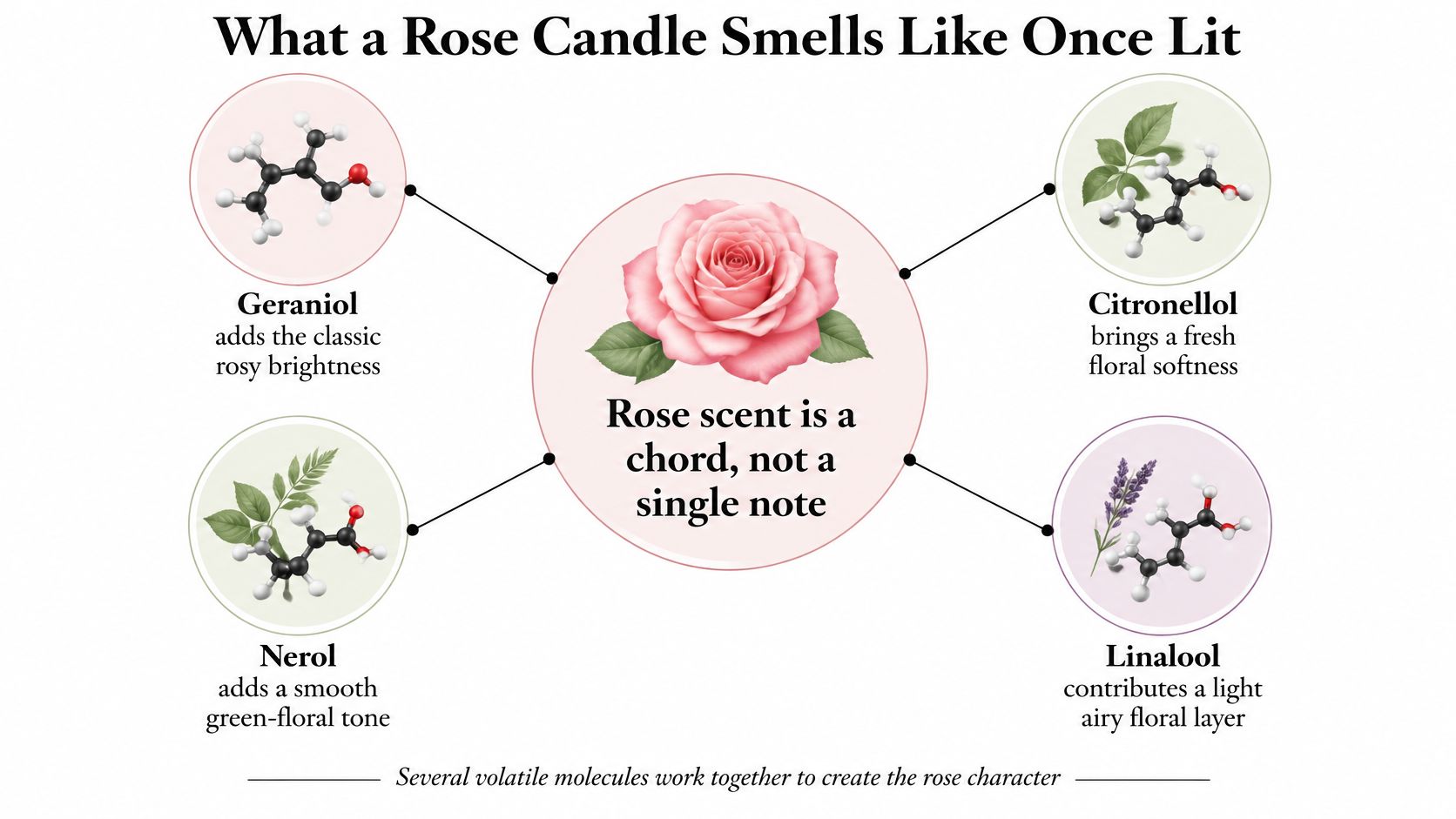
Rose scent is a chord, not a single note. Several fragrance molecules contribute to the impression you recognise as petals, greenery, freshness, and depth.
A review in the Journal of Experimental Botany identifies geraniol, citronellol, nerol, and linalool among the major rose volatiles, alongside deeper contributions from sesquiterpenes such as germacrene-D and beta-caryophyllene. It also describes aldehydic derivatives, including geranial, neral, and citronellal, that contribute sweet, citrus-like facets.
You don't need to memorise those names. Their practical importance is that a convincing rose fragrance relies on a balance of components, rather than one ingredient doing everything.
Cold throw means the fragrance you notice while the candle is unlit. Hot throw is the fragrance released during burning and perceived around the room.
The distinction matters because heat changes how fragrance components leave the wax. Their volatility, compatibility with the wax, and the conditions around the wick affect what reaches your nose. Lighter components can stand out early, while less volatile materials and fixatives help sustain the blend.
A candle that smells rounded beneath its lid may become greener, sharper, or woodier as it warms. That isn't automatically a defect. The question is whether you enjoy the heated composition and can still recognise its intended character.
Don't reward a candle simply for smelling strongest in the jar. Judge the fragrance where you'll actually breathe it.
Use a simple vocabulary rather than trying to identify every ingredient: fresh petal, green, citrus, powdery, and woody. Write down the dominant impression and whether the supporting notes complement the rose or obscure it.
Keep your face away from the flame and rising plume. You're assessing the room's fragrance, not inhaling directly above the wick.
A blend that becomes a pleasant general floral may still suit you. It may not satisfy someone buying specifically for a clear rose-petal character.
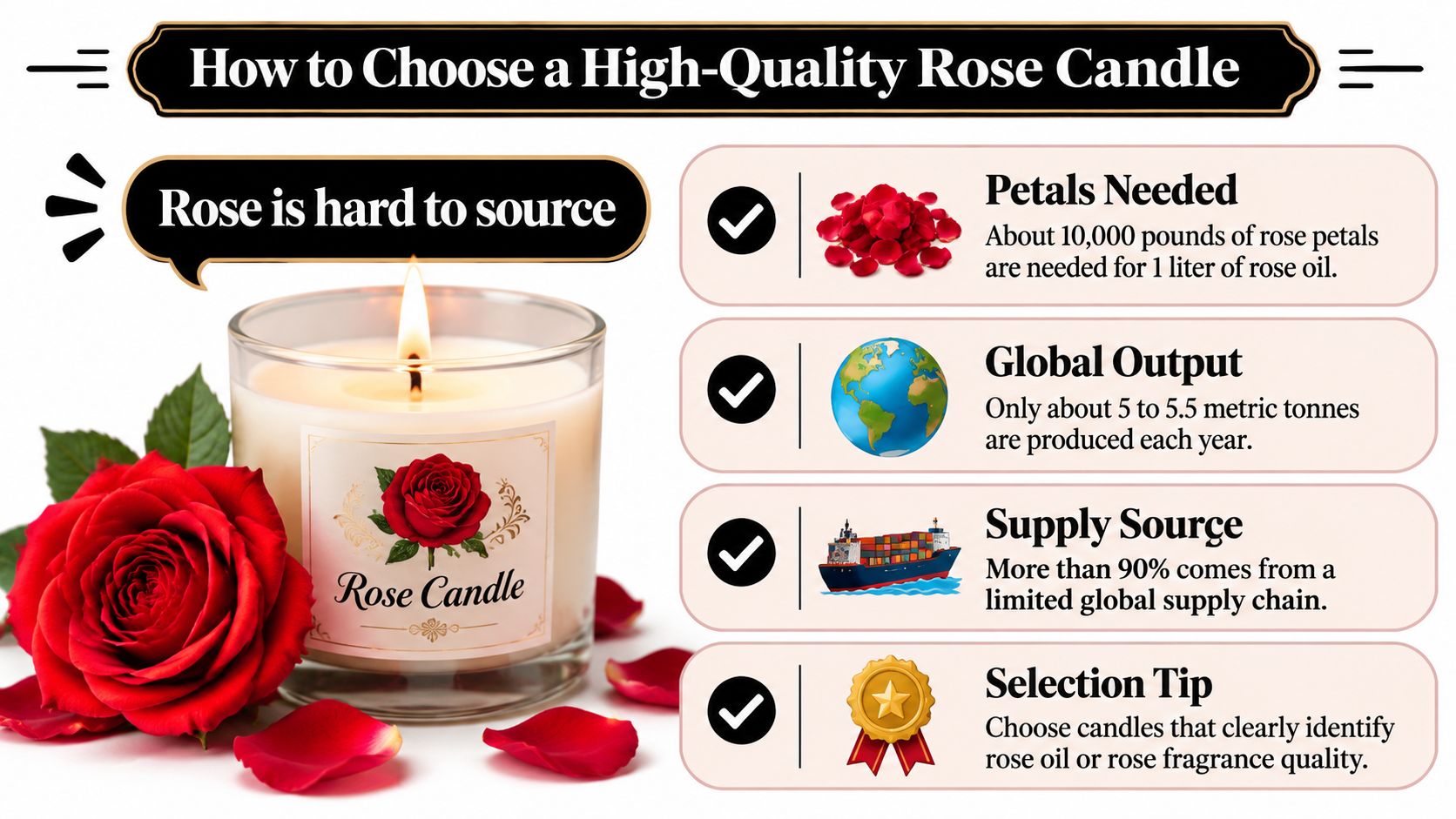
Authentic rose extract requires substantial raw material. The perfumery overview from Sedr Al Khaleej reports that approximately 10,000 pounds of rose petals are needed to produce 1 liter of rose oil, with estimated global production of about 5 to 5.5 metric tonnes per year.
That scarcity explains why a convincing rose candle doesn't have to rely exclusively on rose essential oil. A carefully formulated fragrance oil can deliver a consistent floral impression. Conversely, an essential-oil claim alone doesn't tell you whether the wax, fragrance, and wick work well together.
Use this checklist to separate useful product information from decorative language. A missing detail is a reason to investigate, not proof that a candle is poorly made.
Buying criteria for a quality rose candle
| Criterion | Good sign | Red flag |
|---|---|---|
| Wax | Named soy blend or another clearly identified wax | Unnamed wax or no wax listed |
| Fragrance source | Named rose fragrance oil or rose-based essential oil blend, with concentration disclosed | Bare rose-scent description with no detail |
| Fragrance load | Pleasantly present when lit, not overwhelming in the jar | Oil sweating on the surface or a jar scent that causes discomfort |
| Wick | Cotton or wood suited to the jar, with a stable flame | Sooting, flaring, or a heavily mushroomed tip |
| Burn time | Stated expected hours for the jar | No burn-time information |
| Melt pool | Even melting that progresses towards the edges during permitted sessions | Persistent tunnelling down the centre |
Wax disclosure tells you what you're buying, not which candle must perform best. Soy isn't an automatic safety certificate, and a named alternative isn't automatically inferior.
Fragrance-source information helps you distinguish an ingredient claim from a scent description. Concentration can improve transparency, but a larger percentage isn't a quality score: the formula must remain compatible with the wax and wick.
A cotton wick and a wooden wick can both work well when properly matched to the vessel. Watch the flame rather than assuming one material guarantees less smoke.
Likewise, stated burn time is an expectation, not permission to keep a candle lit continuously. Melt-pool development should be judged within the maker's session limits; don't extend a burn just to force wax to the edge.
Buying rule: Specific scent notes, clear material information, and usable burn instructions are more valuable than luxury language alone.
Use the discussion of premium scented candles as a vocabulary guide, then check whether the actual listing supplies those practical details. A maker who describes the rose precisely and explains how to use the candle gives you a better basis for comparison, though the burn remains the final test.
Soy and natural don't mean emission-free. A floral scent may feel gentle, but its name doesn't establish what happens to indoor air when the candle burns.
An exposure assessment published in Environmental Science & Technology concluded that scented candles used under normal conditions presented no known consumer health risk, while also describing combustion emissions and differences associated with fragrance. That finding supports proportionate precautions, not a blanket promise for every product, room, or person.
Candles can release volatile organic compounds, particulate matter, and ultrafine particles. Fragrance contributes evaporated compounds as well, so occasional use in a ventilated room shouldn't be treated as equivalent to repeated burning in a confined space.
Research on indoor terpene chemistry and human exposure explains how fragrance-related compounds can react with indoor ozone. The practical response is to manage ventilation and combustion rather than chase the strongest possible scent.
Trim the cooled wick before relighting, removing loose char and following the product's specified trim length. Keep the candle away from moving air that makes the flame flicker, but don't confuse avoiding a direct draft with sealing the room.
Burn guidance by household situation
| Situation | Burn guidance | Stop or change if |
|---|---|---|
| Occasional use in a ventilated living room | Use an attended session within the maker's limit; trim the cooled wick first | Soot appears on the jar or the flame flares |
| Small or poorly ventilated room | Open a window or door where practical; keep sessions shorter | Headache or throat irritation develops |
| Bedroom or enclosed room | Use brief, attended sessions; never burn overnight | Any breathing discomfort occurs |
| Asthma or known fragrance sensitivity | Prefer an unscented option or skip candles | Wheezing or breathlessness occurs |
| Households with children or pets | Keep out of reach on a stable surface, away from drafts; ventilate | Coughing occurs or a pet behaves unusually |
Unscented candles still involve combustion. Someone who reacts to smoke or fragrance may be better served by a flameless light rather than another scented product.
The American Chemical Society's summary of scented-wax-melt testing describes fragrance-related nanoparticle levels comparable to previously reported levels from traditional candles. Removing the flame doesn't remove every indoor-air consideration.
Keep candle safety tips alongside the product instructions. Stop burning and ventilate if irritation develops; persistent breathing symptoms warrant medical advice, and unusual symptoms in pets warrant veterinary advice.
Say you're setting up for dinner at home. A low rose candle in clear glass can complement the flowers without blocking conversation, but place it away from napkins, foliage, and reaching hands.
This table setting illustrates the mood, rather than a template to copy without checking clearances.

Let the room feel welcoming before serving food, then extinguish the scented candle if its perfume competes with the meal. Romance doesn't require continuous fragrance.
In the living room, choose a vessel that looks intentional beside your lamps and textiles. Amber glass can complement darker furniture, while blush ceramic suits a softer palette. Use the blend-family table to choose the fragrance mood rather than combining several competing scents.
For a bedroom, an uncluttered dresser offers a more sensible location than a crowded bedside table near bedding. In a bathroom, pale glass or ceramic can sit comfortably with white towels, provided the surface is stable and safely clear of toiletries.
A styling video can help you assess arrangement and visual balance.
Before leaving any room, extinguish its candle. A well-styled evening shouldn't depend on unattended flames.
Follow the candle's stated session limit and stop sooner if the flame becomes unstable or the room feels uncomfortable. Don't treat the advertised total burn time as a continuous-use allowance, and never leave a candle burning while you sleep.
You may have become accustomed to the fragrance, or different burn conditions may have changed what you notice. Step outside and reassess on returning before concluding that the fragrance has disappeared; a weaker impression alone doesn't prove that the candle has used up its top notes.
Only if they enjoy fragrance in the first place. A restrained fresh or powdery blend may suit someone who dislikes rich perfume, but neither family guarantees low intensity; for known sensitivity, choose a fragrance-free gift instead.
Let the candle cool and check for an off-centre wick, drafts, or a session that ended before the wax could melt evenly. Follow the maker's instructions on the next lighting, but don't dig out wax, add fragrance oil, or keep burning beyond the allowed session to correct the tunnel.
Troubleshooting priority: An even wax surface isn't worth an unstable flame or an overheated vessel.
Start with a small format before committing to a large jar or gift set. Your room, seating position, and fragrance preferences matter more than a persuasive description.
Use a notebook or your phone, and keep your observations concrete. Write fresh petal with a dry woody finish rather than nice, because the more specific description will help you choose again.
Keep fragrance preference separate from burn performance. You can love the aroma and reject the candle's behaviour, or find a well-behaved candle too sweet for your taste.
Choose the larger format only when both judgments are positive. That makes your purchase a response to a successful room test, not just an appealing label.
Our Rose Petals candle offers a floral option for exploring this scent family, and our candle range includes hidden jewelry for an added gifting element. Visit Jackpot Candles to compare the available formats and choose a candle for your own room test.
Comments will be approved before showing up.