
free shipping at $99


When it comes down to it, the biggest difference between a fragrance oil and an essential oil is where they come from and what they're meant to do. Essential oils are pure, natural plant extracts prized for their therapeutic aromatherapy benefits, while fragrance oils are synthetically crafted scents engineered for powerful, consistent aromas in products like our candles.
The right choice really just depends on what you're looking for: natural wellness benefits or pure scent performance.
When you’re picking out a scented product, knowing where that beautiful scent comes from is everything. Both essential oils and fragrance oils can create amazing aromatic experiences, but they take completely different journeys to get to your home. One is a direct gift from nature; the other is a masterpiece of scientific artistry.
The conversation often gets stuck in the natural versus synthetic debate, but there's more to it than that. Each oil type has its own strengths and is designed for a specific job. Knowing those roles helps you make a great choice every time.
To make it super simple, here’s a quick rundown of the main differences between fragrance oils and essential oils. This table will help you see the core distinctions at a glance.
| Attribute | Fragrance Oils | Essential Oils |
|---|---|---|
| Origin | Lab-created, often synthetic or a blend of synthetic and natural compounds. | 100% natural, extracted directly from plant materials. |
| Scent Profile | Limitless variety, including abstract concepts like "Ocean Breeze." | Authentic plant aromas, limited to what nature provides. |
| Purpose | Primarily for providing a pleasant and consistent scent. | Used for both scent and therapeutic aromatherapy benefits. |
| Consistency | Highly consistent scent from batch to batch. | Scent can vary based on harvest, climate, and region. |
| Cost | Generally more affordable and cost-stable. | Often more expensive due to complex extraction processes. |
After you've had a look at the key differences, you can see why one might be a better fit for certain products over the other.
Fragrance oils are expertly blended scents designed to shine in products like candles, bath bombs, and soaps. Because they are more stable and cost-effective, they are the go-to for creating consistent, beautiful aromas you can rely on.
The core takeaway is simple: Essential oils are for therapeutic wellness, harnessing the natural chemical properties of plants. Fragrance oils are for pure olfactory enjoyment, designed by perfumers for robust, stable, and captivating scents.
So, choosing between them isn't about which one is "better" in general, but which one is better for a specific purpose. For a product like a candle, where scent stability under high heat is non-negotiable, a high-quality fragrance oil ensures you get a safe, powerful, and room-filling experience that most essential oils just can’t deliver.
To get to the heart of the fragrance oil vs. essential oil debate, you have to go back to the very beginning. Where do they come from? One is pulled directly from the earth, a pure botanical concentrate, while the other is born in a lab, a perfect blend of science and art.
It's these completely different origin stories that dictate how they smell, how they perform, and what they're best used for.
This fundamental split—nature versus nurture, if you will—is the main reason they behave so differently, especially when you introduce the heat from a candle wick.
Essential oils are, in the simplest terms, the very soul of a plant. They're highly concentrated liquids packed with the volatile compounds that give a plant its unique scent, extracted straight from its flowers, leaves, bark, or peel. Capturing this essence is a completely natural, mechanical process.
There are two main ways to do it:
What you get is a complex cocktail of natural chemicals—terpenes, esters, and phenols—that give an oil its signature aroma and its well-known therapeutic properties. A single drop of real peppermint oil has a chemical fingerprint designed by nature that can never be perfectly copied.
The identity of an essential oil is tied directly to its botanical source. Lavender essential oil comes only from the lavender plant; its chemical makeup is a direct result of the soil, climate, and specific species from which it was harvested.
This is both the magic and the challenge of essential oils. Their authenticity is their biggest strength, but it also means their scent can vary from one harvest to the next. More importantly for us candle lovers, their performance can be frustratingly unpredictable when they meet the high heat of a candle flame.
Fragrance oils are a different beast altogether. They are the result of a perfumer's creative vision, meticulously built in a laboratory. Think of them as custom-designed scent compositions, engineered for one specific purpose: to deliver an incredible, consistent aroma in a product like a candle or bath bomb.
This design process involves blending various aroma chemicals to build the perfect scent profile. These building blocks come from a few different places:
This toolkit gives perfumers an almost limitless creative palette. They can recreate scents that are impossible to bottle, like "Ocean Breeze" or "Fresh Linen," or dream up complex, conceptual fragrances. If you're curious about how these custom blends are made, you can learn more about what fragrance oils are made of in our detailed guide.
This scientific approach is what gives fragrance oils their superpowers in product making: stability and consistency. They are engineered to handle high temperatures without breaking down or morphing into something unrecognizable. That makes them the undisputed champion for products like soy wax candles, guaranteeing you get that reliable, room-filling fragrance you love every single time.
When it comes to the actual experience of smelling a candle or a bath bomb, the true personalities of fragrance and essential oils really come out. This is where you’ll notice the biggest differences in variety and staying power. One gives you a pure snapshot of nature, playing by its rules, while the other is like an endless canvas for scent artists, built from the ground up to perform.
Getting a feel for this distinction is everything. It helps you choose the right oil for what you want, whether that's a fleeting moment of natural calm from a diffuser or a powerful, room-filling aroma that sticks around for hours. The choice really boils down to this: do you want the raw, singular voice of a specific plant, or a complex, blended chorus designed to last?
Fragrance oils are all about creative freedom. Since they’re made in a lab, perfumers can blend hundreds of different aromatic compounds—some natural, some synthetic—to create pretty much any scent you can dream up. This is where you get all the amazing aromas that nature just can't produce on its own.
Think about scents like:
This power to design and control the final aroma is a huge plus. It means every bottle of a specific fragrance oil smells exactly the same, which gives you the kind of consistency that’s so important for products like our candles. That reliability ensures the "Warm Vanilla Sugar" candle you fell in love with today will smell identical to the one you buy next year.
The real magic of fragrance oils is their unlimited creativity and rock-solid consistency. They let us create complex, imaginative, and stable scents that go way beyond what you can find in the natural world.
Essential oils, on the other hand, deliver the pure, unedited scent of whatever plant they came from. A drop of peppermint essential oil smells exactly like you just crushed a fresh peppermint leaf in your hand, because that's what it is—the concentrated essence of the plant. That authenticity is their biggest draw.
But being so closely tied to nature also means they’re never quite the same. The final aroma of an essential oil can be seriously influenced by its environment.
A few key factors include:
This all means that one bottle of rosemary essential oil might smell a bit more herbaceous or woody than the next one you buy. While that natural variation is a beautiful reminder of where it came from, it’s a real headache if you’re trying to create products that need to smell exactly the same every single time.
For most of us, maybe the most practical difference is just how long the scent sticks around. It all comes down to chemistry and how quickly an oil's molecules evaporate into the air.
Essential oils are naturally volatile. Their delicate, complex compounds were designed by nature to evaporate pretty quickly. That's why a few drops of eucalyptus oil in a diffuser can blast a room with scent, but then it fades out after a few hours. That fleeting quality is great for aromatherapy, but not so much for long-lasting fragrance.
Fragrance oils are built for endurance. Perfumers are smart—they intentionally use heavier, more stable molecules (often called fixatives) to anchor the scent. These little guys slow down how fast the lighter top notes fly away, letting the whole fragrance last way longer. It’s precisely this engineered stability that makes fragrance oils shine in candles, where the scent has to stand up to high heat and keep throwing for hours. The result is a robust, enduring aroma that fills your space consistently, from the first light to the very last burn.
The real test of any scent oil comes down to performance. When you’re talking about home fragrance, especially in something as hot as a candle, the differences between fragrance oils and essential oils become incredibly clear. It’s not just about what smells good in the bottle—it’s about how that scent holds up to a flame, blends with wax, and fills your living space.
Understanding this practical side of things is everything. The way an oil behaves when heated is probably the single most important factor in creating a candle that’s both satisfying and safe.
When candlemakers talk shop, you’ll hear them mention two key things: cold throw and hot throw. These terms simply describe how a candle smells before and after it's lit, and they are the ultimate measure of a scent oil’s success.
Cold Throw: This is the scent you get from an unlit candle. It’s that first impression when you pick it up and smell the solid wax. A great cold throw is a promise of what's to come.
Hot Throw: This is the main event. Hot throw is all about how well the fragrance travels through a room once the candle is burning. This is where you really see how an oil’s stability and its relationship with the hot wax pool play out.
A truly fantastic candle has to nail both. It needs to be inviting on the shelf and powerful enough to completely change the atmosphere of a room once you light it.
The biggest performance gap between fragrance oils and essential oils really shows up in the hot throw. Fragrance oils are scientifically built to bond with wax and release a strong, consistent scent when heated. Many essential oils just can't handle the same pressure.
This all comes down to chemistry. Fragrance oils are designed with heavier molecules that can withstand high temperatures, ensuring the scent is carried into the air instead of just burning away.
There’s a reason fragrance oils are the undisputed champions of the candle world: they are literally built for the job. Perfumers and chemists design these oils specifically to be stable at high temperatures and to work perfectly in wax. That gives them a massive head start over essential oils.
Because they're engineered for stability, they keep their complex scent profiles even when they’re right next to a flame. An oil designed to smell like "Apple Cinnamon" will actually smell like apple and cinnamon from the first light to the very last, without turning bitter or strange.
This is especially critical for candle brands like Jackpot Candles, which uses a high-quality soy wax blend. Soy wax is famously a bit picky about the oils it partners with. Fragrance oils are formulated to bind perfectly with soy's molecular structure, guaranteeing a robust and reliable hot throw that fills the room every single time. It's why our candles deliver such a rich and consistent fragrance experience.
To give you a clearer picture, here’s a direct comparison of how these oils perform in two of the most popular home fragrance products.
| Performance Metric | Fragrance Oils | Essential Oils |
|---|---|---|
| Candle Hot Throw | Excellent. Formulated for high heat, they bind with wax to release a strong, consistent, room-filling scent. | Poor to Fair. Volatile compounds often burn off quickly, resulting in a weak or non-existent scent when lit. |
| Scent Stability (Heat) | High. The scent profile remains true and doesn't degrade or smell "burnt" when exposed to a flame. | Low. Delicate aromas can be easily destroyed or altered by heat, creating a harsh or unpleasant smell. |
| Bath Bomb Scent Impact | Strong & Lasting. The scent is vibrant upon hitting the water and lingers on the skin afterward. | Good but Fleeting. Provides an immediate aromatic burst, but the scent can dissipate quickly in hot water. |
| Visuals in Bath Bombs | Stable. They don't typically discolor the product or leave an oily residue on the tub. | Can Be Unpredictable. Some EOs (like citrus) can cause discoloration or leave an oily film on the water/tub. |
| Safety in Candles | High. Formulated with high flash points, making them safe for use in high-heat applications. | Variable. Many EOs have low flash points, posing a potential fire risk if not used with extreme caution. |
As you can see, when it comes to performance under heat, fragrance oils have a clear, engineered advantage that makes them the more reliable and effective choice for candles.
While an all-natural essential oil candle sounds lovely in theory, the reality is often disappointing and can even be unsafe. Essential oils are, by their very nature, incredibly volatile. Their delicate aromatic compounds were never meant to survive the intense heat of a burning wick, which can soar to over 1,400°C.
When you expose them to temperatures that high, a few things go wrong:
Scent Degradation: The heat can literally break down the chemical structure of the oil, making it smell burnt, weak, or nothing like its original aroma. That beautiful lavender can quickly turn harsh and medicinal.
Poor Hot Throw: Because they evaporate so quickly, many essential oils simply burn off before they have a chance to mix with the melted wax and get released into the air. You end up with a candle that smells great when it’s cold but has almost no scent when you light it.
Safety Concerns: Every oil has a flash point—the lowest temperature where its vapors can ignite. Many popular essential oils, like citrus and some pine oils, have very low flash points. This makes them a potential fire hazard in candles. To learn more, check out our guide covering common questions about candles made with essential oils.
For all these reasons, getting a safe candle with a powerful, room-filling scent is far more predictable and effective with a well-crafted fragrance oil. It ensures that the beautiful aroma you paid for is exactly what you get—safely and consistently.
When you're exploring the world of scented products, a big question always comes up: what's actually safe to use on your skin and around your home? It's a common myth that "natural" automatically equals "safe," but the reality is a lot more nuanced. Getting to know the safety profiles of both fragrance and essential oils is the key to choosing with confidence.
The real difference in safety between fragrance oils and essential oils comes down to their composition and how they're regulated. Both can be used safely, but they require a different kind of awareness from you.
Essential oils are powerful, highly concentrated extracts straight from plants. Even though they come from nature, that potency means you have to handle them with respect, especially when they come into contact with your skin.
Using undiluted essential oils can lead to a whole range of unwanted reactions. Some of these include:
Because of these risks, the golden rule in aromatherapy is to always dilute essential oils in a carrier oil (like jojoba or coconut oil) before putting them on your skin. A safe dilution is typically around 1-2%, which is just a few drops of essential oil for every ounce of carrier oil.
Fragrance oils, on the other hand, are developed with safety as a top priority from the very beginning. They're specifically made for use in products that touch your skin—think lotions, soaps, and bath bombs—so they have to meet strict industry standards.
The leading authority here is the International Fragrance Association (IFRA). The IFRA creates and enforces rigorous guidelines that spell out the maximum safe usage levels for thousands of different fragrance ingredients, depending on the type of product they're in.
This means a high-quality fragrance oil isn't just a random mix of chemicals; it's a carefully engineered compound designed to be skin-safe for its intended use. Reputable makers stick to these standards to make sure their products are non-toxic and non-irritating for almost everyone.
Of course, anyone can have a personal sensitivity to any substance, whether it's natural or synthetic. That's why doing a small patch test with any new skincare product is always a smart move. When you choose products with high-quality, IFRA-compliant fragrance oils, you're getting the benefit of a system that puts consumer safety first. If you’re on the hunt for worry-free options, you can check out some of the best non-toxic home fragrance choices out there.
This handy decision tree can help you see how your main goal—whether it's powerful scent or therapeutic benefits—points you to the right oil.
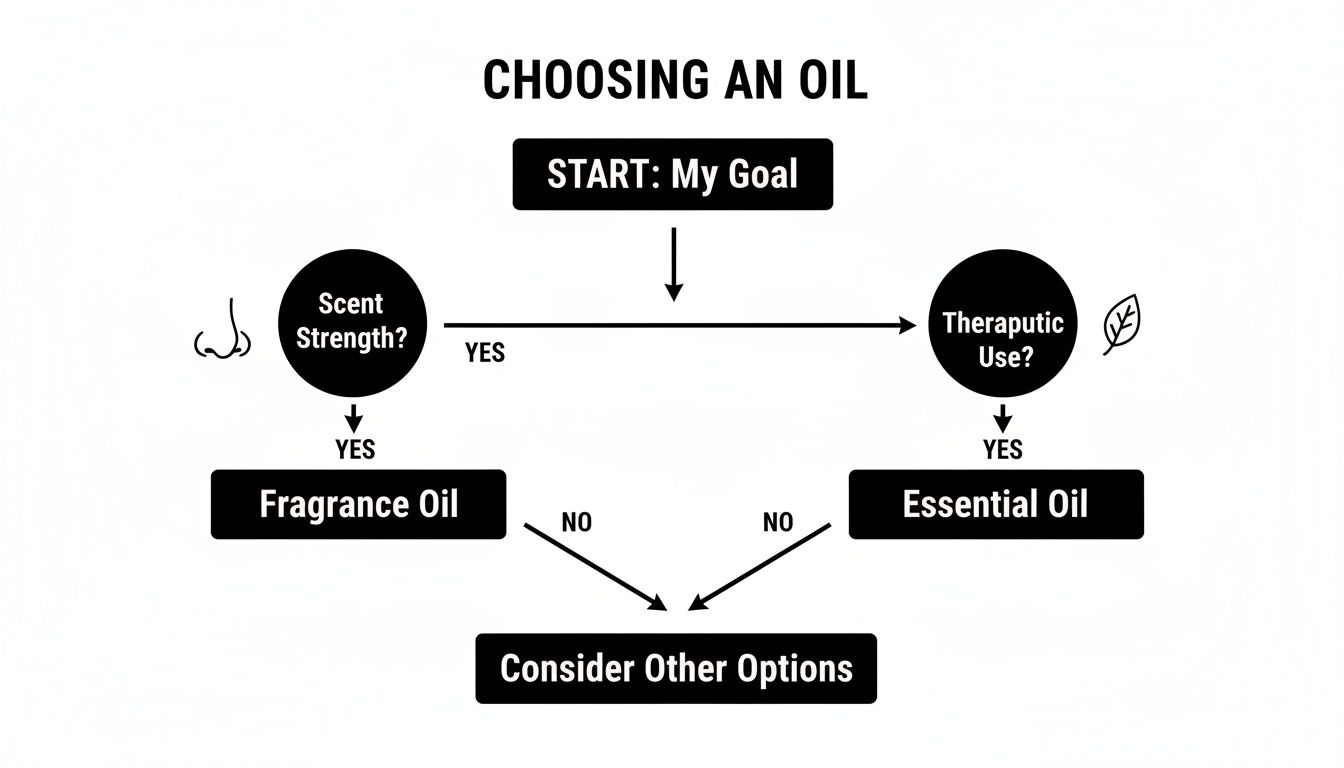
As the flowchart shows, the choice is pretty clear: if you want a strong, lasting scent, fragrance oil is your best bet. If you're after therapeutic effects, essential oils are the way to go.
Beyond the scent itself, the practical matters of cost and environmental impact are huge factors in the fragrance oil vs. essential oil debate. The price tags and sustainability stories behind these oils are often way more complicated than a simple "natural vs. synthetic" label would have you believe. Digging into these details makes it much clearer why one might be chosen over the other, especially for large-scale production.

The economic and ecological sides of this are totally intertwined, showing a delicate balance between sourcing from nature and innovating in a lab.
The often-shocking price of pure essential oils comes down to one thing: it takes an incredible amount of raw plant material to produce just a tiny bit of oil. The whole process is super labor-intensive and resource-heavy, making the final product a truly precious commodity.
Just think about these numbers for a second:
These figures show the cost isn't just pulled out of thin air; it’s directly tied to farming, labor, and the sheer volume of botanicals required. This reality makes using pure essential oils in mass-market products like candles almost impossibly expensive and causes wild price swings based on how well a crop does each year.
The high cost of essential oils is a direct result of their agricultural origin. Factors like crop yields, weather patterns, and labor-intensive harvesting methods all contribute to a volatile and expensive supply chain.
On the flip side, fragrance oils offer amazing affordability and price stability. Since they’re created in a controlled lab environment, their production isn't at the mercy of unpredictable farming conditions. This allows manufacturers to create consistent, budget-friendly scents, which in turn makes beautiful fragrances accessible to a much wider audience.
The conversation around sustainability is just as complex, and there are good points on both sides. The simple "natural is always better" argument doesn't really hold up when you look at the entire environmental picture.
The massive demand for all-natural ingredients has put a real strain on the world's botanical resources. As consumers spend billions on aromatherapy and wellness, the global essential oils market is booming—a trend that really shines a light on the need for responsible sourcing. You can find more info on the growing essential oils market on fortunebusinessinsights.com.
This huge demand creates some serious ecological challenges:
But fragrance oils have their own set of considerations, too. While creating them in a lab avoids the problem of over-harvesting, the process does rely on synthesizing aroma chemicals. The good news is that reputable manufacturers are increasingly turning to green chemistry principles to minimize their impact, focusing on creating biodegradable compounds and using renewable resources.
At the end of the day, neither option is perfect from a sustainability standpoint. The choice often comes down to weighing the environmental pressures of large-scale agriculture against the resources needed for chemical synthesis. For many brands, using high-quality fragrance oils is a more sustainable path because it allows them to create beloved scents without depleting vulnerable natural resources.
When you're diving into the world of home fragrance, it's natural to have a few questions. We get it. Let's clear up some of the most common ones to help you pick the perfect scent for your space.
You can, but you probably won't get the result you're hoping for. Essential oils are incredibly volatile, meaning they evaporate very quickly when heated. The scent will be lovely for a moment, but it will fade fast, leaving you disappointed.
Fragrance oils, on the other hand, are built for the heat. They're specifically designed to provide a powerful, consistent, and long-lasting aroma in applications like candle warmers. If you want a scent that truly fills a room and sticks around, fragrance oils are the way to go.
Here's the bottom line: For genuine aromatherapy—where the goal is to affect your mood or well-being—essential oils are the only choice. Their natural chemical makeup is what provides those therapeutic benefits. But for simply making your home smell incredible? Fragrance oils are your best friend.
This is a big concern for many, and rightfully so! When you buy from a reputable brand, you can rest easy. High-quality fragrance oils are carefully formulated to be safe for their intended use, like in candles or lotions.
These oils have to follow strict safety standards set by organizations like the International Fragrance Association (IFRA). These guidelines ensure the final product is non-toxic and skin-safe. Of course, just like with any product (natural or synthetic), some people might have sensitivities to certain ingredients. It's always a good idea to pay attention to your own body's reactions.
This question really gets to the heart of the matter. If you're looking for true, therapeutic aromatherapy, essential oils are the only option. It’s their complex, all-natural chemical profile that interacts with your body to create a physical or psychological effect.
Fragrance oils are masters of one thing: scent. They are expertly crafted to make your home smell absolutely wonderful, but they don’t contain the specific botanical compounds needed for therapeutic benefits.
At Jackpot Candles, we believe in creating an unforgettable experience. That's why we use premium, perfume-grade fragrance oils in every candle. You get a safe, consistent, and room-filling aroma that lasts, plus a beautiful jewelry surprise waiting inside. Ready to find your new favorite scent? Explore our collection today at https://www.jackpotcandles.com.
Comments will be approved before showing up.