
free shipping at $99


So, what actually makes a candle fragrance oil a "high-quality" one?
It's a lot more than just a nice smell. Think of it like the difference between a generic cup of coffee and a perfectly pulled shot of espresso. Both are coffee, sure, but one is specifically engineered for a far superior experience.
A truly premium fragrance oil is a complex, professionally formulated blend of aromatic compounds designed to perform flawlessly and safely in a candle. It’s not just a pleasant scent; it’s a scientifically engineered product built to deliver a consistent, powerful, and safe experience from the first light to the very last burn.
Let's dig into what separates the good from the great.
When you start making candles, you quickly learn that the best oils are a beautiful blend of art and science. They’re designed to perform reliably every single time you pour, and they all stand on three core pillars that lift them far above the generic, off-the-shelf options.
To really understand what you're buying, you need to look at the non-negotiables—the foundational elements that every serious candle maker should demand from their fragrance oils.
Quality is a combination of artistic creation and scientific precision. A perfumer balances hundreds of potential ingredients to create a scent that is not only beautiful but also structurally sound enough to withstand the heat of a burning candle.
This obsession with quality isn't just a niche concern; it's driving major market growth. The global fragrance oil market was valued at a whopping USD 8.50 billion and is projected to hit USD 11.90 billion by 2032. Why the boom? It's all thanks to people like us demanding better aromatherapy and home fragrance products that offer both a sensory escape and total reliability.
If you want to get a real feel for the artistry involved, diving into a perfume design experience can be incredibly eye-opening. It gives you a hands-on understanding of how top, middle, and base notes are balanced—the very same principles that go into creating exceptional high quality candle fragrance oils.
Have you ever wondered why one candle can fill your entire home with a beautiful fragrance, while another one barely makes a peep? The secret lies in a little thing we candle makers call scent throw. It's the most important way we measure how well a fragrance oil performs, telling us just how strong and far-reaching its aroma will be.
Think of scent throw as having two distinct sides. First up is the cold throw, which is the scent you get when the candle is just sitting there, unlit. This is your first impression—that lovely smell that hits you when you pick up a candle in a shop and gives you a sneak peek of what’s to come.
But the real magic happens with the hot throw. This is the fragrance that fills the air when the candle is burning, creating that perfect ambiance you're looking for. A top-tier fragrance oil needs to nail both, but the hot throw is where it really shows its stuff.
To really get how this works, picture your candle wax as a sponge. When you mix in those high quality candle fragrance oils, the wax—our sponge—soaks up and holds on tight to all the tiny fragrance molecules. But here's the catch: different waxes act like completely different kinds of sponges.
It's this relationship between wax and oil that determines just how much scent gets released. Some waxes are generous, letting the fragrance roam free, while others hold on a bit tighter.
Below is a quick comparison to show you how some common waxes behave when they meet fragrance oil.
| Wax Type | Binding Properties | Typical Hot Throw | Recommended Fragrance Load |
|---|---|---|---|
| Paraffin Wax | Looser molecular structure allows for excellent fragrance release. Think of it as a standard kitchen sponge. | Strong to Very Strong | 8% - 12% |
| Soy Wax | Denser structure holds fragrance tightly, sometimes leading to a more subtle hot throw but a great cold throw. | Moderate to Strong | 6% - 10% |
| Coconut Blends | Formulated to find a happy medium, offering good fragrance retention and a strong, smooth release when lit. | Strong | 7% - 12% |
| Beeswax | Very dense with its own natural honey scent, which can complement some fragrances but overpower others. | Subtle to Moderate | 3% - 6% |
Finding the perfect wax for your chosen fragrance is a key part of the candle-making puzzle, ensuring the scent performs exactly how you want it to.
This infographic shows just how formulation, safety, and performance all tie together in a quality fragrance oil.
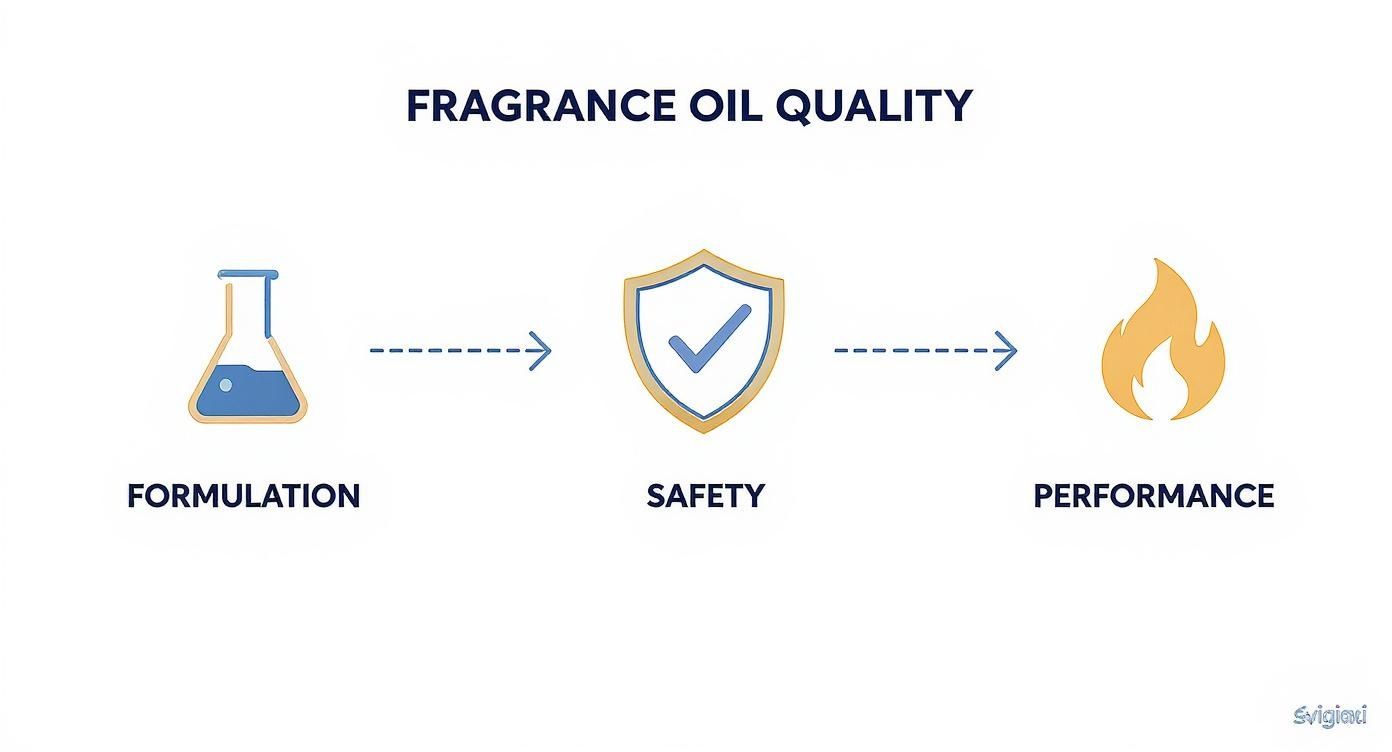
As you can see, a truly fantastic oil has to hit the mark in all three areas to give you that premium, safe, and powerful scent you're after.
Getting that amazing hot throw is where science and art really come together. When you light a candle, the flame melts the wax into a liquid pool. This heat gives the trapped fragrance molecules the energy they need to evaporate and float up into the air, carried by the warm currents rising from the flame.
The larger and deeper the melt pool, the more fragrance is released. This is why proper wicking is just as important as the fragrance oil itself; a good wick ensures an optimal melt pool, unlocking the full potential of the scent.
The fragrance load—the amount of fragrance oil you mix into the wax—also has a huge impact. It might seem like more oil means more scent, but every wax has its limits, usually somewhere between 6% and 12%. Go over that, and the oil can start to seep out of the wax, which can ruin the burn and even be a safety risk.
If you're curious to learn more, you can get a deeper understanding of what candle throw is and why it's so important for the final candle. Nailing this balance is the secret to creating a candle that not only smells incredible on the shelf but performs beautifully when lit.
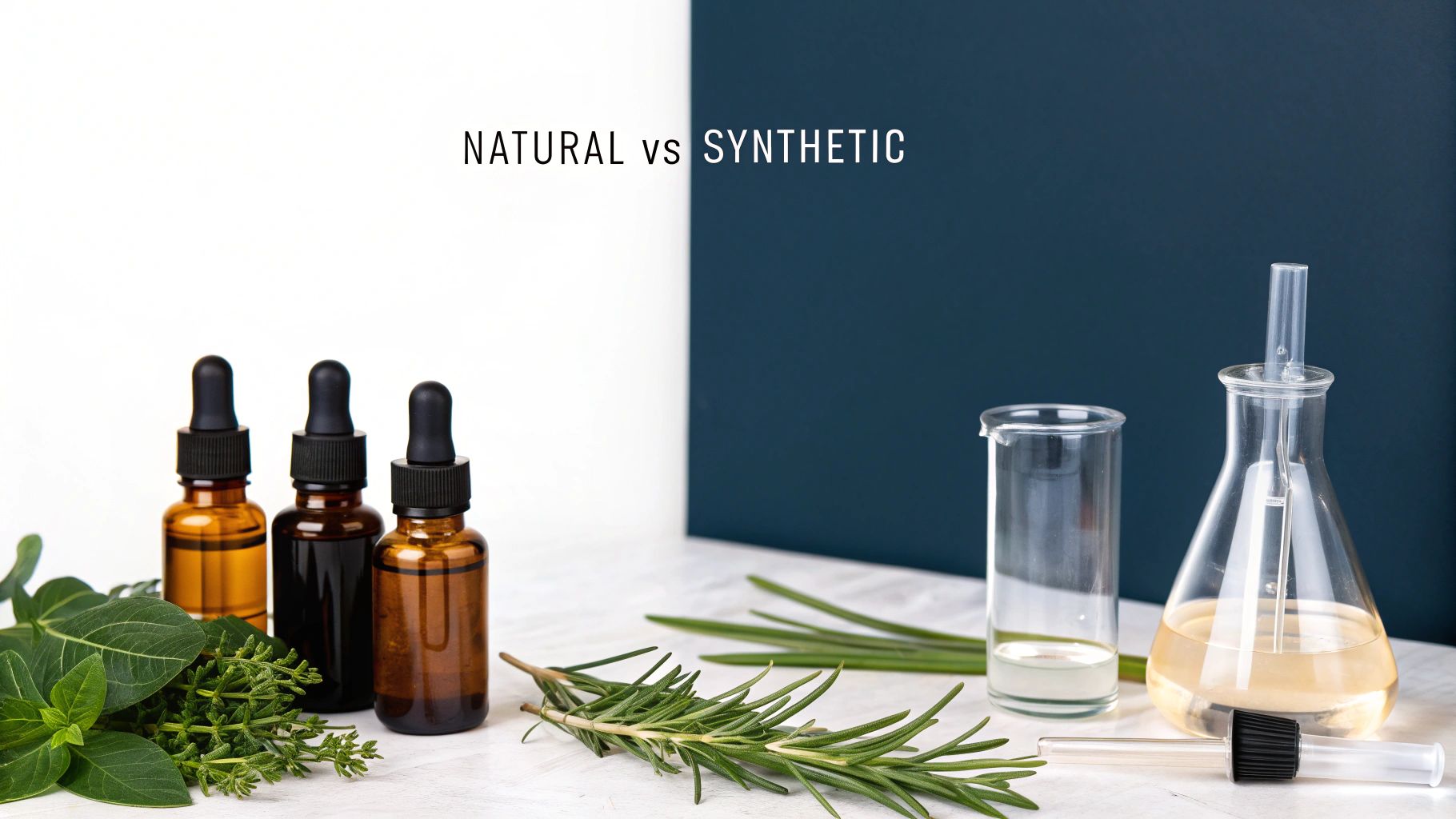
Let's clear the air on a big misunderstanding in the candle world: the idea that "natural" always means "better." When it comes to high-quality candle fragrance oils, the real story is much more interesting. True quality isn't about where an ingredient comes from, but how it's used in a safe, masterful formulation.
Many of the most popular and reliable fragrances you love are actually a thoughtful blend of natural essential oils and safe, lab-created aroma chemicals. This combination gives perfumers a huge creative palette, letting them design scents that are not just gorgeous, but also consistent every single time you light the wick.
This team effort between natural and synthetic allows for some incredible results. While essential oils give a scent its authentic, earthy soul, synthetics can create aromas that are impossible to bottle straight from nature. Ever wonder how a candle can smell like "ocean spray," "fresh linen," or a perfectly ripe peach? That magic comes from the artful use of safe synthetic molecules.
Synthetics aren't a cheap shortcut; they're an essential tool for modern candle making. They bring some specific and powerful advantages to the table that natural oils alone just can't match.
Here’s why safe synthetics are so important:
The best perfumers don't pick sides; they see natural and synthetic ingredients as partners. They use essential oils for their raw, authentic character and then use synthetics to refine, stabilize, and perfect the fragrance into a consistently amazing final product.
This blended approach is all about giving you the sophisticated home fragrances you're looking for. The global scented candle market, valued at a whopping $4.36 billion, is growing fast, thanks to a huge interest in wellness and high-quality aromatherapy at home. People want complex, captivating scents that perform beautifully, and blended oils are the secret to making that happen.
At the end of the day, the debate isn't about natural versus synthetic. It's about quality versus mediocrity. Both essential oils and synthetic fragrance oils have a role to play. To dive deeper into how they differ, you can read our detailed breakdown of fragrance oils vs. essential oils. What matters most is that the ingredients are safe, phthalate-free, and chosen to create the best possible scent experience for you.
Let's talk about something that's even more important than a jaw-droppingly beautiful aroma: safety. At the end of the day, a high-quality candle fragrance oil is a safe one. A scent can be absolutely perfect, but if it's not formulated for safe use in candles, it's a non-starter. This is where the pros are separated from the hobbyists.
Fortunately, you don’t have to just take a supplier's word for it. The fragrance world has a global authority that keeps everyone in check and ensures the products we all use are safe.
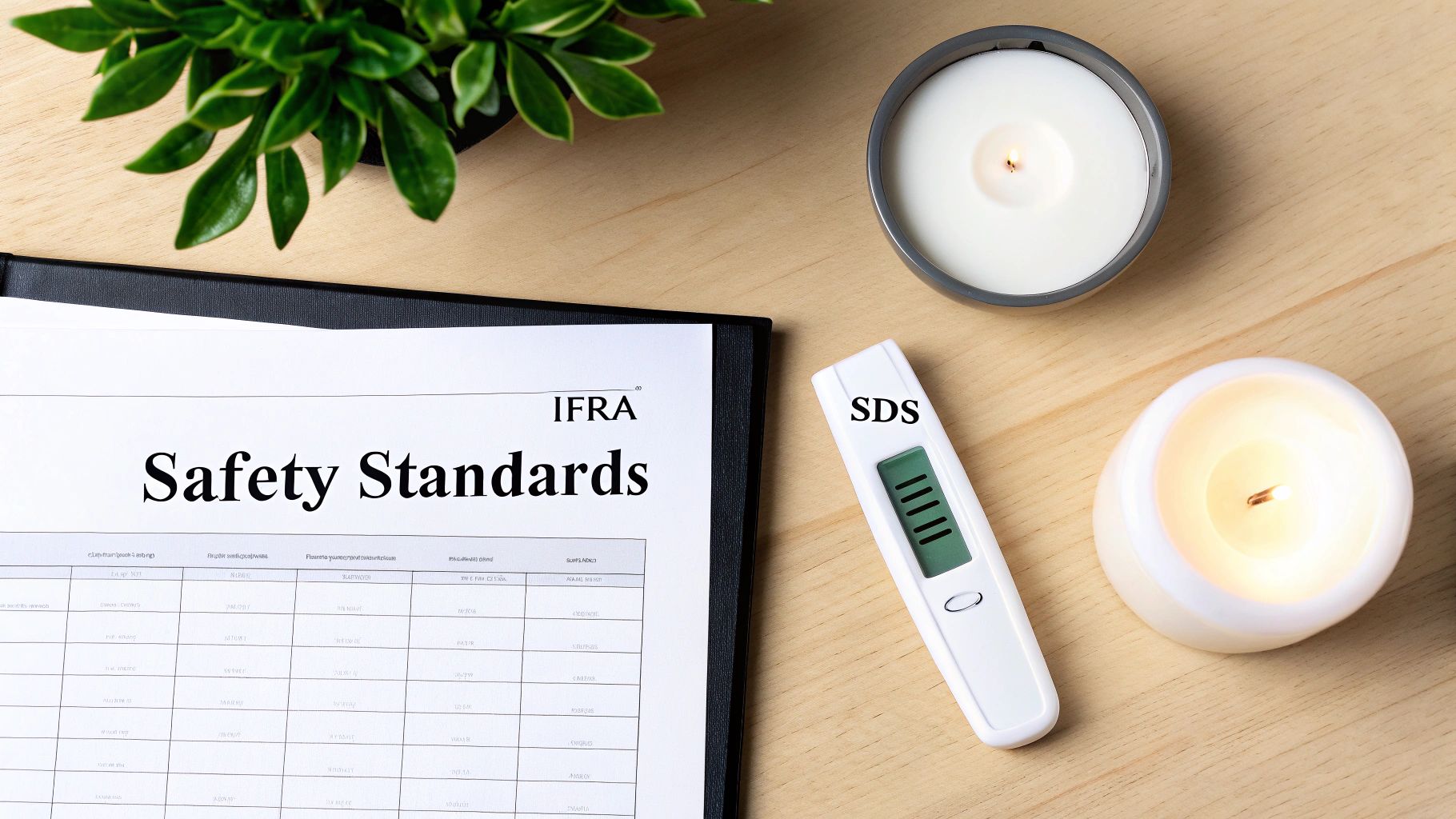
The International Fragrance Association (IFRA) is the big one. Think of them as the worldwide safety regulators for pretty much anything that smells good. Their entire purpose is to set global standards for the safe use of fragrance ingredients, all based on heavy-duty scientific research. They're looking out for things like skin sensitization, irritation, and other potential reactions to protect consumers.
So, when a supplier says their oil is “skin-safe” or “compliant,” they’re almost always talking about these IFRA standards. A reputable company will provide an IFRA conformity certificate for every single fragrance oil they sell. This little document is your golden ticket, the proof that the oil is safe and up to code.
At first glance, an IFRA certificate can look like a bunch of technical jargon, but it's actually pretty simple once you know where to look. The document is broken down into numerous product categories, each with a maximum safe usage level. As a candle maker, you can ignore almost all of them and zero in on just one.
Your key to safety is IFRA Category 12. This category is specifically for candles and other similar products that release fragrance into the air without touching your skin. The percentage you see next to Category 12 is the absolute maximum amount of that fragrance oil you can safely use in your wax.
For example, if the certificate says 10% for Category 12, you know that using a fragrance load up to that amount is perfectly fine and meets global safety standards. It’s a clear, straightforward number that lets you create with total confidence.
The IFRA certificate tells you how much oil you can use, but there are a couple of other documents that are just as crucial for understanding what you're working with.
First up is the Safety Data Sheet (SDS). This provides all the vital info about the oil itself—what’s in it, how to handle it safely, and its flashpoint. The flashpoint is the temperature at which the oil's vapors could ignite, which is obviously critical information for a candle maker.
Finally, always check for a clear statement that the oils are phthalate-free. Phthalates are chemicals that have raised health concerns over the years, and their absence is a real sign of a modern, high-quality formulation. Good suppliers make this information easy to spot, giving you one less thing to worry about.
Alright, you've got the theory down, but what about putting it into practice? Let's move from knowing what makes a great fragrance oil to knowing how to find one.
Sourcing high quality candle fragrance oils isn’t about chasing the lowest price tag. It’s about finding partners who are just as obsessed with quality as you are. Think of this as your playbook for navigating the market like a pro.
https://www.youtube.com/embed/67Ca29F3JeI
First things first: treat every potential supplier like you’re conducting an interview for a key position on your team. Why? Because they are. A reputable company won’t just be transparent; they'll be proud to show you comprehensive documentation for every single oil they sell.
Before you even dream of adding an oil to your cart, you need to see the paperwork. This stuff is non-negotiable. It's your first and most important quality check, proving the supplier follows industry standards and actually cares about safety.
When you're checking out a new supplier, this is what you need to look for. A top-notch company will have all this information front and center, usually right on the product page. No digging required.
To make it easier, here's a little checklist to help you evaluate potential partners.
| Supplier Quality Checklist | ||
|---|---|---|
| Quality Indicator | What to Look For | Why It Matters |
| IFRA Certificates | The specific document confirming safe usage levels for candles (Category 12). | This tells you the maximum percentage of that oil you can safely use in your candle formula. It's a critical safety standard. |
| Safety Data Sheets (SDS) | A detailed document providing all safety info, especially the oil's flashpoint. | The flashpoint is the temperature at which the oil's vapors can ignite. You MUST add fragrance oil below this temp to avoid a fire hazard. |
| Phthalate-Free Statement | A clear, easy-to-find declaration that their oils are formulated without harmful phthalates. | Customers are savvy about clean ingredients. This shows the supplier is committed to modern, safer formulations. |
| Detailed Scent Descriptions | The perfumer's own notes on the top, middle, and base notes of the fragrance. | This goes beyond a simple name like "Vanilla Bean." It helps you understand how the scent will unfold as the candle burns. |
| Performance Notes | Honest reviews or notes on how the oil performs in different waxes (soy, paraffin, etc.), specifically mentioning scent throw. | This real-world feedback saves you time and money by setting realistic expectations for how the oil will behave in your products. |
This checklist is your first line of defense. If a supplier makes you hunt for these documents, consider it a major red flag.
A trustworthy supplier doesn’t just sell you a product; they give you the data you need to use it successfully.
Even with perfect paperwork, the ultimate proof is in the pudding—or in this case, the wax. The real test is how a fragrance oil performs with your specific wax, wicks, and containers.
Here’s the golden rule of sourcing: never, ever commit to a large batch of oil without testing it first. Always start by ordering small 1 oz. samples to make a few test candles.
This tiny upfront investment can save you from flushing hundreds of dollars down the drain on a fragrance that just doesn't work out. As you test, take meticulous notes on both the cold throw (how it smells unlit) and the hot throw (how it smells when burning). Does the scent live up to its description? Is it powerful enough? Does it burn cleanly without causing issues?
Building a great candle business is also about building great relationships. Sourcing isn't a one-time transaction; it requires managing vendor relationships effectively to ensure you always get consistent quality. A great supplier will feel more like a partner in your brand's growth.
And if you want a shortcut to some amazing scents, check out our guide to the best fragrance oils for candle making.
Even when you have the best supplies on hand, running into questions is just part of the candle making journey. Getting a handle on the common hiccups can save you a ton of time, money, and frustration. Let's walk through some of the most frequent questions we hear about working with high-quality candle fragrance oils.
Ever look at a finished candle and see little oily beads on the surface? That's called "sweating," and it's a dead giveaway that your fragrance and wax didn't quite become one. This almost always boils down to one of two things.
First, you might have just used too much fragrance. Every candle wax has a limit to how much oil it can hold, usually somewhere between 6% and 10%. Picture it like trying to stir too much sugar into iced tea—at some point, it just can't dissolve anymore and sinks to the bottom. Go past your wax's limit, and that extra oil has to go somewhere.
The second culprit is usually your blending technique. To get a really strong bond, you need to add your fragrance oil when the wax is hot enough, typically around 185°F (85°C). Then, you have to stir. And I mean really stir—gently but constantly for at least two solid minutes. This gives the oil a chance to fully mix in and bond with the wax molecules.
Every reputable fragrance oil supplier will list a "flashpoint" for their oils, and it's a number you need to pay attention to. The flashpoint is simply the lowest temperature where an oil's vapors could ignite if they meet a spark or flame. This isn't just some boring technical detail; it's a crucial piece of safety info.
You always, always want to add your fragrance oil to the wax at a temperature below its flashpoint. This prevents two big problems:
Always take a peek at the Safety Data Sheet (SDS) for this number before you even start melting your wax.
The flashpoint is a non-negotiable safety parameter. Respecting it protects both the beautiful scent of your candle and the safety of your creative process. A good supplier will always make this information clear and easy to find.
While you technically can, using pure essential oils in candles is often a recipe for disappointment. Essential oils are incredibly volatile and just aren't designed to be burned. When that tiny flame gets going, the high heat can cause them to burn off way too fast.
What you often end up with is a weak, spotty scent throw, or even worse, a smell that's more "burnt" than "beautiful." High-quality candle fragrance oils, on the other hand, are specifically crafted with more stable ingredients. They're built to bind with wax and release their true scent safely and consistently when heated.
Yes. A thousand times, yes. Phthalates are a group of chemicals that have been linked to health concerns over the years. While not all types are considered dangerous, the gold standard in the home fragrance world is to be completely phthalate-free.
Sticking to phthalate-free oils is a huge step in making sure the candles you create are safe for you, your family, and your customers. Any supplier worth their salt will proudly state that their oils are phthalate-free, which makes it easy for you to make a safe and responsible choice.
At Jackpot Candles, we're obsessed with creating an amazing experience from the very first light. That’s why we use our own special soy wax blend and exclusive, perfume-grade fragrances. It’s all about a clean burn and a gorgeous, room-filling aroma. Come discover the difference quality makes.
Explore our collection of premium scented candles at https://www.jackpotcandles.com and find a fragrance you'll fall in love with.
Comments will be approved before showing up.