
free shipping at $99


When it comes to candle making, the fragrance oil you choose is everything. Think of it like this: you can have the most beautiful jar and the smoothest wax, but if the scent is flat or smells artificial, the whole experience falls apart. That's where premium fragrance oils come in.
These aren't your average, one-note scents. They are complex, carefully crafted aromatic blends, using both natural and synthetic ingredients. The whole point is to create a scent that performs beautifully in candle wax, giving you a rich fragrance from the first sniff of the unlit candle all the way to the final flicker.
Ever had a truly fantastic cup of coffee? You know, the kind where you can taste hints of chocolate or fruit, and the aroma alone is an experience? A premium fragrance oil is the gourmet espresso of the candle world. It's not just about being "stronger"; it's a whole different level of artistry, ingredient quality, and safety.
A premium oil stands on three pillars: the complexity of the scent, the quality of the raw materials, and a serious commitment to safety standards. When you get all three right, you elevate a simple candle into something special—an entire mood in a jar. Let's dig into what really sets these oils apart.
A great fragrance tells a story. It doesn't just hit you with one smell; it unfolds over time through a "scent pyramid." This structure gives a fragrance its depth and personality, kind of like how different notes in a song combine to create a beautiful melody.
A basic, standard oil might just have one or two simple notes, which is why it can smell a bit flat. Premium oils, on the other hand, can weave together dozens of different aromatic components, creating a scent that evolves and deepens as your candle burns.
You can't get a beautiful scent from subpar ingredients. It's that simple. The best fragrance houses are obsessive about sourcing high-grade raw materials. They blend natural essences with high-quality synthetic components to get the perfect mix of performance, safety, and complexity.
It's a common myth that "all-natural" is always the best choice for fragrance. The truth is, master perfumers use top-tier synthetic aroma chemicals for good reason. They can recreate scents that are unethical to source (like animal musk), ensure every batch smells exactly the same, and even invent incredible new fragrances that you'd never find in nature.
This dedication to quality ingredients is what prevents those dreaded "scorched" or "chemical" smells you sometimes get from lower-grade oils. When you choose premium fragrance oils for candles, you're really investing in a cleaner, more sophisticated, and unforgettable scent experience.
If you’ve ever been around candle makers, you’ve probably heard the term "scent throw." It’s our way of describing how well a candle's fragrance fills a room. Scent throw is the magic that happens when a lovely, subtle scent from an unlit candle becomes a rich, immersive experience the moment you light the wick. For any candle maker, nailing that powerful, consistent scent throw is the ultimate prize.
A good way to think about it is like making a cup of tea. When you open a box of tea bags, you can smell the delicate, pleasant aroma of the dry leaves—that's your cold throw. But the real magic starts when you drop that bag into hot water. The heat unlocks all the deep, complex fragrances, filling the air around you. Candles work on the same principle: the flame melts the wax into a liquid pool, which then releases the fragrance molecules into the air. We call this the hot throw.
Getting a handle on the difference between cold and hot throw is absolutely crucial. A fantastic cold throw is what makes someone pick up your candle in a store and fall in love. But a fantastic hot throw is what turns them into a loyal customer who comes back again and again.
We've all seen it: a candle that smells incredible on the shelf but gives off almost no scent when you bring it home and light it. It's a huge letdown. On the flip side, a candle that seems pretty subtle when unlit but envelops your living room in a gorgeous aroma is a massive win. The true test of premium fragrance oils for candles is how well they perform on both fronts.
Perfecting your scent throw isn't as simple as just dumping more fragrance oil into your wax. It’s a delicate dance between a few key elements, and if one of them is off, it can throw off the whole performance.
"A great hot throw is the result of synergy between the wax, the wick, and the fragrance oil. When these three elements are perfectly matched, the fragrance is released efficiently and evenly, creating a truly immersive aromatic experience."
This infographic breaks down the core pillars that make a fragrance oil "premium," showing how quality and safety are the foundation for a reliable scent throw.
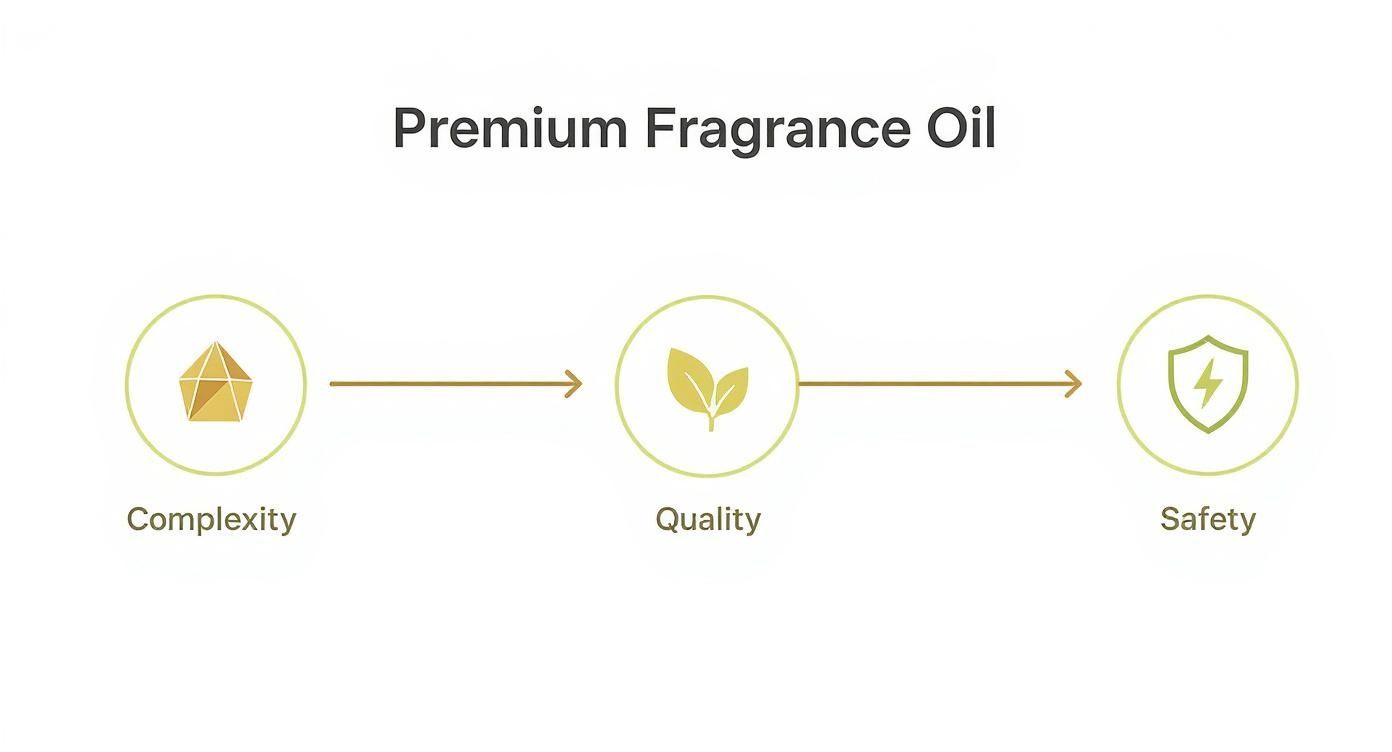
As you can see, things like scent complexity, high-quality materials, and rigorous safety testing all come together to create an oil that performs beautifully. This demand for top-tier, luxurious candles is fueling some serious market growth. The global luxury candle market was valued at USD 603.2 million and is expected to rocket to USD 1,367.1 million, growing at a compound annual rate of 12.4%.
For a deeper dive, you can check out our complete guide on what candle throw is and why it's so important.
The type of wax you choose will have a huge impact on how your fragrance oil behaves. Some waxes are known for their strong hot throw, while others excel at cold throw. Here’s a quick breakdown to help you match your fragrance to your wax.
| Wax Type | Hot Throw Potential | Cold Throw Potential | Best Practices |
|---|---|---|---|
| Paraffin | Excellent | Good | Often considered the best for a strong hot throw. Blends well with most fragrances. |
| Soy Wax | Good | Excellent | Requires longer cure times (1-2 weeks) to develop the best hot throw. |
| Beeswax | Fair | Fair | Has its own natural honey scent that can compete with added fragrances. |
| Coconut Wax | Excellent | Excellent | Holds a high fragrance load (up to 12%) and provides a clean burn with great throw. |
Ultimately, testing is key. Every fragrance oil is a unique blend of ingredients that will interact differently with each wax. Don't be afraid to experiment to find that perfect combination for your candles.
Walking into the world of fragrance oils can feel a little overwhelming. With what seems like a million options, how do you possibly land on the one that perfectly captures the vibe you're going for?
The secret isn't just sniffing a bottle and hoping for the best. It's about putting on your detective hat and getting to know a fragrance's full story—from the first impression to the scent that lingers long after the flame is out. Let’s break down how the pros do it.
Think of scent families as the primary colors of the fragrance world. They’re broad categories that give you a starting point, helping you immediately narrow your search and filter out what you don't want.
Once you know the feeling you want to create, you can head straight for the right family. Designing a candle for a spa-like bathroom? Start your search in the "Fresh" category. Crafting a cozy holiday scent? "Gourmand" or "Woody" is your perfect jumping-off point.
Okay, so you've picked a family. Now it's time to look a little closer at the oil's structure, or what we call the scent pyramid. A truly premium fragrance is designed to be a journey, evolving as the candle burns. This pyramid is your road map.
Top notes are your first impression—what you smell right away. Middle notes are the heart of the fragrance that appears next. And base notes are the deep, rich scents that linger the longest.
This layered complexity is the signature of a high-quality oil. It's what separates a "flat" scent from a dynamic, luxurious experience. This demand for sophisticated, well-crafted fragrances is why the market is booming. Projections show the fragrance oil market is expected to grow from USD 13.70 billion to USD 21.97 billion, with a steady annual growth rate of about 4.38%. You can discover more insights about the fragrance oil market on Market Research Future.
This last step is the most important one. Before you fall in love with a scent, you have to make sure it's safe and that you're buying from a reputable source. This is where you separate the pros from the hobbyist suppliers.
First, always, always look for the IFRA (International Fragrance Association) certificate. This is non-negotiable. This document tells you the maximum percentage of that specific oil that is safe to use in candles. Skipping this step can lead to skin irritation or create other safety hazards.
Next, do a little digging on your supplier. A trustworthy source for premium fragrance oils for candles won't hide information.
Here’s a quick checklist for a great supplier:
By following this three-step process—finding your family, reading the scent pyramid, and verifying safety—you'll be able to choose fragrance oils with total confidence. You'll know that every candle you pour isn't just a product, but a true sensory success.
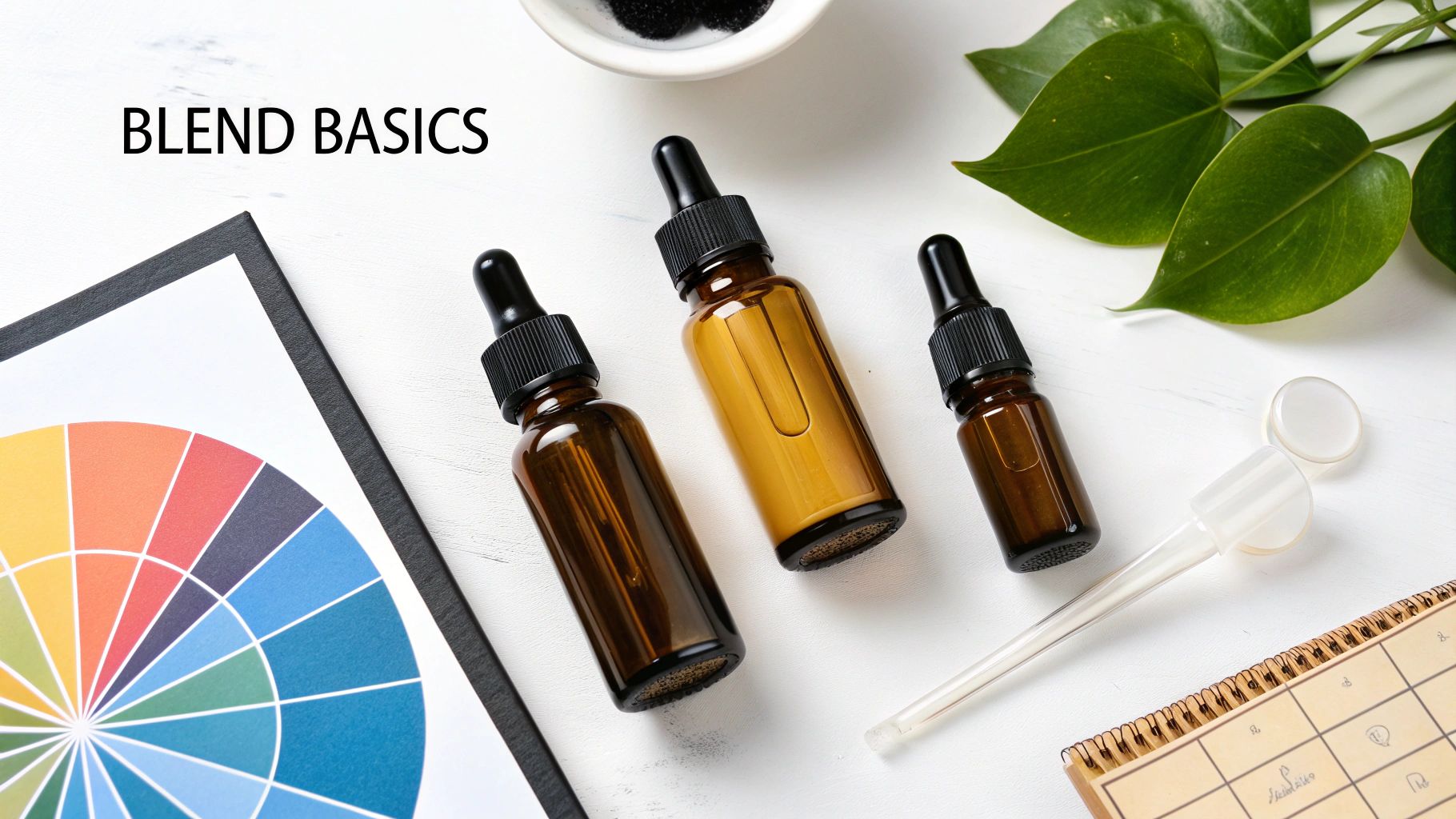
This is where the real magic happens. Moving past single-note fragrances and into blending is like graduating from following a recipe to creating your own. You become a scent artist, mixing and matching different notes to build something that’s uniquely yours.
When you combine different premium fragrance oils for candles, you're crafting an experience that can’t be bought off a shelf. You can design an aroma that tells a story, sparks a specific memory, or sets the perfect mood. It's the ultimate way to put your personal stamp on your creations.
Before you start pouring, you need a map. For scent blending, that map is the fragrance wheel. Think of it as a color wheel, but for your nose. It organizes different scent families in a way that shows you what works together beautifully and what creates an exciting contrast.
The wheel helps you blend with purpose instead of just guessing. It's the secret to building complex, layered scents that don't end up smelling muddy or confusing.
When you're just starting, simple is best. A great, nearly foolproof starting point is the 30-50-20 rule. It’s a classic ratio that helps you build a balanced scent with a clear beginning, middle, and end, just like a professional perfume.
The 30-50-20 Blending Rule:
- 30% Top Notes: These are the first scents you notice, the bright and sparkly introduction.
- 50% Middle Notes: This is the heart of your fragrance—the main event of your scent story.
- 20% Base Notes: These are the deep, grounding notes that anchor the scent and give it a lasting finish.
Let's say you wanted to create a simple, elegant blend. You could try:
This gives you a bright, herbal scent that mellows into a warm, woody base. The best part is you can scale this ratio for any size batch. A pro tip: always test your blend on scent strips before mixing it into a big pot of wax. This lets you tweak your creation without wasting good materials.
As you get into your blending groove, you’ll quickly learn that not all combinations are winners. Knowing a few common pitfalls can save you a lot of time, frustration, and precious fragrance oil.
Here are a few things to watch out for:
Once you nail these basics, you’ll be on your way to crafting truly memorable scents. If you're looking for more inspiration on combining aromas, these fragrance layering tips can offer great inspiration. And for those interested in getting back to basics, learning about creating your own custom oil infusions from natural sources can open up a whole new world of possibilities.
Picking out a spectacular fragrance oil is only half the battle; the other half is won in your workshop. The way you introduce that oil to your wax is a make-or-break moment that dictates everything from scent throw to how your finished candle looks.
Think of it as a delicate dance—if the timing and conditions aren't just right, the fragrance and wax won't bond properly. This is where your technique really shines. Let's walk through the essential steps to get that perfect, fragrant candle every single time.
The fragrance load is simply the percentage of fragrance oil you add to your wax, measured by weight. It's a common myth that more oil automatically means a stronger candle. That's just not how it works! Overloading your wax can actually cause a whole host of problems.
You might see the oil literally seeping out of the wax (we call this "sweating"), or you could get a weak hot throw because the oil isn't properly locked in. Most waxes perform their best with a fragrance load somewhere between 6% and 10%. Always, always check your wax supplier's recommendations—they know their product inside and out.
A correctly calculated fragrance load is the foundation of a safe, high-performing candle. It ensures the oil molecules bind perfectly with the wax molecules, creating a stable structure that releases scent beautifully when you light the wick.
So, how do you figure it out? First, decide on your percentage. Then, you just multiply the total weight of your wax by that percentage. For example, if you're using 500 grams of wax and want an 8% fragrance load, your math looks like this: 500g x 0.08 = 40g of fragrance oil. Easy!
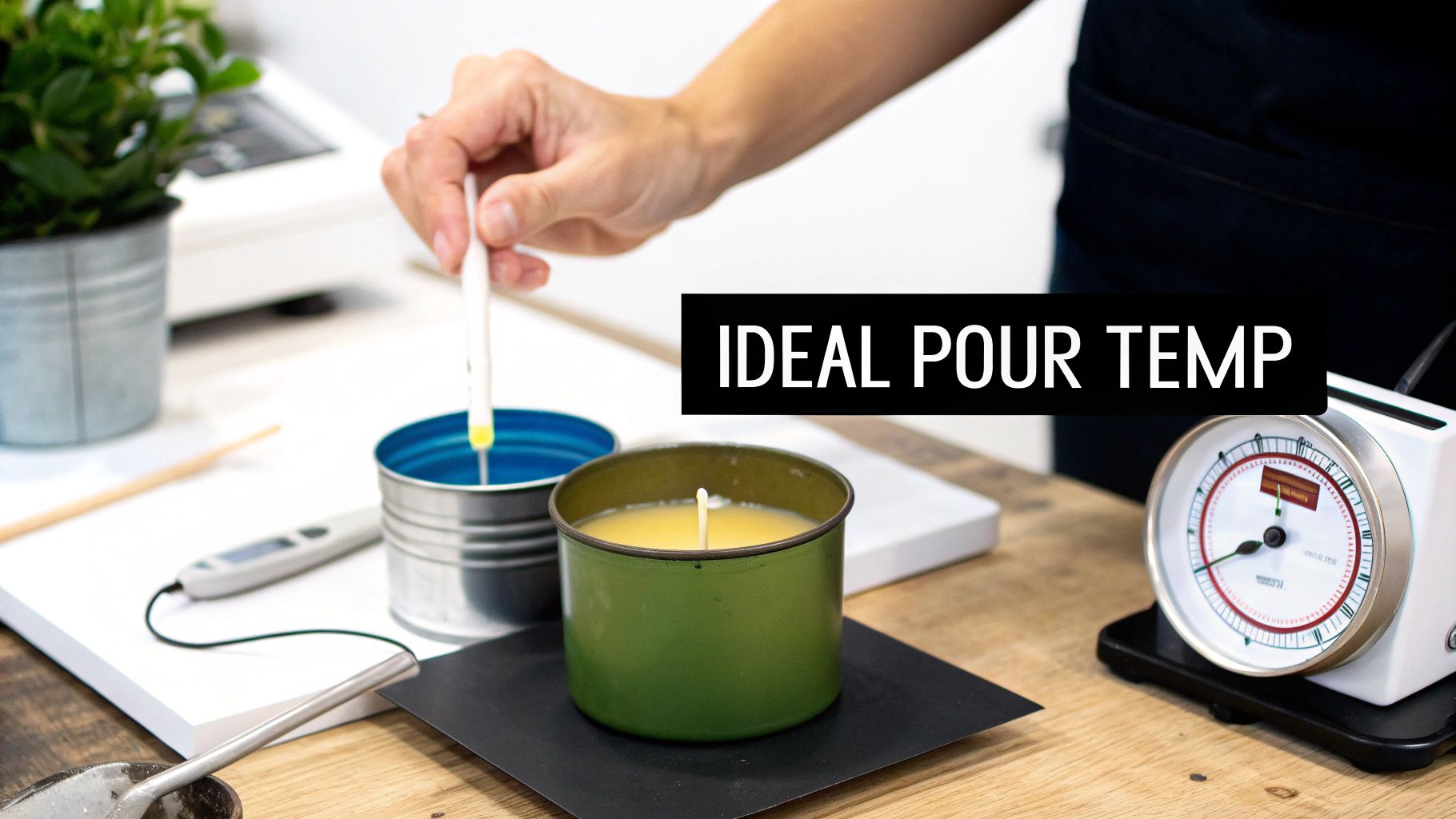
Temperature might just be the most critical part of this whole process. If you add your fragrance oil when the wax is scorching hot, you risk burning off the delicate top notes of your scent, leaving you with a flat, weak aroma. But if you add it when the wax is too cool, the oil won't bind correctly, leading to that dreaded sweating and a lackluster scent throw.
Every fragrance oil has a flashpoint—the temperature where its vapors could ignite. You’ll be working well below this, of course, but it's a good clue to the oil's volatility. The sweet spot for adding fragrance is typically between 180°F and 185°F (82°C to 85°C). This range is hot enough for a solid molecular bond but cool enough to keep the entire scent profile intact.
To make things easier, here’s a quick reference chart for common fragrance loads. Remember to use a digital scale for accuracy—eyeballing it won't cut it here!
| Wax Weight (grams) | Fragrance Load at 6% | Fragrance Load at 8% | Fragrance Load at 10% |
|---|---|---|---|
| 250 | 15 grams | 20 grams | 25 grams |
| 500 | 30 grams | 40 grams | 50 grams |
| 1000 (1kg) | 60 grams | 80 grams | 100 grams |
This chart is a great starting point, but always double-check the maximum load your specific wax can handle.
Once you've added your perfectly measured fragrance to the correctly heated wax, the final step is a good stir. The goal here is to create a seamless emulsion, distributing the oil evenly throughout the wax without whipping up a bunch of air bubbles.
Follow these simple steps for a perfect mix:
By mastering these three key techniques—precise calculation, temperature control, and proper stirring—you guarantee that every drop of your premium fragrance oils for candles works its magic. This attention to detail is what elevates a simple homemade candle into a truly artisanal creation.
Lately, it seems like everyone is paying more attention to what they bring into their homes. It’s no surprise that the demand for natural, sustainable, and clean-burning candles has absolutely skyrocketed. This has put a huge spotlight on the real heart of a candle: its fragrance oil.
To pick a candle that not only smells amazing but also aligns with your values, you first have to understand what you're smelling.
The conversation usually boils down to three main characters: synthetic fragrance oils, natural fragrance oils, and pure essential oils. It’s so easy to just assume that "natural" automatically means "better," but when it comes to candle making, the truth is a lot more interesting than that. Each type has its own strengths and weaknesses, especially when you introduce the heat of a candle flame.
Let's break down what these terms actually mean when you're crafting a high-quality candle.
Synthetic Fragrance Oils: These are the workhorses of the candle world, created by experts in a lab. They give us incredible consistency, complex scent profiles, and amazing performance. Synthetics allow for scents you simply can't find in nature. Plus, the best ones are rigorously tested for safety and can be more sustainable than harvesting rare plants.
Essential Oils: These are the real deal, derived directly from plants. While they offer beautiful, authentic botanical aromas, they can be super fussy in a candle. The high heat from a flame can completely change their chemical makeup, sometimes killing the scent or, even worse, creating a weird, burnt smell.
You have to remember, a fragrance oil is designed to do one thing really well: smell fantastic in an application like a candle. Essential oils are prized for their therapeutic benefits, which often don't survive the intense heat of a burning wick.
This push for ingredient transparency is a huge deal. The global scented candle market, valued at USD 4.36 billion, is expected to hit USD 5.6 billion soon, and it's this exact trend toward natural waxes and high-quality, safe scents that's fueling the growth. You can read more about the 2025 scented candle market trends on Primacyind.com.
For a deeper dive into these scent sources, our guide on fragrance oils vs. essential oils breaks it all down.
At the end of the day, choosing premium fragrance oils for candles usually means finding a masterfully blended, phthalate-free oil. This gives you the best of all worlds: safety, sustainability, and a scent that truly fills the room.
As you get more into the art of candle making, you’re bound to have some questions pop up. Getting straight answers is the best way to build your confidence and really nail your technique. This section is all about tackling the most common questions we hear about using premium fragrance oils for candles.
Think of this as your go-to guide. We'll give you clear, practical answers to solve those little issues and help you perfect your process. The goal? Making sure every single candle you pour is a stunner.
Yes, absolutely—as long as you're getting them from a reputable supplier and using them the right way. The real key is to look for oils specifically made for candle making and to make sure they are phthalate-free. Phthalates are chemicals sometimes used to make scents stick around longer, but top-notch suppliers know to leave them out.
The most important piece of paper you'll need is the IFRA (International Fragrance Association) certificate for every oil. This is non-negotiable. It tells you the maximum percentage of that oil you can safely use in a candle. Any good supplier will have this info ready and waiting for you, so you can create with total peace of mind.
When you store them right, fragrance oils have a pretty solid shelf life, but they won't last forever. Generally, you can expect a high-quality oil to stay perfect for about one to two years. Of course, this can change depending on what the oil is made of.
Fragrance oils heavy on citrus top notes tend to be a bit more fragile and might have a shorter life, sometimes closer to six to twelve months. On the flip side, oils with rich base notes like vanilla or sandalwood can last much, much longer.
To get the most out of your oils, keep them in a cool, dark spot. You want to avoid direct sunlight and big temperature swings. And always, always screw the cap on tight to keep oxygen out, which can mess with the scent over time.
This is easily one of the biggest headaches for candle makers, and it usually boils down to a few key things. First, double-check your fragrance load. Are you using the right amount for your wax? It’s typically between 6-10%. Too little oil and the scent will be shy; too much and it can actually mess up how the candle burns.
Next, take a look at your temperatures. If you add your fragrance oil when the wax is scorching hot, you can literally burn off all those lovely top notes. But if you add it when the wax is too cool, the oil and wax won't bond correctly.
Finally, don't forget about curing time. This is so important. Most candles, especially those with natural waxes like soy, need a good one to two weeks to cure. This gives the fragrance time to fully mix and bind with the wax, unlocking its true scent potential.
At Jackpot Candles, we believe in creating unforgettable experiences. Our candles are crafted with a proprietary soy wax blend and exclusive, perfume-grade fragrances to ensure a rich, powerful aroma that fills your home. Discover your next favorite scent and the surprise jewelry hidden inside today!
Comments will be approved before showing up.