
free shipping at $99


The most popular candle advice is also the least useful: soy is automatically clean, while paraffin is automatically harmful. A candle doesn't burn its label. It burns a particular mixture of wax, fragrance, wick, dye, and air, inside a particular container.
That distinction matters with scented soy blend candles. Soy can provide a plant-based foundation, but the final experience depends on how the maker balances the formula. Fragrance concentration affects vapour release, wick geometry controls the melt pool, and the room itself affects flame behaviour. Even the difference between a smooth, steady burn and a smoky one can come from a wick that is excessively large.
Soy remains a major candle material rather than a niche alternative. One industry summary reports that plant-based waxes such as soy represent roughly 30% of the candle market, while another estimates the soy wax market at about $6.15 billion in 2025 and projects $14.3 billion by 2030, with a 9.4% CAGR (industry market summary). Those figures show its commercial importance, not that every soy candle performs equally.
A label reading “100% soy” identifies the wax base, but it cannot predict the candle's scent throw, flame stability, or burn pattern. The same label leaves unanswered whether the candle will scent a room, tunnel down the centre, smoke at the rim, or form an uneven melt pool.
Wax family is often treated like a safety verdict. That shortcut overlooks the candle as a working system, where wax, fragrance, wick, container, and room conditions interact. A carefully tuned soy blend may produce less visible soot than a poorly wicked candle made from one wax. A well-formulated paraffin candle may also burn more cleanly than a neglected soy candle. Comparable chamber testing found similar total gaseous and particulate emissions across four wax types, including soy, under comparable conditions, as summarized by the National Candle Association.
Read the headline wax claim as a starting point, then ask:
Practical rule: Treat “soy” as the starting material, not the final performance grade.
Soy still affects the candle's feel and origin, but those traits cannot correct a mismatched wick or excessive fragrance. A better question to ask any maker is whether this specific candle was tested as a complete system, with its wick and fragrance included.
A soy blend candle combines hydrogenated soybean oil with one or more complementary waxes. The added wax may be coconut, apricot kernel, palm, paraffin, or another material selected to correct a specific weakness in soy.
A blend works like a recipe correction. Soy may provide a soft texture and a plant-based identity, while a second wax can help address slow melt-pool growth, uneven tops, frosting, surface firmness, or fragrance handling. The finished candle reflects the combined formula, not the behaviour of soy alone.
A 100% soy candle gives the maker one main wax system to manage. That can produce a pleasant finish, but it may also require more careful control of cooling, wick size, and fragrance. A blend offers more variables to tune. Its performance still depends on the complete combination of wax, fragrance, container, and wick.
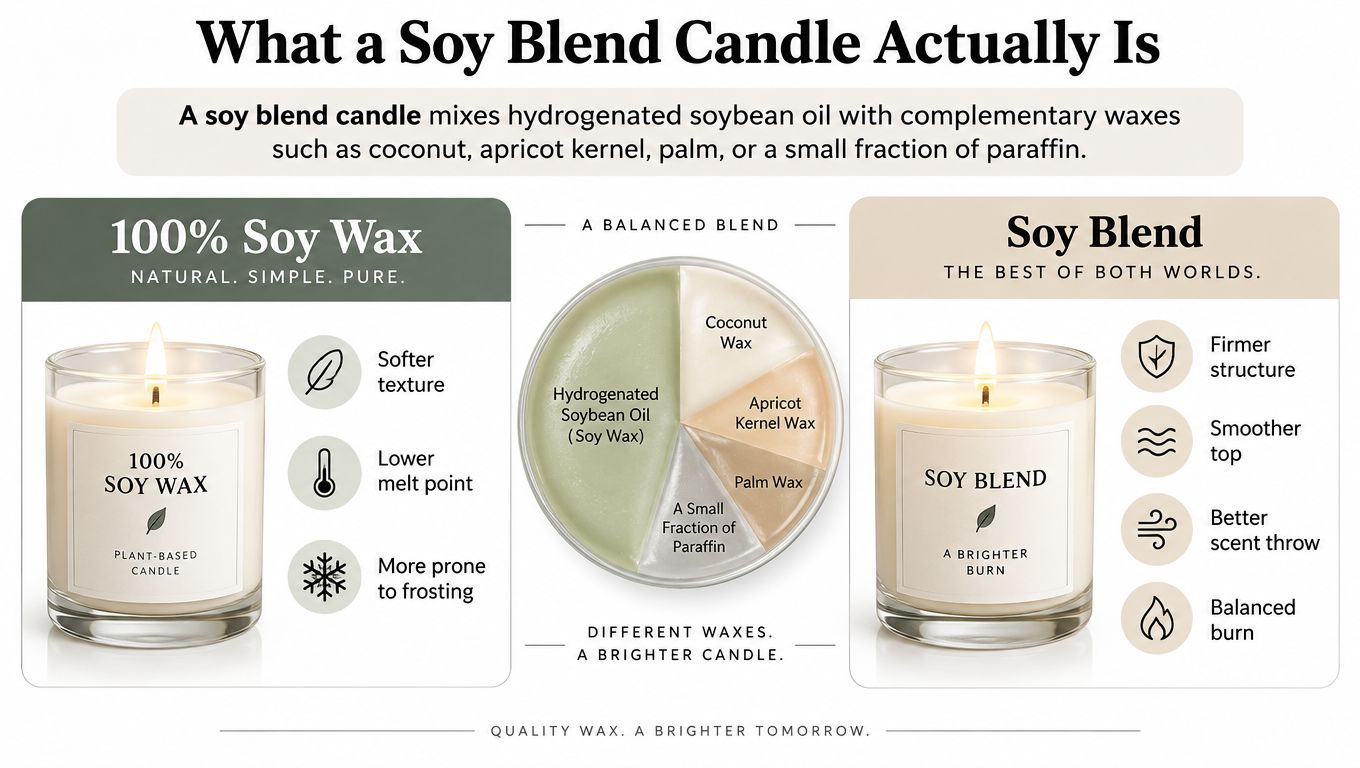
The recipe can vary widely. “Soy blend” might mean mostly soy with a small amount of another wax, or several waxes in a balanced formula. The label alone cannot reveal the ratio unless the maker provides an ingredient breakdown.
For background, shoppers can read this overview of soy wax for candles before comparing blend formulas. The key point is simple: “blend” describes a combined wax system, not one fixed formula. To judge scent throw and burn quality, read beyond the headline wax claim and look for evidence that the formula was tested as a complete candle.
Fragrance load is the amount of fragrance oil measured against the weight of the wax. Candle makers weigh both materials rather than relying on volume because fragrance oils have different densities, and a spoonful doesn't provide a dependable comparison.
A formula with a modest fragrance load may smell faint even when the wax is well chosen. A formula loaded aggressively may smell powerful but burn poorly if the wick and wax can't manage the extra oil. CandleScience lab notes describe fragrance being incorporated at 180°F and report successful fragrance retention at up to 10% load without syneresis in the tested soy wax formulation (soy wax lab notes). Syneresis is the candle maker's term for oil separating from the wax, appearing as beads or a damp-looking surface.
| Fragrance Load | Typical Use | Performance Notes |
|---|---|---|
| Lower load | Lightly scented or decorative candles | May produce a subtle aroma, especially in a large room |
| Moderate load | Everyday scented container candles | Often provides a balance between scent and burn stability |
| Higher load | Strongly scented artisan formulas | Requires careful testing for sweating, flame behaviour, and soot |
| Up to 10% in the cited lab test | Tested soy formulation | Retained fragrance without syneresis under the reported conditions |
The table describes formulation logic, not a universal recipe. A load that works in one soy-coconut wax can fail in another because wax capacity, fragrance chemistry, pour temperature, cure time, and wick design all interact.
Fragrance also behaves differently in a candle than in a perfume. Readers comparing scent concentration may find Middle Eastern eau de parfum explained helpful for understanding why the amount and structure of aromatic material influence perceived strength, even though a candle and a wearable fragrance use different bases.
A candle can't turn an under-loaded formula into a strong scent simply because the label says “premium.”
For shoppers, transparent language is more useful than “maximum scent.” Look for named fragrance notes, clear wax ingredients, and information about testing. Guidance on high-quality candle fragrance oils can also help explain why fragrance selection matters as much as the wax itself.
Candle makers use cold throw and hot throw to describe two different experiences. Cold throw is the aroma you notice when the candle is unlit. Hot throw is the fragrance released while the wax melts and the flame warms the fragrance-bearing pool.
A candle can perform well in one category and poorly in the other. A jar may smell rich on a shop shelf yet become faint after lighting, or it may seem quiet when cold but develop a fuller aroma once the pool warms.
The melt pool acts like a warm diffuser. As the flame heats the wax, fragrance moves from the liquid pool into the air. If the pool stays narrow because the wick is too small, less wax is heated and the room may receive less fragrance. If the wick is too large, the pool may become excessively hot, the flame may grow unstable, and soot can increase.
A coconut-containing blend often carries fragrance efficiently and can produce a broader pool than firm 100% soy. Apricot-containing formulas may give a softer, rounded scent impression, while 100% soy may need more careful wick selection to avoid tunnelling and weak hot throw. These are formulation tendencies, not guarantees.
| Wax Base | Cold Throw | Hot Throw | Typical Load for Strong Throw |
|---|---|---|---|
| 100% soy | Depends on fragrance and cure | Often requires careful wick and formula testing | No universal load |
| Soy-coconut blend | Often noticeable when well formulated | Frequently supports a broad, expressive throw | Depends on wax capacity |
| Soy-apricot blend | Often soft and smooth | Can present lighter notes evenly | Depends on fragrance chemistry |
| Soy-paraffin blend | Varies by recipe | May deliver strong release from a tested formula | Depends on the complete system |
Because these ratings depend on the exact formula, a numerical score would create false precision. A useful guide to soy candle scent throw should therefore be read as a testing discussion, not a promise that every candle with the same wax name will smell identical.
“Clean burning” sounds scientific, but it is not one regulated performance standard. A candle releases combustion products from its flame, warmed wax, fragrance materials, and wick. Wax type matters, yet it is only one part of the indoor-air picture.
A controlled bedroom test found paraffin candles emitted 50 to 60 times more PM2.5 than soy candles in that setup. The soy candles still produced about twice the PM2.5 of matches alone (controlled emission study). The same study reported 146 µg/g of particulates and condensates from high-soot soy candles, compared with 6 to 10 µg/g for reference candles. These results show why wick behavior, soot, and testing conditions matter more than a simple soy-versus-paraffin label.
Fragrance can change the picture substantially. One chamber-study discussion compares 204 µg/h of total VOCs from unscented soy wax with 9,408 µg/h when fragrance was added, a 46-fold increase (fragrance and soy emissions discussion). That comparison does not establish that every fragranced candle is unsafe. It does show that fragrance chemistry and load deserve as much attention as the wax family.
A separate National Candle Association chamber-study summary describes soy and other wax types behaving similarly overall in gaseous and particulate emissions. The advisory committee used a 5% fragrance load by weight to represent typical European and North American formulations. This does not make every candle equivalent. It means soy should not be treated as automatically emission-free, or paraffin as automatically hazardous, without considering the complete formula and burn conditions.
PM2.5 consists of very small particles that can remain suspended in indoor air. For shoppers concerned about home air quality, ventilation, shorter burn sessions, wick trimming, and fragrance intensity all matter. Broader household guidance is available in this resource on home air quality.
| Candle comparison | Reported PM2.5 | Reported total VOCs |
|---|---|---|
| Unscented soy wax | Not reported in the cited comparison | 204 µg/h |
| Fragranced soy wax | Not reported in the cited comparison | 9,408 µg/h |
| Soy versus paraffin in a sealed bedroom | Paraffin emitted 50 to 60 times more PM2.5 | Not reported |
The figures come from different tests, so they should not be combined into a single ranking. Qualitative factors, including soot, wick size, fragrance load, ventilation, and burn duration, can change results. A tested, properly wicked candle is more meaningful than a wax slogan.
Wick sizing has to match the blend, not the word “soy” on the label. Wax texture affects how quickly the melt pool spreads, fragrance load affects how much aromatic material enters that pool, and the wick controls how heat reaches the fuel.
A soy-coconut blend may reach the jar edge readily, so a wick selected for a firmer 100% soy formula could create too much heat. A soy-apricot blend may need a different balance because its softer texture and fragrance release can change how the flame consumes fuel. The same wick can therefore produce different results across blends.
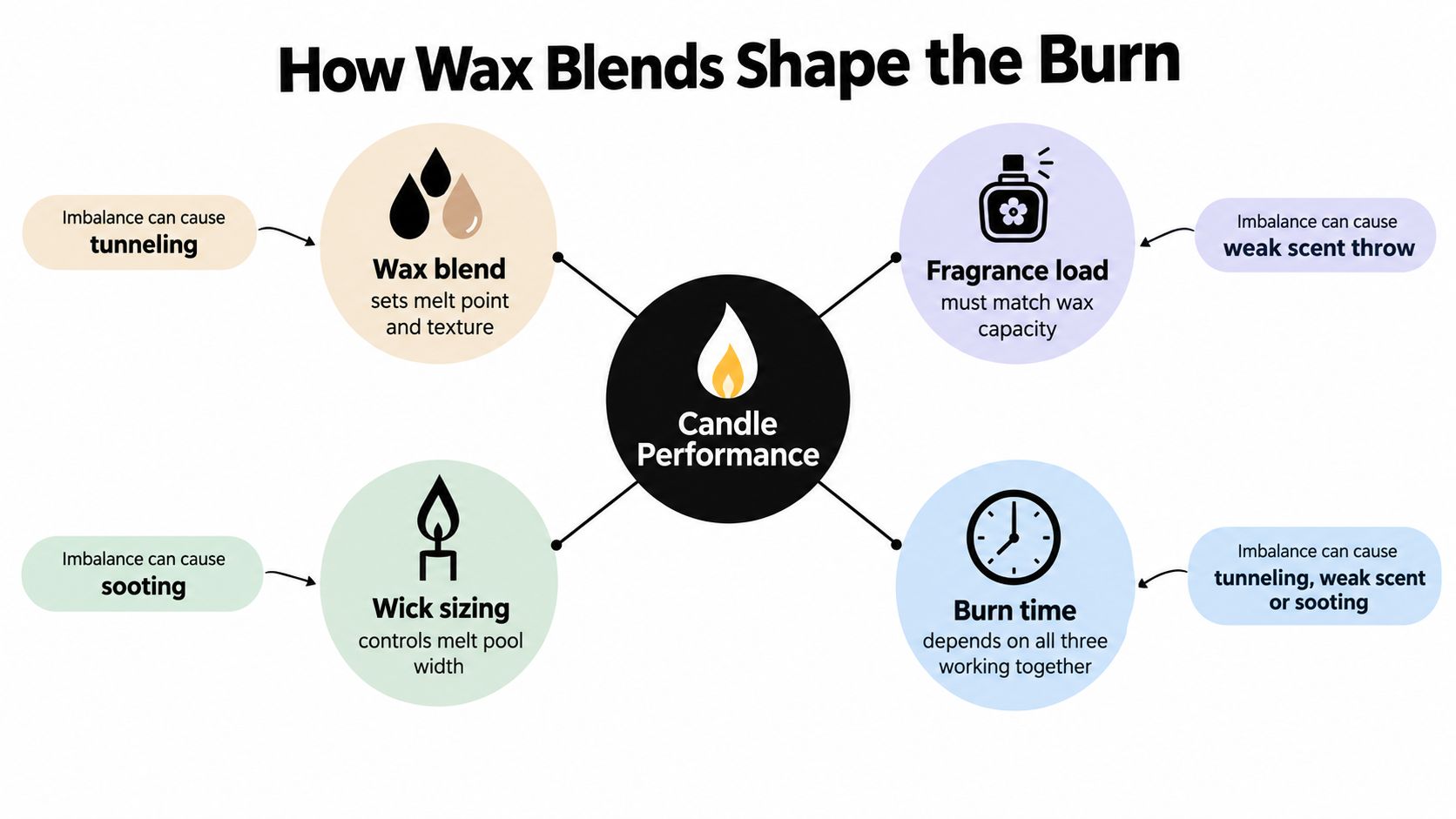
A smaller wick may suit a softer soy-coconut blend because its melt pool can expand quickly. An oversized wick can make that pool excessively hot, increasing smoke or pushing the fragrance oil out of balance. A firmer soy blend may need more heat to reach the container edge, but the maker still has to test flame height and soot rather than choosing by wax name alone.
Fragrance load adds another variable. A high load can create an impressive cold aroma but overwhelm the wick during burning. A lower load may burn neatly while producing a restrained hot throw. The formula needs enough fragrance for the intended experience without asking the wick to process more liquid fuel than it can handle.
Burn time also depends on the complete system, including vessel diameter, wax hardness, wick type, and session length. No single ingredient guarantees an even burn. Tunnelling, smoking, and weak scent often indicate an imbalance between the wax, fragrance, wick, vessel, or burning routine.
A well-made blend is defined by tested compatibility between wax, fragrance, and wick, not by ingredient count.
Start with the label, but don't stop at the first line. “Soy blend” is useful information, yet it doesn't reveal the proportion of soy, the supporting waxes, or the fragrance load. A transparent maker makes it easier to understand what you're buying and what kind of performance to expect.
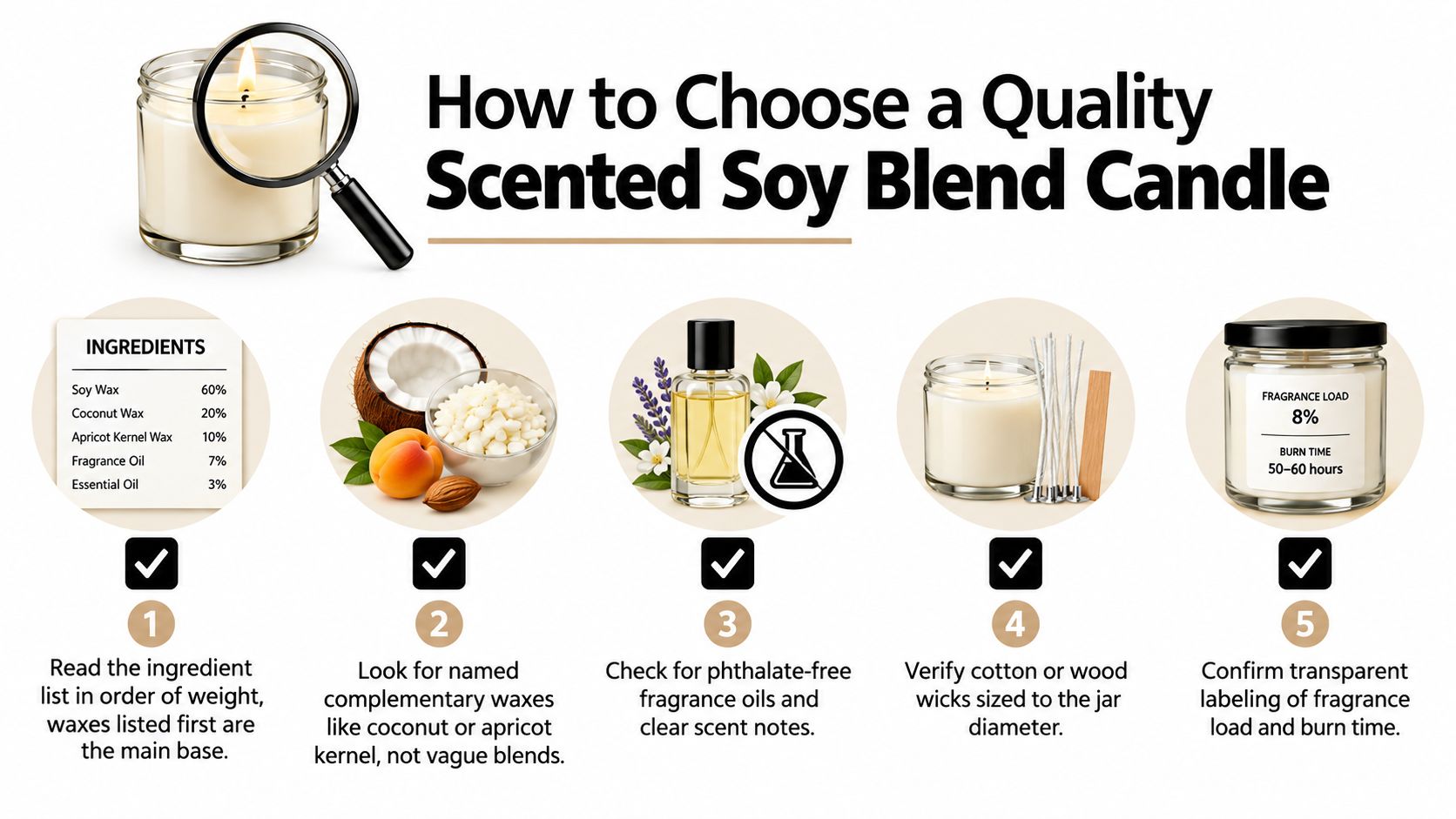
For broader ideas on how materials and buying habits fit into a lower-waste routine, this guide to making your home sustainable offers useful context. Sustainability isn't only about choosing soy. It can also involve using a candle fully, reusing the vessel, and avoiding products that burn poorly and need frequent replacement.
The strongest purchase question is therefore specific: Is this candle well formulated for its jar, fragrance, wick, and intended use? That question gives you more information than choosing a box based on “soy” alone.
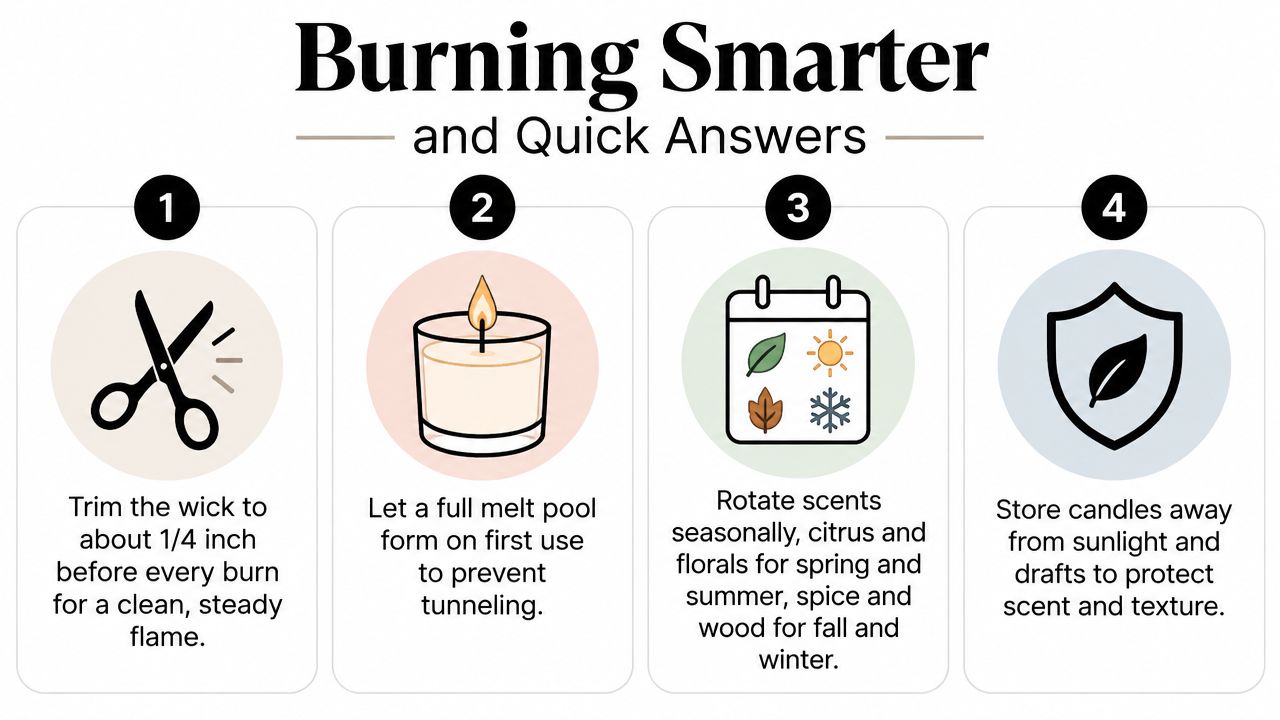
Good candle care is a small experiment in heat control. Trim the wick to about 1/4 inch before each burn, keep the vessel away from drafts, and allow the first session to form a full melt pool. That first melt helps the wax remember an even path instead of digging a narrow tunnel through the center.
Burning sessions also affect scent and safety. A very short session may leave unmelted wax around the edges, while an overly long one can overheat the vessel or make the flame harder to manage. Use the maker's guidance and watch the candle's actual behavior, since wick size, jar shape, and fragrance load work together.
Store candles upright in a cool, dark place. Heat and sunlight can change the wax's appearance and soften delicate fragrance notes. Seasonal rotation can keep a collection feeling fresh. Citrus and herbal profiles often suit brighter periods, while gourmand, spice, and wood notes may feel more at home in colder weather.
Are soy blends safe around pets? Use caution. Safety depends on the fragrance, ventilation, flame, and the animal's sensitivity. Heavily citrus or essential-oil-forward blends deserve extra care around cats. Burn only in a well-ventilated room, keep the vessel and flame inaccessible, and stop if your pet shows irritation.
Does “clean burning” have a fixed meaning? No. Treat it as a marketing description unless the maker explains the wick, fragrance, testing conditions, and expected visible burn behavior.
How long does an 8-ounce candle burn? An 8-ounce candle often burns roughly 40 to 55 hours, though wick size, vessel shape, fragrance load, and session length can move that range considerably. Container size alone is not a guarantee, so follow the maker's instructions.
Can you reuse the vessel? Let leftover wax cool, then remove it carefully. Use hot water to soften residue, allow the wax to separate, and clean the vessel thoroughly before repurposing it. Never pour melted wax down a drain, where it can harden inside the plumbing.
Jackpot Candles makes hand-poured scented candles using a proprietary soy wax blend and perfume-grade fragrance oils, with a surprise jewellery piece inside. Visit Jackpot Candles to compare its scent, vessel, and care information with the formulation principles discussed here.
Comments will be approved before showing up.